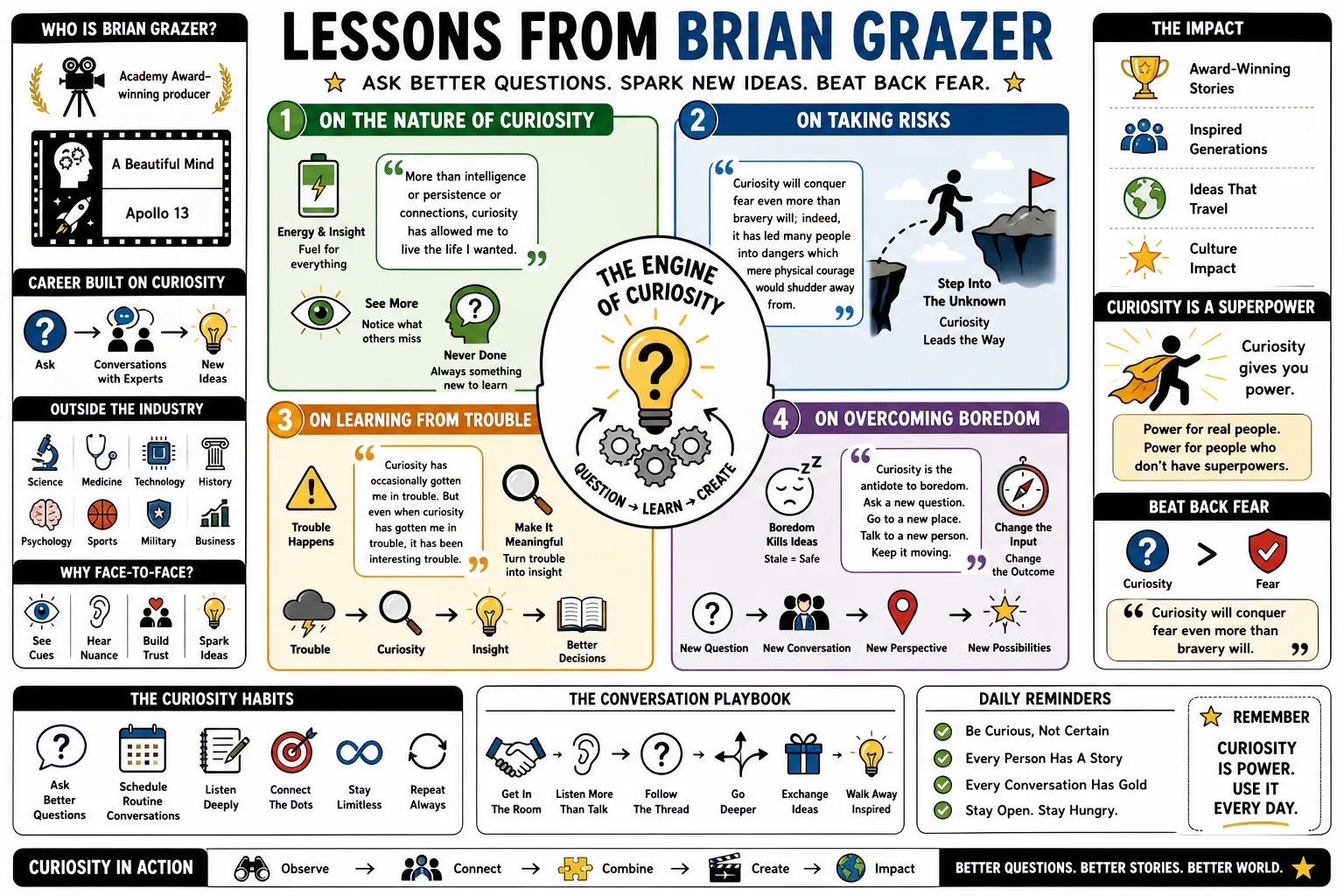
Lessons from Brian Grazer
Brian Grazer is an Academy Award-winning film and television producer who runs Imagine Entertainment with Ron Howard. His credits include Splash, Apollo 13, A Beautiful Mind and 8 Mile, and he wrote A Curious Mind with Charles Fishman. — The Art of Manliness, Podcast #957: "The Power of Curiosity Conversations with Brian Grazer" (2024, transcript).
Part 1: The Engine of Curiosity
- On the Most Important Quality: Grazer: "Curiosity has been the most important quality in giving me the life I've always wanted as a movie and TV producer in Hollywood." — Brian Grazer and Charles Fishman, "Six Kinds of Curiosity" (ChangeThis manifesto adapted from A Curious Mind).
- On Curiosity Conversations: Grazer: "I invented a discipline for myself that I call curiosity conversations." — Brian Grazer and Charles Fishman, "Six Kinds of Curiosity" (ChangeThis manifesto adapted from A Curious Mind).
- On Not Looking for Ideas: Grazer: "The fact that I'm not looking for ideas is what creates the space and the freedom to see new ideas." — Brian Grazer and Charles Fishman, "Six Kinds of Curiosity" (ChangeThis manifesto adapted from A Curious Mind).
- On a Quiet Superpower: Grazer: "Curiosity, in fact, turns out to be a quiet superpower that all of us have." — Brian Grazer and Charles Fishman, "Six Kinds of Curiosity" (ChangeThis manifesto adapted from A Curious Mind).
- On Using It With Purpose: Grazer says "most people don't use their curiosity with a sense of purpose and understanding." — Brian Grazer and Charles Fishman, "Six Kinds of Curiosity" (ChangeThis manifesto adapted from A Curious Mind).
- On the Spark for Innovation: Grazer: "Curiosity is the spark for creativity and innovation, the best long-term investment you can make." — Brian Grazer and Charles Fishman, "Six Kinds of Curiosity" (ChangeThis manifesto adapted from A Curious Mind).
- On Courage: Grazer: "Curiosity is a fantastic source of courage." — Brian Grazer and Charles Fishman, "Six Kinds of Curiosity" (ChangeThis manifesto adapted from A Curious Mind).
- On Management: Grazer: "Curiosity is the best, most under-used management tool." — Brian Grazer and Charles Fishman, "Six Kinds of Curiosity" (ChangeThis manifesto adapted from A Curious Mind).
- On Staying Connected: Grazer: "Curiosity is the best way to stay connected to those who are most important to you." — Brian Grazer and Charles Fishman, "Six Kinds of Curiosity" (ChangeThis manifesto adapted from A Curious Mind).
Part 2: The Art of Human Connection
- On Eye Contact: On what makes curiosity effective, Grazer says "You have to have eye contact. You cannot be distracted. You can't be looking around." — The Art of Manliness, Podcast #957: "The Power of Curiosity Conversations with Brian Grazer" (2024, transcript).
- On Being Real: Grazer: "the more real you are by the connection of no distraction and eye contact, the better your date will be with that person." — The Art of Manliness, Podcast #957: "The Power of Curiosity Conversations with Brian Grazer" (2024, transcript).
- On Not Mechanical Questions: Grazer: "by being genuinely curious, not by asking a series of mechanically driven questions, but by just allowing yourself the freedom to just be." — The Art of Manliness, Podcast #957: "The Power of Curiosity Conversations with Brian Grazer" (2024, transcript).
- On Interested Eyes: Grazer: "If you have interested eyes, and you're a good active listener, most successful people want to talk about themselves." — The Art of Manliness, Podcast #957: "The Power of Curiosity Conversations with Brian Grazer" (2024, transcript).
- On the Worst That Happens: Grazer: "if you reach out to people with genuine interest, the worst that'll happen is you're just being polite." — The Art of Manliness, Podcast #957: "The Power of Curiosity Conversations with Brian Grazer" (2024, transcript).
- On Generosity of Spirit: Grazer: "if you come from a place of the generosity of spirit, that people won't deny you or be offended or cut you short." — The Art of Manliness, Podcast #957: "The Power of Curiosity Conversations with Brian Grazer" (2024, transcript).
- On Keeping Relationships Fresh: Grazer: "Curiosity is what keeps those relationships fresh, interesting, and surprising." — Brian Grazer and Charles Fishman, "Six Kinds of Curiosity" (ChangeThis manifesto adapted from A Curious Mind).
- On Familiarity: Grazer: "familiarity is the enemy of curiosity. And when our curiosity about those closest to us fades, that's the moment when our connection begins to fray." — Brian Grazer and Charles Fishman, "Six Kinds of Curiosity" (ChangeThis manifesto adapted from A Curious Mind).
- On Sentencing Yourself: Of the early habit, Grazer says "I would sentence myself to doing one per day." — The Art of Manliness, Podcast #957: "The Power of Curiosity Conversations with Brian Grazer" (2024, transcript).
Part 3: Storytelling and Filmmaking
- On Storytelling Tool: Grazer: "Curiosity is a vital storytelling tool—and storytelling is the best way to engage and persuade other people, in your work life and your personal life." — Brian Grazer and Charles Fishman, "Six Kinds of Curiosity" (ChangeThis manifesto adapted from A Curious Mind).
- On Other Perspectives: Grazer: "To tell persuasive, compelling stories, you have to be able to imagine how the world looks from other people's perspectives." — Brian Grazer and Charles Fishman, "Six Kinds of Curiosity" (ChangeThis manifesto adapted from A Curious Mind).
- On Disrupting Your Point of View: Grazer: "Emotional curiosity does something vital I think people too often overlook. It lets you imagine the world from inside the head of other people. It disrupts your own point of view." — Brian Grazer and Charles Fishman, "Six Kinds of Curiosity" (ChangeThis manifesto adapted from A Curious Mind).
- On Not Faking the Story: Grazer: "I couldn't do a credible movie about hip-hop music from inside my own experience." — Brian Grazer and Charles Fishman, "Six Kinds of Curiosity" (ChangeThis manifesto adapted from A Curious Mind).
- On Ideas Being the Value: Grazer: "the ideas, the narratives themselves, they are the only things that are going to be of any value." — Deadline: "Brian Grazer On A Career Fueled By A Curious Mind" (2015).
- On the Pencil and Paper: Grazer recalls Lew Wasserman telling him "You put your pencil onto the paper and it has greater value than it did as separate parts. Now get out of here." — Deadline: "Brian Grazer On A Career Fueled By A Curious Mind" (2015).
- On Manufacturing Ideas: Grazer: "I started to manufacture ideas on paper, and in a relatively short period of time I came up with the movie idea for Splash." — Deadline: "Brian Grazer On A Career Fueled By A Curious Mind" (2015).
- On Empowering Artists: Grazer: "you can empower them to become a better version of themselves, but you cannot change them 180 degrees to be someone they are not." — Deadline: "Brian Grazer On A Career Fueled By A Curious Mind" (2015).
- On Every Story Being Different: Grazer: "Every story is a different story with different entry points of perspective." — Deadline: "Brian Grazer On A Career Fueled By A Curious Mind" (2015).
Part 4: Disruption and Comfort Zones
- On Not Copying: Grazer: "I don't want to produce the same movies everyone else is making." — Brian Grazer and Charles Fishman, "Six Kinds of Curiosity" (ChangeThis manifesto adapted from A Curious Mind).
- On Risk-Averse Communities: Grazer: "many creative communities are risk-averse." — Brian Grazer and Charles Fishman, "Six Kinds of Curiosity" (ChangeThis manifesto adapted from A Curious Mind).
- On the Safe Choice: Grazer: "The safest thing to do looks like something that has already been done, and succeeded." — Brian Grazer and Charles Fishman, "Six Kinds of Curiosity" (ChangeThis manifesto adapted from A Curious Mind).
- On Championing the Unconventional: Grazer: "That's what curiosity does for me every day—it gives me confidence to chase the unconventional, to champion the unconventional." — Brian Grazer and Charles Fishman, "Six Kinds of Curiosity" (ChangeThis manifesto adapted from A Curious Mind).
- On Insight and Confidence: Grazer: "Curiosity gives you the information, the insight, to have confidence in ideas that are a little unconventional, a little risky." — Brian Grazer and Charles Fishman, "Six Kinds of Curiosity" (ChangeThis manifesto adapted from A Curious Mind).
- On a Base of Knowledge: Grazer says talking to people outside Hollywood "gives me this incredible base of knowledge about what's percolating in the rest of the world." — Brian Grazer and Charles Fishman, "Six Kinds of Curiosity" (ChangeThis manifesto adapted from A Curious Mind).
- On Leaving Show Business Behind: After Wasserman's advice, Grazer says "I just immediately discontinued meeting new people in show business completely," and it "stretched my world into something much bigger." — Deadline: "Brian Grazer On A Career Fueled By A Curious Mind" (2015).
- On Meeting One New Person a Day: Grazer: "I had made a rule for myself that, for three months, I was going to meet one new person in show business every day." — Brian Grazer and Charles Fishman, "Six Kinds of Curiosity" (ChangeThis manifesto adapted from A Curious Mind).
- On Curiosity as a Habit: Grazer says meeting new people daily works because "that kind of curiosity becomes a habit, an instinct." — Brian Grazer and Charles Fishman, "Six Kinds of Curiosity" (ChangeThis manifesto adapted from A Curious Mind).
Part 5: Navigating Fear and Rejection
- On Getting Inside the Fear: Grazer: "When I have a fear of something, I put the fear aside for a bit and try to get inside what's making me nervous. I ask questions." — Brian Grazer and Charles Fishman, "Six Kinds of Curiosity" (ChangeThis manifesto adapted from A Curious Mind).
- On Two Effects of Questions: Grazer: "The questions do two things: they distract me from the queasy feeling, and I learn some facts about what I'm worried about." — Brian Grazer and Charles Fishman, "Six Kinds of Curiosity" (ChangeThis manifesto adapted from A Curious Mind).
- On Preparing Too Early: Grazer: "I don't start preparing too far in advance, because that just opens up the box of worry." — Brian Grazer and Charles Fishman, "Six Kinds of Curiosity" (ChangeThis manifesto adapted from A Curious Mind).
- On Facing It: Grazer: "the best way to dispel a fear is to face it, to be curious about it." — Brian Grazer and Charles Fishman, "Six Kinds of Curiosity" (ChangeThis manifesto adapted from A Curious Mind).
- On Avoiding Preparation: Grazer: "If you have a fear of giving a speech, you can be so distracted or put off by the anxiety that you avoid getting ready, instead of plunging in." — Brian Grazer and Charles Fishman, "Six Kinds of Curiosity" (ChangeThis manifesto adapted from A Curious Mind).
- On Trusting Your Belief: On pitching after a no, Grazer says "You have to trust your belief. It's like you've turned a vapor into a solid, and you have to buy into it." — Deadline: "Brian Grazer On A Career Fueled By A Curious Mind" (2015).
- On Being Indecisive: Grazer: "if you don't go forward at that point, you're just indecisive." — Deadline: "Brian Grazer On A Career Fueled By A Curious Mind" (2015).
- On Tolerance for Waiting: Grazer: "I'm so used to movies taking a long time, it's not that tough. I have an amazing amount of tolerance for that." — Deadline: "Brian Grazer On A Career Fueled By A Curious Mind" (2015).
- On Twelve Years: Of Friday Night Lights, Grazer says it "ended with the perfect director, Peter Berg, but there was 12 years in between." — Deadline: "Brian Grazer On A Career Fueled By A Curious Mind" (2015).
Part 6: The Practice of Curiosity Conversations
- On Not Asking for Anything: Grazer: "I defined these meetings for me, that I would not ask for anything. I wouldn't have an agenda and an ask." — The Art of Manliness, Podcast #957: "The Power of Curiosity Conversations with Brian Grazer" (2024, transcript).
- On Every Person Saying Yes: Grazer on his early requests: "I will not ask for a job. And every person said yes, every single one." — The Art of Manliness, Podcast #957: "The Power of Curiosity Conversations with Brian Grazer" (2024, transcript).
- On Being Prepared: On the Isaac Asimov dud, Grazer says "You got to be prepared." — The Art of Manliness, Podcast #957: "The Power of Curiosity Conversations with Brian Grazer" (2024, transcript).
- On the Asimov Meeting: Grazer: "They didn't feel intellectually stimulated by me. And I say they're right. Because I probably didn't know science fiction well enough to attract his interest." — The Art of Manliness, Podcast #957: "The Power of Curiosity Conversations with Brian Grazer" (2024, transcript).
- On Better Preparation: Grazer: "I became better prepared, and I matured into a smarter person with a better access point when I met somebody." — Deadline: "Brian Grazer On A Career Fueled By A Curious Mind" (2015).
- On Bringing Something: Grazer: "I brought something that would be of interest or value to them." — Deadline: "Brian Grazer On A Career Fueled By A Curious Mind" (2015).
- On Fulfillment: Grazer: "I found them literally the most fulfilling thing I was doing." — The Art of Manliness, Podcast #957: "The Power of Curiosity Conversations with Brian Grazer" (2024, transcript).
- On Regular People: Grazer: "So the answer is yes, yes, yes, I do this with regular people." — The Art of Manliness, Podcast #957: "The Power of Curiosity Conversations with Brian Grazer" (2024, transcript).
- On What Drives People: Grazer: "I want to know what drives people." — The Art of Manliness, Podcast #957: "The Power of Curiosity Conversations with Brian Grazer" (2024, transcript).
- On Ten Minutes a Day: Grazer: "introducing yourself to people you don't know who work in your company or your industry, and having a brief curiosity conversation, is about the best investment of 10 minutes you can make each day." — Brian Grazer and Charles Fishman, "Six Kinds of Curiosity" (ChangeThis manifesto adapted from A Curious Mind).
Part 7: Asking the Right Questions
- On Questions as Management: Grazer: "I think questions are the most under-used management tool we've got." — Brian Grazer and Charles Fishman, "Six Kinds of Curiosity" (ChangeThis manifesto adapted from A Curious Mind).
- On Questions Instead of Orders: Grazer: "I often manage people with curiosity—by asking questions instead of giving orders." — Brian Grazer and Charles Fishman, "Six Kinds of Curiosity" (ChangeThis manifesto adapted from A Curious Mind).
- On Space for Worries: Grazer: "Asking questions creates a space for people to raise issues they are worried about." — Brian Grazer and Charles Fishman, "Six Kinds of Curiosity" (ChangeThis manifesto adapted from A Curious Mind).
- On Shared Responsibility: Grazer: "Asking questions implies that the person you're talking to has both the authority to come up with the ideas, the answers, the solutions—and some of the responsibility to as well." — Brian Grazer and Charles Fishman, "Six Kinds of Curiosity" (ChangeThis manifesto adapted from A Curious Mind).
- On Asking Tom Cruise: On Far and Away, Grazer says "I went to the key player, the person other people would respect, and I asked that a question: Can you be the leader here?" — Brian Grazer and Charles Fishman, "Six Kinds of Curiosity" (ChangeThis manifesto adapted from A Curious Mind).
- On Asking for Help: Grazer: "I think asking for people's help—rather than directing it—is almost always the smart way of doing things, regardless of the stakes. It creates engagement rather than resistance." — Brian Grazer and Charles Fishman, "Six Kinds of Curiosity" (ChangeThis manifesto adapted from A Curious Mind).
- On Listening to the Answers: Grazer: "But you do have to listen to the answers." — Brian Grazer and Charles Fishman, "Six Kinds of Curiosity" (ChangeThis manifesto adapted from A Curious Mind).
- On Questions Before a Talk: Grazer's prep questions for a speech include "What do people coming to this event expect to hear?" — Brian Grazer and Charles Fishman, "Six Kinds of Curiosity" (ChangeThis manifesto adapted from A Curious Mind).
- On Not Cross-Examining: Grazer says questions at work should be "not like a prosecutor on a cross-exam, of course, but with a genuine spirit of curiosity." — Brian Grazer and Charles Fishman, "Six Kinds of Curiosity" (ChangeThis manifesto adapted from A Curious Mind).
Part 8: Empathy and Leadership
- On Understanding People: Grazer: "Understand where people are coming from isn't optional—it's how we can be most effective." — Brian Grazer and Charles Fishman, "Six Kinds of Curiosity" (ChangeThis manifesto adapted from A Curious Mind).
- On Who Is in Charge: Grazer: "I'm never worried about who is in charge." — Brian Grazer and Charles Fishman, "Six Kinds of Curiosity" (ChangeThis manifesto adapted from A Curious Mind).
- On the Best Possible Decision: Grazer: "I'm worried about making sure we get the best possible decision, the best possible casting, script, movie trailer, financing deal—the best possible movie." — Brian Grazer and Charles Fishman, "Six Kinds of Curiosity" (ChangeThis manifesto adapted from A Curious Mind).
- On a Boss Who Listens: Grazer: "You're letting people know the boss is willing to listen—even to information that's unpleasant or unexpected." — Brian Grazer and Charles Fishman, "Six Kinds of Curiosity" (ChangeThis manifesto adapted from A Curious Mind).
- On Diverse Perspectives: Grazer: "You're letting people know you value a diversity of perspectives." — Brian Grazer and Charles Fishman, "Six Kinds of Curiosity" (ChangeThis manifesto adapted from A Curious Mind).
- On How They Say It: Grazer: "I'm paying attention to what they say, of course. But I'm paying just as close attention to how they say it, to their body language, to how they respond to my questions." — Brian Grazer and Charles Fishman, "Six Kinds of Curiosity" (ChangeThis manifesto adapted from A Curious Mind).
- On Losing Connection: Grazer: "when we stop asking genuine questions of those around us—and most important, when we stop really listening to the answers—that's when we start to lose our connection." — Brian Grazer and Charles Fishman, "Six Kinds of Curiosity" (ChangeThis manifesto adapted from A Curious Mind).
- On Empowering Tom Cruise: Grazer: "All I did was empower him to do the things that he likes to do." — Deadline: "Brian Grazer On A Career Fueled By A Curious Mind" (2015).
- On Emotional Injury: Grazer: "I basically want to know what drives them. Often there's an injury, an emotional injury in their life that drives them." — The Art of Manliness, Podcast #957: "The Power of Curiosity Conversations with Brian Grazer" (2024, transcript).
- On Getting Through the Injury: Grazer: "The emotional injury either causes you to get through the emotional injury to attain your potential, to attain your goal." — The Art of Manliness, Podcast #957: "The Power of Curiosity Conversations with Brian Grazer" (2024, transcript).