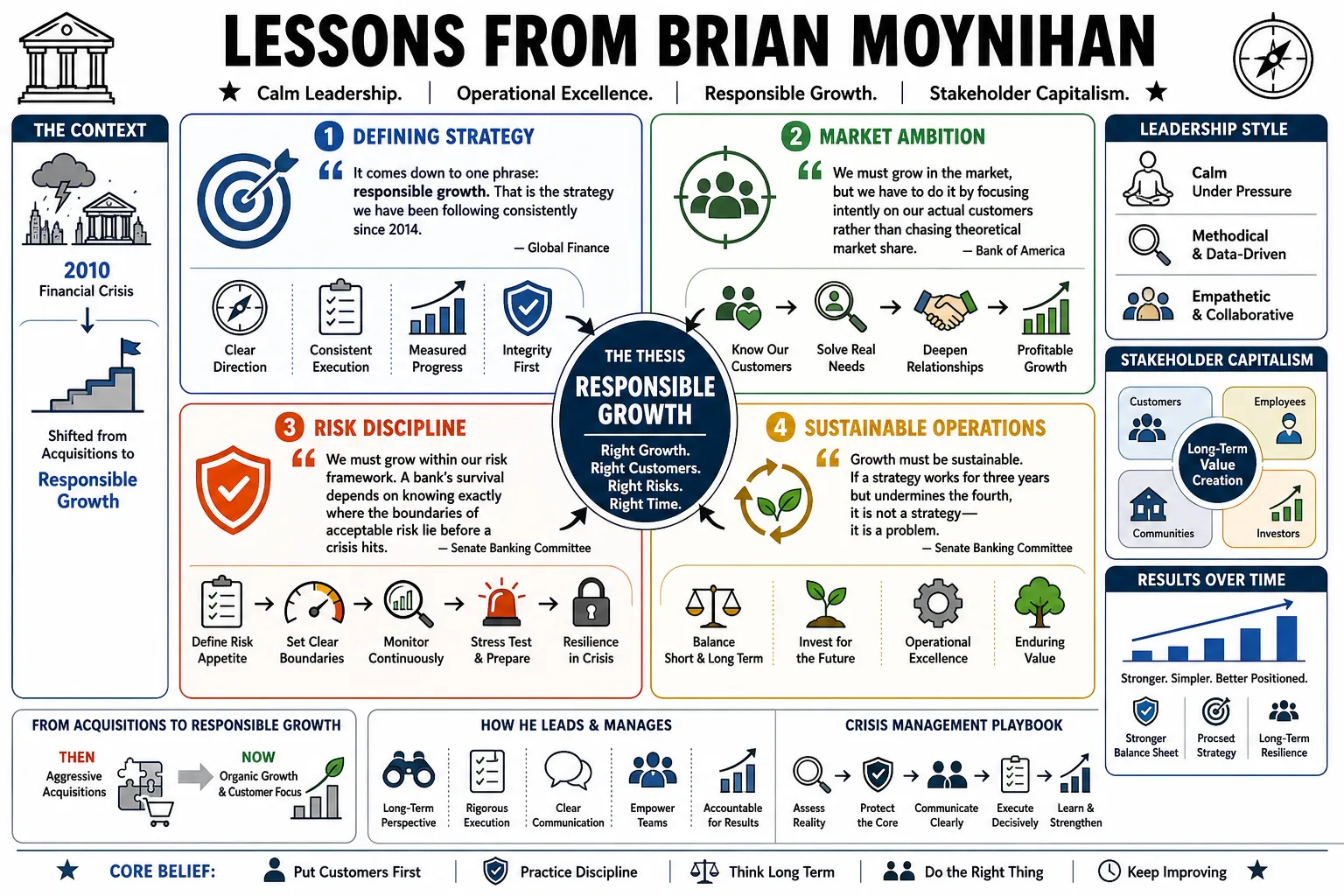
Lessons from Brian Moynihan
Brian Moynihan is chairman and chief executive officer of Bank of America; in a 2021 interview he described it as his 12th year as CEO. — LEADERS: "Responsible Growth," an interview with Brian Moynihan (2021).
Part 1: Strategy & Responsible Growth
- On One Phrase: Moynihan: "It comes down to one phrase: responsible growth." — Global Finance: "Responsible Growth: Q&A With Bank Of America CEO Brian Moynihan" (2023).
- On Consistency Since 2014: Moynihan: "That's the strategy we've been following consistently since 2014." — Global Finance: "Responsible Growth: Q&A With Bank Of America CEO Brian Moynihan" (2023).
- On Customer Focus: Moynihan: "At the heart of responsible growth is a customer-focused strategy." — Global Finance: "Responsible Growth: Q&A With Bank Of America CEO Brian Moynihan" (2023).
- On Doing Well by Clients: Moynihan: "Doing well by our clients means investing in people, technology and solutions that lead to them continue to put their trust in us and grow with us." — Global Finance: "Responsible Growth: Q&A With Bank Of America CEO Brian Moynihan" (2023).
- On the Rest of Responsible Growth: Moynihan: "Responsible growth also means being disciplined in our risk principles, being a great place to work for our employees and sharing our success with the communities we serve." — Global Finance: "Responsible Growth: Q&A With Bank Of America CEO Brian Moynihan" (2023).
- On Operational Excellence: Moynihan: "Lastly, it requires good expense management, or what we call operational excellence." — Global Finance: "Responsible Growth: Q&A With Bank Of America CEO Brian Moynihan" (2023).
- On Counting Referrals: Moynihan: "We track how well we deliver these integrated capabilities by the number of client referrals between our lines of business in our local markets." — Global Finance: "Responsible Growth: Q&A With Bank Of America CEO Brian Moynihan" (2023).
- On Bringing the Whole Company: Moynihan: "In each market, we also focus on bringing the entire company to every customer or client." — Global Finance: "Responsible Growth: Q&A With Bank Of America CEO Brian Moynihan" (2023).
- On Deciding by Principle: Moynihan: "We make decisions for the business by asking if it is consistent with our principle of responsible growth." — LEADERS: "Responsible Growth," an interview with Brian Moynihan (2021).
- On Profits and Purpose: Moynihan: "We believe that we can deliver for all of our stakeholders – customers, teammates, shareholders and society – which is about profits and purpose." — LEADERS: "Responsible Growth," an interview with Brian Moynihan (2021).
Part 2: Leadership & Team Dynamics
- On Communicating Genuinely: Moynihan: "It has to be genuine, real, and straight forward, and you have to communicate it regularly and show that you are living the principles." — LEADERS: "Responsible Growth," an interview with Brian Moynihan (2021).
- On a Reason to Come to Work: Moynihan, on coming out of the financial crisis: "it was critical to give people a reason to come to work and to define our purpose as a company." — LEADERS: "Responsible Growth," an interview with Brian Moynihan (2021).
- On Repetition: Moynihan: "This quarter will be my 46th earnings call as CEO and we consistently open with our focus on responsible growth and this repetition resonates with the team." — LEADERS: "Responsible Growth," an interview with Brian Moynihan (2021).
- On Living the Purpose: Moynihan: "It is about being clear about our purpose, communicating that purpose regularly, and then living the purpose every day." — LEADERS: "Responsible Growth," an interview with Brian Moynihan (2021).
- On Being Prepared: On his management style, Moynihan says "I expect people to be prepared and to put their teammates and the company first." — LEADERS: "Responsible Growth," an interview with Brian Moynihan (2021).
- On Having Fun: Moynihan: "We enjoy what we do and have fun." — LEADERS: "Responsible Growth," an interview with Brian Moynihan (2021).
- On Thinking About What Is Next: Moynihan: "In order to be fresh in this job, you have to always be thinking about what is next." — LEADERS: "Responsible Growth," an interview with Brian Moynihan (2021).
- On Getting Away From the Short Term: Moynihan: "If you believe that you can do this, it gets you away from the short term." — LEADERS: "Responsible Growth," an interview with Brian Moynihan (2021).
- On Giving Up Revenue: Moynihan: "We have made decisions that gave up revenue in the short term because we were following our long-term strategy, and this has worked out well for us." — LEADERS: "Responsible Growth," an interview with Brian Moynihan (2021).
Part 3: Capitalism & Purpose
- On the Money Required: Moynihan: "it will take a tremendous amount of money and it will take capitalism to make this happen." — LEADERS: "Responsible Growth," an interview with Brian Moynihan (2021).
- On Big Companies Helping: Moynihan: "If big companies and capitalism do not try to help with these problems, they are not going to get solved." — LEADERS: "Responsible Growth," an interview with Brian Moynihan (2021).
- On Inclusive Capitalism: Moynihan: "you need to make sure that what comes out of that is fair and equitable and just, which is what we refer to as inclusive capitalism." — LEADERS: "Responsible Growth," an interview with Brian Moynihan (2021).
- On Bringing Business to the Table: Moynihan: "The only way we are going to win this fight and meet these challenges is by bringing business to the table." — LEADERS: "Responsible Growth," an interview with Brian Moynihan (2021).
- On ESG and Failures: Moynihan: "if a company doesn't do well on ESG factors, you will find that these companies constitute 90 percent of the business failures over the last decade." — LEADERS: "Responsible Growth," an interview with Brian Moynihan (2021).
- On ESG Performance: Moynihan: "Investors will do better if they invest in companies that have a strong ESG performance." — LEADERS: "Responsible Growth," an interview with Brian Moynihan (2021).
- On Why Diversity Matters: Moynihan: "We believe that diversity is important because it is the right thing to do, and it is also important for the business since we need to mirror the diversity of our customers and society." — LEADERS: "Responsible Growth," an interview with Brian Moynihan (2021).
- On Matching Society: Moynihan: "our workforce should match the diversity in society and we need to continue to attract the best talent possible." — LEADERS: "Responsible Growth," an interview with Brian Moynihan (2021).
- On the Pathways Program: On Pathways, Moynihan says "we said we would hire 10,000 teammates from low-income households and neighborhoods for career path jobs." — LEADERS: "Responsible Growth," an interview with Brian Moynihan (2021).
Part 4: Managing Through Crisis & Resilience
- On Principles in Uncertainty: Moynihan: "When you are making decisions in uncertain times, you have to make decisions that are consistent with your principles." — LEADERS: "Responsible Growth," an interview with Brian Moynihan (2021).
- On High-Risk Teammates: Moynihan: "the first thing we did was to take all of our high-risk people, which was over 20,000 people, out of our offices as fast as we could." — LEADERS: "Responsible Growth," an interview with Brian Moynihan (2021).
- On No Layoffs: Moynihan: "We made a commitment to no layoffs and continued to adapt with roughly 90 percent of our people eventually working from home." — LEADERS: "Responsible Growth," an interview with Brian Moynihan (2021).
- On Childcare Support: Moynihan: "we offered our teammates $100 a day to hire someone to come to their homes to support their needs." — LEADERS: "Responsible Growth," an interview with Brian Moynihan (2021).
- On Removing Distractions: Moynihan: "We wanted to take any possible distractions and additional pressures off of our teammates." — LEADERS: "Responsible Growth," an interview with Brian Moynihan (2021).
- On PPP: Moynihan: "We had 10,000 people working on PPP in April 2020 which didn't even exist in February 2020." — LEADERS: "Responsible Growth," an interview with Brian Moynihan (2021).
- On Expecting Calm: Moynihan: "Coming out of the pandemic, we expected we would return to the relative calm that we experienced in the years leading up to 2020." — Global Finance: "Responsible Growth: Q&A With Bank Of America CEO Brian Moynihan" (2023).
- On What Is Certain: Moynihan: "The only thing we can be certain about right now is how we deliver." — Global Finance: "Responsible Growth: Q&A With Bank Of America CEO Brian Moynihan" (2023).
- On Financial Stability: Moynihan: "we have to be careful that we keep the financial stability and strength in the United States paramount." — Face the Nation transcript: Bank of America CEO Brian Moynihan (2023).
Part 5: Customer Centricity & Technology
- On High Touch, High Tech: Moynihan: "We believe in high touch, high tech." — LEADERS: "Responsible Growth," an interview with Brian Moynihan (2021).
- On Branch Traffic: Moynihan: "We will have 300,000 to 400,000 people come to our branches today so it is still relevant." — LEADERS: "Responsible Growth," an interview with Brian Moynihan (2021).
- On Options and Convenience: Moynihan: "It is about providing the customer with options and making it as efficient and convenient as possible." — LEADERS: "Responsible Growth," an interview with Brian Moynihan (2021).
- On Being There: Moynihan: "our responsibility is to be there for them no matter what they decide to do." — LEADERS: "Responsible Growth," an interview with Brian Moynihan (2021).
- On Technology Spending: Moynihan: "we have spent more than $30 billion over the past decade on new technology initiatives." — Global Finance: "Responsible Growth: Q&A With Bank Of America CEO Brian Moynihan" (2023).
- On Satisfied Clients: Moynihan: "Simply put, more satisfied clients do more business with us." — Global Finance: "Responsible Growth: Q&A With Bank Of America CEO Brian Moynihan" (2023).
- On Digital Value: Moynihan: "Our clients tell us they clearly appreciate the value and convenience of our digital platforms." — Global Finance: "Responsible Growth: Q&A With Bank Of America CEO Brian Moynihan" (2023).
- On Net New Accounts: Moynihan: "in Consumer Banking, we added approximately 157,000 net new checking accounts in the second quarter." — Global Finance: "Responsible Growth: Q&A With Bank Of America CEO Brian Moynihan" (2023).
- On Consecutive Growth: Moynihan: "It was our eighteenth consecutive quarter of growth." — Global Finance: "Responsible Growth: Q&A With Bank Of America CEO Brian Moynihan" (2023).
Part 6: Career Philosophy & Practical Wisdom
- On a Serious Debt Discussion: Moynihan: "we need to have a serious discussion about how much debt we can have in this country, how much we could afford and how it's spent and that discussion needs to go on." — Face the Nation transcript: Bank of America CEO Brian Moynihan (2023).
- On Thousands of Ideas: Brian Moynihan: "Every year, we come up with thousands of ideas to take out and re-engineer the company." — The Economic Club of Washington, D.C.: Brian Moynihan (2025 transcript).
- On Learning From Challengers: Brian Moynihan: "And so, the idea is we’re not afraid of them, but on the other hand you got to learn from them and drive it." — The Economic Club of Washington, D.C.: Brian Moynihan (2018 edited transcript).
- On Why You Join: Brian Moynihan: "The appeal is – I always tell people, if you want to do this to make money, please go somewhere else." — The Economic Club of Washington, D.C.: Brian Moynihan (2018 edited transcript).
- On Following Responsibility: Brian Moynihan: "So, I became a corporate lawyer more by I could see the opportunity to get responsibility." — The Economic Club of Washington, D.C.: Brian Moynihan (2025 transcript).
- On Wanting to Help People: Brian Moynihan: "But if you’re going to come to our company, you really want to help people." — The Economic Club of Washington, D.C.: Brian Moynihan (2025 transcript).
- On What Law Practice Didn’t Teach: Brian Moynihan: "Because I had practiced law and done it well, I think, but what I hadn’t done is ever managed people or managed a company or driven people through an integration or reengineered the company." — The Economic Club of Washington, D.C.: Brian Moynihan (2018 edited transcript).
- On the Pendulum: Brian Moynihan: "Well, I think with anything that happens you swing a pendulum, and the idea is to get it back to the middle." — The Economic Club of Washington, D.C.: Brian Moynihan (2018 edited transcript).
Part 7: Corporate Responsibility & ESG
- On Metrics You Can Calculate: Brian Moynihan: "real metrics that you can really calculate, that are material by definition, and then can be measured over time" — Bank of America CEO Highlights the Competitive Advantages of ESG Principles | Workday CA.
- On Plans, Measurement and Reporting: Brian Moynihan: "We have to have a plan at every company, we have to measure that plan and we have to report out on that plan so we can be held accountable." — Chief Executive: Brian Moynihan, “What Does Society Want From We CEOs?”.
- On Purpose and Profit: Brian Moynihan: "these business activities lend themselves to a better brand, more client favorability, a better place for our teammates to work, and better profits." — Chief Executive: Brian Moynihan, “What Does Society Want From We CEOs?”.
- On a Minimum Starting Wage: Brian Moynihan: "A minimum starting wage of 20 dollars an hour or $41 thousand per year." — Chief Executive: Brian Moynihan, “What Does Society Want From We CEOs?”.
- On Investors Substantiating ESG: Brian Moynihan: "Investors are now trying to substantiate how they are investing consistent with ESG principles because the people who give them the money want them to do that." — Bank of America CEO Highlights the Competitive Advantages of ESG Principles | Workday CA.
- On Capitalism Having the Money: Brian Moynihan: "Capitalism has the money. Capitalism has the talent. Capitalism has the innovation behind it. And, yes, it has a profit motive." — Chief Executive: Brian Moynihan, “What Does Society Want From We CEOs?”.
- On Helping Communities Succeed: Brian Moynihan: "We try to work with nonprofits and communities to create opportunity for them to be successful." — The Economic Club of Washington, D.C.: Brian Moynihan (2025 transcript).
- On Greenwashing: Brian Moynihan: "If you say you do this on the environment, and it's not in metrics that are understood and agreed to by other people, you're going to be spending a lot of time saying, ‘You know, that is not right. It's not calculable. It's greenwashing.’" — Bank of America CEO Highlights the Competitive Advantages of ESG Principles | Workday CA.
- On Changing Emissions Over Time: Brian Moynihan: "The question is, you want to reduce emissions. You've got to change that over time" — Trade Offs | Bank of America: Financing the transition | Investment Insights | Fidelity Australia.
Part 8: The Weight of Leadership & Integrity
- On Banks and American Capitalism: Brian Moynihan: "The American banking system is probably the story as much of American capitalism being successful" — The Economic Club of Washington, D.C.: Brian Moynihan (2025 transcript).
- On Not Leaving Yourself at the Door: Brian Moynihan: "We want everybody to come to work in a company with one simple statement: I can be anything I want to be and I don’t have to leave myself at the door." — The Economic Club of Washington, D.C.: Brian Moynihan (2018 edited transcript).
- On Saying Hi to Teammates: Brian Moynihan: "I – look, at the end of the day, you know, I go – and often go and say hi to the teammates, because that’s kind of fun." — The Economic Club of Washington, D.C.: Brian Moynihan (2025 transcript).
- On the Genius of the And: Brian Moynihan: "That duty is to drive the genius of the ‘and.’ To deliver profits and purpose." — Chief Executive: Brian Moynihan, “What Does Society Want From We CEOs?”.
- On Profits Done the Right Way: Brian Moynihan: "You want to deliver a lot of profits done the right way, with a purpose around it." — The Economic Club of Washington, D.C.: Brian Moynihan (2025 transcript).
- On Owning It: Brian Moynihan: "It can’t be a problem for us, because we got to face it down and own it and drive it." — The Economic Club of Washington, D.C.: Brian Moynihan (2018 edited transcript).