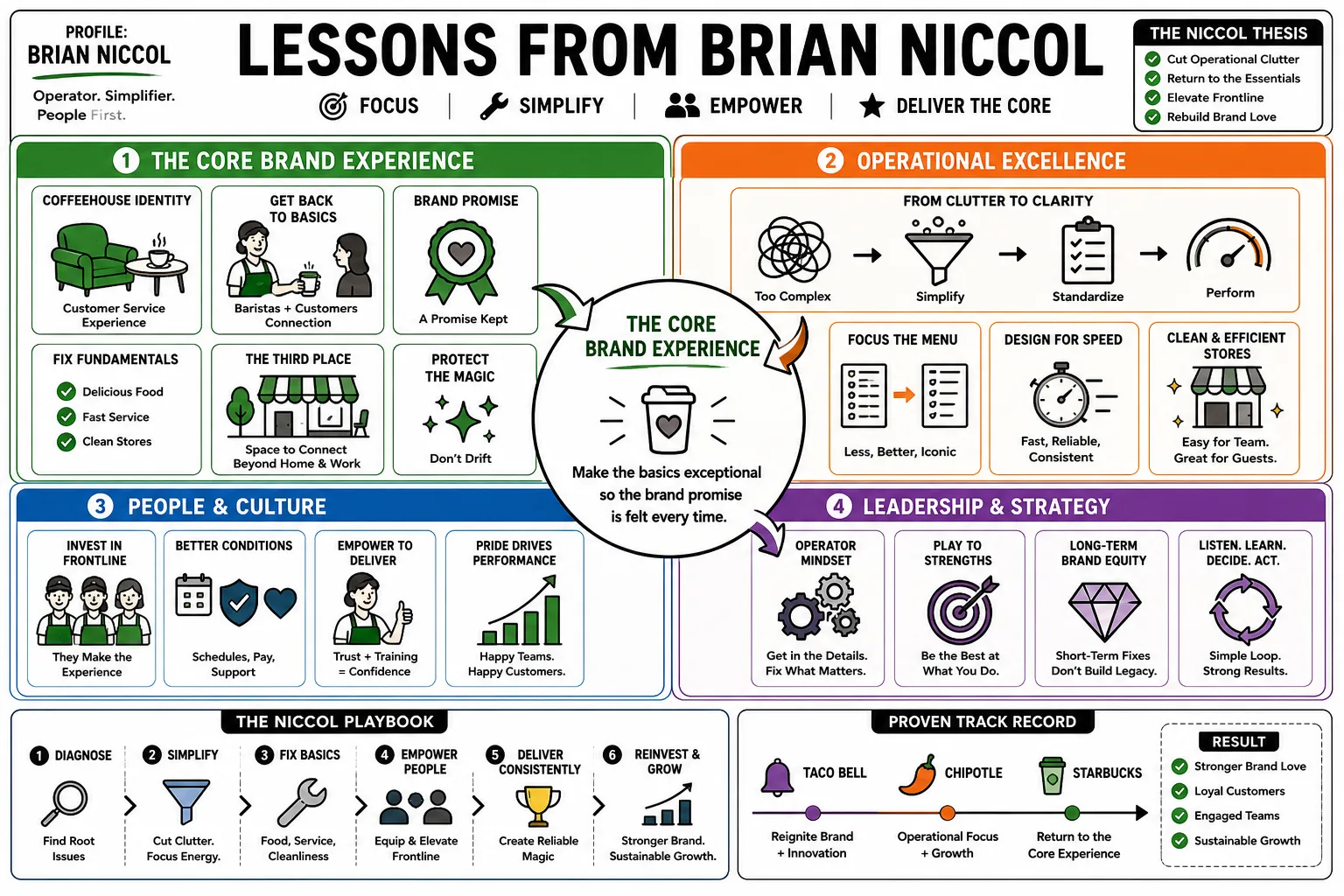
Lessons from Brian Niccol
Before taking over at Starbucks, Brian Niccol made his name reviving stalled restaurant chains as CEO of Taco Bell and Chipotle. He typically fixes these companies by cutting operational clutter, sticking to core products, and improving conditions for frontline workers. This collection details his approach to brand identity, operations, and leadership.
Part 1: The Core Brand Experience
- On the coffeehouse identity: "We got really focused on trying to be efficient and run it like a manufacturing facility, as opposed to recognizing this is actually a customer service experience." — Business Insider: Retail & Dining
- On getting back to basics: "It is about returning to the essentials of the brand: the coffeehouse experience and the connection between baristas and customers." — Starbucks Official Channel: Leadership & Stories
- On brand promise: "A brand is a promise kept. When you drift from what made you special, you have to fight to reclaim that original magic." — CNBC: Retail & Executive Interviews
- On fixing fundamentals: "Before you try to reinvent a brand, you have to make sure the food is delicious, the service is fast, and the stores are clean." — Restaurant Dive (Industry Dive): Food & Dining News
- On the third place: "People need a space between home and work. When a store loses that welcoming feeling, it loses its purpose." — The Wall Street Journal: Business & Leadership
- On brand trust: "Trust is earned in drops and lost in buckets. You rebuild it by showing up consistently every single day." — Forbes: Business & Leadership
- On visual identity: "The way a store looks and smells communicates immediately whether you care about the product you are serving." — Bloomberg Television: Executive Interviews
- On authenticity: "Customers know when you are faking it. You cannot market your way out of a bad core experience." — QSR Magazine: Fast Casual Leadership
- On heritage: "You have to respect the history of a company while being honest about what is no longer working." — Harvard Business Review: Leadership
- On core products: "If your core product is not great, all the limited-time offers in the world will not save your business." — Nation's Restaurant News: Fast Casual
Part 2: Operational Simplicity
- On menu bloat: "Complexity is the enemy of execution. We have to make it easier for our teams to deliver a great product." — Business Insider: Retail & Dining
- On store execution: "Great strategy dies on the vine if the person at the counter cannot physically do what you are asking them to do." — CNBC: Retail & Executive Interviews
- On clearing roadblocks: "My job is to remove the friction that keeps our employees from doing their best work." — The Wall Street Journal: Business & Leadership
- On operational focus: "When you try to do a hundred things, you do none of them well. Pick the three things that matter most." — Bloomberg Television: Executive Interviews
- On speed of service: "Speed is not about rushing the customer; it is about being so prepared that the transaction feels effortless." — QSR Magazine: Fast Casual Leadership
- On standardization: "You need tight standards for the things that matter, and freedom for the things that create personal connection." — Restaurant Dive (Industry Dive): Food & Dining News
- On kitchen design: "If the physical layout fights the employee, the customer is the one who ultimately pays the price in bad service." — Forbes: Business & Leadership
- On supply chain: "A reliable supply chain is invisible to the customer but essential to everything we do inside the restaurant." — Nation's Restaurant News: Fast Casual
- On solving bottlenecks: "You do not fix a bottleneck by adding more tasks. You fix it by stripping tasks away." — Semafor: Business Newsletters
Part 3: Frontline Culture and Employees
- On employee feedback: "Listening more and talking less is the most underrated skill a leader can have." — Business Insider: Retail & Dining
- On culture shifts: "I knew our culture was changing when I saw Reddit threads where applicants talked about our renewed focus on customer service." — The Wall Street Journal: Business & Leadership
- On frontline reality: "You cannot understand the business from a boardroom. You have to put on an apron and see what happens during a rush." — CNBC: Retail & Executive Interviews
- On investing in people: "People are the foundation of profitability. If you do not pay well and treat them well, the business model breaks." — Forbes: Business & Leadership
- On barista empowerment: "We need to let the people making the drinks make the calls on how to delight the person standing in front of them." — Starbucks Official Channel: Leadership & Stories
- On retaining talent: "The best way to keep great employees is to make sure they are not exhausted by broken processes." — Bloomberg Television: Executive Interviews
- On clear expectations: "Ambiguity causes stress. Employees want to know exactly what good looks like." — Harvard Business Review: Leadership
- On team morale: "A stressed team makes mistakes. A supported team creates regular customers." — QSR Magazine: Fast Casual Leadership
- On career mobility: "When people see a path from the register to management, they treat the business like it is their own." — Nation's Restaurant News: Fast Casual
- On respect: "Respecting the craft of the frontline worker is the first step in fixing a broken service model." — Restaurant Dive (Industry Dive): Food & Dining News
Part 4: Customer Connection
- On the customer experience: "We are not in the transaction business; we are in the hospitality business." — Business Insider: Retail & Dining
- On human interaction: "A smile and a perfectly made order can change the trajectory of someone's entire morning." — Starbucks Official Channel: Leadership & Stories
- On listening to complaints: "Your most frustrated customers are giving you the exact blueprint of what you need to fix first." — Forbes: Business & Leadership
- On consistency: "Customers do not come back because of a clever ad. They come back because they got exactly what they expected." — The Wall Street Journal: Business & Leadership
- On reading the room: "You have to be attuned to cultural trends without losing the soul of your own brand." — Bloomberg Television: Executive Interviews
- On value perception: "Value is not strictly about price. It is about feeling like the experience was worth the money." — CNBC: Retail & Executive Interviews
- On customization: "People want things their way, but it is our job to make sure offering choices does not destroy the flow of service." — QSR Magazine: Fast Casual Leadership
- On morning routines: "Being part of someone's daily routine is a privilege. If you make it difficult, they will easily find another routine." — Restaurant Dive (Industry Dive): Food & Dining News
- On loyalty programs: "A rewards program should feel like a thank you, not a complicated math problem." — Nation's Restaurant News: Fast Casual
Part 5: Leadership and Accountability
- On making decisions: "Leadership means hearing feedback and being brave enough to make unpopular decisions." — Business Insider: Retail & Dining
- On owning mistakes: "Initially, I did not position the turnaround plan as part of the cultural conversation quickly enough. That was on me." — Semafor: Business Newsletters
- On accountability: "You cannot hold a team accountable for results if you have not given them the tools to achieve those results." — Harvard Business Review: Leadership
- On ego: "The moment a leader thinks they know better than the customer, the brand is in trouble." — Masters of Scale: Executive Podcast Archive
- On clear communication: "If the strategy cannot be explained in one simple sentence, it is not going to work." — Forbes: Business & Leadership
- On patience: "You have to act with urgency on the problems, but have patience with the people adapting to the change." — Bloomberg Television: Executive Interviews
- On leading through crisis: "In a crisis, people do not need a cheerleader. They need clarity, direction, and honesty." — The Wall Street Journal: Business & Leadership
- On executive isolation: "The biggest risk for a CEO is filtering. You have to demand the unvarnished truth from your team." — CNBC: Retail & Executive Interviews
- On setting standards: "You get the behavior you tolerate. If you accept mediocrity once, it becomes the new standard." — QSR Magazine: Fast Casual Leadership
- On team building: "Hire people who are obsessed with the details you might overlook." — Restaurant Dive (Industry Dive): Food & Dining News
Part 6: Technology and Innovation
- On the role of AI: "Technology should enhance, not replace, human connection." — Starbucks Official Channel: Leadership & Stories
- On mobile ordering: "Digital ordering should be a convenience, never a barrier that overwhelms the physical store." — The Wall Street Journal: Business & Leadership
- On testing new ideas: "You do not roll out a massive change across thousands of stores on a hunch. You test, you measure, and you iterate." — Bloomberg Television: Executive Interviews
- On digital versus physical: "A great app cannot make up for a cold, uninviting store. The two have to work together." — CNBC: Retail & Executive Interviews
- On automation: "Automate the tasks that drain energy, so employees have more energy for the customer." — Forbes: Business & Leadership
- On data: "Data tells you what is happening. Spending time in the store tells you why it is happening." — Business Insider: Retail & Dining
- On innovation pipelines: "Innovation is more than new products; it is finding a faster way to clean a blender." — QSR Magazine: Fast Casual Leadership
- On the drive-thru model: "We realized people wanted drive-thru convenience without degrading the quality of the food. Technology bridged that gap." — Restaurant Dive (Industry Dive): Food & Dining News
- On forced tech: "If a new technology requires a massive manual, it is the wrong technology for a fast-paced environment." — Nation's Restaurant News: Fast Casual
Part 7: Turnaround Strategy
- On diagnosing the problem: "The first ninety days of a turnaround are for listening. If you act before you listen, you solve the wrong problems." — Masters of Scale: Executive Podcast Archive
- On winning back trust: "After a crisis, you do not get the benefit of the doubt. You have to prove you have changed every single day." — The Wall Street Journal: Business & Leadership
- On prioritizing fixes: "You cannot fix twenty things at once. Fix the food, fix the speed, fix the culture. In that order." — CNBC: Retail & Executive Interviews
- On short-term pain: "Turnarounds require making decisions that will hurt this quarter's numbers to save next year's business." — Bloomberg Television: Executive Interviews
- On aligning the board: "A turnaround needs air cover from the board. If they are impatient, the strategy will fail." — Harvard Business Review: Leadership
- On historical baggage: "You have to honor what made the company great in the past without being chained to its outdated methods." — Forbes: Business & Leadership
- On momentum: "Small wins matter. When the team sees one metric improve, they start believing the rest can too." — Business Insider: Retail & Dining
- On marketing during a rebuild: "Do not promise an experience in an ad that your stores are not currently equipped to deliver." — QSR Magazine: Fast Casual Leadership
- On defining success: "A turnaround is over when the conversation shifts from fixing the past to inventing the future." — Restaurant Dive (Industry Dive): Food & Dining News
Part 8: Career and Personal Development
- On career risk: "Taking a job at a company in crisis is scary, but it is also where you have the most room to make a real impact." — Masters of Scale: Executive Podcast Archive
- On learning from failures: "The promotions teach you what you are good at. The failures teach you what you need to change." — The Wall Street Journal: Business & Leadership
- On mentorship: "Find leaders who will tell you when your idea is terrible. Those are the ones who actually care about your career." — CNBC: Retail & Executive Interviews
- On stepping outside your lane: "You become a better CEO when you spend time deeply understanding the marketing and supply chain, and not only the financials." — Bloomberg Television: Executive Interviews
- On staying grounded: "When you start believing your own press releases, you lose touch with the reality of the business." — Forbes: Business & Leadership
- On resilience: "There will be weeks where everything goes wrong. Your job is to absorb the panic so your team does not have to." — Business Insider: Retail & Dining
- On early career lessons: "My time in brand management taught me that the consumer is the only boss that really matters." — Harvard Business Review: Leadership
- On transitions: "What made you successful in your last role will not automatically make you successful in your next one." — Semafor: Business Newsletters
- On legacy: "I do not want to be remembered for stock prices. I want to be remembered for building places where people loved to work." — Nation's Restaurant News: Fast Casual