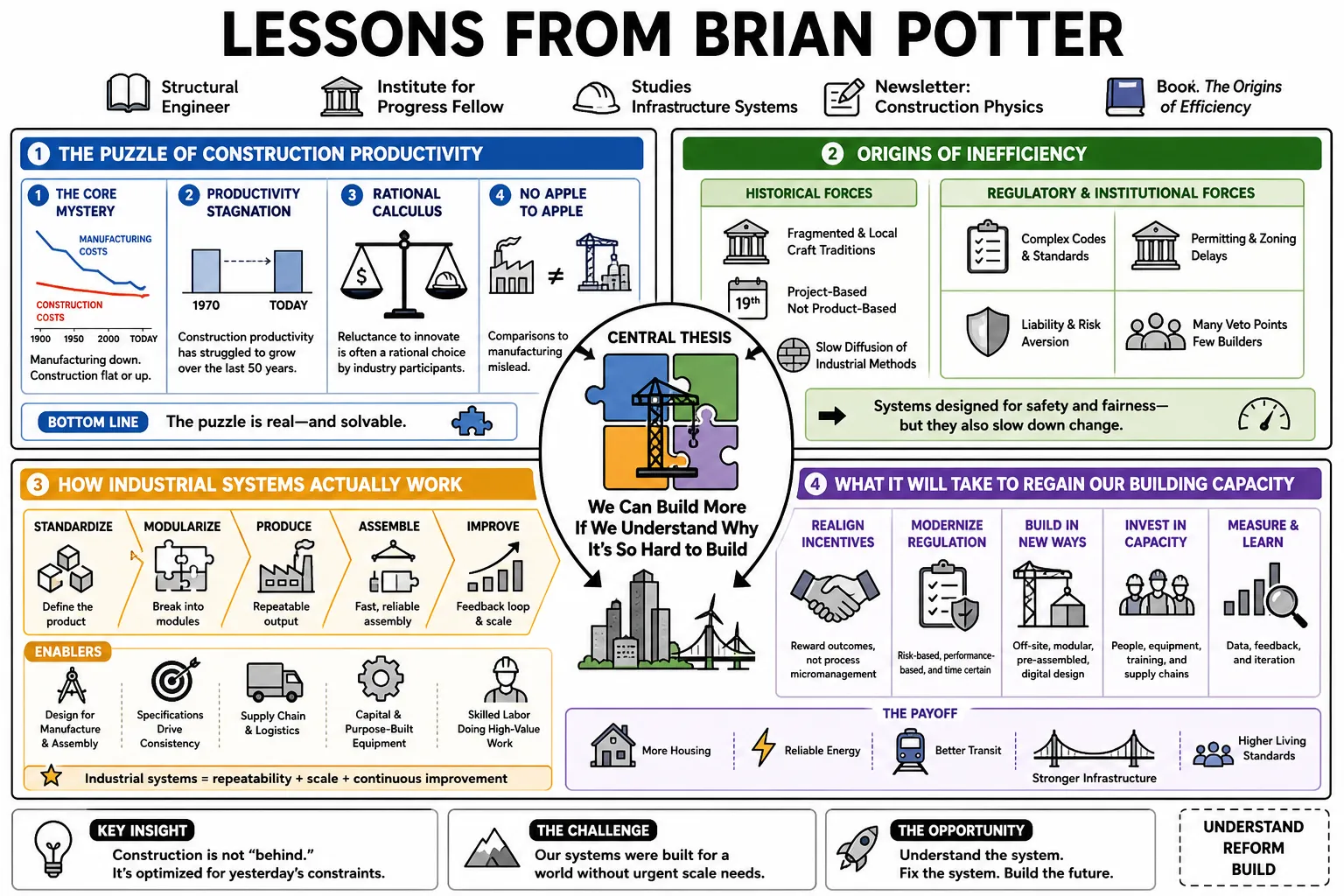
Lessons from Brian Potter
Structural engineer and Institute for Progress fellow Brian Potter studies why the modern world struggles to build physical infrastructure efficiently. Through his newsletter Construction Physics and book The Origins of Efficiency, he unpacks the historical and regulatory forces that dictate the cost of housing, energy, and transportation. This profile gathers his explanations of how industrial systems actually work and what it will take to regain our capacity to build.
Part 1: The Puzzle of Construction Productivity
- On the core mystery: "While manufacturing costs have plummeted over the last century, construction costs have remained stubbornly high or even increased." — Source: Construction Physics
- On industry stagnation: "Construction productivity has struggled to grow over the last 50 years, defying the trend seen in almost every other sector of the economy." — Source: Institute for Progress
- On rational actors: "The reluctance to innovate in construction is often a rational calculus by industry participants, not just a matter of culture or stubborn tradition." — Source: Construction Physics
- On simple comparisons: "People often compare construction to manufacturing, asking why we can't build houses like we build cars, but the constraints of geography and custom design make the comparison flawed." — Source: Odd Lots Podcast
- On the great slowdown: "The great slowdown in American production is most visible in our inability to build physical infrastructure quickly and cheaply." — Source: Plain English Podcast
- On fragmented markets: "The construction industry is highly fragmented, which makes it incredibly difficult for any single player to invest heavily in R&D or force systemic changes." — Source: Construction Physics
- On the cost of bespoke design: "Because almost every building is treated as a unique prototype designed for a specific plot of land, the industry misses out on the learning curves that drive down costs in mass production." — Source: Lumafield Interview
- On Baumol's cost disease: "As other sectors become more efficient and wages rise, sectors like construction that rely heavily on manual labor become comparatively more expensive." — Source: Institute for Progress
- On technological adoption: "Adopting new technology in construction often requires coordinating across a fragmented chain of architects, engineers, contractors, and local regulators, which slows down diffusion." — Source: Construction Physics
- On the physics of building: "Building things in the physical world involves moving heavy materials, dealing with unpredictable weather, and managing complex site logistics that software doesn't have to face." — Source: Construction Physics
Part 2: Lessons from Katerra and Prefabrication
- On the factory-built thesis: "I came to believe their thesis that if you just build these buildings in factories, it would be much cheaper. It was not really correct." — Source: Webb Analytics
- On lacking repetitive volume: "Construction lacks the repetitive, identical volume required to make factory production radically cheaper than on-site assembly." — Source: Architect Magazine
- On scaling too fast: "Katerra scaled up massively prior to having a product people wanted to buy, and it spent several fitful years and painful pivots trying to find one." — Source: Construction Physics
- On industry buy-in: "Architects and designers weren't willing to specify Katerra's products; they wanted to use what they were familiar with." — Source: Architect Magazine
- On competing with low overhead: "Executives would complain about how hard it was to compete with low-overhead contractors who used little more than power tools and manual labor." — Source: Construction Physics
- On software in construction: "Building a comprehensive software platform to manage construction end-to-end is incredibly difficult because every project requires different workflows and tools." — Source: Not Boring
- On the limits of modular: "Modular construction shifts labor from the job site to the factory, but it introduces massive new costs in transportation and limits design flexibility." — Source: Odd Lots Podcast
- On vertical integration: "Trying to vertically integrate design, manufacturing, and general contracting means you have to be excellent at three completely different businesses simultaneously." — Source: Construction Genius Podcast
- On market discovery: "Startups often assume the construction market wants a standardized product, only to discover that developers place a high premium on customizability." — Source: Construction Physics
- On failure modes: "The failure of highly capitalized construction startups often comes down to underestimating the complexity and stubborn efficiency of the existing contracting ecosystem." — Source: Construction Physics
Part 3: The Mechanics of Efficiency
- On the driver of civilization: "Efficiency is the engine that powers human civilization." — Source: Stripe Press
- On the nature of progress: "Almost everything that distinguishes modern life from the past flows from our ability to make things using less human effort." — Source: Mindvalley Interview
- On the five factors: "There are five fundamental characteristics of a production process that can be manipulated to lower costs: the transformation method, production rate, input cost, buffer size, and output variability." — Source: Econlib
- On deliberate effort: "Every drop in cost, every additional ounce of efficiency we can squeeze from a bundle of inputs is the product of deliberate effort." — Source: Econlib
- On bottom-up innovation: "Efficiency doesn't just happen through aggregate technological change; it comes from thousands of workers and engineers redesigning products and rearranging factories." — Source: Econlib
- On standardizing inputs: "A critical step in industrialization is reducing the variability of inputs, which allows machines to replace human judgment." — Source: The Origins of Efficiency
- On continuous measurement: "You cannot improve a process until you can measure it accurately and isolate the specific steps where time or materials are being wasted." — Source: The Origins of Efficiency
- On the learning curve: "Industries that produce millions of identical units benefit from a learning curve where each doubling of cumulative production reliably reduces per-unit costs." — Source: Econlib
- On systemic design: "Reference: In an Unleashed discussion of The Origins of Efficiency, Potter describes efficiency as a system of levers: production method, rate, input costs, step removal, and variability reduction, with organizations and work structure acting as production technology." — Reference: Unleashed episode notes on Brian Potter's five levers of efficiency
- On translating gains: "The ongoing challenge is applying the mechanisms of efficiency that worked for semiconductors and automobiles to stagnant sectors like housing and infrastructure." — Source: Goodreads Review
Part 4: Regulation and Environmental Review
- On procedural environmentalism: "Environmental review has devolved into procedural environmentalism, where the focus is on meeting legal documentation requirements rather than achieving substantive environmental goals." — Source: Institute for Progress
- On NEPA delays: "NEPA, while originally intended to infuse environmental considerations into federal decision-making, has become a source of massive costs, uncertainty, and years-long delays." — Source: Institute for Progress
- On clean energy: "Procedural hurdles intended to protect the environment are now frequently misused to delay the exact clean energy projects we need to decarbonize." — Source: Institute for Progress
- On litigation risk: "The threat of litigation under NEPA forces agencies to produce thousands of pages of bulletproof documentation, slowing down essential infrastructure." — Source: The Reg Review
- On categorical exclusions: "We need to increase the use of categorical exclusions to bypass lengthy reviews for project types that have known, minimal environmental impacts." — Source: C3 Solutions
- On generic impact statements: "Using generic environmental impact statements for well-understood technologies, like advanced nuclear reactors, could significantly streamline deployment." — Source: C3 Solutions
- On the cost of uncertainty: "Regulatory uncertainty inflates construction costs by making it difficult for contractors to plan timelines and allocate resources effectively." — Source: U.S. Senate Testimony
- On statutes of limitations: "Shortening the statutes of limitations for legal challenges against infrastructure projects is a necessary step to reduce endless project limbo." — Source: Grokipedia
- On public-sector expertise: "A government that spends a decade reviewing a transit line before breaking ground is a government that has lost its capacity to build." — Source: Dwarkesh Podcast
Part 5: Historical Infrastructure and Industrialization
- On the Arsenal of Democracy: "America's wartime production during WWII succeeded because of immense state coordination, guaranteed demand, and a willingness to standardize designs rapidly." — Source: EconTalk
- On early manufacturing: "The history of shipbuilding and steel production shows that industrialization often starts with messy, localized experiments before converging on dominant methods." — Source: Construction Physics
- On mass production: "Ford's assembly line didn't just organize labor differently; it forced the creation of high-precision machine tools to guarantee interchangeable parts." — Source: The Origins of Efficiency
- On historical precedents: "Looking back at the Empire State Building or the Hoover Dam, we see that rapid construction was possible when labor was cheap and regulatory burdens were minimal." — Source: Plain English Podcast
- On the evolution of tools: "The progression from manual hand tools to steam, electric, and pneumatic power fundamentally altered the speed at which physical material could be shaped." — Source: Construction Physics
- On containerization: "The shipping container is a perfect example of how a simple physical standard can reorganize an entire global supply chain and slash transportation costs." — Source: The Origins of Efficiency
- On historical comparisons: "Reference: Potter's safety history cautions against romanticizing early fast construction: he notes that construction was once extraordinarily dangerous, with Hoover Dam tunnel deaths, Empire State Building workers riding crane hooks, and construction fatalities falling more than 90% since the mid-20th century." — Reference: Construction Physics essay on how much safer construction has gotten
- On path dependence: "Many of the materials and methods we use today, like dimensional lumber or Portland cement, became standard due to historical path dependence rather than absolute superiority." — Source: Construction Physics
- On early automation: "The first attempts to automate skilled trades like bricklaying often failed because machines struggled to adapt to the minor variations in mortar and brick size that humans handle intuitively." — Source: Construction Physics
Part 6: Systems Thinking and Complexity
- On unseen complexity: "Things are always more complicated than they seem; simple explanations very rarely exist." — Source: Construction Physics
- On systemic barriers: "What looks like an obvious improvement to an outsider is frequently hindered by deep-seated, systemic barriers in the real world." — Source: Construction Physics
- On holistic innovation: "Innovation fails when it focuses solely on technology without aligning the entire system, including regulation, financing, land use, and distribution." — Source: The Lending Stars
- On swapping processes: "Switching production processes is not merely a technical swap; it often requires a complete overhaul of the surrounding economic ecosystem." — Source: Construction Physics
- On net-margin-positive scale: "Innovation without system-level alignment rarely achieves the necessary net-margin-positive scale." — Source: The Lending Stars
- On single-point solutions: "There is no single silver bullet for construction costs because the inefficiencies are distributed across a long, complex value chain." — Source: Construction Physics
- On the illusion of simplicity: "When a process looks simple, it usually means that a massive amount of complexity has been successfully hidden behind a standardized interface." — Source: Construction Physics
- On incentive alignment: "You cannot change how a building is framed or wired unless you also change how the local inspectors are trained to evaluate it." — Source: Construction Physics
- On feedback loops: "Complex physical systems have slow feedback loops, which means it takes years to learn whether a new material or structural design will actually hold up." — Source: Construction Physics
Part 7: Housing Costs and NIMBYism
- On housing barriers: "The high cost of building homes in America is heavily driven by local zoning laws and the political power of neighbors to block development." — Source: Odd Lots Podcast
- On local opposition: "NIMBYism doesn't just block projects outright; it forces developers to spend years in design iterations and legal battles, driving up the cost of capital." — Source: Dwarkesh Podcast
- On land values: "As construction gets more efficient, the gains are often absorbed by rising land values in desirable locations rather than translating to cheaper homes." — Source: Construction Physics
- On code requirements: "Modern building codes mandate higher energy efficiency, better fire safety, and stronger seismic resilience, all of which add baseline costs to new housing." — Source: Construction Physics
- On the trades shortage: "The shortage of skilled tradespeople makes labor more expensive, but it also reduces the overall capacity of the industry to build fast enough to meet demand." — Source: Odd Lots Podcast
- On bespoke planning: "Reference: In the Unleashed episode notes, Potter says construction struggles to achieve economies of scale because buildings are hard to transport, materials and labor remain expensive, and builders face different codes, permitting jurisdictions, and environmental requirements." — Reference: Unleashed episode notes on construction economies of scale and permitting jurisdictions
- On the financialization of housing: "Because housing is treated as an investment vehicle, there is immense political pressure from existing homeowners to maintain scarcity and protect property values." — Source: Dwarkesh Podcast
- On multi-family challenges: "Building multi-family housing involves much more complex structural and mechanical engineering than single-family homes, limiting the pool of contractors who can do it cheaply." — Source: Construction Physics
- On regulatory accretion: "Building costs suffer from regulatory accretion—rules are constantly added to address specific problems, but old or redundant rules are rarely removed." — Source: Construction Physics
Part 8: The Path Forward for Building
- On incremental progress: "The most likely path to cheaper construction is through thousands of incremental improvements in materials, software, and project management, rather than a single disruptive technology." — Source: Construction Physics
- On robotics: "Robotics in construction will likely start with specialized machines doing single, repetitive tasks like drywall finishing or rebar tying, rather than general-purpose humanoid robots." — Source: Construction Physics
- On standardization: "We need to push for more standardized, interoperable building components that can be mass-produced and assembled easily on site." — Source: Construction Physics
- On policy reform: "Permitting reform is a prerequisite for a physical renaissance; we cannot build the future if it remains illegal to break ground." — Source: Institute for Progress
- On state capacity: "Reviving state capacity requires governments to build in-house technical expertise rather than outsourcing every project management decision to consultants." — Source: Institute for Progress
- On better materials: "Advances in material science, such as lower-carbon concrete and stronger engineered timber, offer a practical way to improve building performance without overhauling the labor model." — Source: Construction Physics
- On advanced manufacturing: "Techniques from aerospace and automotive manufacturing, like 3D printing and advanced composites, will slowly bleed into construction as costs come down." — Source: Lumafield Interview
- On energy abundance: "Unlocking cheap, abundant energy is essential for driving down the input costs of heavy materials like steel, cement, and glass." — Source: Institute for Progress
- On the built environment: "Improving how we build is the most direct way to raise the standard of living, because the built environment determines how much space, mobility, and energy people can afford." — Source: Mindvalley Interview