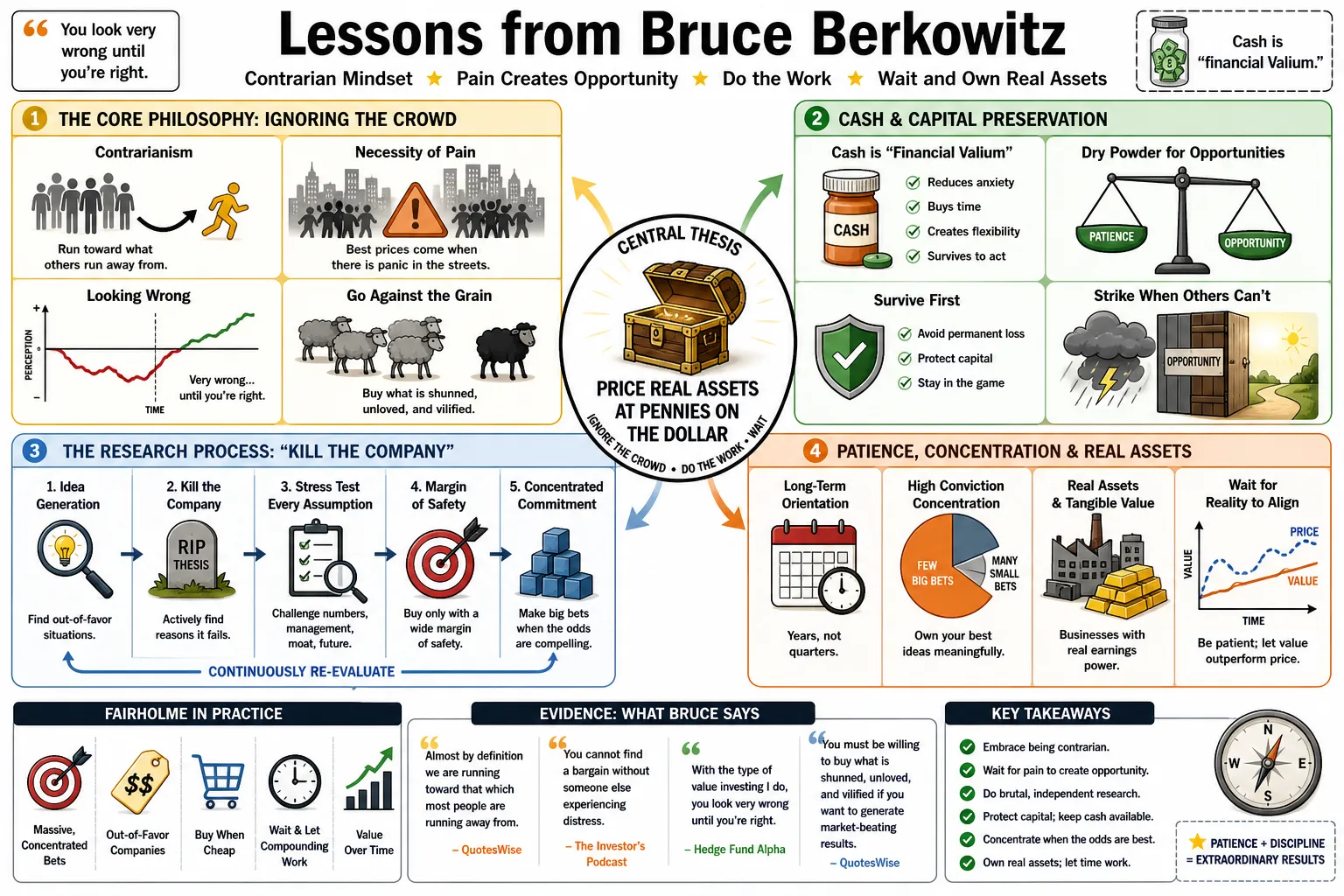
Lessons from Bruce Berkowitz
Bruce Berkowitz is the founder of the Fairholme Fund and Fairholme Capital Management. He concentrates his investments in a relatively small number of companies, focuses on free cash flow, and describes cash as "financial valium". — Hedge Fund Alpha: Bruce Berkowitz resource page (quotes from Fairholme calls and letters).
Part 1: The Core Philosophy: Ignoring the Crowd
- On Running Toward the Unloved: Berkowitz: "Almost by definition we are running toward that which most people are running away from. Because how else are you going to get a very reasonable cheap price on a good company unless the market place believes something is terribly wrong." — Hedge Fund Alpha: Bruce Berkowitz resource page (quotes from Fairholme calls and letters).
- On Ignoring the Crowd: Berkowitz: "At Fairholme Fund, our trademark is we ignore the crowd. So we pay attention to what matters and what matters is cash. We count cash, ignore the crowd." — Hedge Fund Alpha: Bruce Berkowitz resource page (quotes from Fairholme calls and letters).
- On Looking Wrong: Berkowitz: "I can be right but until other people agree that I'm right", "I'm going to look very wrong." — Interview with Erik Schatzker: "Why Bruce Berkowitz Still Likes Stocks Others Hate" (2017, video transcript).
- On Greed and Envy: Berkowitz on why people chase hot investments: "it's greed and envy. It's as simple as that." — Richer, Wiser, Happier: "Ignore the Crowd w/ Super-investor Bruce Berkowitz" (transcript).
- On Waiting for a Crash: Berkowitz recalls telling his wife during a boom: "We can't go out anymore until there's a crash and people become sensible again." — Richer, Wiser, Happier: "Ignore the Crowd w/ Super-investor Bruce Berkowitz" (transcript).
- On Hearing Only Wins: Berkowitz: "no one tells you really about their losses." — Richer, Wiser, Happier: "Ignore the Crowd w/ Super-investor Bruce Berkowitz" (transcript).
- On ETFs: Berkowitz: "an ETF is only as good as the constituents within the ETF". — Interview with Erik Schatzker: "Why Bruce Berkowitz Still Likes Stocks Others Hate" (2017, video transcript).
- On Delegated Thinking: Berkowitz says it bothers him that "thinking is being delegated to a sort of a mathematical equation that everything should average out okay over the long period". — Interview with Erik Schatzker: "Why Bruce Berkowitz Still Likes Stocks Others Hate" (2017, video transcript).
- On Following the Cash: Berkowitz: "I just go by the math I count I basically follow the cash I invested a discount and I stick to that process". — Interview with Erik Schatzker: "Why Bruce Berkowitz Still Likes Stocks Others Hate" (2017, video transcript).
- On Holding On: Berkowitz: "as long as I still think the value is there I stay with the investment". — Interview with Erik Schatzker: "Why Bruce Berkowitz Still Likes Stocks Others Hate" (2017, video transcript).
Part 2: Defining Risk and Surviving Volatility
- On Not Losing: Berkowitz says he tells his kids: "you don't need to do much better than eight, 9% as long as you don't lose." — Richer, Wiser, Happier: "Ignore the Crowd w/ Super-investor Bruce Berkowitz" (transcript).
- On Ownership: Berkowitz on Fannie Mae and Freddie Mac: "in highly regulated industries, there's a possibility that ownership is an illusion." — Richer, Wiser, Happier: "Ignore the Crowd w/ Super-investor Bruce Berkowitz" (transcript).
- On Regulatory Risk: Berkowitz: "how do you invest in a business where, again, one regulator on one panicky day can take your assets away from you really?" — Richer, Wiser, Happier: "Ignore the Crowd w/ Super-investor Bruce Berkowitz" (transcript).
- On Government Reliability: Berkowitz after losing nine to zero at the Supreme Court: "I think the government is less reliable than the guy upstairs. I can't handicap it anymore." — Richer, Wiser, Happier: "Ignore the Crowd w/ Super-investor Bruce Berkowitz" (transcript).
- On Saying No to a Bet: Berkowitz on a suspicious bet he refused as a teenage bookmaker: "It just doesn't make sense. The risk is way too high." — Richer, Wiser, Happier: "Ignore the Crowd w/ Super-investor Bruce Berkowitz" (transcript).
- On Banks in Hard Times: Berkowitz: "banks put on the very best loans during the most difficult times. They tighten up their standards, they charge more, they ask for more." — Richer, Wiser, Happier: "Ignore the Crowd w/ Super-investor Bruce Berkowitz" (transcript).
- On Failed Retailers: On Sears, Berkowitz says his thesis was "that from a failed retailer can come a great real estate portfolio." — Richer, Wiser, Happier: "Ignore the Crowd w/ Super-investor Bruce Berkowitz" (transcript).
- On Selling Below Cash: Berkowitz on Bank of America and AIG at their worst: "both companies were basically selling for less than the cash they had in the bank". — Interview with Erik Schatzker: "Why Bruce Berkowitz Still Likes Stocks Others Hate" (2017, video transcript).
- On Fixable Problems: Berkowitz says that when companies have issues, "you have to determine that those issues are fixable". — Interview with Erik Schatzker: "Why Bruce Berkowitz Still Likes Stocks Others Hate" (2017, video transcript).
- On Price and Value: Berkowitz: "over time either the price is going to go to the value or the value is going to come down to the price or most likely they meet somewhere the middle". — Interview with Erik Schatzker: "Why Bruce Berkowitz Still Likes Stocks Others Hate" (2017, video transcript).
Part 3: Cash, Free Cash Flow, and Financial Valium
- On Financial Valium: Berkowitz: "Since of the start of the Fairholme Fund, we've always had a double digit cash percentage and for us cash is a, you could call it financial valium. It gives us the wherewithal to take focused positions and of course when no one else has cash, cash becomes very valuable." — Hedge Fund Alpha: Bruce Berkowitz resource page (quotes from Fairholme calls and letters).
- On Stock as a Junior Bond: Berkowitz: "At Fairholme, we treat common stock as the most junior bond in a company's capital structure, where the true earnings, the free cash flow of a company, are akin to a coupon without a maturity date." — Hedge Fund Alpha: Bruce Berkowitz resource page (quotes from Fairholme calls and letters).
- On Buying Right: Berkowitz: "Price matters, and buying right is half the battle. Getting a reasonable estimate of expected free cash flow is the other half." — Hedge Fund Alpha: Bruce Berkowitz resource page (quotes from Fairholme calls and letters).
- On Spending Cash: Berkowitz: "at the end of the day, all you can spend is cash." — Richer, Wiser, Happier: "Ignore the Crowd w/ Super-investor Bruce Berkowitz" (transcript).
- On Accounting Tricks: Berkowitz: "there are so many accounting tricks." — Richer, Wiser, Happier: "Ignore the Crowd w/ Super-investor Bruce Berkowitz" (transcript).
- On Distributable Cash: Berkowitz: "a lot of the very good decisions I made were based upon the figuring out the distributable cash a company had, how much cash they were generating after spending what they had to maintain the steady state of the operation." — Richer, Wiser, Happier: "Ignore the Crowd w/ Super-investor Bruce Berkowitz" (transcript).
- On Inflation and Free Cash: Berkowitz: "The best way we can protect against inflation is by finding companies that generate large amounts of free cash, which then can either be profitably reallocated into the company or paid to shareholders." — Hedge Fund Alpha: Bruce Berkowitz resource page (quotes from Fairholme calls and letters).
- On Countable Cash: Berkowitz on Enterprise Products: "you can count the cash easily, and the cash is quite significant." — Richer, Wiser, Happier: "Ignore the Crowd w/ Super-investor Bruce Berkowitz" (transcript).
- On the Toll Booth: Berkowitz on midstream pipelines: "it's a toll booth where you want to call it an annuity with upside." — Richer, Wiser, Happier: "Ignore the Crowd w/ Super-investor Bruce Berkowitz" (transcript).
Part 4: Concentration vs. Diversification
- On Best Ideas: Berkowitz: "If you can buy more of your best idea, why put (the money) into your 10th-best idea or your 20th-best idea? If we're confident in what we do, then that's the way we should do it. The only reason, not to is a fear of being wrong. The more positions you have, the more average you are." — Hedge Fund Alpha: Bruce Berkowitz resource page (quotes from Fairholme calls and letters).
- On Layered Diversification: Berkowitz on investors who use many managers and funds: "you might as well go into an index fund." — Richer, Wiser, Happier: "Ignore the Crowd w/ Super-investor Bruce Berkowitz" (transcript).
- On Closet Indexers: Berkowitz on the brokerage-era managers he saw: "closet indexers who need to be in a lemming like group so that no matter what happens, no one gets blamed". — Richer, Wiser, Happier: "Ignore the Crowd w/ Super-investor Bruce Berkowitz" (transcript).
- On Minutiae: Berkowitz: "I always enjoyed getting into the minutiae and trying to understand the business as opposed to sort of roughly understanding a lot of things". — Richer, Wiser, Happier: "Ignore the Crowd w/ Super-investor Bruce Berkowitz" (transcript).
- On How Concentration Grew: Berkowitz explains how St. Joe reached 82% of the fund: "if someone's selling the fund, remaining shareholders are buying more of what's left in the fund." — Richer, Wiser, Happier: "Ignore the Crowd w/ Super-investor Bruce Berkowitz" (transcript).
- On Eating Your Own Cooking: Berkowitz: "I need to eat my own cooking and I need to make it important". — Interview with Erik Schatzker: "Why Bruce Berkowitz Still Likes Stocks Others Hate" (2017, video transcript).
- On the Home Team: Berkowitz on emerging markets: "It's hard enough when you're the home team, investing in your own backyard. I don't want to play an away game, where I don't know all the rules." — Hedge Fund Alpha: Bruce Berkowitz resource page (quotes from Fairholme calls and letters).
- On Circle of Competence: Berkowitz on the tech leaders: "that is not my circle of competence". — Interview with Erik Schatzker: "Why Bruce Berkowitz Still Likes Stocks Others Hate" (2017, video transcript).
- On the Present and the Past: Berkowitz: "I'm strictly about the present and the past". — Interview with Erik Schatzker: "Why Bruce Berkowitz Still Likes Stocks Others Hate" (2017, video transcript).
Part 5: "Kill the Company": Inversion and Stress Testing
- On Killing Cherished Ideas: Berkowitz: "Try and kill our most cherished ideas and we put our shareholders first, that's what it all about." — Hedge Fund Alpha: Bruce Berkowitz resource page (quotes from Fairholme calls and letters).
- On Inverting the Process: On Sears, Berkowitz says: "this is a good example of how we invert the investment process. I can't see how we're going to lose." — Hedge Fund Alpha: Bruce Berkowitz resource page (quotes from Fairholme calls and letters).
- On the Pieces of Sears: Berkowitz on Sears: "the value of all the pieces, in death, is worth more than the current market price." — Hedge Fund Alpha: Bruce Berkowitz resource page (quotes from Fairholme calls and letters).
- On Heads We Win: Berkowitz: "if the stock price goes down, the company continues to buy back stock, great, we win. If the stock price just goes up, we win." — Hedge Fund Alpha: Bruce Berkowitz resource page (quotes from Fairholme calls and letters).
- On Betting on Financials: Berkowitz on financial stocks: "I don't deserve to be in this business. Because everything I look at tells me that the financial companies that we've invested in are extremely cheap". — Hedge Fund Alpha: Bruce Berkowitz resource page (quotes from Fairholme calls and letters).
- On Retail's Recovery: Berkowitz on Sears: "the recovery of retail always seemed to be right around the corner, but never came." — Richer, Wiser, Happier: "Ignore the Crowd w/ Super-investor Bruce Berkowitz" (transcript).
- On the Next Amazon: Berkowitz on Sears: "I did not think Sears was going to become the next Amazon, even though Amazon did become the next Sears." — Richer, Wiser, Happier: "Ignore the Crowd w/ Super-investor Bruce Berkowitz" (transcript).
- On Fixing Problems: Berkowitz: "the company has to be able to fix its problems for you to be able to realize the underlying value". — Interview with Erik Schatzker: "Why Bruce Berkowitz Still Likes Stocks Others Hate" (2017, video transcript).
- On Choosing the Wrong People: Berkowitz on his own mistakes: "I selected the wrong people for the wrong tasks". — Richer, Wiser, Happier: "Ignore the Crowd w/ Super-investor Bruce Berkowitz" (transcript).
Part 6: Margin of Safety and Deep Value
- On Selling a Position: Berkowitz says that after years of studying a company, selling "almost felt like divorce". — Interview with Erik Schatzker: "Why Bruce Berkowitz Still Likes Stocks Others Hate" (2017, video transcript).
- On Businesslike Investing: Berkowitz: "I've always known that the best way to invest is when it's most businesslike I've always wanted to be long-term oriented". — Interview with Erik Schatzker: "Why Bruce Berkowitz Still Likes Stocks Others Hate" (2017, video transcript).
- On Declines Along the Way: Berkowitz: "normally what happens that the investment declines tremendously in value", and later "clouds disperse and people get a better look at the assets and liabilities within the company". — Interview with Erik Schatzker: "Why Bruce Berkowitz Still Likes Stocks Others Hate" (2017, video transcript).
- On the Gap Between Price and Value: Berkowitz: "you have a situation where you have a price and you have a value". — Interview with Erik Schatzker: "Why Bruce Berkowitz Still Likes Stocks Others Hate" (2017, video transcript).
- On Value in the Physical World: Berkowitz: "there is value in the physical world". — Interview with Erik Schatzker: "Why Bruce Berkowitz Still Likes Stocks Others Hate" (2017, video transcript).
- On a Dollar for Fifty Cents: Berkowitz: "I'm the guy who's looking to buy a dollar for 50s". — Interview with Erik Schatzker: "Why Bruce Berkowitz Still Likes Stocks Others Hate" (2017, video transcript).
- On Conservative Balance Sheets: Berkowitz on St. Joe: "net debt-free at the corporate level" with "plenty of liquidity, very conservatively leveraged." — Richer, Wiser, Happier: "Ignore the Crowd w/ Super-investor Bruce Berkowitz" (transcript).
- On Long Horizons: Berkowitz on real estate: "Most people really can't see beyond a few years." He adds: "And then after five, 10 years, everything's discounted to zero." — Richer, Wiser, Happier: "Ignore the Crowd w/ Super-investor Bruce Berkowitz" (transcript).
- On Buying at a Discount: Berkowitz: "I've always bought assets at a significant discount to I believe the value". — Interview with Erik Schatzker: "Why Bruce Berkowitz Still Likes Stocks Others Hate" (2017, video transcript).
Part 7: Assessing Management and "The Jockey"
- On All Shareholders: Berkowitz: "you have to do what's best for all shareholders." — Richer, Wiser, Happier: "Ignore the Crowd w/ Super-investor Bruce Berkowitz" (transcript).
- On Captaining the Ship: Berkowitz: "I believe that if you're going to be the chairman of a company, you have to be somewhat the captain of the ship." — Richer, Wiser, Happier: "Ignore the Crowd w/ Super-investor Bruce Berkowitz" (transcript).
- On Taking No Pay: Berkowitz on his role as St. Joe chairman: "I don't take a penny of compensation." — Richer, Wiser, Happier: "Ignore the Crowd w/ Super-investor Bruce Berkowitz" (transcript).
- On Shared Outcomes: Berkowitz: "if St. Joe does well, I'll do very well and all shareholders will do very well". — Richer, Wiser, Happier: "Ignore the Crowd w/ Super-investor Bruce Berkowitz" (transcript).
- On Wasteful Trustees: Berkowitz on St. Joe's old board: "the company could be run for much less and needed to focus on their shareholders". — Richer, Wiser, Happier: "Ignore the Crowd w/ Super-investor Bruce Berkowitz" (transcript).
- On Owners: Berkowitz on the new St. Joe approach: "They were owners and everyone had to be treated well." — Richer, Wiser, Happier: "Ignore the Crowd w/ Super-investor Bruce Berkowitz" (transcript).
- On Finding Management: Berkowitz: "it took time to find a management team that would agree with me". — Richer, Wiser, Happier: "Ignore the Crowd w/ Super-investor Bruce Berkowitz" (transcript).
- On Extending Competence: Berkowitz on hiring mistakes: "I thought person A who is competent in a certain area could extend that competence to an adjacent area and just it didn't work out." — Richer, Wiser, Happier: "Ignore the Crowd w/ Super-investor Bruce Berkowitz" (transcript).
Part 8: The Psychology of a Contrarian
- On a Father's Gambling: Berkowitz on his father: "I learned a lot from the failures of the gambler." It "Taught me a lot of what not to do." — Richer, Wiser, Happier: "Ignore the Crowd w/ Super-investor Bruce Berkowitz" (transcript).
- On Balancing the Book: Berkowitz on bookmaking as a teenager: "my only job was to try and balance the book, try and get it equally weighted so that no matter who won or lost. I made something". — Richer, Wiser, Happier: "Ignore the Crowd w/ Super-investor Bruce Berkowitz" (transcript).
- On Legal Bookmaking: Berkowitz on opening a brokerage account: "realized that this is just another form of bookmaking, but this is a legal form of bookmaking." — Richer, Wiser, Happier: "Ignore the Crowd w/ Super-investor Bruce Berkowitz" (transcript).
- On Dinner Party Winners: Berkowitz: "You go out, you listen to people who you're sharing a dinner with, telling you how much money you've made." — Richer, Wiser, Happier: "Ignore the Crowd w/ Super-investor Bruce Berkowitz" (transcript).
- On Shareholders Who Lose Faith: Berkowitz on the fund's underperformance: "to a great extent my heart goes out to our shareholders especially those shareholders who have" lost faith. — Interview with Erik Schatzker: "Why Bruce Berkowitz Still Likes Stocks Others Hate" (2017, video transcript).
- On Five Steps Backward: Berkowitz: "Maybe if I'm a masochist, I'm constantly taking five steps backwards in order to hopefully advance much further." — Richer, Wiser, Happier: "Ignore the Crowd w/ Super-investor Bruce Berkowitz" (transcript).
- On Doing It His Way: Berkowitz: "I'm looking forward to the next 20 or 30 years. But on my terms where it's enjoyable, I don't market. I don't raise money." — Richer, Wiser, Happier: "Ignore the Crowd w/ Super-investor Bruce Berkowitz" (transcript).
- On Following What You Like: Berkowitz: "you have to follow what you like to do and what you think is going to win." — Richer, Wiser, Happier: "Ignore the Crowd w/ Super-investor Bruce Berkowitz" (transcript).
- On Investing Like an Owner: Berkowitz: "it was always my desire to invest client's money." He wanted to invest "The way I would invest my money." — Richer, Wiser, Happier: "Ignore the Crowd w/ Super-investor Bruce Berkowitz" (transcript).