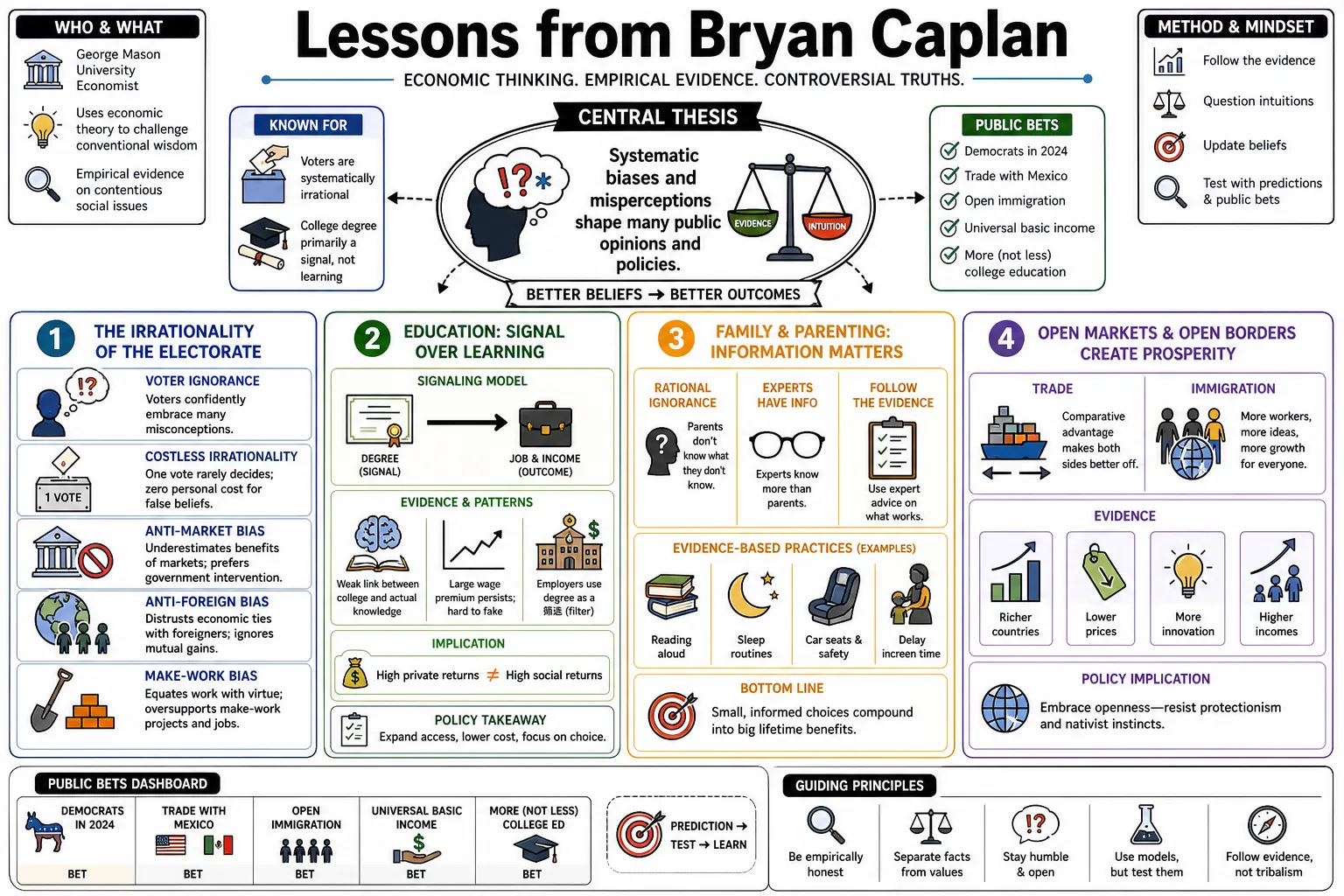
Lessons from Bryan Caplan
Bryan Caplan is a professor of economics at George Mason University. He is the author of The Myth of the Rational Voter, The Case Against Education, Selfish Reasons to Have More Kids, Open Borders and Build, Baby, Build, and he writes the Bet On It blog. — Open Borders book page.
Part 1: The Irrationality of the Electorate
- On Model Assumptions: Caplan: "Actual democracies have never met its highly restrictive assumptions". — Bet On It: "The Neo-Median Voter Model".
- On the Median Voter Model: Caplan: "The Median Voter Model says that democratic competition impels politicians to offer whatever policies maximally satisfy the median voter." — Bet On It: "The Neo-Median Voter Model".
- On Framing Policies: Caplan: "if you frame policies as “Government should do more X,” “Government should do less X,” and “Government should stay the course,” public opinion data usually reveals that the latter is the median position." — Bet On It: "The Neo-Median Voter Model".
- On Reminding Voters of Taxes: Caplan: "the main counterexample, category-specific spending, usually goes away if you add a reminder along the lines of “Remember, more spending requires more taxes.”" — Bet On It: "The Neo-Median Voter Model".
- On Diverging Platforms: Caplan: "In the Neo-Median Voter Model, platforms diverge widely, especially on issues where the base is passionate and the median voter in the general election is apathetic." — Bet On It: "The Neo-Median Voter Model".
- On Presidential Power: Caplan: "it is only a slight exaggeration to say that despite much rhetoric to the contrary, the president is more than halfway to being a four-year dictator." — Bet On It: "The Neo-Median Voter Model".
- On Expressive Primaries: Caplan: "Partisan voters in both parties pay almost no attention to the impending general election; they vote expressively for whichever candidate most appeals to them." — Bet On It: "The Neo-Median Voter Model".
- On Who Cuts Corners: Caplan: "Consumers, not firms, cut corners." — Bet On It: "Could You Get It If You Were Rich?".
- On Paying for Safety: Caplan: "Markets will happily provide all the safety people are willing to pay for." — Bet On It: "Could You Get It If You Were Rich?".
- On Getting It if You Were Rich: Caplan: "For any given product, could you get it if you were rich?" — Bet On It: "Could You Get It If You Were Rich?".
Part 2: Challenging the Value of Traditional Education
- On Eighty Percent Signaling: Caplan: "what I really say is that 80% of the causal effect is signaling. Eighty percent of the causal effect." — EconTalk: "Bryan Caplan on the Case Against Education" (transcript).
- On Ability Bias: Caplan: "adding in my preferred estimate for ability bias is that subtracts off 45% of the apparent effect." — EconTalk: "Bryan Caplan on the Case Against Education" (transcript).
- On Dividing the Remainder: Caplan: "we have to divide that 55% between 20% human capital and 80% signaling". — EconTalk: "Bryan Caplan on the Case Against Education" (transcript).
- On the Sheepskin Effect: Caplan: "most of the payoff from education comes from crossing the finish lines, from diploma years." — EconTalk: "Bryan Caplan on the Case Against Education" (transcript).
- On the Last Year: Caplan on the human capital view: "Why would the last year pay so much more than the earlier years?" — EconTalk: "Bryan Caplan on the Case Against Education" (transcript).
- On Testing What People Learn: Caplan: "if there is no designable test that can show that people learn something, then they haven't learned it." — EconTalk: "Bryan Caplan on the Case Against Education" (transcript).
- On Crediting Education: Caplan: "Let's just give education credit for everything people know, and then see how much they know." — EconTalk: "Bryan Caplan on the Case Against Education" (transcript).
- On Educational Idealists: Caplan: "What's amazing about Educational Psychology is the people who go into it are educational idealists." — EconTalk: "Bryan Caplan on the Case Against Education" (transcript).
- On Conscientiousness: Caplan: "the second best predictor of job performance is conscientiousness". — EconTalk: "Bryan Caplan on the Case Against Education" (transcript).
- On Senators Per State: Caplan: "when half of Americans can't do that, I want to say they don't know it." — EconTalk: "Bryan Caplan on the Case Against Education" (transcript).
Part 3: A New Perspective on Parenting
- On the Pain and the Gain: Caplan: "To be brutally honest, we're reluctant to have more children because we think that the pain outweighs the gain." — Excerpt from Selfish Reasons to Have More Kids (2011).
- On Enlightened Self-Interest: Caplan: "it is in the average person's enlightened self-interest to have more kids". — Excerpt from Selfish Reasons to Have More Kids (2011).
- On Preaching: Caplan: "Preaching against selfishness is usually about as productive as nagging a brick wall." — Excerpt from Selfish Reasons to Have More Kids (2011).
- On the Average Person: Caplan: "The claim is not that everyone should have lots of kids, but that the average person should have more kids." — Excerpt from Selfish Reasons to Have More Kids (2011).
- On Nature and Nurture: Caplan: "Nature, not nurture, explains most family resemblance, so parents can safely cut themselves a lot of additional slack." — Excerpt from Selfish Reasons to Have More Kids (2011).
- On Safer Kids: Caplan: "Despite the horror stories in the media, kids are much safer today than they were in the “Idyllic Fifties.”" — Excerpt from Selfish Reasons to Have More Kids (2011).
- On Start-Up Costs: Caplan: "Kids have high start-up costs, but wise parents weigh their initial sleep deprivation against a lifetime of rewards". — Excerpt from Selfish Reasons to Have More Kids (2011).
- On Parental Effort: Caplan: "careful measurement confirms that parental effort is at an all-time high". — Excerpt from Selfish Reasons to Have More Kids (2011).
- On Neglect: Caplan: "My alternative is not child neglect." — Excerpt from Selfish Reasons to Have More Kids (2011).
- On Information, Not Orders: Caplan: "I'm here to provide information, not run your life." — Excerpt from Selfish Reasons to Have More Kids (2011).
Part 4: The Case for Open Borders
- On Starving Without Low-Skilled Workers: Caplan: "we'd starve without low-skilled workers, because they grow almost all of our food." — Bet On It: "An Ode to Low-Skilled Workers".
- On Living in Tents: Caplan: "The vast majority of construction and infrastructure workers lack college degrees, and without them, we'd be living in tents." — Bet On It: "An Ode to Low-Skilled Workers".
- On the Major Premise: Caplan: "Social Desirability Bias obviously stops even the angriest nativists from stating the Major Premise." — Bet On It: "An Ode to Low-Skilled Workers".
- On Fiscal Burdens: Caplan: "low-skilled natives are generally a bigger fiscal burden than low-skilled immigrants, because the former are far more likely to receive exorbitantly-priced public education". — Bet On It: "An Ode to Low-Skilled Workers".
- On Total Production: Caplan: "total production for humanity goes up, not down". — Bet On It: "An Ode to Low-Skilled Workers".
- On Deporting Everyone: Caplan: "Deporting all illegal aliens currently residing in the United States has exactly the same insuperable problems." — Bet On It: "Immigration Laws Are Made to Be Broken".
- On False Positives: Caplan: "stricter enforcement means more false positives". — Bet On It: "Immigration Laws Are Made to Be Broken".
- On Murderers and Migrants: Caplan: "Murderers are obviously worse than illegal immigrants. Much worse." — Bet On It: "Immigration Laws Are Made to Be Broken".
- On Evil Laws: Caplan: "If a law is totally evil, then it's fine to break it and wrong to enforce it." — Bet On It: "Immigration Laws Are Made to Be Broken".
Part 5: The Economics of Housing Scarcity
- On Capital Loss Without Negativity: Caplan: "The lesson, rather, is that NIMBY negativity is not the automatic response for everyone who experiences a capital loss." — Bet On It: "CDs vs. NIMBY".
- On Upside With the Downside: Caplan: "Most enjoy some upside with their downside." — Bet On It: "CDs vs. NIMBY".
- On the Archetypal NIMBY: Caplan: "It fully applies to the archetypal NIMBY who opposes housing deregulation because he already has a valuable home!" — Bet On It: "CDs vs. NIMBY".
- On a Million-Dollar Home: Caplan: "Suppose you own a $1M home, then deregulation halves its value." — Bet On It: "CDs vs. NIMBY".
- On the Dream Home: Caplan: "The dream home that previously cost $2M now only costs $1M, so their consumer surplus potentially rises by a full $1M." — Bet On It: "CDs vs. NIMBY".
- On Cheaper Housing for Kids: Caplan: "Even if you're in your “forever home,” even if you have no desire to travel, crashing housing prices have a massive upside: cheaper housing for your kids." — Bet On It: "CDs vs. NIMBY".
- On Rental and Sale Markets: Caplan: "rental and sale markets are closely connected". — Bet On It: "CDs vs. NIMBY".
- On Smaller Inheritances: Caplan: "Yes, their inheritance will be less, but they'll get to enjoy cheaper housing for a lifetime." — Bet On It: "CDs vs. NIMBY".
- On Loving Your Kids: Caplan: "I love them, so their surplus is also my surplus." — Bet On It: "CDs vs. NIMBY".
Part 6: Reassessing the Causes of Poverty
- On Overestimating Constraints: Caplan on beliefs he has long held: "Widespread overestimation of constraints relative to preferences." — Bet On It: "High Agency Is High Variance".
- On Can't Versus Doesn't Want To: Caplan: "People are quick to say, “He can't do X” when the correct story is obviously, “He doesn't want to do X.”" — Bet On It: "High Agency Is High Variance".
- On Conformity: Caplan: "Most humans are deeply conformist." — Bet On It: "High Agency Is High Variance".
- On Nonconformists: Caplan: "in a modern anonymous society, this creates immense opportunities for thoughtful nonconformists." — Bet On It: "High Agency Is High Variance".
- On Reputational Risk: Caplan: "Hardly anyone will notice, so the reputational risk is much lower than your emotions tell you." — Bet On It: "High Agency Is High Variance".
- On Changing Lanes: Caplan: "No one ever told me a professor could become a graphic novelist." — Bet On It: "High Agency Is High Variance".
Part 7: The Power of Public Bets
- On Base Rates: Caplan: "I take base rates very seriously, and the base rate for new techs grossly overpromising and underdelivering is at least 95%." — Bet On It: "AI Bet!" (2023).
- On Kahneman's Maxim: Caplan: "Kahneman's maxim that “Nothing is as important as you think it is, while you're thinking about it” is relevant as well." — Bet On It: "AI Bet!" (2023).
- On AI Fandom: Caplan: "To my eyes, AI fandom looks more like a mass hysteria than a sensible reaction." — Bet On It: "AI Bet!" (2023).
- On ChatGPT's Grade: Caplan: "ChatGPT got a D on my last labor economics midterm." — Bet On It: "AI Bet!" (2023).
- On Spelling Out the Bet: Caplan's bet terms: "If the AI gets an A on at least 5 of out 6 of those exams". — Bet On It: "AI Bet!" (2023).
- On Not Self-Censoring: Caplan: "I'm definitely not going to self-censor to protect myself." — Bet On It: "Persecution Bet" (2021).
- On the Persecution Bet: Caplan: "I bet Todd Proebsting $50 at even odds that I will NOT be “clearly mistreated” by George Mason University before January 1, 2031." — Bet On It: "Persecution Bet" (2021).
- On Defining Mistreatment: Caplan: "Todd doesn't win for “GMU strongly disagrees with what Prof. Caplan said about pickpockets,” but Todd does win for “GMU strongly condemns Prof. Caplan for saying that about pickpockets.”" — Bet On It: "Persecution Bet" (2021).
Part 8: Contrarianism and Economic Reasoning
- On Confused Populism: Caplan: "While they know the populist “They cut corners to save money” accusation is deeply confused, they still endorse policies inspired by the populist complaint." — Bet On It: "Could You Get It If You Were Rich?".
- On Where Regulation Is Strictest: Caplan: "Government quality regulations are normally strictest for safety and loosest for sheer luxury and convenience." — Bet On It: "Could You Get It If You Were Rich?".
- On Free Will: Caplan: "I observe my free will via introspection in every waking moment". — Bet On It: "High Agency Is High Variance".
- On Looking Stupid: Caplan endorses Cate Hall's advice: "Be willing to look stupid." — Bet On It: "High Agency Is High Variance".
- On Trying a New Lane: Caplan: "If you're curious, experimentally enter a new lane and see if it works for you". — Bet On It: "High Agency Is High Variance".
- On Becoming a Graphic Novelist: Caplan: "I just started making storyboards and ten years later, I was a graphic novelist." — Bet On It: "High Agency Is High Variance".
- On Wishful Thinking: Caplan: "if you want to say that people have been transformed but it's a way that no one can actually show, no matter how hard they try, then I'm going to say, 'No. That just sounds like wishful thinking.'" — EconTalk: "Bryan Caplan on the Case Against Education" (transcript).
- On Designing a Better Test: Caplan: "Fine. Design a better test, and then show it to me." — EconTalk: "Bryan Caplan on the Case Against Education" (transcript).
- On Being Fair to Education: Caplan: "I try to actually bend over backwards to be fair to education." — EconTalk: "Bryan Caplan on the Case Against Education" (transcript).