Cal Turner Jr. is the former CEO of Dollar General, which grew under his leadership from 150 stores and $40 million in sales to over 6,000 stores and more than $6 billion in sales. — Transcript: Dollar General, Cal Turner Jr..
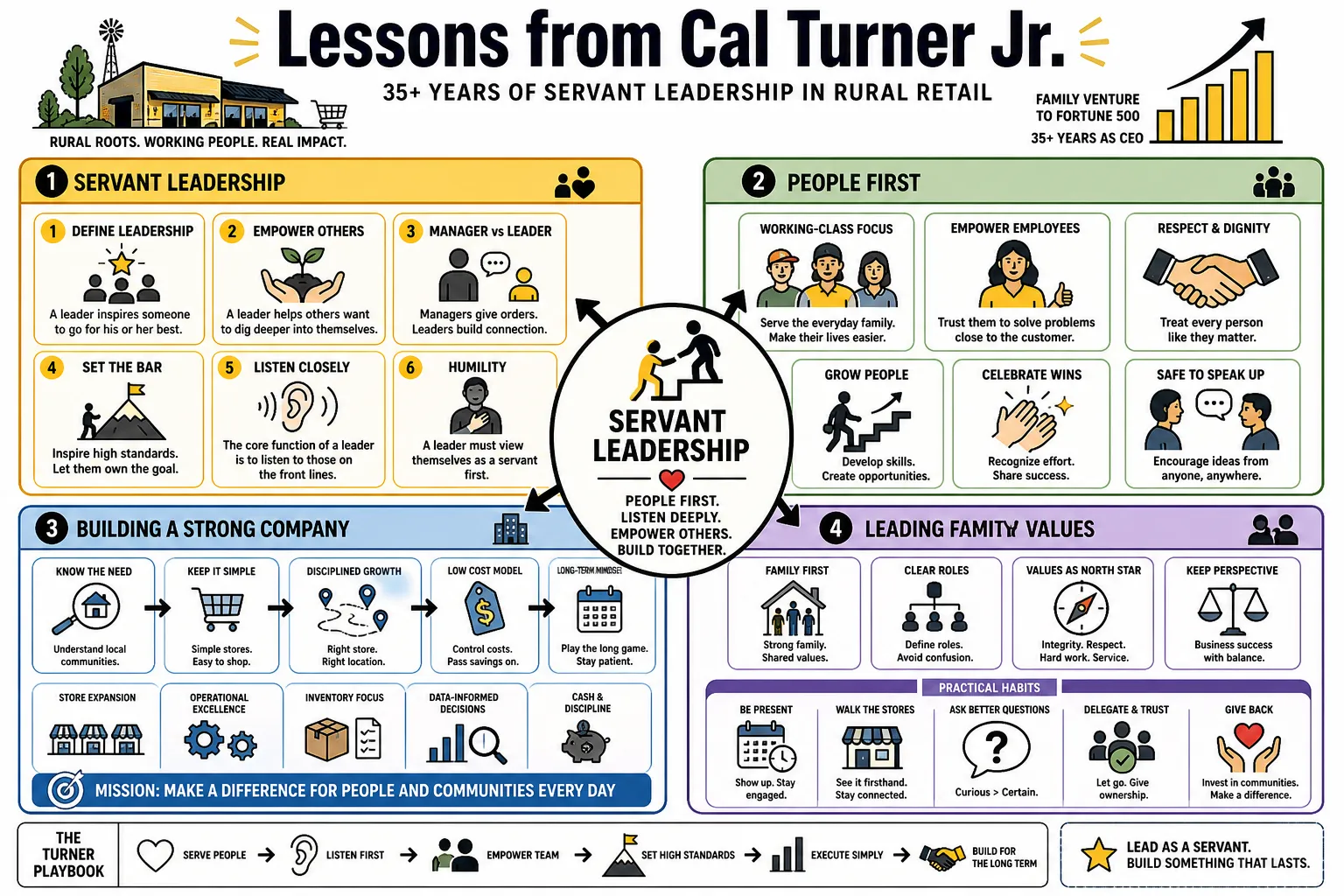
Part 1: Servant Leadership
- On Giving Your Job to the Organization: Cal Turner Jr: "A good CEO, in my opinion, gives his or her job to the whole organization and brings them into the CEO agenda." — Former Dollar General CEO Cal Turner, Jr. Shares Leadership Advice (Chief Executive Q&A).
- On Burnout and Self-Importance: Cal Turner Jr: "I am more empowered to get on with its not being about me, and the less it is about me, I think the less likely there is to be burnout." — Cal Turner, Jr.: The Legacy of Dollar General a Story of Inspiration.
- On Listening as Leadership: Cal Turner Jr: "The highest talent of leadership is that communication talent that’s based on solid listening." — Former Dollar General CEO Cal Turner, Jr. Shares Leadership Advice (Chief Executive Q&A).
- On Following Employees and Customers: Cal Turner Jr: "As CEO of Dollar General, I considered myself to be a follower of Christ, and a follower of all of the employees and the customers that were mine, supposedly, to lead." — “Family & Faith” with Cal Turner Jr. — The Weight.
- On Leadership Culture and Next Steps: Cal Turner Jr: "Sometimes we try to figure out the whole problem when if we had the right leadership culture, we could figure out the next best step in route to the achievement of our vision." — Cal Turner, Jr.: The Legacy of Dollar General a Story of Inspiration.
- On Diminishing Your Role: Cal Turner Jr: "Maybe I as a leader should consider diminishing my role and expanding theirs in order to provide for that future event of my absence." — Cal Turner, Jr.: The Legacy of Dollar General a Story of Inspiration.
- On Leadership as Followership: Cal Turner Jr: "In fact, I believe leadership certainly in the Richard Rohr sense also would more likely be defined as followership." — Cal Turner, Jr.: The Legacy of Dollar General a Story of Inspiration.
- On Getting Over Yourself: Cal Turner Jr: "I think you can get out of the way of other people if you try to get over yourself a little bit." — Cal Turner, Jr.: The Legacy of Dollar General a Story of Inspiration.
- On Talking About Values: Cal Turner Jr: "The leader should largely talk about values and what is important to all of us that we can get excited together about." — Cal Turner, Jr.: The Legacy of Dollar General a Story of Inspiration.
- On Leading by Poking Fun at Yourself: Cal Turner Jr: "My style of leadership was to poke fun at myself and say, I've done most of the jobs all of you do, and admit that I was not good at any one of those jobs I did, except the first one--sweeping the floor in the warehouse." — “Family & Faith” with Cal Turner Jr. — The Weight.
Part 2: The Customer First
- On Learning What Customers Need From Your Father: Cal Turner Jr: "From my father, I learned to pay attention to the customer and that’s pretty strong guiding principle for any CEO." — Former Dollar General CEO Cal Turner, Jr. Shares Leadership Advice (Chief Executive Q&A).
- On Watching How Others Retail: Cal Turner Jr: "Cal Sr. was a country boy who observed what the city boys did in retailing and he noticed the Louisville and Nashville, Tennessee department stores would run big full color ads once a month, dollar days sales." — Transcript: Dollar General, Cal Turner Jr. - The Big Picture.
- On Customers Filling the Store: Cal Turner Jr: "The store when it first opened was so full of customers that they had to close the door." — Transcript: Dollar General, Cal Turner Jr. - The Big Picture.
- On Staying Connected to the Customer: Cal Turner Jr: "If you don’t stay connected to the customer as a retailer and if you aren’t meeting a customer need with your store, your days are numbered." — Transcript: Dollar General, Cal Turner Jr. - The Big Picture.
- On Making Value Pop: Cal Turner Jr: "We can make value pop for the customer because we’ll sell everything for a dollar." — Transcript: Dollar General, Cal Turner Jr. - The Big Picture.
- On Straightening Out the Merchandise: Cal Turner Jr: "You get the merchandise straight and the customer messes it up and you have to straighten that again." — Transcript: Dollar General, Cal Turner Jr. - The Big Picture.
- On the Dollar Price Point: Cal Turner Jr: "You do know that one dollar is the best price point God ever made and that would be what will build our store around." — Transcript: Dollar General, Cal Turner Jr. - The Big Picture.
- On Staying in Touch: Cal Turner Jr: "I think that’s a good principle of retailing, stay directly in touch with the customer." — Transcript: Dollar General, Cal Turner Jr. - The Big Picture.
- On Starting With the Customer in Mind: Cal Turner Jr: "Start with the customer in mind and work with your vendors to create a value the customer needs." — Transcript: Dollar General, Cal Turner Jr. - The Big Picture.
Part 3: Personal Growth and Learning
- On Learning From Everyone: Cal Turner Jr: "Luther Turner, because he only had a third grade education, Chris, had an empowering assumption that everybody he met was smarter than he and that he should learn something from everybody he met, because he only had a third grade education." — “Family & Faith” with Cal Turner Jr. — The Weight.
- On the Willingness to Learn: Cal Turner Jr: "If you can produce students who are good thinkers and who are interested in learning for the rest of their lives, that's more important to us than even English." — Former Dollar General CEO Shares Story, Life Lessons with SF Students (quoted remarks).
- On Early CEO Training From a Mother: Cal Turner Jr: "I am fortunate to have had what I considered to be early CEO training, from my mother." — Former Dollar General CEO Cal Turner, Jr. Shares Leadership Advice (Chief Executive Q&A).
- On Holding Up a Mirror: Cal Turner Jr: "From her I learned to try to hold a mirror in front of my face, figuratively, always to understand how I came across with others." — “Family & Faith” with Cal Turner Jr. — The Weight.
- On Doing Every Job: Cal Turner Jr: "I can’t think of a single job I wasn’t doing and I think that’s why there’s no hair on top of my head now." — Transcript: Dollar General, Cal Turner Jr. - The Big Picture.
- On Successors Who Are Better: Cal Turner Jr: "A good leader is someone whose successors are better." — Former Dollar General CEO Shares Story, Life Lessons with SF Students (quoted remarks).
- On Fascination With Questions: Cal Turner Jr: "I am fascinated by questions, especially when they lead to answers by others who would implement the answer." — Cal Turner, Jr.: The Legacy of Dollar General a Story of Inspiration.
- On Asking About Problems: Cal Turner Jr: "You don’t want to ask questions that elicit the answer of how wonderful the company is." — Former Dollar General CEO Cal Turner, Jr. Shares Leadership Advice (Chief Executive Q&A).
- On Redefining Yourself: Cal Turner Jr: "You need to redefine yourself in almost any organization based on what your people can help you figure out would work." — Transcript: Dollar General, Cal Turner Jr. - The Big Picture.
- On Not Being Good at the Jobs: Cal Turner Jr: "I have most of the jobs in that retail company myself and I was not good at a single thing I did except sweeping the floor." — Transcript: Dollar General, Cal Turner Jr. - The Big Picture.
Part 4: Family Business Dynamics
- On Business as a Family Enterprise: Cal Turner Jr: "Business to him was a family enterprise." — Former Dollar General CEO Cal Turner, Jr. Shares Leadership Advice (Chief Executive Q&A).
- On Growing Up as a Family Business: Cal Turner Jr: "We had to grow up as a family business that could learn the best way it could be professionally managed." — Transcript: Dollar General, Cal Turner Jr. - The Big Picture.
- On an Affirming Father: Cal Turner Jr: "My father was the most completely affirming father I could ever have hoped to have, saying things such as, 'Cal Jr. is smarter than I am,' with conviction." — “Family & Faith” with Cal Turner Jr. — The Weight.
- On Two Camps in the Company: Cal Turner Jr: "We had been doing strategic planning for years but we weren’t able to implement it very well because we had two camps in the company, one for each brother." — Transcript: Dollar General, Cal Turner Jr. - The Big Picture.
- On Implementing the Plan: Cal Turner Jr: "We learned that the key wasn't so much the quality of your plan, as it was the quality of implementation of that plan." — Business & Philanthropy with Cal Turner Jr. (The Weight).
- On One Head: Cal Turner Jr: "To me, the healing began when my father called me about 24 hours after learning that I’d fired my brother and he said I haven’t slept since that call, son, but I realize now that just as an animal cannot live with two heads, neither can a company." — Transcript: Dollar General, Cal Turner Jr. - The Big Picture.
- On Being Called Cal Turner Jr.: Cal Turner Jr: "I always lived with the label Cal Turner Jr., and my relationship with my father was largely a business relationship, which has to be unusual." — “Family & Faith” with Cal Turner Jr. — The Weight.
Part 5: Valuing People
- On Customers Becoming Associates: Cal Turner Jr: "We found that building a business required our offering opportunity to develop our customer base that could become our associates and build the company." — Transcript: Dollar General, Cal Turner Jr. - The Big Picture.
- On Recruiting by Talking People Out of It: Cal Turner Jr: "We found in recruiting employees to our store, we could often find the best employees by talking people out of coming to work for us." — Transcript: Dollar General, Cal Turner Jr. - The Big Picture.
- On Motivated Senior Management: Cal Turner Jr: "The board approved it and somehow, the turnaround of that company that wasn’t yet working started to work when all of senior management got that motivated to make it work." — Transcript: Dollar General, Cal Turner Jr. - The Big Picture.
- On Telling Candidates What's Hard: Cal Turner Jr: "Let me tell you what’s — let me tell you what’s hard about this job you’re applying for." — Transcript: Dollar General, Cal Turner Jr. - The Big Picture.
- On Respecting Opinions About Problems: Cal Turner Jr: "Not only do I respect your ability to do them, but I also respect your opinion about the problems, how they happen in the first place, and the ability of all of us to come together to fix problems for the benefit of all of us." — Cal Turner, Jr.: The Legacy of Dollar General a Story of Inspiration.
- On Shared Values: Cal Turner Jr: "I have always wanted my values to unite the thinking and effort of all of us because I want them to be shared values." — Cal Turner, Jr.: The Legacy of Dollar General a Story of Inspiration.
- On Asking for Help: Cal Turner Jr: "To grow and to develop and to reach out to other people and say, I really need your help here." — Transcript: Dollar General, Cal Turner Jr. - The Big Picture.
- On Strategic Commonality: Cal Turner Jr: "When someone is in it for themselves, it doesn’t take you too long to know that you don’t have strategic commonality with that person." — Cal Turner, Jr.: The Legacy of Dollar General a Story of Inspiration.
- On Connecting With Others: Cal Turner Jr: "All of these things, I enjoy, but it is the activity that connects me with others that is fulfilling and life gives a lot of opportunity to be in partnership with other people." — Transcript: Dollar General, Cal Turner Jr. - The Big Picture.
Part 6: Navigating Mistakes
- On Separating the Person From the Problem: Cal Turner Jr: "My mother taught me to separate the person from the problem and people can come together to solve the problem better." — Transcript: Dollar General, Cal Turner Jr. - The Big Picture.
- On Hard Decisions: Cal Turner Jr: "I said before you can write a personal mission statement, you have to realize that hard decision making in life is never white versus black." — Business & Philanthropy with Cal Turner Jr. (The Weight).
- On Learning From Failure: Cal Turner Jr: "Failure is hard and sometimes it takes failure to learn lessons that should be learned which only failure can teach." — Transcript: Dollar General, Cal Turner Jr. - The Big Picture.
- On Acknowledging Mistakes: Cal Turner Jr: "We have good people who mess up and the key to getting it right is to acknowledge that we have messed up in a way that helps us all to fix it." — Transcript: Dollar General, Cal Turner Jr. - The Big Picture.
- On Projecting Confidence: Cal Turner Jr: "Certainly, when we went public and I didn’t know what in the heck I was doing, I had to project confidence while I was quaking in my boots." — Transcript: Dollar General, Cal Turner Jr. - The Big Picture.
- On the Way You Ask Questions: Cal Turner Jr: "I was once criticized by a new vice president of our company who said, “the way you ask questions encourages them to tell you what’s wrong.”" — Former Dollar General CEO Cal Turner, Jr. Shares Leadership Advice (Chief Executive Q&A).
- On Cutaway and Pruning Pain: Cal Turner Jr: "I don't know which pain hurts more--the cutaway pain or the pruning for more growth." — Business & Philanthropy with Cal Turner Jr. (The Weight).
Part 7: The Dollar General Philosophy
- On Saving From Each Paycheck: Cal Turner Jr: "He cast himself to learn something from everybody he met and he believed in saving something from each paycheck." — Former Dollar General CEO Cal Turner, Jr. Shares Leadership Advice (Chief Executive Q&A).
- On Paying a Dollar a Square Foot: Cal Turner Jr: "We got a little more particular about where we would put our stores, but he still only wants us to pay a dollar square foot per year." — Transcript: Dollar General, Cal Turner Jr. - The Big Picture.
- On Buying at Half Price: Cal Turner Jr: "My father and my grandfather found a big brick building in Scottsville, Kentucky that they could buy for half price, and a Turner will buy anything at half price." — “Family & Faith” with Cal Turner Jr. — The Weight.
- On Places Retail Wouldn't Pick: Cal Turner Jr: "My dad used to think our prices and merchandise are so compelling that we can open the store anywhere and some of the buildings he leased, he’d say that about them, they were just places most retail wouldn’t pick." — Transcript: Dollar General, Cal Turner Jr. - The Big Picture.
- On Not Modeling Yourself on the Competition: Cal Turner Jr: "Whatever enterprise we are in, we are a unique organization, so we don’t have to model ourselves after the competition." — Cal Turner, Jr.: The Legacy of Dollar General a Story of Inspiration.
- On Becoming a Customer-Driven Distributor: Cal Turner Jr: "The ones that stay closer connected with the customer are going to survive, and for example, when Dollar General changed its mind set by saying we’re not a retailer, were a customer driven distributor, that really got the company going." — Transcript: Dollar General, Cal Turner Jr. - The Big Picture.
- On Vendors as Partners: Cal Turner Jr: "My dad believed that vendors were great partners and that was an opportunity for development of the company, the partnerships that you could form with vendors even." — Transcript: Dollar General, Cal Turner Jr. - The Big Picture.
- On Paying Back Customers: Cal Turner Jr: "The joy of paying back to the Dollar General customers, because the Turner family wealth comes from serving them, and they are salt of the earth people who are struggling to get by." — Business & Philanthropy with Cal Turner Jr. (The Weight).
Part 8: Faith and Values
- On Being Held in Mind: Cal Turner Jr: "I was overwhelmed by the conviction that, while it was amazingly wonderful that Jesus Christ had gone to Calvary for everyone, that he nevertheless, specifically had Cal Turner Jr. in mind." — “Family & Faith” with Cal Turner Jr. — The Weight.
- On Owning Your Need: Cal Turner Jr: "When you have to do something that is beyond you, you own your need for Christ better than when you're macho, cocky." — “Family & Faith” with Cal Turner Jr. — The Weight.
- On Faith in Relationships: Cal Turner Jr: "I can't talk about the important relationships of my life without bringing faith into it." — “Family & Faith” with Cal Turner Jr. — The Weight.
- On Sharing Lessons: Cal Turner Jr: "The opportunity to share life's lessons learned is probably the greatest philanthropy, and I applaud what you're doing here." — Business & Philanthropy with Cal Turner Jr. (The Weight).
- On Tax-Advantaged Giving: Cal Turner Jr: "My decision was every year, I would have the accountants to tell me how much I could give away that would be tax advantaged." — Business & Philanthropy with Cal Turner Jr. (The Weight).
- On Mission and Money: Cal Turner Jr: "Perhaps where there is no mission, there is no money." — Cal Turner, Jr.: The Legacy of Dollar General a Story of Inspiration.
- On Grounding of Power: Cal Turner Jr: "I had the best grounding of power in corporate America, in my opinion, because our family owned enough stock in the company, that my position was secure." — “Family & Faith” with Cal Turner Jr. — The Weight.
- On Aging: Cal Turner Jr: "I believe it's a blessing to age because it's easier to get yourself out of the way of Christ because you're less and less impressed with yourself in old age." — “Family & Faith” with Cal Turner Jr. — The Weight.