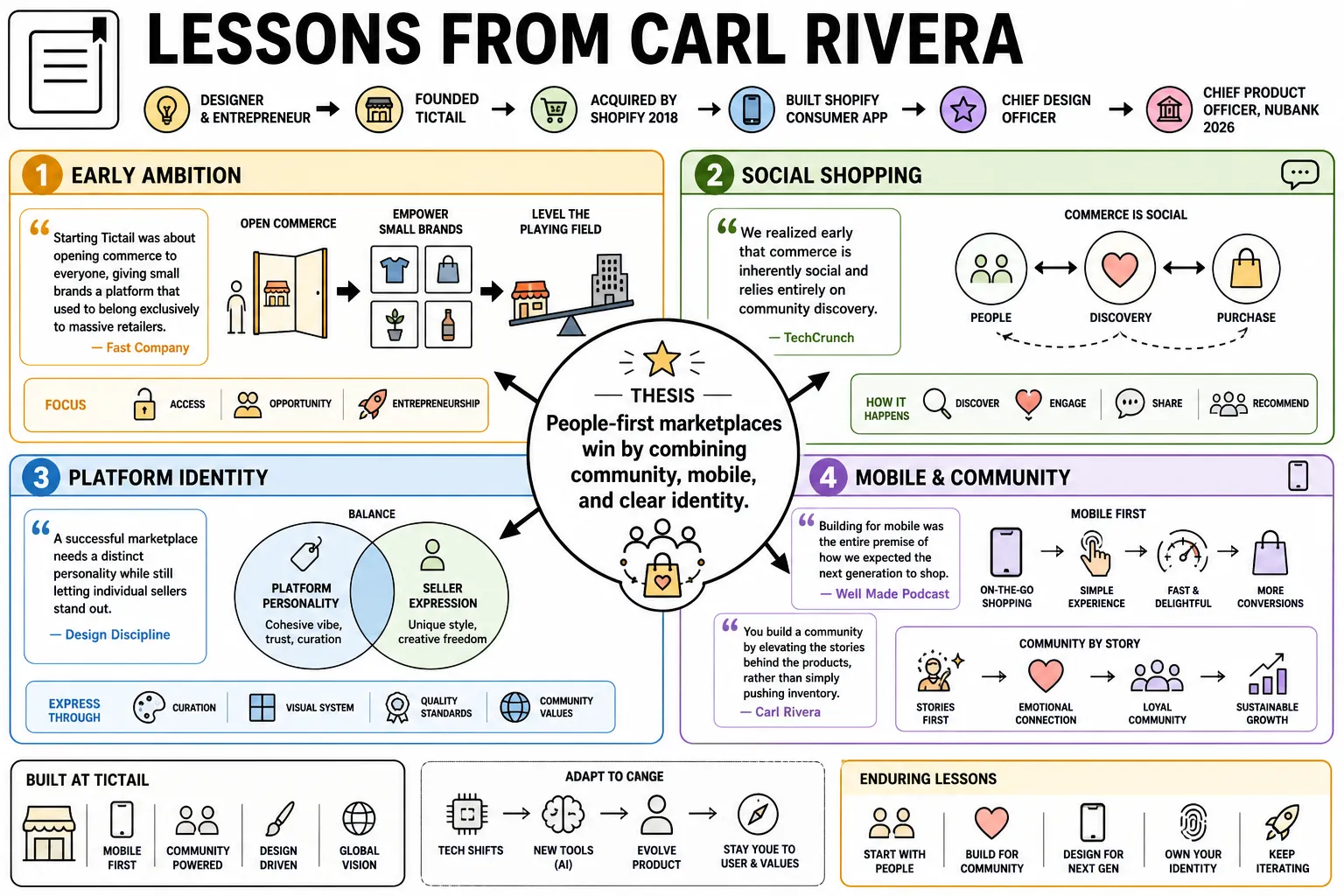
Lessons from Carl Rivera
Carl Rivera is Chief Product Officer at Nubank, which he joined in May 2026 after more than seven years at Shopify, where he was Chief Design Officer and earlier VP of Product for Merchant Services. Earlier he co-founded Tictail, which Shopify acquired in 2018. — Nubank appoints Carl Rivera as Chief Product Officer.
Part 1: Entrepreneurship and Building Tictail
- On Why Tictail Began: Carl Rivera: "My mother had just started her own business and I could see the difficulties she faced." — Stories: Carl Waldekranz, co-founder, Tictail.com (The Spin-Off interview).
- On a Constant Dialogue With the Community: Carl Rivera: "Social media is a core part of Tictail as it enables us to have a constant dialogue with our community, both brands and shoppers." — Stories: Carl Waldekranz, co-founder, Tictail.com (The Spin-Off interview).
- On Community, Simplicity and Design: Carl Rivera: "We focus on strong community integration, simplicity of use, and attractive, customizable design for the brands and want to create an exciting and seamless discovery experience for shoppers looking for the brands they’re about to fall in love with." — Stories: Carl Waldekranz, co-founder, Tictail.com (The Spin-Off interview).
- On the Move to Mobile: Carl Rivera: "There’s the enormous move to mobile shopping that’s only just started; we saw lately that the split between desktop and mobile purchases on Tictail are now split 50/50." — Stories: Carl Waldekranz, co-founder, Tictail.com (The Spin-Off interview).
- On Brands Inspired by Other Brands: Carl Rivera: "This always motivates other like-minded brands who also want to build their business around brand values and story, with Tictail as their brand destination." — Stories: Carl Waldekranz, co-founder, Tictail.com (The Spin-Off interview).
- On Stockholm: Carl Rivera: "I think Stockholm is one of the best places on earth to start a business." — 40 000 Indie Online Stores, Powered by Tictail (Startup Letters interview).
- On Building for People Who Do Not Care About E-Commerce: Carl Rivera: "With Tictail we wanted to create an ecommerce platform for all the people that don’t care about e-commerce; the designers, the artists - the independent entrepreneurs." — 40 000 Indie Online Stores, Powered by Tictail (Startup Letters interview).
- On Creating Collections: Carl Rivera: "We have the great job of looking through all the brands and creating collections and we constantly update these to make sure as many as possible are showcased." — Stories: Carl Waldekranz, co-founder, Tictail.com (The Spin-Off interview).
- On Boosting Human Capital: Carl Rivera: "Being four kids with little to no startup experience we realised we needed to boost our human capital; the idea of creating an advisory board was born." — Skin in the game (Medium essay by Carl W Rivera).
- On Showcasing the Versatility of Brands: Carl Rivera: "Our goal is to showcase the versatility of brands on Tictail." — Stories: Carl Waldekranz, co-founder, Tictail.com (The Spin-Off interview).
Part 2: The Shopify Acquisition
- On a Good Advisory Board Member: Carl Rivera: "A good member of an advisory board is someone that will support you behind your back, that will put their relationships and history on the line for you and compensate for the experience you lack." — Skin in the game (Medium essay by Carl W Rivera).
- On Not Expecting Engagement to Be Enough: Carl Rivera: "By offering equity for nothing more than their engagement, you are basically asking the question; do you want this free lottery ticket that will either make you rich or cost you nothing?" — Skin in the game (Medium essay by Carl W Rivera).
- On Giving Permission: Carl Rivera: "Just saying that design actually really matters and we’re going to become the best at it. Just saying that, my experience was that a lot of people just immediately became better designers because they felt that someone said that they were allowed to." — Carl Rivera - Chief Design Officer at Shopify.
- On OKRs for the Company, Teams and People: Carl Rivera: "We then implemented an OKR framework setting goals for the company, for each team and for each person that everyone could follow on our internal wiki." — 40 000 Indie Online Stores, Powered by Tictail (Startup Letters interview).
- On Cells of 3-5 People: Carl Rivera: "To create entrepreneurial freedom we decided we would break down the organisation into smaller cells of 3-5 people, mimicking the size of a new startup." — 40 000 Indie Online Stores, Powered by Tictail (Startup Letters interview).
- On Keeping the Product Moving in One Direction: Carl Rivera: "However as more people join it’s been challenging to ensure that the product continues to move towards the same direction." — 40 000 Indie Online Stores, Powered by Tictail (Startup Letters interview).
- On Owning the Conversation: Carl Rivera: "If any person cares about it, then just start to speak about it and own that space in the conversation and have the most ideas and be the most passionate about your ideas and fight for your ideas." — Carl Rivera - Chief Design Officer at Shopify.
- On Ideas and Execution: Carl Rivera: "In my opinion an idea is worthless without execution so the only tangible value is the people behind that idea." — Skin in the game (Medium essay by Carl W Rivera).
- On Latent Talent: Carl Rivera: "There was a ton of latent talent in the company in design specifically. There were a lot of people that were really outstanding but were producing at about 70% of their capabilities." — Carl Rivera - Chief Design Officer at Shopify.
Part 3: Designing the Shop App
- On Tictail as Empowering Entrepreneurs: Carl Rivera: "The long-term plan is to focus on our main goals of empowering entrepreneurs and bringing the next generation of brands and their supporters closer together." — Stories: Carl Waldekranz, co-founder, Tictail.com (The Spin-Off interview).
- On Online Shoppers Getting Smarter: Carl Rivera: "Then just looking at online shoppers–they continue to become smarter and more demanding of online experiences and brands are delivering this raising the bar all the time." — Stories: Carl Waldekranz, co-founder, Tictail.com (The Spin-Off interview).
Part 4: Product Development Philosophy
- On Form-Function Fit: Carl Rivera: "Let’s call this form x function fit - the difference between potential and adoption." — Carl Rivera takes on Chief Design Officer role at Shopify as it reimagines itself for post-AI world (Retail Technology Innovation Hub, quoting Rivera’s LinkedIn post).
- On Imagining the Future Through Design: Carl Rivera: "When you face ambiguity and don’t know where the world is going, there’s no better way to imagine that future than through design" — Design Has Never Been More Important: Inside Shopify’s Acquisition of Molly (Codrops interview, quoting Carl Rivera).
- On Designers Never Being More Important: Carl Rivera: "We’re saying the opposite. They’ve never been more important than they are right now." — Design Has Never Been More Important: Inside Shopify’s Acquisition of Molly (Codrops interview, quoting Carl Rivera).
- On Instinct Over KPIs: Carl Rivera: "But to me, the most important measure isn’t a KPI. It’s whether the work feels right. Are we proud of it? Did it accelerate our vision? Does it make the product more delightful? I’m comfortable leaning on instinct." — Design Has Never Been More Important: Inside Shopify’s Acquisition of Molly (Codrops interview, quoting Carl Rivera).
- On Great People in a Room: Carl Rivera: "When you get really great people into a room, they look around and they get super excited and they work really hard and they inspire each other." — Carl Rivera - Chief Design Officer at Shopify.
- On Fear and Startup Cost: Carl Rivera: "Fear combined with startup cost. You open up cursor or you open up terminal and they really don’t feel like welcoming interfaces." — Carl Rivera - Chief Design Officer at Shopify.
Part 5: The Role of Design Leadership
- On Leading Before the Title: Carl Rivera: "Be a leader. You can claim that space and you can be a leader well before you have people report into you in an org chart." — Carl Rivera - Chief Design Officer at Shopify.
- On Aligning Ambition With the Organisation: Carl Rivera: "My role is to align our ambition with our organisation and ensure design doesn't just participate in the conversation - we lead it." — Carl Rivera takes on Chief Design Officer role at Shopify as it reimagines itself for post-AI world (Retail Technology Innovation Hub, quoting Rivera’s LinkedIn post).
- On a Fluid Organization: Carl Rivera: "I wanted to achieve an organization that was much more fluid with far fewer people attached to single defined problems." — Carl Rivera - Chief Design Officer at Shopify.
- On Hiring for Taste: Carl Rivera: "We hire for taste. For aesthetics. For a point of view. It’s the difference between utility and affinity. Anyone can generate a good baseline, designers reach for the ceiling." — Carl Rivera - Chief Design Officer at Shopify.
- On Raising Expectations: Carl Rivera: "By raising expectations for ourselves and each other, we’ll attract people who want that environment, and they’ll keep raising the bar." — Design Has Never Been More Important: Inside Shopify’s Acquisition of Molly (Codrops interview, quoting Carl Rivera).
- On Moving Between Many Problems: Carl Rivera: "People who have jumped between many problems quickly bring a unique skill set. That adaptability is crucial when technology and user expectations are changing so fast." — Design Has Never Been More Important: Inside Shopify’s Acquisition of Molly (Codrops interview, quoting Carl Rivera).
- On a Cultural Pillar: Carl Rivera: "That culture is exactly the one we want to spread across Shopify. They’ll be a cultural pillar that helps manifest the ways of working we want everyone to embrace." — Design Has Never Been More Important: Inside Shopify’s Acquisition of Molly (Codrops interview, quoting Carl Rivera).
- On Process Following Material: Carl Rivera: "Companies generally try to come up with the process because it feels like management, and then they take all of their material and squeeze it into that process." — Carl Rivera - Chief Design Officer at Shopify.
Part 6: Artificial Intelligence and Vibe Coding
- On AI Being the Spark and Design Giving It Form: Carl Rivera: "I’m taking this role today because I believe the role of design has never been more important. We are at the onset of the most profound change of our lifetime - AI is the spark - but it’s design that will give it form." — Carl Rivera takes on Chief Design Officer role at Shopify as it reimagines itself for post-AI world (Retail Technology Innovation Hub, quoting Rivera’s LinkedIn post).
- On Learning New Problems Quickly: Carl Rivera: "The best trait a designer can have right now is the ability to quickly learn a new problem and generate many different options. That’s what the agency world trains you to do, and it’s exactly what big companies like Shopify need." — Design Has Never Been More Important: Inside Shopify’s Acquisition of Molly (Codrops interview, quoting Carl Rivera).
- On Leading the Change: Carl Rivera: "Our job is not to keep up with this change but to lead it and define it." — Carl Rivera takes on Chief Design Officer role at Shopify as it reimagines itself for post-AI world (Retail Technology Innovation Hub, quoting Rivera’s LinkedIn post).
- On Moving Beyond Chat: Carl Rivera: "If AI had existed ten years ago, I don’t believe products would look the way they do today. We need to move beyond chat as the default interface and create experiences where AI feels native, invisible, and context-aware." — Design Has Never Been More Important: Inside Shopify’s Acquisition of Molly (Codrops interview, quoting Carl Rivera).
- On Designers Defining AI Interaction Patterns: Carl Rivera: "It’s designers who will define the interaction patterns of AI in commerce. This is our role: to make the abstract real, to imagine the future, and to bring it into the present." — Design Has Never Been More Important: Inside Shopify’s Acquisition of Molly (Codrops interview, quoting Carl Rivera).
- On Embedding to Respond Quickly: Carl Rivera: "If something changes in the market and we need to respond quickly, Molly can embed with a team for a few months, supercharging their generative process" — Design Has Never Been More Important: Inside Shopify’s Acquisition of Molly (Codrops interview, quoting Carl Rivera).
- On Democratising Selling Online: Carl Rivera: "Essentially we just want to democratise selling online. We want to make selling online available to those people who don't care about e-commerce" — Tictail Founder Carl Waldekranz: Future of E-Commerce is Democratisation (IBTimes UK, quoting Waldekranz).
- On Defining a New Paradigm: Carl Rivera: "Design will more than colour what this means to Shopify - it will help define this new paradigm." — Carl Rivera takes on Chief Design Officer role at Shopify as it reimagines itself for post-AI world (Retail Technology Innovation Hub, quoting Rivera’s LinkedIn post).
- On Getting Past the Hurdle: Carl Rivera: "Once you get past it, it’s very natural and fluid and very easy." — Carl Rivera - Chief Design Officer at Shopify.
- On AI as a Panel Next to the Product: Carl Rivera: "You have the product, which looks the same as it has for ten years, and then a little panel next to it that says AI. That can’t be the future" — Design Has Never Been More Important: Inside Shopify’s Acquisition of Molly (Codrops interview, quoting Carl Rivera).
Part 7: Craft and Quality
- On the First Product That Felt Right: Carl Rivera: "History doesn’t remember the first iteration but the first product that felt right." — Carl Rivera takes on Chief Design Officer role at Shopify as it reimagines itself for post-AI world (Retail Technology Innovation Hub, quoting Rivera’s LinkedIn post).
- On Making Abstract Ideas Tangible: Carl Rivera: "Design turns abstract ideas into something you can hold and touch, so everyone can align on the same vision." — Design Has Never Been More Important: Inside Shopify’s Acquisition of Molly (Codrops interview, quoting Carl Rivera).
- On a Bar for Amazing Work: Carl Rivera: "There should be no space in our company for people that can’t produce amazing work." — Carl Rivera - Chief Design Officer at Shopify.
Part 8: The Future of Commerce
- On E-Commerce Entering the Consumer Tech Era: Carl Rivera: "It’s finally taking the step from e-commerce as it was perceived in the ’90s to what it will be in the consumer tech era–with Tictail hopefully playing a big part in this–much like blogs that went through this transformation a few years ago when Tumblr stepped into the scene." — Stories: Carl Waldekranz, co-founder, Tictail.com (The Spin-Off interview).
- On the Brands of the Future Starting on the Platform: Carl Rivera: "We want to see the successful brands of the future starting off on Tictail." — Stories: Carl Waldekranz, co-founder, Tictail.com (The Spin-Off interview).
- On Building a Bank People Love: Carl Rivera: "Everyone has a bank. Almost no one loves theirs." — Carl Rivera on LinkedIn: I’m becoming CPO at Nubank.
- On Physical Stores Changing Format: Carl Rivera: "I believe that it will eventually happen, but there are still a lot of things that make physical stores much more convenient." — Tictail Founder Carl Waldekranz: Future of E-Commerce is Democratisation (IBTimes UK, quoting Waldekranz).
- On the Brand and the Story: Carl Rivera: "Marketplaces aren't so great for all users. To a lot of small and medium sized companies, their main value proposition is not just the product and the price, but also the brand and the story connected to it" — Tictail Founder Carl Waldekranz: Future of E-Commerce is Democratisation (IBTimes UK, quoting Waldekranz).
- On Having No Choice in a Marketplace: Carl Rivera: "In a marketplace you have no choice - you get put next to your biggest competitors." — Tictail Founder Carl Waldekranz: Future of E-Commerce is Democratisation (IBTimes UK, quoting Waldekranz).
- On the Dawn of AI: Carl Rivera: "It’s really interesting to consider that the moment Shopify decides to reinstate the Chief Design Officer role is at the dawn of AI" — Design Has Never Been More Important: Inside Shopify’s Acquisition of Molly (Codrops interview, quoting Carl Rivera).
- On the Future Being Unevenly Distributed: Carl Rivera: "We don’t need to dream up sci-fi scenarios. The future is already here — just unevenly distributed. Our job is to bring it into the hands of entrepreneurs and make it usable for everyone." — Design Has Never Been More Important: Inside Shopify’s Acquisition of Molly (Codrops interview, quoting Carl Rivera).
- On Being Positioned for the Moment: Carl Rivera: "No other company is positioned like we are in this period of change." — Carl Rivera takes on Chief Design Officer role at Shopify as it reimagines itself for post-AI world (Retail Technology Innovation Hub, quoting Rivera’s LinkedIn post).