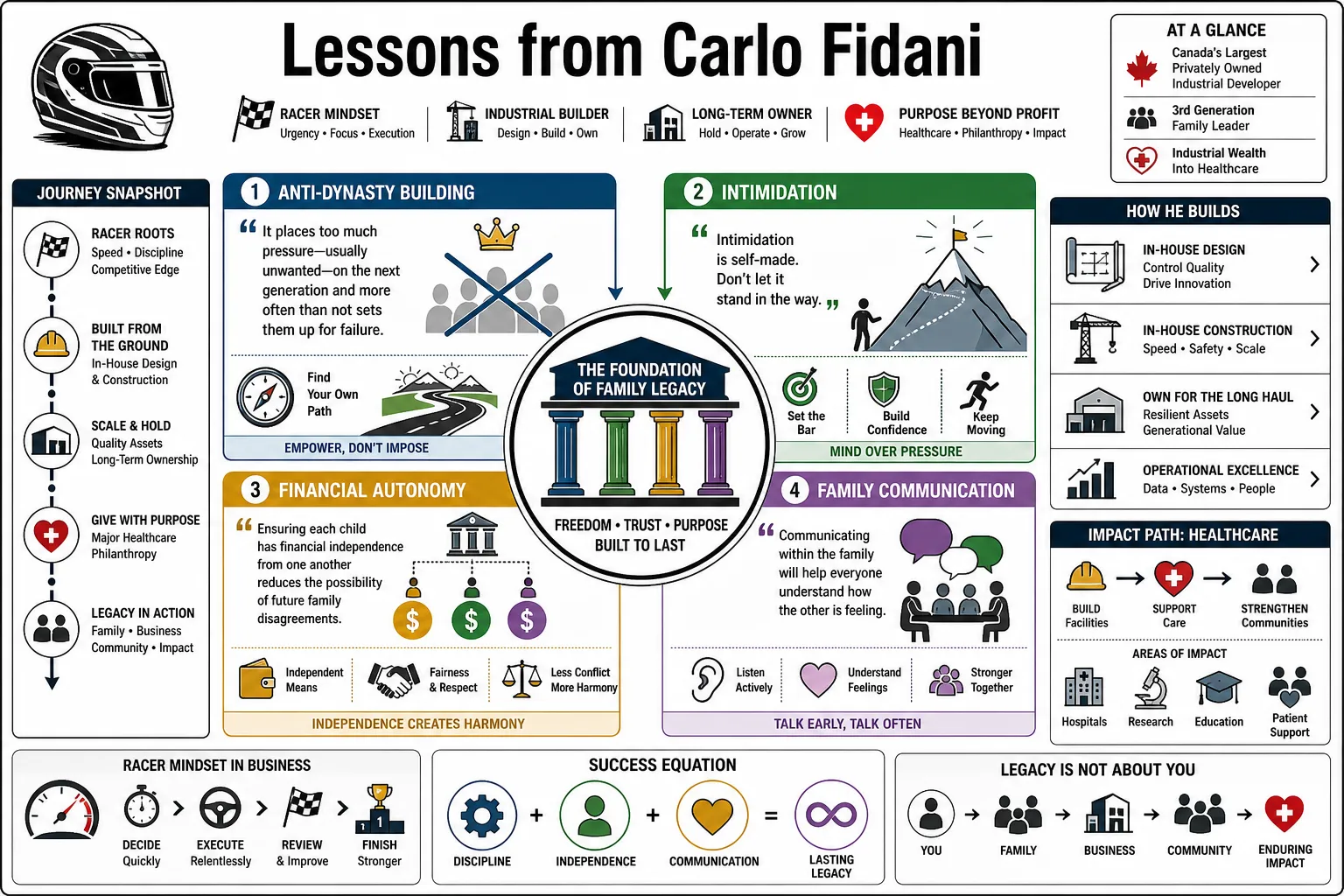
Lessons from Carlo Fidani
As the third-generation leader of Orlando Corporation, Carlo Fidani runs Canada’s largest privately owned industrial real estate developer. He brings the urgency of a motorsport racer to massive infrastructure projects, relying on in-house design and construction to build properties he holds for the long haul. This profile examines how he navigates family business succession and directs industrial wealth into large-scale healthcare philanthropy.
Part 1: The Foundation of Family Legacy
- On Anti-Dynasty Building: "It places too much pressure—usually unwanted—on the next generation and more often than not sets them up for failure." — Canadian Family Offices on YouTube]
- On the Pressure of Legacy: Children of successful families must overcome the fear of not measuring up as early as possible to find their own path. — Canadian Family Offices on YouTube]
- On Intimidation: "Intimidation is self-made. Don’t let it stand in the way." — Canadian Family Offices on YouTube]
- On Financial Autonomy: Ensuring each child has financial independence from one another reduces the possibility of future family disagreements. — Canadian Family Offices on YouTube]
- On Family Communication: "Communicating within the family will help everyone understand how the other is feeling." — Canadian Family Offices on YouTube]
- On Shared Values: While successive generations may adopt different methods, the foundational values of integrity and hard work must remain constant. — Canadian Family Offices on YouTube]
- On Early Exposure: He grew up immersed in the construction environment, gaining practical skills as a youth before joining the family company full-time. — Orlando Corp Introduction]
- On Generational Evolution: The business transitioned from a post-WWII construction firm founded in 1948 into a massive real estate developer under the guidance of his father and himself. — Lifestyles Magazine]
- On Honoring Founders: Maintaining the core values passed down from his grandfather is essential, even while aggressively expanding the company's footprint. — Success Story]
Part 2: Navigating Succession
- On Personal Gratification: "Success for me comes from the gratification of what you do, not from what others want for you." — Canadian Family Offices on YouTube]
- On Early Involvement: Children should be involved in succession planning early to develop a sensible understanding of the family's business circumstances. — Canadian Family Offices on YouTube]
- On the 25-Year Apprenticeship: His own succession was a long-term, organic transition where he worked alongside his father for 25 years before taking the helm. — Canadian Family Offices on YouTube]
- On Alternative Paths: Success does not require joining the family firm; it can be found just as meaningfully outside the family business. — Canadian Family Offices on YouTube]
- On Unwanted Pressure: Forcing children into the business breeds resentment and undermines both the child's potential and the company's stability. — Canadian Family Offices on YouTube]
- On Patience: A successful handover requires acknowledging the successor's interest with immense patience rather than rushing the transition. — Canadian Family Offices on YouTube]
- On Natural Transitions: Leadership changes should feel like a natural progression of responsibilities rather than a sudden shift in power. — Canadian Family Offices on YouTube]
- On Finding Passion: Allowing children to discover their own passions is more productive than enforcing a rigid dynasty. — Canadian Family Offices on YouTube]
- On Different Approaches: A successor does not need to be a clone of the founder; they can be different people who take different approaches to achieve the same goals. — Canadian Family Offices on YouTube]
Part 3: Real Estate and Design-Build
- On Vertical Integration: Orlando Corporation's strategy relies on a vertically integrated model that controls land acquisition, design, construction, and property management. — Orlando Corp Leadership]
- On the Design-Build Concept: By controlling the entire lifecycle of a project, a developer can ensure consistent quality and operational efficiency. — Italian Chamber of Commerce]
- On Scale: Under his leadership, the company's portfolio expanded to manage over 46 million square feet of industrial, office, and commercial space. — Orlando Corp Leadership]
- On Heartland Town Centre: Managing a 2.2 million square foot power centre requires treating retail hubs as massive, integrated ecosystems. — SkyriseCities]
- On Future-Proofing Retail: There are active plans to redevelop sprawling retail centres into mixed-use communities by adding residential buildings and park spaces. — SkyriseCities]
- On Sustainable Development: He steered the company's modern projects toward sustainability, prioritizing LEED certification in industrial builds. — Orlando Corp Leadership]
- On Market Adaptation: The company successfully evolved from capitalizing on the post-WWII building boom to dominating modern industrial logistics. — Lifestyles Magazine]
- On Naming Legacy: Orlando Corporation was rebranded from "Fidani and Sons" as a nod to his father, effectively meaning "Orey’s Land Company." — Lifestyles Magazine]
- On Private Ownership: Operating as Canada's largest privately owned industrial landlord allows for strategic patience that public markets rarely permit. — Canadian Family Offices on YouTube]
- On Complete Control: Retaining ownership of massive power centres rather than selling them off ensures long-term revenue and quality control. — SkyriseCities]
Part 4: The Developer's Mindset
- On the "Race" of Development: "Every successful development is a race to be won." — The Land Economist]
- On Racing Deadlines: The development process is a constant race against strict deadlines and budgets to bring a project to life. — The Land Economist]
- On the Checkered Flag: The ultimate goal of any property development is reaching the checkered flag of a fully-leased, high-quality building. — The Land Economist]
- On Undeveloped Land: Success requires driving large tracts of raw land relentlessly through every complex phase of municipal and physical development. — The Land Economist]
- On Hands-On Management: "From the architects and builders, to the paving and landscaping, every aspect of the development was sourced through, and directed by the Orlando Corporation." — Canadian Tire Motorsport Park]
- On Execution Speed: Applying a motorsport mentality to construction forces teams to prioritize efficiency without sacrificing safety or quality. — The Land Economist]
- On Overcoming Bureaucracy: Pushing massive industrial projects to completion requires treating zoning and planning as strategic hurdles to be systematically cleared. — The Land Economist]
- On Managing Contractors: A developer must directly oversee every trade to ensure the final product matches the initial vision. — Canadian Tire Motorsport Park]
- On Tenant Acquisition: Development doesn't end at construction; the race is only won when the property is occupied by reliable tenants. — The Land Economist]
- On End-to-End Responsibility: When you design, build, and manage the property, you own the long-term consequences of every early-stage decision. — Italian Chamber of Commerce]
Part 5: Motorsports and the Racing Parallel
- On Purchasing Mosport: He recognized that his expertise in commercial property acquisition was the missing element needed to save and revitalize the historic track. — IMSA]
- On Corporate Diversification: Transforming a racetrack requires appealing to corporate Canada by building modern, multi-purpose event centres alongside the circuit. — Canadian Auto Dealer]
- On Strategic Partnerships: Securing a long-term naming rights deal with Canadian Tire provided the stability needed to execute a massive modernization plan. — IMSA Drivers]
- On Acting as a Custodian: He viewed his ownership of the track as a custodianship, aiming to leave the iconic 1961 Grand Prix circuit better than he found it. — Canadian Auto Dealer]
- On Modernizing Infrastructure: Successful track management requires upgrading unglamorous infrastructure, like tunnels and paddock areas, to improve the overall fan and driver experience. — Canadian Auto Dealer]
- On Driver Development: Expanding training facilities minimizes risk for novice drivers while creating a high-margin environment for corporate team-building. — Canadian Tire Motorsport Park]
- On Attracting Major Events: Upgrading safety and facilities was the direct catalyst for bringing international series like NASCAR back to Canada. — Racer]
- On Knowing When to Sell: After 14 years of modernization, he sold the track to a group he trusted to respect its history and elevate it further. — Canadian Auto Dealer]
- On the Developer’s Eye: Real estate principles apply everywhere; improving a racetrack is fundamentally about maximizing the utility and revenue of the underlying land. — IMSA]
Part 6: The Philosophy of Philanthropy
- On Gratitude: "We are very fortunate to live in a country of opportunity, [and] philanthropy is a way to show our gratitude and give back to the community." — Success Story]
- On the Joy of Giving: "But it’s also fun and rewarding, which is something often overlooked by folks." — Canadian Family Offices on YouTube]
- On Generational Empathy: He credits his grandfather, who found ways to help people even when he had very little during the Depression, for establishing the family's charitable ethos. — Canadian Family Offices on YouTube]
- On the Transformative Power: He firmly believes in the transformative power of philanthropy and human ingenuity to solve massive societal challenges. — Canadian Family Offices on YouTube]
- On Acknowledging the Workforce: He views family philanthropy as a direct way to honor the "Orlando family" of employees who built the company's success. — Canadian Family Offices on YouTube]
- On Structured Giving: Establishing the FDC Foundation allowed the family to systematically channel hundreds of millions into critical public infrastructure. — Success Story]
- On Staying Private: Despite the scale of his donations, he maintains an intensely private life, often preferring his gifts to speak louder than his public persona. — Canadian Family Offices on YouTube]
- On Community Debt: He operates under the belief that massive business success creates a corresponding debt to the region that fostered it. — Canadian Family Offices on YouTube]
- On Encouraging Others: By initiating massive gift-matching programs, he leverages his own capital to force broader community participation in funding hospitals. — Grizzly Bulls]
- On Corporate Duty: Corporations that benefit from regional growth have an obligation to fund the social infrastructure required to support that growing population. — Lifestyles Magazine]
Part 7: Healthcare Infrastructure and Giving
- On the Promise of Stem Cells: "The promise of stem cells is massive... the future of medical science depends on stem cell research and its unlimited possibilities." — Cantech Letter]
- On Modernizing Hospitals: His historic $75 million donation to the Scarborough Health Network was driven by a need to bring aging suburban hospitals up to modern standards. — Lifestyles Magazine]
- On Medical Academies: Funding institutions like the Mississauga Academy of Medicine directly addresses systemic issues like the shortage of family physicians in Ontario. — U of T Mississauga]
- On Mental Health: Beyond physical medicine, he views mental health funding as critical, backing bioinformatics and computational biology research at CAMH. — Success Story]
- On Cancer Care: Establishing regional cancer centres ensures that patients do not have to travel punishing distances for world-class treatment. — Success Story]
- On Educational Infrastructure: A $25 million gift for the Scarborough Academy of Medicine recognized that expanding healthcare access requires physically building more spaces to train students. — U of T Mississauga]
- On Leveraging Real Estate Wealth: He directly converts industrial real estate profits into life-saving medical infrastructure, effectively turning warehouses into hospitals. — Orlando Corp Leadership]
- On Collaborative Funding: Major medical breakthroughs require private philanthropists to fill the gaps left by traditional government healthcare budgets. — Mirage News]
- On Regional Equity: His donations are often targeted at rapidly growing, under-resourced suburban areas that have historically been overlooked in favor of downtown hospitals. — Lifestyles Magazine]
Part 8: Long-Term Vision and Stewardship
- On Patient Capital: The family's business model is built on patient property development, holding assets for decades rather than flipping them for short-term gains. — Red Carpet Life]
- On Conservative Financing: Maintaining a business with minimal debt protects generational wealth and provides absolute stability during economic downturns. — Red Carpet Life]
- On Land Appreciation: A core lesson of his success is committing to a long-term hold strategy to capture the massive, inevitable appreciation of suburban land values. — Red Carpet Life]
- On Economic Impact: His approach to industrial development was recognized with the Order of Canada for fundamentally shaping the country's economic prosperity. — Orlando Corp Leadership]
- On Asset Evolution: True stewardship means recognizing when an asset, like a sprawling retail centre, must evolve into a mixed-use community to remain relevant. — SkyriseCities]
- On Building for the Future: Every industrial park or hospital wing funded is treated as a permanent addition to the community's landscape. — Lifestyles Magazine]
- On Avoiding Leverage: Aggressive, high-leverage growth is actively avoided in favor of methodical, self-funded expansion. — Red Carpet Life]
- On Regional Commitment: By keeping his investments and philanthropy overwhelmingly focused on the Greater Toronto Area, he compounds his impact on a single, massive ecosystem. — Charitable Impact]
- On the Ultimate Metric: The final measure of a developer is whether the communities they built and the institutions they funded outlast them. — Lifestyles Magazine]