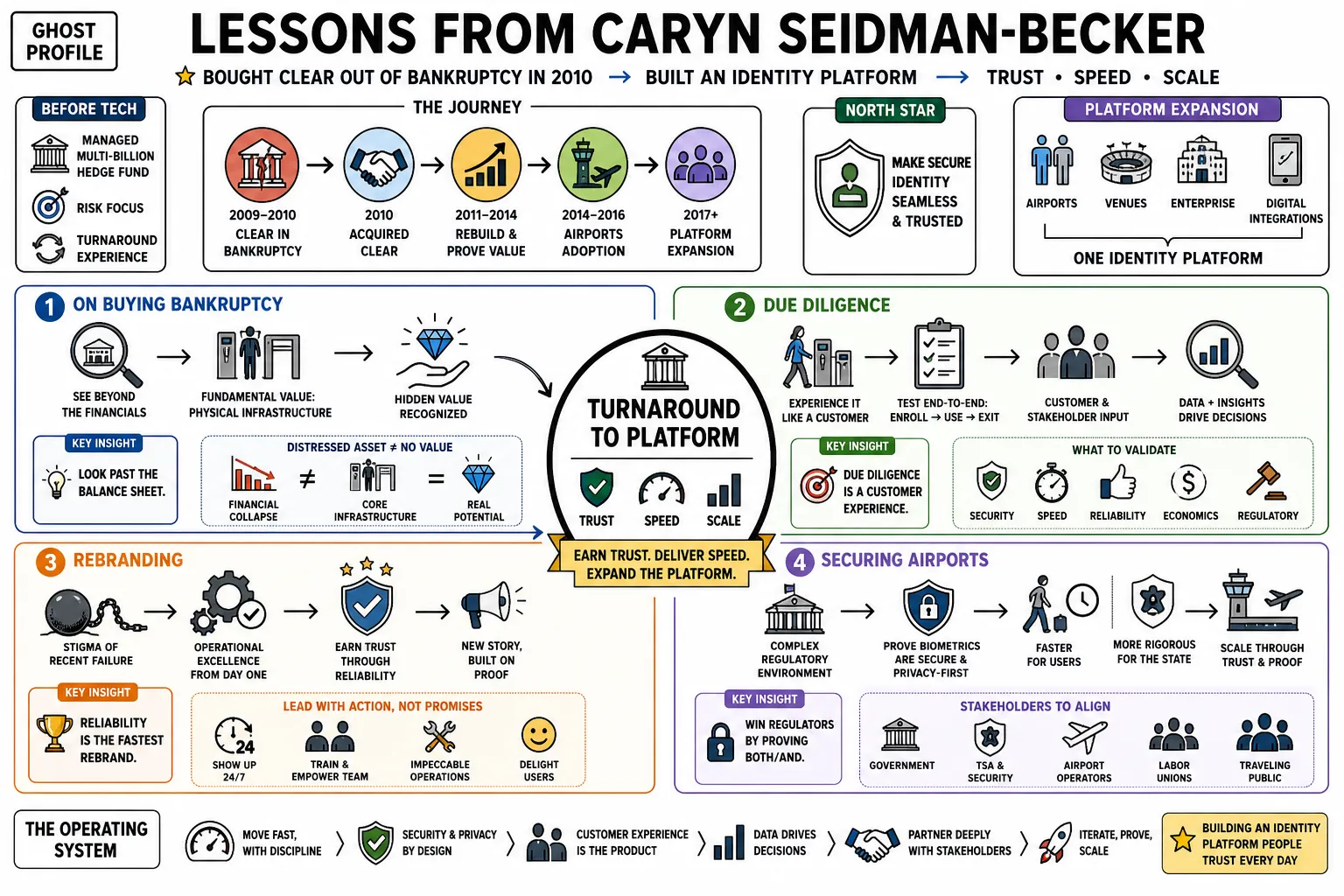
Lessons from Caryn Seidman-Becker
Caryn Seidman-Becker bought CLEAR out of bankruptcy in 2010 and built it into an identity platform. Before entering the technology sector, she managed a multi-billion-dollar hedge fund, bringing that background in risk and turnarounds to her role as CEO. The insights below outline her approach to operating quickly, earning consumer trust, and expanding a single product into a platform.
Part 1: The Turnaround of CLEAR
- On Buying Bankruptcy: "The decision to buy CLEAR out of bankruptcy was born from recognizing the fundamental value of the physical infrastructure despite the financial collapse." — Forbes
- On Due Diligence: "Assessing a distressed asset requires looking past the balance sheet and experiencing the product exactly as the customer does." — Invest Like the Best
- On Rebranding: "When a brand carries the weight of a recent failure, the fastest way to overcome the stigma is undeniable operational reliability from day one." — The Kara Goldin Show
- On Securing Airports: "Navigating the regulatory environment of airports meant proving that biometric security could be both faster for the user and more rigorous for the state." — CNBC
- On First Principles: "The core assumption in 2010 was that people would always trade a modest fee for a guaranteed reduction in friction." — The Wall Street Journal
- On Capital Efficiency: "Surviving the early years post-bankruptcy demanded extreme discipline with capital, focusing strictly on reopening profitable lanes." — Forbes
- On Early Adopters: "The most important customers during the turnaround were the travelers who had felt the loss of the service most acutely when it went offline." — Invest Like the Best
- On Physical Operations: "Software is only part of the equation; maintaining kiosks and staffing lanes efficiently is the true operational bottleneck." — J.P. Morgan
- On Pacing: "Scaling too quickly after a restructuring is a common trap; the focus must remain on perfecting the unit economics of a single location first." — In Search of Excellence
- On Legacy Systems: "Replacing outdated biometric hardware required a complete overhaul rather than incremental patches to build a foundation for the next decade." — CNBC
Part 2: Bias for Action and Urgency
- On Time: "Every week represents roughly two percent of the year; treating time as a mathematically scarce resource forces immediate movement." — CLEAR
- On Decision Making: "Postponing a difficult decision usually compounds the problem rather than revealing a better solution." — The Kara Goldin Show
- On Momentum: "A company with a bias for action can survive incorrect choices, but it will suffocate from prolonged hesitation." — Invest Like the Best
- On Meetings: "Delaying a conversation until a formal meeting can be scheduled is a failure of internal communication speed." — CLEAR
- On Iteration: "Launching an imperfect product and fixing it in real-time teaches a team more than a year of closed-door beta testing." — Forbes
- On Urgency vs. Panic: "True urgency is methodical and continuous; panic is erratic and burns out the organization." — In Search of Excellence
- On Opportunity Cost: "The cost of waiting for perfect information is almost always higher than the cost of a calculated misstep." — J.P. Morgan
- On Pushing the Pace: "Leaders must set an uncomfortable cadence to ensure the organization does not settle into complacency." — CNBC
- On Recovery: "When a mistake is made due to speed, the correct response is to fix it with equal speed, not to slow down subsequent decisions." — Invest Like the Best
Part 3: Rebuilding Trust
- On Consumer Data: "Trust is the only currency that matters when asking individuals to hand over their biometric information." — The Wall Street Journal
- On Transparency: "Rebuilding the brand required extreme candor about past failures and a clear roadmap for how data would be protected moving forward." — Forbes
- On Stakeholders: "Trust must be established simultaneously with customers, airport authorities, and government regulators." — CNBC
- On Opt-in Systems: "Securing an individual's identity is only ethical and sustainable if the user retains complete control over their participation." — CLEAR
- On Security Audits: "Inviting third-party scrutiny is a requirement, not an option, for any company handling sensitive personal data." — Invest Like the Best
- On Broken Promises: "Overcoming the cynicism of early users who lost money in the bankruptcy required honoring past memberships without question." — The Kara Goldin Show
- On Consistent Delivery: "Trust is not built through marketing campaigns; it is built by delivering a flawless experience every single time a user approaches a kiosk." — J.P. Morgan
- On Privacy by Design: "The architecture of the database must ensure that even internal employees cannot access biometric records without systemic safeguards." — The Wall Street Journal
- On Long-term Value: "A business model that monetizes user data at the expense of privacy will eventually destroy its own foundation." — Forbes
Part 4: Mission and Vision
- On Friction: "The core enemy of modern life is the accumulation of small, unnecessary delays; the mission is to systematically eliminate them." — Invest Like the Best
- On Enroll Once, Use Everywhere: "The ultimate vision is a single, secure enrollment that unlocks access to buildings, events, and travel without repeated verification." — CLEAR
- On Identity: "Your physical self is the most secure and intuitive form of identification available." — CNBC
- On Beyond Aviation: "Airports were merely the most difficult proving ground; the technology was always intended for hospitals, stadiums, and offices." — Forbes
- On Healthcare: "Applying biometric identity to medical records can eliminate dangerous administrative errors and streamline patient intake." — J.P. Morgan
- On the Customer Experience: "The technology should be invisible; the user should only notice the absence of a line." — The Kara Goldin Show
- On Security vs. Convenience: "The traditional trade-off between strict security and user convenience is a false dichotomy that biometrics resolves." — The Wall Street Journal
- On Ubiquity: "The platform only reaches its full potential when it becomes an assumed layer of infrastructure in everyday life." — In Search of Excellence
- On Purpose: "Building a company around a mission to save people time provides a quantifiable metric for success." — CLEAR
Part 5: From Product to Platform
- On Expansion: "Transitioning from a single consumer application to an enterprise platform requires rebuilding the underlying architecture to be modular." — Invest Like the Best
- On APIs: "The true scale of the network is realized when third-party developers can embed the identity verification layer into their own applications." — Forbes
- On Sports Venues: "Stadiums provided the perfect secondary market to prove the system could handle massive, concentrated bursts of foot traffic." — CNBC
- On Network Effects: "Every new partner added to the ecosystem increases the utility of the membership for the end user." — J.P. Morgan
- On Enterprise Sales: "Selling to businesses requires proving that the platform not only improves the user experience but also reduces their liability and staffing costs." — The Wall Street Journal
- On Vertical Integration: "Owning the hardware, the software, and the customer relationship ensures quality control during the transition to a platform." — Invest Like the Best
- On Age Verification: "Extending the platform to verify age for regulated purchases is a natural extension of the core identity product." — The Kara Goldin Show
- On Payment Integration: "Linking secure identity directly to payment methods removes the final point of friction in a physical transaction." — Forbes
- On Partner Vetting: "As a platform, you are only as secure as the weakest partner you allow into your ecosystem." — CNBC
- On Scalability: "The transition to a cloud-based architecture was non-negotiable for handling the data throughput of a national platform." — CLEAR
Part 6: Leadership and Culture
- On Lifting Others: "The most effective leaders focus their energy on elevating the capabilities of their team, rather than proving their own intelligence." — The Kara Goldin Show
- On Humility: "A CEO who stops asking questions is a liability to the company's future." — Invest Like the Best
- On Hiring: "Look for individuals who demonstrate a history of resilience; skills can be taught, but grit is intrinsic." — In Search of Excellence
- On Accountability: "Culture is defined by what leadership tolerates when a key metric is missed." — Forbes
- On Feedback: "Constructive criticism must be delivered clearly and immediately; withholding feedback is a disservice to the employee." — J.P. Morgan
- On Diversity of Thought: "A room full of people with identical financial backgrounds will inevitably miss a fatal flaw in a consumer product." — CNBC
- On Founder Mentality: "Maintaining an ownership mindset across the organization prevents the bureaucracy that typically accompanies growth." — CLEAR
- On Resilience: "The ability of a team to absorb a public failure and return to work the next day is the truest test of corporate culture." — Invest Like the Best
- On Communication: "During periods of rapid expansion, the message from leadership must be repetitive and unmistakable." — The Kara Goldin Show
- On Leading by Example: "You cannot demand an extreme work ethic from your organization if you are not visibly matching that effort." — In Search of Excellence
Part 7: Career Growth and Grit
- On Wall Street Lessons: "Managing a hedge fund teaches you how to quickly parse complex data and separate signal from noise." — Invest Like the Best
- On Being Atypical: "Recognizing that you do not fit the traditional mold for a specific role can become a distinct advantage if leveraged correctly." — University of Michigan (Wikipedia)
- On Early Hustle: "Being the first person in the office and the last to leave is the simplest way for a junior employee to force their way into important conversations." — University of Michigan (Wikipedia)
- On Career Pivots: "Moving from finance to technology requires discarding the assumption that past success guarantees future competence." — Forbes
- On Managing Crises: "The 2008 financial crisis instilled a permanent understanding that external conditions can change overnight, requiring immediate adaptation." — In Search of Excellence
- On Overcoming Rejection: "Hearing 'no' from investors or partners should be treated as a requirement for refinement, not a final verdict." — The Kara Goldin Show
- On Self-Reliance: "When navigating uncharted territory, you must trust your own analysis over the consensus of industry veterans." — Invest Like the Best
- On Continuous Learning: "The transition from an investor to an operator demands a brutal, ongoing assessment of your own operational blind spots." — CNBC
- On Defining Success: "True career satisfaction comes from building something tangible that alters the daily routine of a large population." — J.P. Morgan
Part 8: The Future of Identity
- On Digital Wallets: "Physical identification cards are an anachronism; the future relies on secure, encrypted digital wallets bound to biometrics." — The Wall Street Journal
- On AI Integration: "Machine learning will drastically reduce the friction of enrollment by instantly verifying the authenticity of physical documents against government databases." — CNBC
- On Fraud Prevention: "The rise of deepfakes requires an identity layer that proves biological presence, not just visual matching." — Invest Like the Best
- On Workplace Security: "Corporate offices will increasingly rely on biometric access to monitor building occupancy and secure sensitive areas without physical badges." — Forbes
- On Global Standards: "The next hurdle for secure identity is creating interoperability between different national verification systems." — The Kara Goldin Show
- On E-commerce: "Integrating verifiable identity directly into online checkouts will eliminate the massive financial drain of synthetic fraud." — J.P. Morgan
- On Healthcare Compliance: "Biometrics will be necessary to meet increasingly stringent federal requirements for patient data access and Medicare fraud prevention." — Forbes
- On the End of Passwords: "The concept of remembering a string of characters to access a bank account will soon be viewed as a historical security flaw." — The Wall Street Journal
- On Human Autonomy: "The ultimate goal of automated identity verification is to return time and autonomy back to the individual." — CLEAR