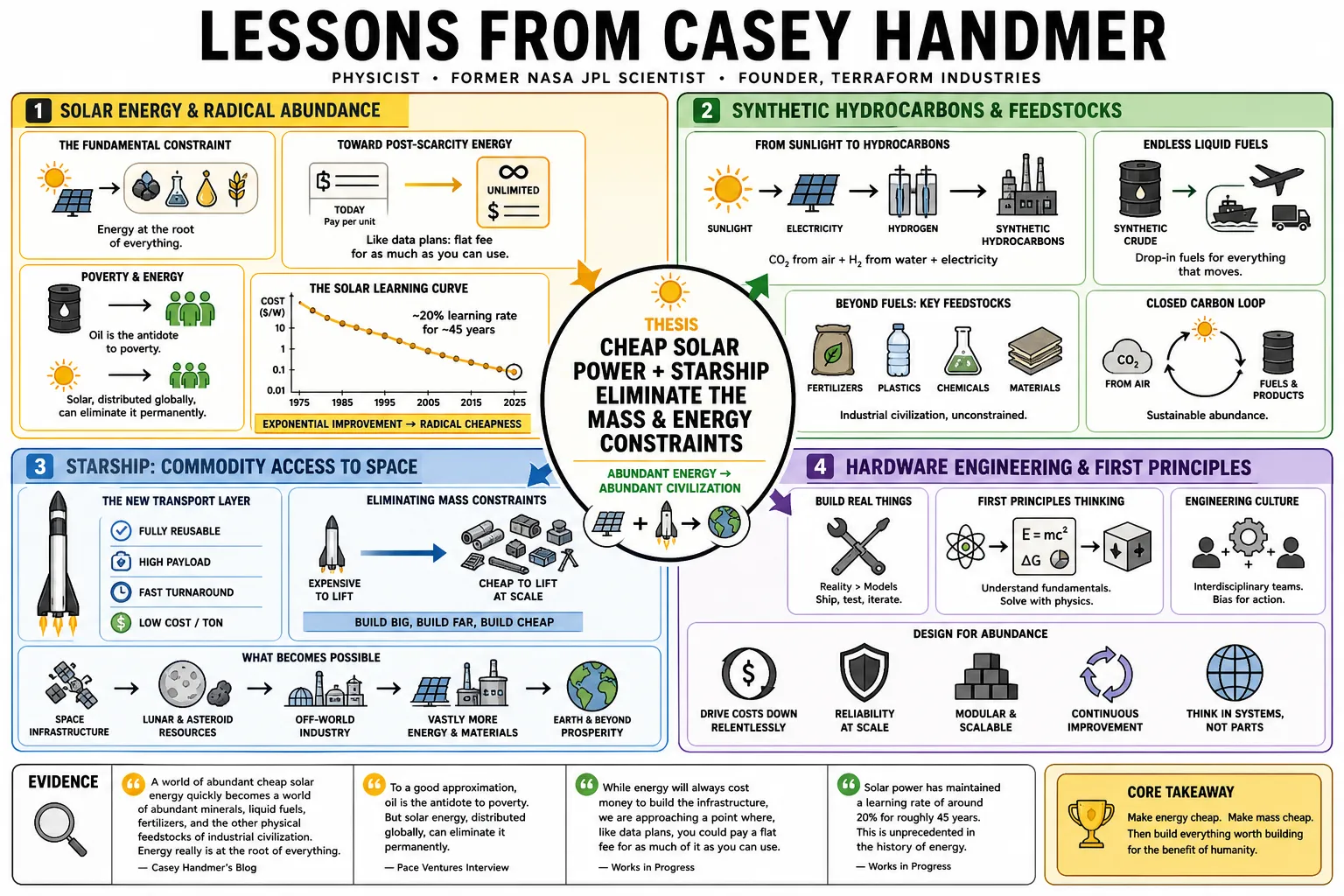
Lessons from Casey Handmer
Casey Handmer is a dual US/Australia citizen based in Los Angeles who founded and runs Terraform Industries, a solar synthetic fuel tech startup. — Australian Dynamism - Casey Handmer.
Part 1: Solar Energy and Radical Abundance
- On the fundamental constraint: Casey Handmer: "We are in the midst of a fundamental transformation in our economic civilization-scale industrial energy metabolism." — Radical Energy Abundance.
- On poverty and energy: Casey Handmer: "To a good approximation, oil is the antidote to poverty." — The solar industrial revolution is the biggest investment opportunity in history.
- On the Limits of Biofuels: Casey Handmer: "There is no path to energy abundance via biofuels which does not extend this agricultural monoculture to every possible fertile corner of the Earth, due to the low intrinsic CO2-capture efficiency of even the best plants." — Terraformer Environmental Calculus.
- On the solar learning curve: Casey Handmer: "For solar power, the learning rate is between 30% and 40%, which is one of the reasons that solar power is now so cheap." — We need more water than rain can provide: refilling rivers with desalination.
- On solar maximalism: Casey Handmer: "Solar is going to continue to displace all other primary electricity generators." — Energy Predictions 2025.
- On Upgrading Neglected Land: Casey Handmer: "The Terraformer is designed to convert economically unproductive and neglected land into oil and gas wells, which is about the largest value upgrade imaginable." — How Terraform Navigated The Idea Maze.
- On grid dependency: Casey Handmer: "Solar power production will locally feed the grid, but also provide power behind the meter, and beyond the meter in off-grid developments." — Energy Predictions 2025.
- On the Next Energy Transition: Casey Handmer: "If it’s cheaper to make heat electrically than burn rocks, what is the next transition after that?" — Radical Energy Abundance.
- On a Solar Farm and a Coal Seam: Casey Handmer: "I computed that a solar farm operating for 20 years will produce energy equivalent in value to a coal seam 3m thick." — "The Program," or, a strategy for universal prosperity in the twenty first century.
- On Unlimited Inputs: Casey Handmer: "Its fundamental inputs, sunlight and air, are essentially unlimited on any scale meaningful to the next few centuries of growth and development." — Terraformer Environmental Calculus.
Part 2: Synthetic Fuels and Industrializing the Atmosphere
- On Synthesizing Instead of Drilling: Casey Handmer: "As solar cost at the array falls below $10/MWh in the next few years, it will be cheaper to synthesize hydrocarbons from CO2 and water vapor than to drill them from the ground and refine and transport them." — Radical Energy Abundance.
- On Storing Energy as Methanol: Casey Handmer: "A methanol tank farm can store energy hundreds of times more cheaply than H2 storage or battery storage." — How Terraform Navigated The Idea Maze.
- On legacy infrastructure: Casey Handmer: "Terraform Industries’ synthetic natural gas process is not particularly complicated or difficult to achieve." — We’re going to need a lot of solar panels.
- On decentralized fuel production: Casey Handmer: "The fuel plant will not be drilling for oil and gas on Mars." — New Opportunities for Space Companies.
- On atmospheric carbon: Casey Handmer: "Another under-appreciated benefit of the Terraformer is that it creates an economic forcing function for carbon capture via direct air capture (DAC)." — Terraformer Environmental Calculus.
- On the cost of synthetic gas: Casey Handmer: "The way out is up – producing more fuel, but without extracting it from the ground." — Terraformer Environmental Calculus.
- On Where Batteries Fall Short: Casey Handmer: "Other end uses are so power intensive and cost sensitive (eg synthetic fuels, cement production) that batteries are cost prohibitive and solar applications must adapt to intermittent power production." — The solar industrial revolution is the biggest investment opportunity in history.
- On an Integrated System: Casey Handmer: "The Terraformer must be an integrated system localized with the solar array, displacing (and thus deleting) the expensive electrical inverter." — How Terraform Navigated The Idea Maze.
- On What Moves the Needle on Climate: Casey Handmer: "One thing, and only one thing, separates neat ideas which move the needle on climate and neat ideas that make no difference: Large scale adoption, catalyzed by transformative value generation in enormous markets." — How Terraform Navigated The Idea Maze.
- On Water From Capture: Casey Handmer: "In areas with insufficient water to supply the Terraformer, its DAC component can be adapted to recover the water it naturally captures in its CO2 sorbent material, producing as much water as it needs and, if desired, even more." — Terraformer Environmental Calculus.
Part 3: The SpaceX Starship Paradigm Shift
- On the death of the mass constraint: Casey Handmer: "Starship obliterates the mass constraint and every last vestige of cultural baggage that constraint has gouged into the minds of spacecraft designers." — Starship is Still Not Understood.
- On Lunar Landers and Big Rockets: Casey Handmer: "You might be forgiven for thinking that because SLS is big like the Saturn V, there is also room somewhere in the fairing for a lunar lander, like in Apollo, but you’d be wrong." — NASA’s Orion Space Capsule Is Flaming Garbage.
- On design heuristics: Casey Handmer: "We need a team of economists to rederive the relative elasticities of various design choices and boil them down to a new set of design heuristics for space system production oriented towards maximizing volume of production." — Starship is Still Not Understood.
- On false analogies: Casey Handmer: "In space, no-one can reason by analogy." — Blog Series: Countering misconceptions in space journalism.
- On Not Rebuilding Machinery for Space: Casey Handmer: "Starship’s generous cargo capacity means that existing industrial machinery does not need the usual space treatment of being rebuilt from paper-thin titanium to be light enough." — New Opportunities for Space Companies.
- On reusability: Casey Handmer: "Even in the 1960s, space exploration advocates realized that the cost of expendable rockets like the Saturn V would never permit wide access to space." — Lunar exploration architectures.
- On space logistics: Casey Handmer: "Starship is a vehicle designed to move cargo in the millions of tonnes." — Don’t stage off Starship!.
- On Legacy Power Plants: Casey Handmer: "More recently, solar photovoltaic (PV) power got cheaper than coal, and in advanced markets it is already cheaper to build and operate solar than to continue operating a legacy thermal power plant." — Radical Energy Abundance.
- On a Rocket That Can Barely Lift Its Payload: Casey Handmer: "In reality, it’s insanely expensive, dangerous, and underpowered and can barely lift a reasonable payload to LEO." — SLS is still a national disgrace.
- On multiplanetary economics: Casey Handmer: "SpaceX is determined to put people on Mars, to build a whole self-sustaining city there." — NASA Is Worth Saving.
Part 4: Working on Hardware and Physical Engineering
- On choosing what to work on: Casey Handmer: "You should work on hardware for one simple reason: One day you will die. You only get a few chances to work on really big projects, to build the future." — You Should Be Working On Hardware.
- On the deficit of builders: Casey Handmer: "There are many, many more important, good businesses to build than there are people building them. When you build something, you can accelerate the future by decades." — You Should Be Working On Hardware.
- On learning physical engineering: Casey Handmer: "But I don't know anything about hardware? No-one does. Humanity is still in its infancy." — You Should Be Working On Hardware.
- On the process of mastery: Casey Handmer: "Step One is to admit that it's time to read books and ask stupid questions. Step Two is to spend a year or three in the trenches climbing a new tower of esoteric knowledge." — You Should Be Working On Hardware.
- On an Immature Hardware Sector: Casey Handmer: "The hardware sector is not mature outside of a handful of extremely restrictive verticals." — You Should Be Working On Hardware.
- On the difficulty of creation: Casey Handmer: "It's a lot easier to criticize than to build." — Elon Musk is not understood.
- On Taking On Impossible Problems: Casey Handmer: "Elon’s companies are all doing crazy financially risky things – taking on impossible problems, and succeeding." — Elon Musk is not understood.
- On Iterating Every Six Months: Casey Handmer: "The reason solar is winning is because the manufacturing technology can be iterated every six months, so the learning curve is much faster." — Is nuclear power a solution to climate change?.
- On Record Industrial Investment: Casey Handmer: "Solar investment and manufacturing R&D is screaming along at record rates, with US re-shoring and re-industrialization exceeding even the build up to WW2." — Radical Energy Abundance.
Part 5: Bureaucracy, Risk, and Legacy Aerospace
- On legacy aerospace design: Casey Handmer: "Historically, mission/system design has been grievously afflicted by absurdly harsh mass constraints, since launch costs to LEO are as high as $10,000/kg and single launches cost hundreds of millions." — Starship is Still Not Understood.
- On NASA's opportunity: Casey Handmer: "NASA is in the midst of the biggest opportunity since its founding in 1958." — Starship is Still Not Understood.
- On Government Inefficiency: Casey Handmer: "Government inefficiency spans some insane spectrum from the trillions wasted on pork projects – which is all but open corruption – to relatively tiny daily hassles and indignities." — Why do we need a Department of Government Efficiency?.
- On Modeling What Matters: Casey Handmer: "I developed a huge spreadsheet to model costs and the market, but in the end most of the story can be told by looking at relative rates of production, construction, and investment." — Is nuclear power a solution to climate change?.
- On Risk Mismanagement: Casey Handmer: "My focus here is on risk mismanagement at the architectural and organizational level – the ultimate root cause of NASA’s previous tragedies and the lesson that is yet to be learned." — SLS: Is cancellation too good?.
- On Resource-Constrained Hardware Startups: Casey Handmer: "Hardware development in a start up setting is insanely resource constrained." — How to Learn Hardware.
- On contracting models: Casey Handmer: "NASA’s internal development capabilities are so atrophied that when they tell their contractor community that they’re only doing firm fixed price contracts henceforth, Boeing will publicly announce that they will only be doing cost plus, and NASA has no choice." — NASA’s Orion Space Capsule Is Flaming Garbage.
- On Redundant Layers of Management: Casey Handmer: "We don’t need redundant layers of functional line management, this ends up creating more problems in terms of talent allocation than it solves." — NASA Is Worth Saving.
- On Adapting Old Architectures: Casey Handmer: "The Starship atmospheric test prototypes are deep into construction, and I still routinely hear space visionaries adapting old exploration architectures for Starship." — The SpaceX Starship is a very big deal.
Part 6: Mars Exploration and Settlement Economics
- On Chemistry on Mars: Casey Handmer: "At the most basic level, machinery with the Mars base is concerned with performing primarily chemical transformations of matter between different forms." — New Opportunities for Space Companies.
- On Power for a Lunar Base: Casey Handmer: "No matter what, the Lunar base will still need plenty of power to run life support, crush rocks, and shoot them into space." — Space AI: I guess we’re doing Moon factories now.
- On Mars fuel production: Casey Handmer: "In particular, Mars production requires enormous quantities of methane and oxygen to refuel Starships flying back to Earth, as well as the local production of materials which are scarce on Mars but common on Earth, such as nitrogen." — Understanding the make-buy question in a growing Mars city.
- On Not Moving Carbon From Crust to Air: Casey Handmer: "The Terraformer sources its CO2 from the air, so even if all our fuel is burned, it will not result in the transport of carbon from the crust to the atmosphere." — Terraformer Environmental Calculus.
- On the economics of Mars: Casey Handmer: "Five years ago, building a city on Mars was conceived as a philanthropic venture and the best a market could offer was a set of tools to maximize the utility of each marginal tonne of cargo upmass." — Space AI: I guess we’re doing Moon factories now.
- On Making More Water: Casey Handmer: "The key to solving water scarcity at the scale necessary to terraform Nevada is not to build bigger dams or to resort to rain dances, but to make more water using solar powered desalination technology." — We can Terraform the American West.
- On Martian power grids: Casey Handmer: "Mars power will most likely be provided by large solar arrays on the surface." — What can we send to Mars on the first Starships?.
- On space hype: Casey Handmer: "Despite the hype, the fundamental economics are well understood by the mining industry." — Lunar water is not that exciting.
- On National Self-Sufficiency in Fuel: Casey Handmer: "If any nation on Earth can be self-sufficient with respect to food, it can be self-sufficient with respect to oil and gas with about 10% of the land." — How Terraform Navigated The Idea Maze.
Part 7: Energy Metabolism and Human Progress
- On the arc of human history: Casey Handmer: "Suffice to say that solar PV is far cheaper, and growing far faster, than any other energy source in history." — How Terraform Navigated The Idea Maze.
- On Energy-Intensive Commodities: Casey Handmer: "Energy intensive fuels and materials are commodities whose cost is driven by energy opex and whose cheap reliable supply is essential to our civilization and life as we know it." — How Terraform Navigated The Idea Maze.
- On decoupling growth and emissions: Casey Handmer: "Synthetic fuels are the single biggest lever we have to double global economic growth." — The solar industrial revolution is the biggest investment opportunity in history.
- On Capital Efficiency: Casey Handmer: "Adding too much solar or batteries degrades capital efficiency – the correct response is to add more GPUs in this case." — Direct Current Data Centers.
- On Turning Light Into Fuel: Casey Handmer: "The job of the Terraformer is to transform light energy into a low hassle, high energy density, transportable, storable fuel." — How Terraform Navigated The Idea Maze.
- On Technology Lifting Scarcity: Casey Handmer: "Or we can let technology continue to lift the burden of scarcity, allowing supply to increase in tempo with our increasing civilizational wealth, ensuring that everyone sees benefits to generally increased prosperity." — Economics and AI take off.
- On Seven Percent Energy Growth: Casey Handmer: "From 1948 until 1973, world per capita energy consumption grew at 7% per year. 7% annual energy growth means billions of humans being lifted from the poverty of pre-industrial subsistence agriculture." — The Program 2020.
- On energy security: Casey Handmer: "Synthetic fuel needs only sunlight and air, so no strategically fraught dependence on geology and foreign security issues." — Terraformer Environmental Calculus.
- On Scaling Production: Casey Handmer: "Even if we copied each new factory 5 times, reducing learning rate by 5x in exchange for increasing production 5x, price declines will still stimulate far more demand than this expanded production can meet." — We’re going to need a lot of solar panels.
Part 8: Strategy, Scale, and Building the Future
- On Organizational Inefficiency: Casey Handmer: "In no way is that vision impeded by the laws of physics – only by the so called “laws” of organizational inefficiency and trained myopia." — SLS: Is cancellation too good?.
- On Unjustifiable Architecture: Casey Handmer: "We have seen how Shuttle and SLS came to exist, and we have seen how utterly unjustifiable the architecture is in terms of first principles." — SLS: Is cancellation too good?.
- On Moving From Software to Hardware: Casey Handmer: "His drive and success in moving from software into multiple hard hardware problems is unprecedented." — Elon Musk is not understood.
- On an Emergency Solar Crash Program: Casey Handmer: "We also need to choose a future of abundance, and that means an immediate emergency crash program to mass produce solar panels wherever and however we can at the highest possible rate." — We’re going to need a lot of solar panels.
- On learning by doing: Casey Handmer: "You need to understand how you fit into your team and how your team fits into the organization as a whole – use your technical skills to analyze this complex machine." — Stuff you should have been taught in college but weren’t.
- On Journalists in the World: Casey Handmer: "The news does occur sooner on X, but we need journalists out in the world reporting on stuff, not just punting hot takes around their bubbles." — Elon Musk is not understood.
- On Optimism and Confidence: Casey Handmer: "I’m accustomed to articulating a minority view point, but in this I’m confident – there are millions of Americans who want NASA to once again embody a golden century of supreme optimism and confidence." — NASA Is Worth Saving.
- On Organizational Problems at NASA: Casey Handmer: "I am writing this blog because, in every possible way, the SLS program embodies the logical union of all of these organizational problems that have troubled NASA since its inception in 1958." — SLS: Is cancellation too good?.
- On Putting Civilization Back on Track: Casey Handmer: "In 2023, the exponentially expanding growth of solar is putting our civilization permanently back on track to increased productivity, longevity, prosperity, and happiness." — Radical Energy Abundance.