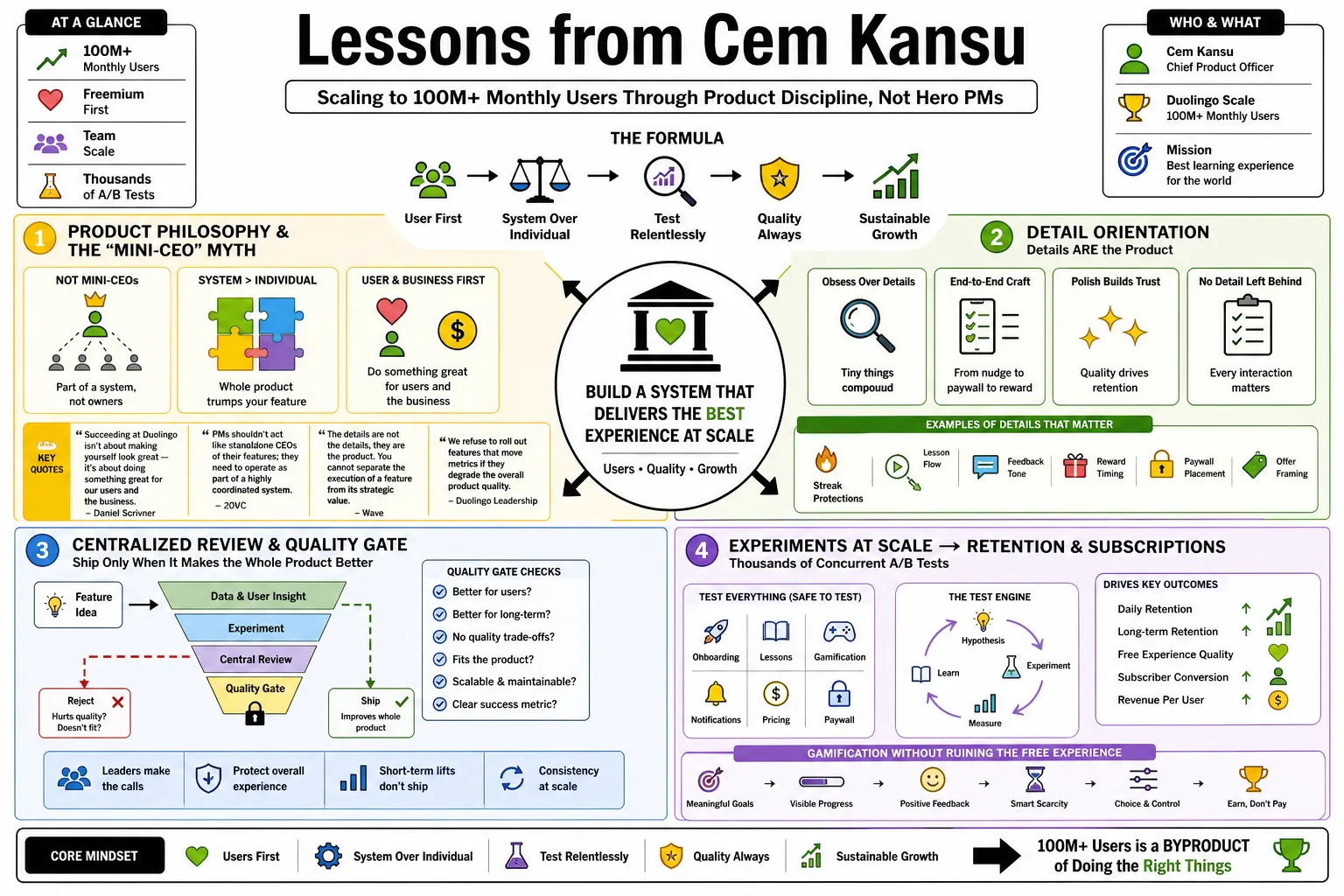
Lessons from Cem Kansu
Cem Kansu, Duolingo’s Chief Product Officer, has discussed how the company combines an accessible free learning experience, high-volume experimentation, product reviews, and empowered product teams. He distinguishes team ownership from the notion that a PM simply dictates strategy while others execute. The lessons below have been narrowed to what his direct interviews and writing support. — 20VC — Cem Kansu Interview.
Part 1: Product Philosophy & The "Mini-CEO" Myth
- On the PM Role: Kansu advises PMs to focus on doing consequential work for users and the business rather than on making their own work visible. — Cem Kansu — Product Advice.
- On the Mini-CEO Myth: Kansu rejects the idea that a PM merely decides strategy while others execute. He expects PMs to understand the user-facing details and work with designers and engineers, while teams still have meaningful decision ownership. — 20VC — Cem Kansu Interview.
- On Detail Orientation: Kansu says consumer products depend on pixel-level execution and that PMs should understand how design details affect behavior. The “details are the product” phrase in the old lesson was attributed by the interviewer to Spotify’s Gustav Söderström, not to Kansu. — 20VC — Cem Kansu Interview.
- On Product Review: Teams present proposed changes in a product review with the CEO, CPO, design head, and product leaders, then refine the work or move to a prototype or A/B test. — 20VC — Cem Kansu Interview.
- On Quality Control: Kansu asks teams to bring a clear recommendation to product review and use leadership feedback to improve the proposal before shipping. The source does not establish that every change is centrally approved or that reviews necessarily slow delivery. — Cem Kansu — Product Review.
- On Long-Term Thinking: Kansu frames the free learning experience as a long-term investment in a durable business, even when moving a feature from paid to free creates a near-term revenue cost. — Sub Club — Free Users and Growth.
- On Simplification: Kansu’s advice to PMs includes simplifying a proposal as far as possible; the old claim that most features should be killed is not established. — Cem Kansu — Product Advice.
- On Using the Product: Kansu says many ideas begin with employees’ own heavy use of Duolingo; his Lenny interview adds that most employees use it daily and discuss features they notice. — 20VC — Cem Kansu Interview.
Part 2: A/B Testing & Relentless Experimentation
- On Testing Volume: Kansu said Duolingo ran more than 300 A/B tests in a quarter, from small visual changes to major redesigns. The scale allows learning from user behavior, but test count alone is not a goal. — The Product Manager — Cem Kansu Interview.
- On Guardrail Metrics: Duolingo gives teams room to run randomized experiments but stops a local metric win if it damages a core guardrail; Kansu used revenue rising while daily active users fall as an example. — MAU Talk — Retention and Growth.
- On Testing Limits: Kansu warns that repeated small A/B tests can trap teams in a local maximum; occasionally they should test a substantially different experience rather than only adjusting existing screens. — The Product Manager — Cem Kansu Interview.
- On Hypothesis Generation: Duolingo uses employees’ daily use, user-research studies, public-forum reactions, and long-term holdouts alongside quantitative experiments to decide what to investigate. — Lenny’s Newsletter — How Duolingo Builds Product.
- On Incremental Gains: Kansu said Duolingo’s day-one retention improved roughly three- to fourfold over years of repeated experimentation, rather than from a single growth trick. — MAU Talk — Retention and Growth.
- On Long-Term Holdouts: For social features, Duolingo sometimes keeps a small control group for more than three months because users need time to form connections before the effect is measurable. — Lenny’s Newsletter — How Duolingo Builds Product.
- On Cultivating Experimentation: Kansu advises early-career PMs to build data fluency and run many experiments; that is his stated practice, not evidence for the old “celebrate every failure” quotation. — Cem Kansu — Product Advice.
Part 3: Retention, Gamification & The Core Loop
- On Retention: Kansu treats retention as central to growth: in his account, improving the habit of returning to learn has driven much of Duolingo’s product-led growth. — MAU Talk — Retention and Growth.
- On Making Learning Engaging: Kansu says the difficult part of self-directed language learning is keeping learners motivated; Duolingo uses game mechanics and playful messaging to make repeated practice appealing. The old broccoli-and-ice-cream quotation is not verified as his. — MAU Talk — Retention and Growth.
- On Streaks: Kansu describes streaks as one of the mechanics that helps turn language study into a daily habit. — MAU Talk — Retention and Growth.
- On Leaderboards: Kansu says Duolingo kept leaderboards free partly because social features gain value when more learners can participate, not because of a documented claim about status anxiety. — The Product Manager — Cem Kansu Interview.
- On Push Notifications: Kansu describes Duolingo’s personalized, playful push notifications as a way to bring learners back; the source does not establish the old finite-resource rule. — MAU Talk — Retention and Growth.
- On Daily Active Users: Kansu discusses daily active users as a high-level business measure, while emphasizing retention as evidence that learners build a valuable habit. — 20VC — Cem Kansu Interview.
- On Progress and Motivation: Kansu says lesson difficulty matters for habit formation: tests suggested learners stayed more engaged when questions were challenging but mostly answerable, around an 80% success range. — The Product Manager — Cem Kansu Interview.
- On Streak Freezes: Kansu explains that streak freezes give learners a way to preserve a habit after missing a day; the old specific missed-flight example is not established. — 20VC — Cem Kansu Interview.
- On Emotional Design: Kansu describes Duolingo’s character design, animations, and pixel-level detail as deliberate parts of the consumer experience rather than decoration alone. — 20VC — Cem Kansu Interview.
Part 4: The Freemium Model & Monetization Strategy
- On the Free Growth Engine: Kansu argues that a strong free learning product encourages word of mouth and organic growth; fully paid education apps may become more dependent on paid acquisition. — The Product Manager — Cem Kansu Interview.
- On Monetization Boundaries: Kansu says Duolingo keeps core educational content free and uses paid offerings for additional convenience and features; he warns that overly aggressive monetization can harm the free experience. — The Product Manager — Cem Kansu Interview.
- On Evolving the Free Tier: Kansu has supported moving Practice Hub and Explain My Answer from paid tiers to free access when doing so strengthens the free product, even at some revenue cost. The old “never take things away” rule was inaccurate. — Sub Club — Free Users and Growth.
- On Advertising Quality: Kansu describes placing ads around lesson completion and controlling ad categories and quality so advertising does not overwhelm the learning experience. — Sub Club — Free Users and Growth.
- On Subscription Timing: Kansu says purchase behavior depends on what a learner has just experienced; Duolingo tests upgrade prompts in context rather than relying only on abstract price surveys. — The Product Manager — Cem Kansu Interview.
- On Pricing Tests: Kansu says surveys and “painted door” tests gave poor signals for small price differences, so Duolingo ultimately A/B-tested subscription prices. The old country-specific $10 comparison is not evidenced. — The Product Manager — Cem Kansu Interview.
- On Free Trials: Kansu initially doubted free trials would help a freemium app, then found they lowered payment hesitation. He described seven-day trial messaging and a pre-billing reminder, not the old two-week claim. — Sub Club — Free Users and Growth.
- On Mission Alignment: Kansu says keeping educational content free serves both Duolingo’s access-to-education mission and its word-of-mouth growth model. The old claim about wealthy subscribers subsidizing others is not established. — The Product Manager — Cem Kansu Interview.
Part 5: Metrics, Goal Setting & OKRs
- On Product Metrics: Kansu names revenue and daily active users as top-level measures while using daily retention to judge whether learners form a valuable habit. The old “ten metrics means zero” quote is not verified. — 20VC — Cem Kansu Interview.
- On OKR Cadence: Kansu describes quarterly team and area OKRs, followed by a companywide leadership review in the first week of the quarter; teams retain latitude to set their own strategy within aligned priorities. — Lenny’s Newsletter — How Duolingo Builds Product.
- On Team Metric Ownership: Kansu distinguishes metric-based teams, which aim to move a defined measure, from feature-based teams, whose progress can require several qualitative and quantitative signals. — Lenny’s Newsletter — How Duolingo Builds Product.
- On Learning Signals: Kansu says learning efficacy cannot be reduced to one perfect metric, so meaningful product trade-offs sometimes require leadership judgment alongside measured outcomes. — Sub Club — Free Users and Growth.
- On Engagement Quality: Kansu looks beyond an aggregate active-user count to daily retention and whether people return to practice; the old claim that Duolingo measures “active learning time” is not established. — 20VC — Cem Kansu Interview.
Part 6: Team Structure & Product Rituals
- On Cross-Functional Teams: Kansu describes product teams co-led by PMs and engineering leads, with decisions divided by domain and informed by design and research. — Lenny’s Newsletter — How Duolingo Builds Product.
- On Planning Cycles: Duolingo’s team and area OKRs move through drafts and feedback before senior-leadership review; Kansu says the process balances alignment with time spent making progress. — Lenny’s Newsletter — How Duolingo Builds Product.
- On Design Reviews: Kansu’s product-review process asks teams to present a proposal and gather CEO, product, and design feedback before prototyping or A/B testing. — 20VC — Cem Kansu Interview.
- On PM Skills: Kansu’s advice emphasizes data fluency, design judgment, collaboration, and doing consequential product work; the old hiring-criteria quote is not verified. — Cem Kansu — Product Advice.
- On User Research: Kansu says feature teams combine usage by employees, formal user research, public-forum reactions, and long-term experiments when judging whether a feature works. — Lenny’s Newsletter — How Duolingo Builds Product.
- On Team Autonomy: Kansu says product teams have latitude to set their own strategy while area-level OKRs and product reviews provide alignment and feedback. The old claim of “complete autonomy” is too absolute. — Lenny’s Newsletter — How Duolingo Builds Product.
Part 7: AI Integration & The Future of Learning
- On AI Conversation Practice: Kansu describes Video Call with Lily as a way to give learners level-appropriate language-conversation practice; he says user value resonates more than an “AI” label. — The Product Manager — Cem Kansu Interview.
- On Scaling Courses: Kansu says AI-assisted tooling helped Duolingo greatly increase the pace of creating language courses; the old specific cost and localization claim is not established. — Cem Kansu — AI in Duolingo Product.
- On Personalized Conversation: Kansu says Lily’s AI conversations adapt the vocabulary to the learner’s known words and introduce some new ones; this supports a concrete personalized feature, not the old “holy grail” prediction. — The Product Manager — Cem Kansu Interview.
- On Duolingo Max: Kansu explains that Max initially housed AI-intensive conversation and explanation features partly because LLM calls had material costs; Explain My Answer later moved to free when costs fell. — Sub Club — Free Users and Growth.
- On AI Productivity: In the 20VC interview, Kansu estimated an average engineering-productivity gain closer to 10–20% from current AI tools, not the old claim that engineers build ten times faster. — 20VC — Cem Kansu Interview.
- On Explanatory Feedback: Kansu describes Explain My Answer as using an LLM to explain why a learner’s specific response was wrong; Duolingo later moved the feature from Max to free access. — Sub Club — Free Users and Growth.
Part 8: Growth, Launch Strategies & Adaptation
- On Revising Monetization Strategy: Kansu recalled that Duolingo changed its view of ads, in-app purchases, and subscriptions as circumstances changed; the old sweeping two-year market prediction is not supported. — 20VC — Cem Kansu Interview.
- On Shareable Year-in-Review Features: Kansu highlighted Duolingo’s Year in Review as a product feature people could share; the old universal claim that virality cannot be engineered through referral codes is not established. — Cem Kansu — Year in Review.
- On Expanding Beyond Languages: Kansu says Math and Music could reuse Duolingo mechanics such as streaks and leaderboards while requiring designs suited to those subjects. — Cem Kansu — Duolingo Math and Music.
- On Listening to Public Feedback: Kansu says product teams use Reddit and Twitter reactions as one signal of how users respond to features, alongside research and holdout tests; the competitor-obsession claim is not evidenced. — Lenny’s Newsletter — How Duolingo Builds Product.