Lessons from Charles Schulz
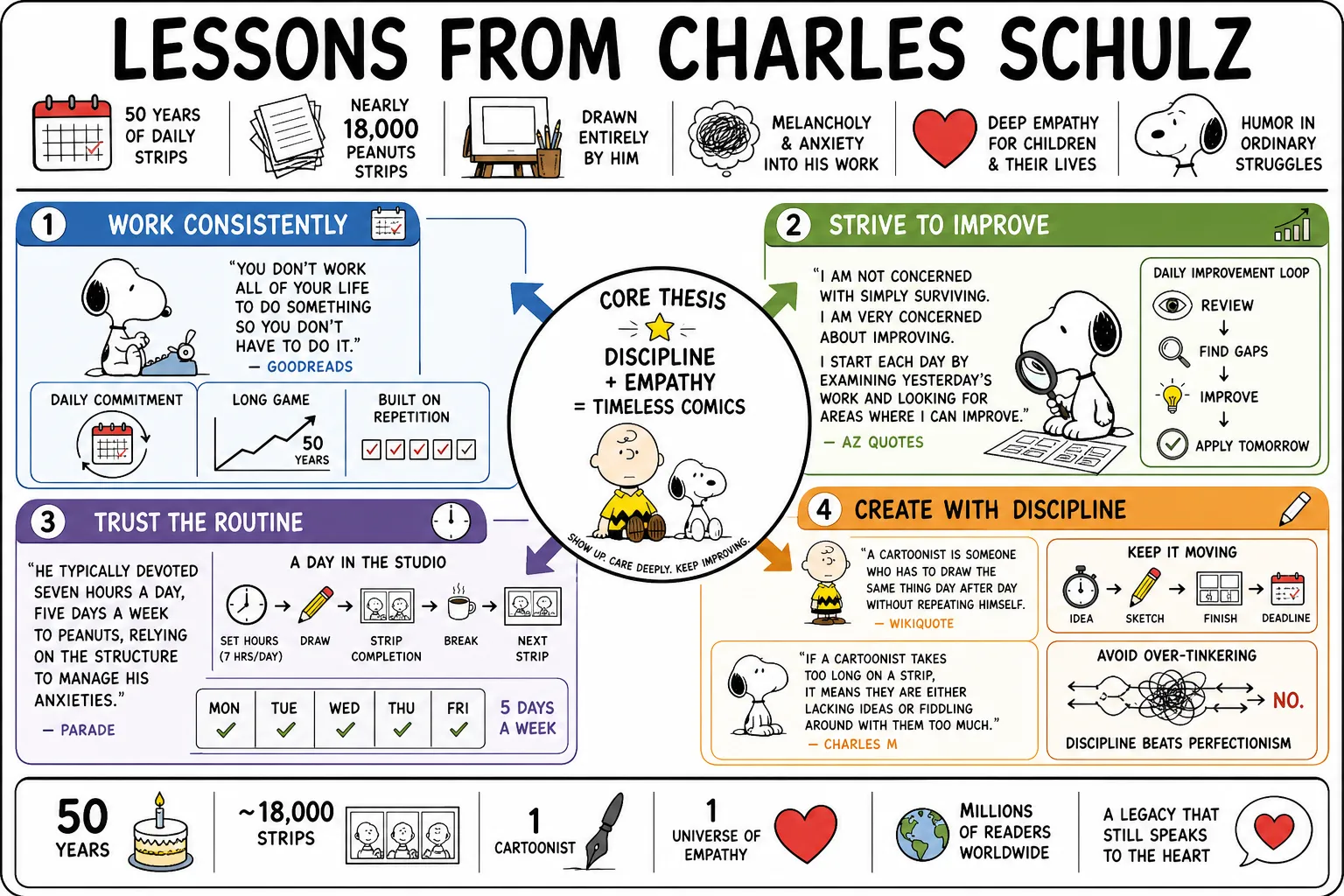
Charles Schulz spent fifty years drawing nearly 18,000 Peanuts strips entirely by himself. He poured his own melancholy and anxiety into Charlie Brown and Snoopy, changing comics by treating the emotional lives of children seriously. His solitary discipline and deep empathy for his characters show how to find humor in ordinary struggles.
Part 1: The Discipline of the Daily Grind
- On working consistently: "You don't work all of your life to do something so you don't have to do it." — Charles M. Schulz on Wikipedia
- On improvement: "I am not concerned with simply surviving. I am very concerned about improving. I start each day by examining yesterday's work and looking for areas where I can improve." — BrainyQuote: Charles M. Schulz Quotes
- On daily routine: "He typically devoted seven hours a day, five days a week to Peanuts, relying on the structure to manage his anxieties." — TODAY: Peanuts Quotes & Philosophy
- On showing up: "A cartoonist is someone who has to draw the same thing day after day without repeating himself." — Wikiquote: Charles M. Schulz
- On avoiding over-tinkering: "If a cartoonist takes too long on a strip, it means they are either lacking ideas or fiddling around with them too much." — Charles M. Schulz Museum: About Schulz
- On professional intent: "Waiting for inspiration is a mistake because cartooning is a profession that requires setting down an idea deliberately at will." — Open Culture: Art & Animation
- On missing deadlines: "Across fifty years and nearly 18,000 strips, he never missed a single deadline, treating his craft with absolute seriousness." — SFGate: Entertainment
- On lifelong commitment: "I would feel just terrible if I couldn't draw comic strips... I would feel very empty if I were not allowed to do this sort of thing." — TODAY: Peanuts Quotes & Philosophy
- On observation: "He practiced mental drawing constantly, observing how light hit a collar or how a sleeve wrinkled to inform his daily work." — Austin Kleon: Blog Archive
- On innate purpose: "It seems beyond the comprehension of people that someone can be born to draw comic strips, but I think I was." — Inspiritful: Charles Schulz Quotes
Part 2: The Craft of Cartooning
- On design: "Cartooning really is just designing." — BrainyQuote: Charles M. Schulz Quotes
- On visual fundamentals: "Visuals must remain the basis of cartooning, a fundamental element he felt modern cartoonists had sometimes neglected." — The Comics Journal Feed
- On drawing from life: "If you're going to draw a comic strip every day, you're going to have to draw on every experience in your life." — BrainyQuote: Charles M. Schulz Quotes
- On self-awareness: "If I were a better artist, I'd be a painter, and if I were a better writer, I'd write books. But I'm not, so I draw cartoons!" — Wikiquote: Charles M. Schulz
- On audience: "I never give my work to somebody else and say, 'What do you think about that?' I just don't trust anybody. If I think it's funny... I send it in anyway." — Wikiquote: Charles M. Schulz
- On minimalism: "He utilized suspended action and deliberate empty spaces, removing the non-essential to find the truth of a gag." — The Marginalian: Archive
- On the medium of thought: "He viewed drawing as a way of thinking, often starting with Snoopy on his doghouse and doodling to see where the scenario led." — Open Culture: Art & Animation
- On brevity: "The goal of a comic strip is to leave readers with a little something in the few seconds it takes to read it." — MeTV: Stories Archive
- On necessary egotism: "You have to be an egotist to draw comics. Why else would you think the pictures you draw are funny enough that people would want to buy them?" — Charles M. Schulz Museum: About Schulz
Part 3: Melancholy and Depression
- On the origin of humor: "There's a melancholy feeling in a lot of cartoonists, because cartooning, like all other humor, comes from bad things happening." — Primerus Portal
- On posture and mood: "This is my depressed stance. When you're depressed, it makes a lot of difference how you stand... If you're going to get any joy out of being depressed, you've got to stand like this." — Charles M. Schulz on Wikipedia
- On the source of comedy: "Happiness does not create humor. Sadness creates humor. There's nothing funny about being happy." — Substack: Discover
- On processing pain: "He used the strip to transmute personal pain, such as his mother’s early death, into a universally understood art form." — The Independent: Books & Arts
- On living with sadness: "His characters proved to readers that it is entirely acceptable to feel sad or lonely and still keep going." — Medium: Comics Feed
- On existential weight: "Unlike contemporaries who made childhood carefree, Schulz showed that children feel defeat and existential weight deeply." — The Marginalian: Archive
- On quick fixes: "When Charlie Brown asks for help with his deep depression, Lucy’s iconic response mocks the uselessness of easy answers." — TIME: The Vault Archive
- On continuous struggle: "Sometimes I lie awake at night, and I ask, 'Where have I gone wrong?' Then a voice says to me, 'This is going to take more than one night.'" — Charles M. Schulz on Wikipedia
- On artistic transformation: "By giving his internal struggles a voice through his characters, he found a way to resolve his own complex unhappiness." — CBC: Entertainment News
- On alienation: "His characters served as vehicles for his own lifelong sense of alienation and inferiority, making them highly relatable." — Peanuts Comic Strip on Wikipedia
Part 4: Rejection and Anxiety
- On living with dread: "I have a new philosophy. I’m only going to dread one day at a time." — Peanuts Comic Strip on Wikipedia
- On the secret of life: "That's the secret to life... replace one worry with another." — Official Peanuts: About Peanuts
- On total rejection: "The whole of you is rejected when a woman says, 'You're not worth it.'" — The Independent: Books & Arts
- On persistence: "Charlie Brown’s willingness to keep trying to kick the football, despite inevitable failure, models resilience in the face of certain rejection." — Peanuts Studio Portal
- On self-worth: "I gave up trying to understand people long ago. Now I let them try to understand me!" — Peanuts Comic Strip on Wikipedia
- On inevitable defeat: "'Knees always lose!' is a reflection on how physical and emotional setbacks are a guaranteed part of life." — Charles M. Schulz on Wikipedia
- On the fear of failure: "He believed that the possibility of failure makes the small victories in life actually mean something." — CBR on YouTube
- On managing anxiety: "The structured, daily schedule of drawing the comic was his primary mechanism for managing his own severe anxiety." — TODAY: Peanuts Quotes & Philosophy
- On vulnerability: "By portraying characters as small adults dealing with heavy concerns, he created a safe space for readers to acknowledge their own insecurities." — Schulz Museum: Historical Timeline
Part 5: Friendship and Connection
- On true friendship: "Friendship isn't about who you've known the longest. It's all about the friend who comes and stands by your side in bad times." — Inspiritful: Charles Schulz Quotes
- On acceptance: "Just thinking about a friend makes you want to do a happy dance, because a friend is someone who loves you in spite of your faults." — BrainyQuote: Charles M. Schulz Quotes
- On providing comfort: "Are you upset little friend? Have you been lying awake worrying? Well, don't worry... I'm here." — Charles M. Schulz on Wikipedia
- On goodbyes: "Someone always leaves. Then we would have to say good-bye. I hate good-byes. I know what I need. I need more hellos." — Charles M. Schulz on Wikipedia
- On humanity vs. individuals: "I love mankind... it's people I can't stand!!" — Charles M. Schulz Museum: About Schulz
- On loneliness: "Absence makes the heart grow fonder, but it sure makes the rest of you lonely." — BrainyQuote: Charles M. Schulz Quotes
- On unspoken bonds: "A core theme of his work is the quiet, unwavering loyalty between characters who bicker constantly but never truly abandon each other." — The Economic Times: News
- On shared isolation: "The characters often lean on walls or sit under trees together, demonstrating that simply being present with someone is enough to ease loneliness." — Charles M. Schulz Biography on Wikipedia
- On the nature of care: "The flood waters will recede, the famine will end, the sun will shine tomorrow, and I will always be here to take care of you." — Charles M. Schulz on Wikipedia
Part 6: Love and Heartbreak
- On basic needs: "All you need is love. But a little chocolate now and then doesn't hurt." — Inspiritful: Charles Schulz Quotes
- On unrequited love: "Nothing takes the taste out of peanut butter quite like unrequited love." — BrainyQuote: Charles M. Schulz Quotes
- On small gestures: "Love is getting someone a glass of water in the middle of the night." — Peanuts Studio Portal
- On companionship: "Love is walking hand-in-hand." — Peanuts Studio Portal
- On irrationality: "Love makes you do strange things." — BrainyQuote: Charles M. Schulz Quotes
- On inspiration: "The Little Red-Haired Girl was inspired by a real woman who rejected his marriage proposal, embedding genuine heartbreak into the strip's DNA." — Biography: Charles Schulz
- On longing: "Charlie Brown’s endless, unfulfilled pining for the Little Red-Haired Girl represents the universal human experience of desiring what we cannot have." — Amnesta: Other Writings
- On vulnerability in romance: "To love is to risk the absolute rejection of the self, a theme Schulz returned to repeatedly throughout his life's work." — The Independent: Books & Arts
- On romantic illusions: "Snoopy's fantastical romances and Charlie Brown's grounded heartbreak show the duality of how we approach love as both a dream and a painful reality." — Peanuts Overview on Wikipedia
Part 7: Childhood and Memory
- On simple joys: "Happiness is a warm puppy." — Charles M. Schulz on Wikipedia
- On past wounds: "He never forgot the teasing and taunting of the school playground and utilized those exact memories to make his characters authentic." — Schulz Museum: Historical Timeline
- On the myth of childhood: "He strongly rejected the idea that childhood is a carefree, golden time, insisting that children experience acute emotional pain." — The Marginalian: Archive
- On emotional intensity: "A child's emotions are often felt more intensely than an adult's, a reality that his work validated for millions of readers." — The Marginalian: Archive
- On lingering trauma: "He believed that childhood wounds remain fresh throughout our lives, but that adults possess the power to heal them through humor." — Peanuts Comic Strip on Wikipedia
- On his own youth: "As a teenager, he felt deeply ordinary and lonely, feelings that became the foundational soil from which Charlie Brown grew." — TIME: The Vault Archive
- On memory's toll: "You try for a little happiness, and what do you get? A few memories and a fat stomach!" — Charles M. Schulz on Wikipedia
- On taking children seriously: "By giving children adult vocabularies and existential problems, he respected the intelligence and depth of his young audience." — PopMatters: Culture
- On everyday cruelties: "The strip consistently highlighted the casual cruelty children inflict on one another, stripping away the sanitized view of youth." — The Comics Journal Feed
- On the resilience of youth: "Despite constant setbacks, his child characters wake up every day ready to try again, showcasing the innate resilience of childhood." — Charles M. Schulz Biography on Wikipedia
Part 8: Humor and Philosophy
- On the secret of life: "I think I've discovered the secret of life. You just hang around until you get used to it." — Charles M. Schulz on Wikipedia
- On perspective: "Don't worry about the world ending today. It's already tomorrow in Australia." — Charles M. Schulz on Wikipedia
- On messaging: "He actively avoided trying to implant a specific message, preferring to let readers interpret the stories based on their own lives." — MeTV: Stories Archive
- On creative fulfillment: "I'm at my happiest when I have a good idea and I'm drawing it well, and it comes out well and somebody laughs at it." — Peanuts Comic Strip on Wikipedia
- On comic strip koans: "Critics noted that his strips functioned like comic strip koans, offering simple, unresolved observations that question the meaning of life." — TIME: The Vault Archive
- On the struggle of the artist: "Snoopy's endless attempts to write a novel playfully mocked the agonizing, often fruitless nature of the creative process." — 13th Dimension: Peanuts Tag
- On narrative pivots: "Schulz mastered the art of the sharp emotional turn, seamlessly pivoting from a simple gag to a devastating truth in four panels." — CBR on YouTube
- On labels: "He shunned labels like philosopher, insisting he was simply a cartoonist trying to draw funny things for a living." — Schulz Museum: Historical Timeline
- On the comic medium: "By exploring the interior problems of daily life, he turned a standard newspaper comic into a space for genuine philosophical reflection." — Charles M. Schulz Museum: About Schulz