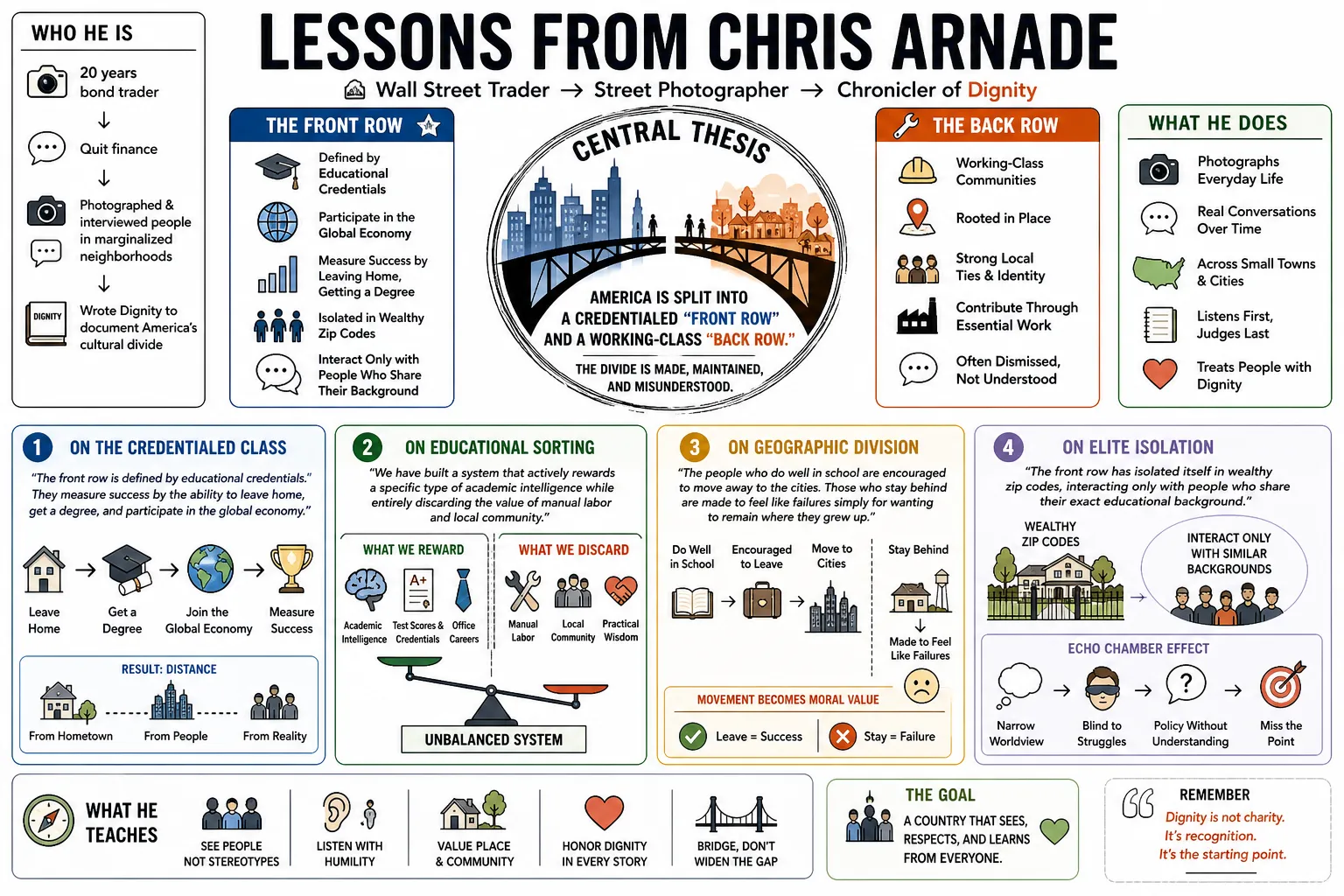
Lessons from Chris Arnade
After twenty years as a Wall Street bond trader, Chris Arnade quit finance to photograph and interview people in marginalized neighborhoods across the United States. His book Dignity documents the cultural divide between America's credentialed "front row" and its working-class "back row." This profile covers his observations on poverty, community, and the limits of elite technocracy. — Back Row America.
Part 1: The Front Row and the Back Row
- The credentialed class: Arnade calls the education-and-career track the front row: people who did well in school, moved for credentials and jobs, and came to treat that path as the standard of success. — Back Row America.
- Educational sorting: His front-row/back-row distinction questions a culture that recognizes credentials while overlooking other sources of skill, belonging and dignity. — What Holds America Together?.
- The pressure to leave: Arnade argues that education often rewards leaving home for elite institutions, while people who stay may value family and place rather than lack ambition. — Back Row America.
- Elite isolation: He describes his former professional and residential circles as socially narrow, despite their self-image as open-minded and globally connected. — Back Row America.
- Exclusion beyond income: Arnade says the divide is not only material: unfamiliarity with the front row’s unwritten rules and with its preferred way of thinking can exclude people from its credential path. — EconTalk — Chris Arnade on Dignity.
- A widening divide: In Arnade’s account, the shift toward post-industrial, intellectual work widened the gap between credentialed professionals and people whose work and communities lost status. — What Holds America Together?.
- Who the back row includes: The back row is Arnade’s shorthand for people outside the elite credential path; it is not simply a label for everyone who chose not to leave home. — What Holds America Together?.
- Against moralizing hardship: His reporting challenged the tendency to treat people facing addiction or poverty as personal failures; he found stereotypes about the Bronx community inadequate. — EconTalk — Chris Arnade on Dignity.
- Dignity in non-college work: Arnade argues that communities need respected work available outside long and costly credential pathways, and points to manufacturing work in the Midwest as an example. — What Holds America Together?.
- Different priorities: He came to see that some people value proximity to family, faith and home more than the mobility that the front row treats as advancement. — Back Row America.
Part 2: Dignity and Humiliation
- Humiliation beyond economics: Arnade argues that a society organized around a narrow credential path can make people outside it feel rejected, even when their lives have value that the credential system does not measure. — EconTalk — Chris Arnade on Dignity.
- The experience of humiliation: He describes people in communities he visited as feeling left behind, mocked or stigmatized, not merely short of income. — Back Row America.
- Respect as well as resources: Arnade says people he met wanted to be treated with respect and as members of a community, not only offered material help. — Trying to “Save” the Poor Doesn’t Actually Help.
- Rejecting stigma: In his Bronx reporting, Arnade found that labels applied to people with addiction or unstable housing obscured their stories and their desire to be seen as full people. — EconTalk — Chris Arnade on Dignity.
- Worth beyond a résumé: He identifies family, place, faith and culture as sources of meaning that do not require elite credentials. — What Holds America Together?.
- Mocking ordinary places: Arnade came to see McDonald’s as a useful gathering place in neighborhoods where few other accessible institutions were open, complicating elite disdain for it. — EconTalk — Chris Arnade on Dignity.
- Dignity amid addiction: His portraits sought to let people living with addiction describe themselves on their own terms; Takeesha, for example, named her roles as mother and believer as well as sex worker. — Back Row America.
- The limits of pity: After trying to rescue people he photographed, Arnade concluded that friendship and respectful treatment mattered more than approaching them as a personal project. — Trying to “Save” the Poor Doesn’t Actually Help.
- Loss of recognized place: Arnade treats the decline of respected work and local institutions as a loss of meaning and belonging, not only income. — What Holds America Together?.
- Respect for hands-on work: He argues that tangible manufacturing work can provide dignity and that elite careerism has too often undervalued it. — What Holds America Together?.
Part 3: The Value of Place and Community
- McDonald’s as a community center: Arnade found that in some back-row neighborhoods, churches and McDonald’s were among the few places consistently open and welcoming; the latter also functioned as a gathering place. — Back Row America.
- Local ties: Arnade says family, place and faith can give people a sense of belonging that an elite résumé does not capture. — EconTalk — Chris Arnade on Dignity.
- Staying near family: He points to a young woman in East Los Angeles who stayed close to home to translate for her mother, and a young man in Reno who stayed to support his mother’s sobriety, as examples of obligations an elite mobility model can overlook. — EconTalk — Chris Arnade on Dignity.
- Front-row mobility: Arnade describes many credentialed professionals, himself included, as treating cities as career steps and moving repeatedly rather than building a lasting identity around one place. — What Holds America Together?.
- The meaning of home: People Arnade interviewed often answered questions about why they stayed in a declining town simply by saying it was home, then naming its people, landscape and routines. — What Holds America Together?.
- Local ownership and connection: Arnade recalls an orange-juice factory-owning family embedded in his hometown and argues that local ownership can make employers more accountable to community ties. — EconTalk — Chris Arnade on Dignity.
- Informal networks: In Arnade’s account, ties to family, congregation and familiar local places form social capital that a purely economic account of a town can miss. — EconTalk — Chris Arnade on Dignity.
- Learning by being present: Arnade’s long walks and conversations changed what he thought he knew from data about the South Bronx; being physically present revealed a functioning community behind its stigma. — EconTalk — Chris Arnade on Dignity.
Part 4: Faith and Non-Material Meaning
- How elites see religion: Arnade came to recognize that his earlier dismissal of working-class faith as irrational had obscured the dignity and hope it gave people he met. — Back Row America.
- Churches as accessible places: In communities Arnade visited, churches were among the institutions that remained open to people often excluded elsewhere and offered a space to belong. — EconTalk — Chris Arnade on Dignity.
- Meaning outside a career: Arnade argues that faith can provide meaning and belonging without requiring educational or professional credentials. — What Holds America Together?.
- Reconsidering secular judgment: After meeting people whose faith helped them endure hardship, Arnade reconsidered his own assumption that their beliefs should be dismissed as irrational. — The People Who Challenged My Atheism.
- A place without a résumé: Arnade observed that churches could receive people on their own terms, without the entry barriers of elite institutions. — EconTalk — Chris Arnade on Dignity.
- Faith amid hardship: Arnade recounts people facing addiction and homelessness who described faith as a source of hope and identity. Their testimony is not evidence that religious conversion is a clinical treatment. — The People Who Challenged My Atheism.
Part 5: Leaving Wall Street
- Disillusionment after the financial crisis: Arnade says he had long found banking intellectually engaging, but the 2008 crisis and his industry’s response made him question its ethics and eventually leave. — EconTalk — Wall Street and American Poverty.
- The limits of a top-down view: He contrasts finance’s statistical, top-down view of places with the individual lives his portraits and walks brought into focus. — Image Deconstructed Interview.
- Finance’s narrow perspective: Looking back, Arnade says Wall Street helped him learn intensely about markets but offered a narrow view of places that often missed the neighborhoods beyond investors’ usual routes. — Conversations with Tyler — Chris Arnade.
- Questioning pure meritocracy: His work with people in the Bronx convinced him that talent and hard work alone do not give everyone an equal chance. — Image Deconstructed Interview.
- Finding a fitting new vocation: Arnade describes being paid to walk, observe and write as an unusually good fit for him, while acknowledging it earns less than his former finance career. — Conversations with Tyler — Chris Arnade.
- What models miss: The data-centered habits of his old career missed community and beauty he discovered by walking and talking with residents of the South Bronx. — EconTalk — Chris Arnade on Dignity.
- Bubble thinking: Arnade says finance’s tightly connected culture encouraged shared assumptions and made it hard to recognize the industry’s responsibility after the crisis. — EconTalk — Wall Street and American Poverty.
- Recognizing a social bubble: He describes his former professional and residential world as privileged and cloistered, and says the walks exposed how little he understood about people outside it. — Back Row America.
- Learning outside the bank: Arnade’s walks into Hunts Point, camera in hand, became a listening practice that changed his understanding of what numbers alone could show. — EconTalk — Chris Arnade on Dignity.
Part 6: The Art of Walking
- Travel beyond landmarks: Arnade prefers walking through ordinary neighborhoods to building a trip around famous sights, but says he would not dissuade someone who wants to see the Mona Lisa. — EconTalk — How to Walk the World.
- Writing grounded in experience: Arnade returned to regular writing through a walking newsletter because he wanted his judgments to grow out of meeting people and moving through the world, not from staying in a room issuing policy opinions. — Four Years of Walking the World.
- Observing ordinary places: Arnade found that spending time in McDonald’s revealed conversations and community life he had missed when viewing neighborhoods from a distance. — EconTalk — Chris Arnade on Dignity.
- Listening to strangers: His walks became a listening practice: a camera helped people open up, and conversations challenged what his data-centered work had taught him. — EconTalk — Chris Arnade on Dignity.
- Slow travel: Walking and public transit are Arnade’s way of seeing ordinary urban life beyond the wealthy districts that investors and many tourists frequent. — Conversations with Tyler — Chris Arnade.
- Observation before prescription: Arnade says he grew uneasy writing policy opinions from a room; he returned to walking and meeting people to understand places on their own terms. — Four Years of Walking the World.
- Solitude and thought: Arnade says he spends much of his walking time alone and finds that solitude helps him think, while still enjoying occasional company. — Curious Worldview Interview.
- The camera as an opening: He says carrying a camera helped start conversations during his long New York walks, eventually turning them into a listening tour. — EconTalk — Chris Arnade on Dignity.
- Portraits with consent and respect: Arnade wanted portraits to include the subjects’ own stories and avoided distant, sensational images of addiction that left viewers ignorant of the person photographed. — Image Deconstructed Interview.
Part 7: Addiction and Despair
- Addiction and lost belonging: Drawing on people he knew in drug-affected neighborhoods, Arnade describes addiction as entangled with pain, isolation and a search for belonging—not simply as a response to lost jobs. — Why I Don’t Use Heroin.
- Why drugs can appeal: Arnade writes that heroin offered some people he knew temporary relief from trauma and a way into a street community; he also emphasizes its harms and does not call it a generally rational choice. — Why I Don’t Use Heroin.
- Disorder in public spaces: In a 2026 essay, Arnade describes seeing addiction and mental distress play out in public spaces in several US cities and argues that the country should respond more seriously. — America and Public Disorder.
- Learning through comparison: Arnade says walking overseas sharpened his view that the United States tolerates too much disorder in shared public places. — America and Public Disorder.
- A symptom of deeper trouble: Arnade treats visible street addiction as a sign that society has failed people who need care and stable connections, rather than as a problem solved by stigma alone. — Why I Don’t Use Heroin.
- Respect for people with addiction: He argues that people living with addiction should be approached as people and friends, not only as cases to be rescued or punished. — Trying to “Save” the Poor Doesn’t Actually Help.
- Jobs, despair and resilience in Buffalo: In Buffalo, Arnade connected the loss of good jobs and population to despair he observed, while also finding enduring pride and community in bars, churches, mosques and restaurants. — Walking America: Buffalo.
- Escape and belonging: Arnade says heroin provided some people he knew both temporary escape from painful circumstances and a sense of belonging among others in the drug scene. — Why I Don’t Use Heroin.
Part 8: The Limits of Technocracy
- Listening before trying to rescue: Arnade learned that approaching people with a mission to save them could make him miss their wishes; he argues for friendship and respect first. — Trying to “Save” the Poor Doesn’t Actually Help.
- Limits of distant policy: Arnade says he cannot offer a simple policy solution for rebuilding the local ties and norms lost in struggling towns, and urges attention to residents’ own attachments. — EconTalk — Chris Arnade on Dignity.
- Knowledge outside datasets: His South Bronx walks showed Arnade a functioning community behind statistics and reputational labels that had led him to expect only danger and failure. — EconTalk — Chris Arnade on Dignity.
- People beyond variables: Arnade’s work challenged his own habit of treating neighborhoods as numbers by foregrounding individual voices and relationships. — Image Deconstructed Interview.
- Arriving ready to listen: Arnade says his walks became a listening tour after he realized his quantitative approach was missing the voices of people affected by decisions made at a distance. — EconTalk — Chris Arnade on Dignity.
- Ask people who live there: He changed his views by speaking with people in neighborhoods others had warned him against, rather than treating outside judgments as a full account of those places. — Back Row America.
- The limits of urban renewal: Walking Buffalo, Arnade saw a succession of convention centers, sports arenas and government buildings that, in his view, had not erased the city’s long struggle after industrial decline. — Walking America: Buffalo.
- Humility about other people’s lives: Arnade’s encounters in the Bronx and across the country made him question his own front-row assumptions about what people value and how they define dignity. — Back Row America.