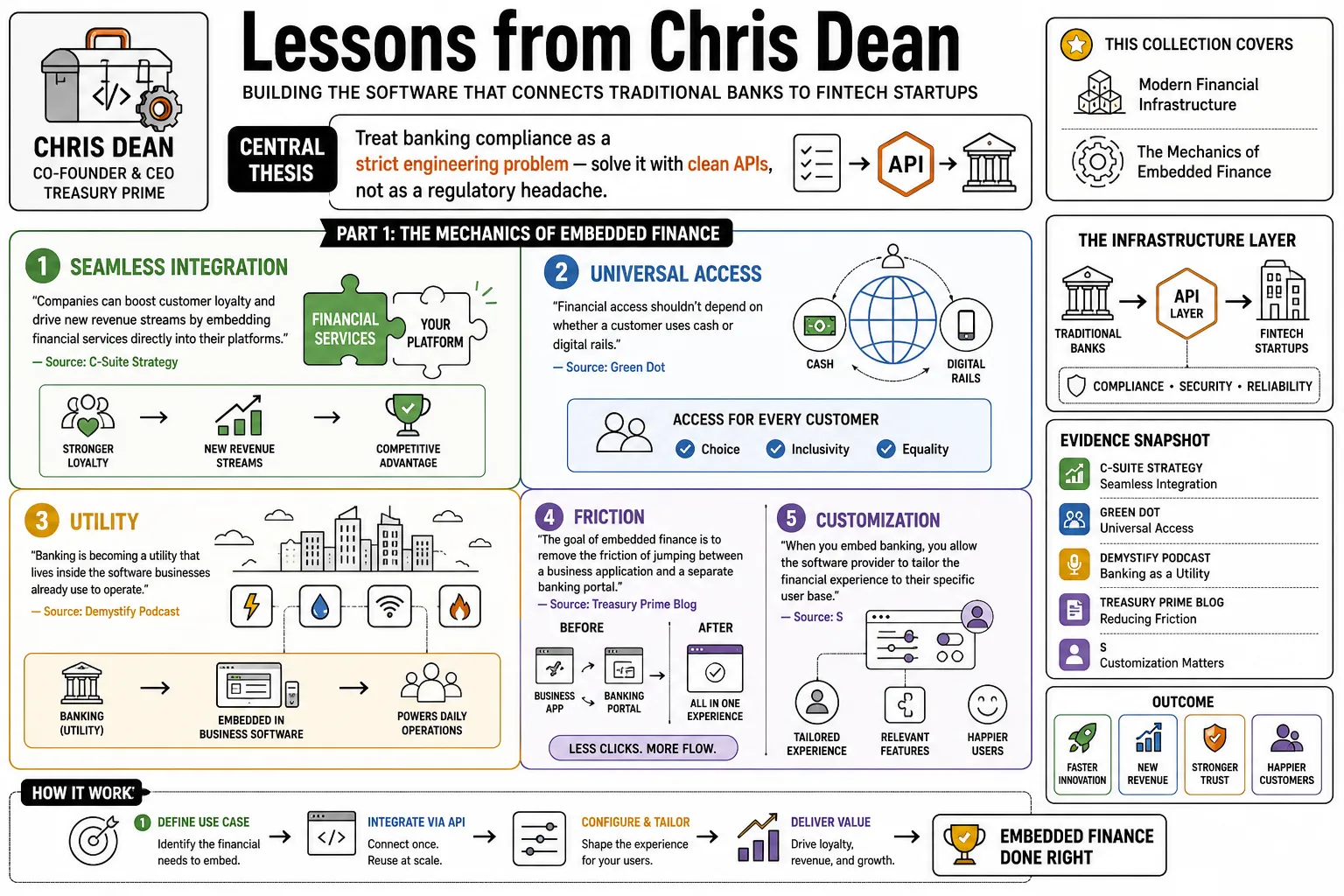
Lessons from Chris Dean
Chris Dean co-founded Treasury Prime, a software provider connecting banks and technology companies that want to offer banking features. His work emphasizes both APIs and the regulated bank's continuing responsibility for oversight and compliance. — Chris Dean’s BaaS guide.
Part 1: The Mechanics of Embedded Finance
- Embedding Banking Features: Dean describes embedding accounts and payments in a company's own product as a potential way to create revenue, learn about customer needs and support loyalty. — Chris Dean’s Embedded Banking Q&A.
- Cash and Digital Access: Dean said, “Financial access shouldn’t depend on whether a customer uses cash or digital rails.” He made the point while announcing a cash-loading option for digital accounts. — Treasury Prime Prime Cash announcement.
- Banking Inside Workflows: Dean gives the example of a landlord-software product that embeds a bank account so rent, deposits and property expenses can be handled inside the existing workflow. — Software Engineering Daily interview.
- Reducing Product Friction: Dean describes using banking APIs to let a software product offer accounts, cards and payments inside its own interface, rather than sending users to a separate banking product. — Chris Dean’s Embedded Banking Q&A.
- Fit the Customer Journey: Dean says an embedded banking feature creates value when it fits a customer's journey and meets a real need, rather than being added for its own sake. — Treasury Prime embedded-banking guide.
- Possible Revenue Streams: Dean identifies account balances, payments, interchange and recurring fees as different ways an embedded banking product may earn revenue. — Chris Dean’s Embedded Banking Q&A.
- The API Bridge: Dean describes Treasury Prime's software as an API bridge: technology firms can build banking features while the partner bank remains a necessary regulated participant. — Software Engineering Daily interview.
- Non-Bank Brands Can Offer Banking: Dean explains that a technology company without a bank charter can offer banking features through a regulated bank and software vendor; it does not thereby become a bank. — Chris Dean’s BaaS guide.
Part 2: Bank and Fintech Partnerships
- Partner Discovery: Dean described partner discovery as a source of friction for banks and said better matching means they need not begin each fintech conversation from scratch. — Tearsheet interview on bank–fintech discovery.
- Mutual Value: Dean argues that a bank–fintech partnership is more sustainable when both parties derive value, rather than when one side is merely a service provider to the other. — Chris Dean’s BaaS guide.
- Choose a Compatible Bank: Before committing to a bank partner, Dean recommends researching the institution, demonstrating the product, seeking feedback and gauging its openness to innovation. — Chris Dean’s BaaS guide.
- Tooling for Bank Partnerships: In the 2024 bank-direct shift, Dean described giving banks software and sales support to originate, onboard and manage their own fintech relationships. — Chris Dean’s bank-direct announcement.
- Faster Integration as a Design Aim: Dean describes the bank-vendor partnership model as technically sophisticated and quick to integrate; he does not give a general weeks-versus-years launch benchmark. — Chris Dean’s BaaS guide.
- Bank Oversight Remains Central: Dean stresses that using an API vendor does not transfer the regulated bank's responsibility for compliance and governance. — Chris Dean’s BaaS guide.
- Shared Risk Visibility: Dean describes bank-direct tooling designed to give banks actionable insights, configurable risk controls and a shared dashboard for collaboration with fintech partners. — Chris Dean’s bank-direct announcement.
- Treat the Bank as a Partner: Dean advises fintechs to approach the bank as an equal partner rather than a vendor, because a one-sided relationship may be short-lived and create regulatory difficulty. — Chris Dean’s BaaS guide.
Part 3: The API Economy and Infrastructure
- Stand on Earlier Work: Dean names “stand on the shoulders of giants” as a favorite life lesson. He describes improving his engineering approach after a friend connected it to earlier military-strategy ideas. — Authority Magazine interview with Chris Dean.
- Different Bank Cores Need Different Adapters: Dean describes connecting banks with dissimilar core systems, including an older mainframe-based core, by building bank-specific shims and workflows behind a common API. — Software Engineering Daily interview.
- Distribution Creates Payment Utility: Dean uses the ability to pay at a local sandwich shop with a bank card to illustrate the reach of Visa and Mastercard acceptance networks, while asking whether a stablecoin wallet might someday change the point-of-sale interaction. — FinXTech interview on payment networks.
- The API Is Only the Surface: Dean says the visible API is a small part of Treasury Prime's product; behind it sits a workflow engine and adapters for the many systems a bank uses. — Software Engineering Daily interview.
- Scale for Sudden Demand: Dean describes adding compute capacity as traffic grows and maintaining a separate cluster for high-volume card authorization; clients' sudden publicity spikes informed that design. — Software Engineering Daily interview.
- Expose Distinct Banking Capabilities: Dean lists account opening, ACH, wires and card issuance among the capabilities Treasury Prime exposed through its API; he does not claim every developer wants every module. — Software Engineering Daily interview.
- Document the Path Developers Use: After observing that clients mostly used the REST API rather than language-specific examples, Dean says the team simplified its documentation around practical curl commands. — Software Engineering Daily interview.
- Make Transaction State Explicit: Dean explains that when a bank system is slow or unavailable, a money-movement request can remain pending while Treasury Prime queues, retries and later reports its processed state. — Software Engineering Daily interview.
Part 4: Startup Growth and Scale
- Keep Iterating: Dean treats a startup's first product version as an experiment: test what customers use, learn from it and keep improving rather than quitting after the first attempt. — Chris Dean’s Demo Day lessons.
- Prove a First Customer Is Live: Dean pushed to have Treasury Prime's first bank customer live in production by Y Combinator Demo Day so he could present a working product, not only a pitch, to investors. — Chris Dean’s Demo Day lessons.
- Do Not Fill a Role Just to Fill It: Dean says he would leave a startup role open and keep searching rather than hire a merely adequate candidate to meet an immediate staffing need. — QED Investors interview with Chris Dean.
- Fundamentals Before More Capital: Dean argues that product-market fit and unit economics need to work before capital can sensibly accelerate growth, and that the long-term quality of an investor matters beyond the check size. — QED Investors interview with Chris Dean.
- Start With One Problem: Dean says an early startup should choose one problem it can solve well; Treasury Prime initially concentrated on deposit services rather than trying to build credit products too. — Chris Dean’s Demo Day lessons.
- Build What the First Customer Needs: Dean recommends putting a needed product in customers' hands and watching whether they actually use it. Treasury Prime's first bank client needed commercial account opening, so the team built that before pursuing its broader vision. — Chris Dean’s Demo Day lessons.
- Handle Comparison Pressure: Dean recalls the stress of weekly Y Combinator progress reports and the feeling that other startups were growing faster; his practical response was to seek partner advice and keep testing the next iteration. — Chris Dean’s Demo Day lessons.
- Recognize Impatience: Dean identifies impatience and a tendency to abandon an approach too quickly as weaknesses he wishes he handled better; he does not present speed alone as a virtue. — QED Investors interview with Chris Dean.
- Earn Cross-Functional Bank Buy-In: Dean recounts that an innovation team could like a banking software proposal while the bank's risk and operations teams resisted it; selling to a bank required addressing those operational concerns too. — QED Investors interview with Chris Dean.
Part 5: Product Strategy and Development
- Avoid Rebuilding Every Bank Integration: Dean says having each technology firm integrate separately with every bank was not sustainable; his earlier team instead built a reusable platform for banks to work with fintech clients. — QED Investors interview with Chris Dean.
- Keep the Core Stack Simple: Dean describes using a small set of technologies and a largely monolithic API service to reduce moving parts, simplify onboarding and make the system easier to scale and operate. — Software Engineering Daily interview.
- Build Security Into Operations: Dean describes dedicated security staff, penetration tests, code reviews and transaction checks as part of operating banking APIs that sit in front of bank systems. — Software Engineering Daily interview.
- Measure Real Product Use: Dean says a startup product is judged by whether customers actually use or buy it; he values that direct feedback over approval that never turns into adoption. — QED Investors interview with Chris Dean.
- Find the Segment That Wants the Product: Dean says the largest banks were not interested in Treasury Prime's early approach, while many smaller banks were; that response helped shape a network of community-bank partners. — QED Investors interview with Chris Dean.
Part 6: Navigating Regulatory Complexity
- Make Compliance Part of the Product: Dean describes compliance and audit records as core parts of banking software: a bank needs visibility into applications, identity checks and transactions, not just an API for moving money. — Software Engineering Daily interview.
- Scale Identity and Anti-Money-Laundering Controls: Dean says a banking platform's identity and anti-money-laundering processes must scale with transaction volume while the bank retains oversight of the fintech program. — Chris Dean on scaling bank oversight.
- Respond to Regulatory Scrutiny With Bank Oversight: As regulators scrutinized banking-as-a-service partnerships, Dean advocated a model in which banks directly contract with, onboard and manage their fintech partners. — Chris Dean’s bank-direct essay.
- Keep an Auditable Record: Dean describes keeping application, identity-verification and transaction records so a bank can assemble evidence when a regulator requests information about a program. — Software Engineering Daily interview.
- Separate and Reconcile Fintech Funds: Dean argues that distinct fintech deposit and settlement accounts, paired with real-time reconciliation against bank-core data, help banks oversee the programs they sponsor. — Chris Dean on bank-program controls.
- Monitor Transactions for Fraud: Dean describes transaction checks and monitoring as part of the security work required when banking APIs sit between fintech products and bank systems. — Software Engineering Daily interview.
- Mediate Access to Bank Cores: Dean describes bank-specific adapters and security checks between outside API calls and banks' underlying systems, rather than exposing each bank core directly to fintech developers. — Software Engineering Daily interview.
Part 7: Leadership and Engineering Culture
- Build Remote-Team Communication Rituals: Dean says Treasury Prime used weekly all-hands calls, periodic virtual gatherings and annual in-person meetings to help its remote staff ask questions and maintain team culture. — QED Investors interview with Chris Dean.
- Choose Teammates Who Earn Trust: Dean says individual ability matters, but a strong team also needs people who can trust, respect and support one another; he makes that a hiring and leadership priority. — QED Investors interview with Chris Dean.
- Invest in Cross-Domain Training: Dean says banking and fintech require different knowledge, so Treasury Prime trains employees and tries to retain them long enough for that investment to compound. — QED Investors interview with Chris Dean.
Part 8: The Future of Banking
- One Integration Across Multiple Banks: Dean describes a common open-banking-style API that lets a fintech work with several bank partners through one integration and reconcile activity across them. — TechCrunch interview with Chris Dean.
- Use AI to Match Bank and Fintech Partners: Dean says Treasury Prime's AI Marketplace uses machine learning and language models to help banks identify fintech partners aligned with their needs; he does not claim AI has replaced bank back-office staff. — Treasury Prime AI Marketplace announcement.
- Offer Faster Transfers Between Partner Banks: Dean says Treasury Prime built its OneKey Banking rail in response to clients seeking faster, less expensive transfers between banks in its network; he describes movement in milliseconds. — Payments Dive interview on OneKey Banking.
- Build Banking Features for Specific Industries: Dean expects banking capabilities to appear inside software built for particular business categories, rather than only inside general-purpose banking apps. — TechCrunch interview on vertical banking tools.
- Use Embedded Banking for Concrete Customer Needs: Dean points to employer-linked savings tools and benefits for first-time cardholders as examples of embedded banking serving customers in ways a standalone bank app might not. — Treasury Prime embedded-banking white paper.
- Distinguish Stablecoins From Tokenized Deposits: Dean sees stablecoins as potentially useful for slow or confusing international wires and tokenized deposits as more convenient for customers who want digital payments within an existing bank relationship. He presents these as emerging, not settled, payment uses. — FinXTech interview on stablecoins.