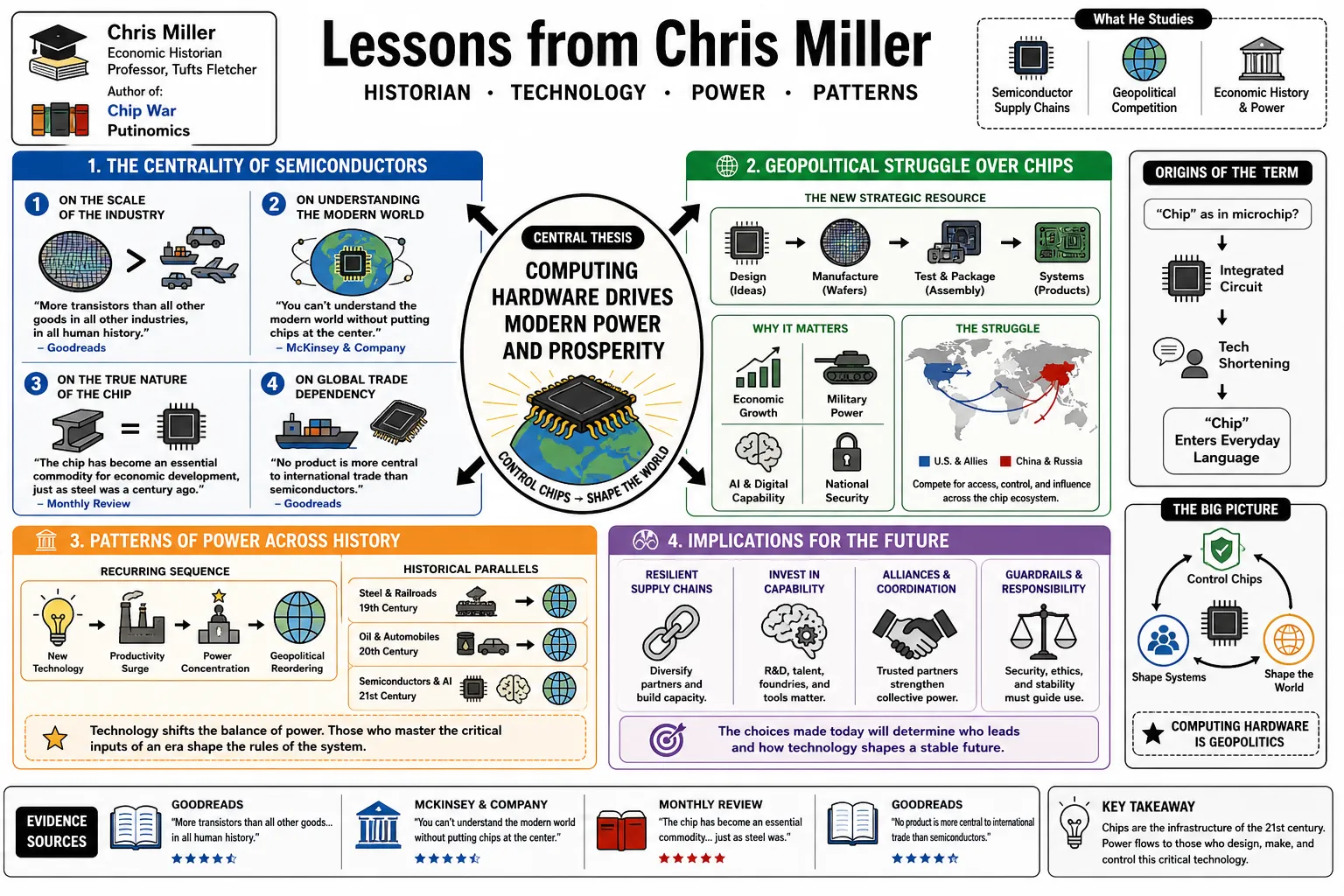
Lessons from Chris Miller
Chris Miller is an economic historian and professor at Tufts University’s Fletcher School. He is best known for analyzing the geopolitical struggle over semiconductor supply chains in Chip War and Russian economic history in Putinomics. This profile outlines his views on technology, historical patterns of power, and how computing hardware dictates modern international relations.
Part 1: The Centrality of Semiconductors
- On the scale of the chip industry: "Last year, the chip industry produced more transistors than the combined quantity of all goods produced by all other companies, in all other industries, in all human history." — Source: Goodreads
- On understanding the modern world: "You can’t understand the modern world without putting chips at the center of the story." — Source: McKinsey & Company
- On the true nature of the chip: "It would not be an exaggeration to say that the chip has become an essential commodity for economic development, just as steel was a century ago." — Source: Monthly Review
- On global trade dependency: "No product is more central to international trade than semiconductors." — Source: Goodreads
- On the origins of the colloquial term: "Kilby called his invention an 'integrated circuit,' but it became known colloquially as a 'chip,' because each integrated circuit was made from a piece of silicon 'chipped' off a circular silicon wafer." — Source: Goodreads
- On chips as a fundamental resource: "Semiconductors have effectively become the crude oil of the 21st century, powering almost every modern device from consumer appliances to military systems." — Source: Substack
- On manufacturing difficulty: "Making chips is the most fascinating and complicated manufacturing problem in human history." — Source: El Pais
- On the ubiquity of computational power: "We rarely think about the tiny pieces of silicon that make everything work, yet they dictate the limits of human capability and economic growth." — Source: Financial Times
- On the foundation of artificial intelligence: "Without continuous advancements in semiconductor manufacturing, the current boom in artificial intelligence would be physically impossible to sustain." — Source: Hear This Idea
- On technological dominance: "Whoever controls the semiconductor industry controls the future of technology, and much of the future economy." — Source: Substack
Part 2: The Geopolitics of Technology
- On the nature of modern competition: "The current struggle over advanced computing power is driven by national security concerns, specifically the deployment of intelligence and military superiority." — Source: Asia Pacific Initiative
- On the invisible currency of power: "Control over the chokepoints of chip production gives certain nations immense geopolitical leverage, functioning as a hidden currency in international relations." — Source: McKinsey & Company
- On American complacency: "So Washington kept telling itself that the U.S. was running faster, blindly ignoring the deterioration in the U.S. position, the rise in China’s capabilities, and the staggering reliance on Taiwan and South Korea." — Source: Goodreads
- On Washington's past vocabulary: "In polite company in Washington and Silicon Valley, it was easier simply to repeat words like multilateralism, globalization, and innovation, concepts that were too vacuous to offend anyone in a position of power." — Source: Goodreads
- On shifting from trade to security: "The geopolitical landscape has shifted from viewing tech disputes merely as matters of market share to defining them as existential matters of national defense." — Source: WordPress
- On technology and foreign policy: "A nation's foreign policy is now inextricably linked to its ability to secure advanced technologies and deny those same technologies to adversaries." — Source: Tufts University
- On the limits of free markets in tech: "The idea that global supply chains would remain permanently insulated from state intervention was a historical anomaly that has now come to a close." — Source: Financial Times
- On hardware versus software: "While much of the public focus has been on software and algorithms, the true geopolitical battleground lies in the hardware that allows software to run." — Source: Carnegie Council
- On technological sovereignty: "Nations are increasingly recognizing that relying on geopolitical rivals for foundational technologies is a strategic risk they can no longer accept." — Source: Foreign Affairs
- On the illusion of decoupling: "Complete separation of global tech ecosystems is nearly impossible due to the deep integration of knowledge, capital, and specialized manufacturing." — Source: Noahpinion
Part 3: The Chip Supply Chain and Vulnerabilities
- On Taiwan's production dominance: "Chips from Taiwan provide 37 percent of the world’s new computing power each year." — Source: Summrize
- On Dutch manufacturing monopolies: "The Dutch company ASML builds 100 percent of the world’s extreme ultraviolet lithography machines, without which cutting-edge chips are simply impossible to make." — Source: Summrize
- On Korean memory production: "Two Korean companies produce 44 percent of the world’s memory chips." — Source: Summrize
- On supply chain fragility: "A single chip might involve designs from the U.S. and UK, machinery from the Netherlands, and assembly in Southeast Asia, making the global economy uniquely vulnerable." — Source: Monthly Review
- On the role of TSMC: "Taiwan Semiconductor Manufacturing Company has become the most critical node in the global economy, producing the vast majority of the world's most advanced chips." — Source: The Hundred
- On extreme ultraviolet lithography: "The engineering precision required to manipulate light at the extreme ultraviolet spectrum represents a bottleneck that no single country can easily replicate." — Source: Hidden Forces
- On the geographic concentration of risk: "The concentration of advanced manufacturing in earthquake-prone and geopolitically contested areas poses an unprecedented risk to global stability." — Source: World Economic Forum
- On the cost of fabrication facilities: "Building a single cutting-edge semiconductor fab now costs tens of billions of dollars, creating massive barriers to entry for new competitors." — Source: American Enterprise Institute
- On design versus manufacturing: "The historical U.S. decision to separate chip design from manufacturing led to immense profitability but resulted in the loss of critical production capabilities." — Source: The Wire China
- On the necessity of global talent: "The semiconductor supply chain is not just a flow of materials; it relies on a highly specialized, globally distributed pool of engineering talent." — Source: Institut Montaigne
Part 4: U.S.-China Tech Rivalry
- On Chinese import volume: "China’s import of chips, $260 billion in 2017, the year of Xi’s Davos debut, was far larger than Saudi Arabia’s export of oil or Germany’s export of cars." — Source: Goodreads
- On the fundamental trade paradox: "Our fundamental problem is that our number one customer is our number one competitor." — Source: Goodreads
- On strategic vulnerability: "China's leaders have identified their reliance on foreign chipmakers as a critical vulnerability." — Source: Bookfave
- On Chinese response strategy: "They've set out a plan to rework the world's chip industry by buying foreign chipmakers, stealing their technology, and providing billions of dollars in subsidies." — Source: Bookfave
- On the purpose of American export controls: "The goal of recent U.S. restrictions is not just to maintain a lead, but to actively degrade China's ability to produce the advanced chips needed for military applications." — Source: Noahpinion
- On domestic capabilities: "Despite massive state investment, China's efforts to achieve semiconductor self-sufficiency face immense hurdles due to restricted access to foreign tools and materials." — Source: Financial Times
- On the role of legacy chips: "While cutting-edge chips dominate headlines, China is rapidly building capacity in older legacy chips, which remain crucial for automotive and industrial sectors." — Source: ChinaTalk
- On the impossibility of total isolation: "Total containment of China's tech sector is unfeasible; the objective is targeted friction at critical technological nodes." — Source: Council on Foreign Relations
- On the race for algorithmic supremacy: "The U.S.-China technology rivalry is ultimately a contest to determine which system will harness artificial intelligence to maximize economic and military power." — Source: Metacast
- On the risk of escalation: "The intertwined nature of the U.S. and Chinese tech economies means that aggressive decoupling carries risks of severe collateral damage to both sides." — Source: Bloomberg Talks
Part 5: Putinomics and Russian Economic Strategy
- On the core goal of Putinomics: "Putinomics made it possible for Russia's president to survive repeated financial and political shocks. This strategy will not make Russia rich, but it has kept the country stable and kept the ruling elite in power." — Source: Tufts University
- On the pillars of the Russian model: "Putinomics relies on a three-pronged strategy: macroeconomic stability, social stability, and selective efficiency that does not threaten the regime." — Source: Tufts University
- On the memory of the 1990s: "For most Russians, the 1990s was a period of chaos, and there was a real desire for stability. That meant stability in economic terms and stability in political terms." — Source: Tufts University
- On the nature of Russian corruption: "There has indeed been greed and theft aplenty in modern Russia. Much of this has been related to the president's friends, who have used corrupt contracts with state-owned firms to accumulate fortunes." — Source: Goodreads
- On the true cost of corruption: "The cost of this corruption is not only the money diverted from better uses, but also the investments that did not occur because potential entrepreneurs feared for the safety of their firms." — Source: Goodreads
- On hidden financial networks: "Evidence is plentiful, however, that the system of shell companies and offshore bank accounts that Russia's elite use to hide their financial dealings from prying eyes has shaped Russian financial and corporate life." — Source: Goodreads
- On cronyism over competence: "These connections, rather than any evident business skill, allowed him to amass a tremendous fortune." — Source: Goodreads
- On Putin's true priorities: "Ultimately, Putin’s objectives are driven by imperial ambition and territorial control rather than traditional economic maximization; he is a czar, not a businessman." — Source: Substack
- On the resilience of the regime: "Western analysts repeatedly underestimated Putin's economic model, expecting sanctions and oil crashes to end his rule, but his prioritization of low debt and high reserves provided durable shock absorbers." — Source: UTB
Part 6: Russia's Historical Pivot to Asia
- On the Russian ambition in Asia: "In Europe we were hangers-on and slaves, while in Asia we shall be masters." — Source: SciSpace
- On the pendulum of Russian history: "If we follow the course of Russian history, we shall find a perpetual swinging of the pendulum between two poles of attraction, Europe and Asia." — Source: Asian Review of Books
- On recurrent historical patterns: "Russia's pivots to Asia are not unique to the modern era; they represent a centuries-old pattern of seeking status and power in the East when European avenues are blocked." — Source: SciSpace
- On the illusion of the East: "Historical pivots to Asia have frequently been fueled by excessive optimism, only to be heavily tempered by logistical realities and vast geographical distances." — Source: Asian Review of Books
- On Russia's European roots: "Despite repeated attempts to reorient toward the Pacific, Russia remains fundamentally rooted in European culture and economics, limiting the depth of its Asian integration." — Source: Goodreads
- On the limits of partnership: "While current alignment with China serves immediate strategic goals, historical mutual suspicion and unequal power dynamics constrain a true, long-term alliance." — Source: Texas National Security Review
- On infrastructural challenges: "Dreams of dominating Asian markets have continually foundered on the immense cost and difficulty of building infrastructure across the Siberian expanse." — Source: Air University
- On the search for glory: "When internal modernization stalled, Russian leaders historically looked to expansion in the East as a substitute for domestic prosperity and a source of national prestige." — Source: SciSpace
- On modern implications: "Putin’s current turn toward China is the latest iteration of this historical pendulum, driven more by alienation from the West than by organic economic synergy with the East." — Source: Asian Review of Books
Part 7: The Nature of Modern Conflict and Sanctions
- On the effectiveness of sanctions: "Sanctions rarely provoke immediate regime change, but they serve to gradually degrade a target nation's industrial capacity and technological edge over time." — Source: Foreign Policy Research Institute
- On technological warfare: "Denying a rival access to cutting-edge microelectronics is now considered as critical to national security as denying them access to physical weapons materials." — Source: Council on Foreign Relations
- On military modernization: "The precision and lethality of modern military systems are entirely dependent on semiconductors, making the supply chain a primary target in any sustained conflict." — Source: Carnegie Council
- On the changing definition of a blockade: "A modern blockade does not require ships; it requires coordinated export controls that choke off a nation's supply of essential silicon." — Source: Hidden Forces
- On the role of allied coordination: "Export controls are only effective when implemented as a coalition; unilateral restrictions simply drive adversaries to alternative international suppliers." — Source: Noahpinion
- On the duality of commercial technology: "The line between commercial and military technology has vanished, as the same chips powering consumer electronics are used to guide missiles." — Source: Financial Times
- On industrial capacity: "Modern conflicts are often won by the side that can out-manufacture the other, a reality that places a premium on resilient domestic supply chains." — Source: Tufts University
- On the persistence of legacy systems: "While advanced AI chips garner attention, conflicts often rely heavily on the mass production of basic, mature-node semiconductors for fundamental battlefield operations." — Source: ChinaTalk
Part 8: The Future of Computing and Power
- On the enduring relevance of Moore's Law: "The relentless miniaturization of transistors has been the primary driver of global economic growth, and maintaining this pace is the defining engineering challenge of our time." — Source: Hear This Idea
- On the limits of physics: "As manufacturing approaches the atomic scale, the industry must rely on increasingly exotic materials and extreme physical processes to continue advancing." — Source: Simplecast
- On the importance of advanced packaging: "Reference: Miller argues that the AI-server boom is making advanced packaging and 3D stacking increasingly central, because progress now depends not only on fabrication nodes but also on how multiple components are assembled into higher-performance systems." — Reference: Tech Taiwan transcript with Chris Miller on AI supply chains
- On the transition of global influence: "The nation that houses the most advanced semiconductor fabrication facilities holds the keys to the next generation of artificial intelligence and quantum computing." — Source: Metacast
- On industrial policy: "Governments worldwide have realized that passive reliance on free markets is insufficient to guarantee access to the technologies defining the future." — Source: Financial Times
- On the role of subsidies: "The global rush to subsidize domestic chip production reflects a fundamental shift toward prioritizing supply chain resilience over pure cost efficiency." — Source: Institut Montaigne
- On the human element: "Despite the focus on machines and silicon, the ultimate bottleneck in semiconductor advancement is the finite global supply of highly trained engineers and physicists." — Source: McKinsey & Company
- On technology and societal structure: "The distribution of computing power will increasingly dictate the distribution of economic opportunity and political influence across the globe." — Source: World Economic Forum
- On the ongoing chip war: "The battle for semiconductor supremacy is not a temporary trade dispute, but a permanent feature of the 21st-century geopolitical landscape." — Source: Goodreads