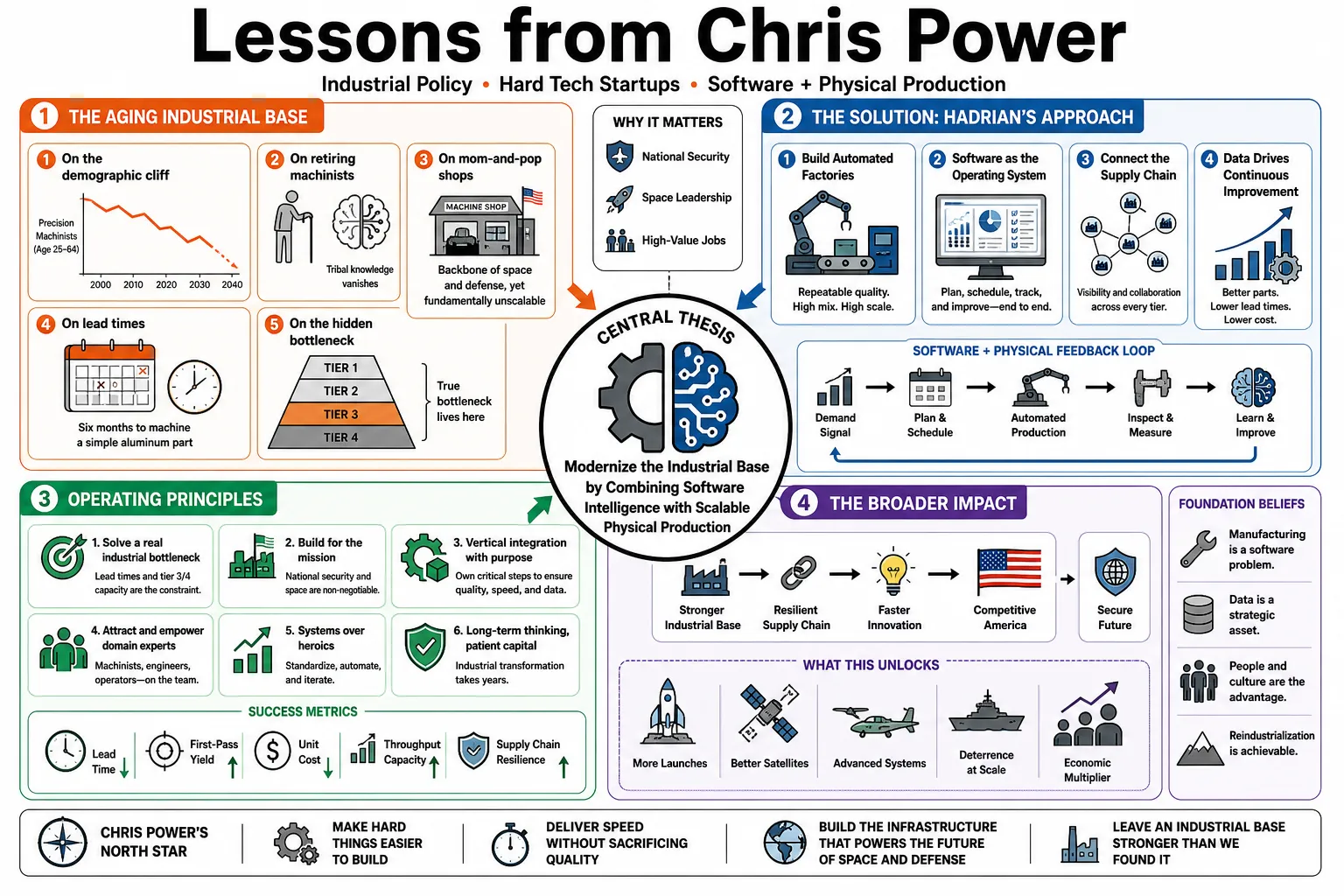
Lessons from Chris Power
Chris Power founded Hadrian to build software-enabled factories for precision aerospace and defense components. He argues that aging, fragmented suppliers and slow production threaten domestic industrial capacity. — a16z Building Better Factories.
Part 1: The Aging Industrial Base
- The demographic and capacity problem: Power argues that an aging network of independent machine shops creates both a workforce succession problem and a production-capacity risk for aerospace and defense. — Power Congressional Testimony.
- Separate owner and worker demographics: In 2022 Power estimated the average small machine-shop owner was about 60 and the average worker about 55. He treated both as succession challenges for the supplier base. — a16z Rockets, Jets, and Chips.
- A fragmented supplier base: Power described thousands of small owner-operated shops supplying complex aerospace and defense components. Their fragmentation, not an inherent inability of any one shop to grow, is the scale challenge. — a16z Rockets, Jets, and Chips.
- Lead times constrain builders: Power said legacy precision-parts suppliers often worked to 10–12-week lead times, slowing faster-moving space customers. Hadrian sought a substantially faster service for supported work. — a16z Rockets, Jets, and Chips.
- Look beneath the prime contractor: Power traces defense manufacturing bottlenecks deep into networks of small suppliers whose know-how may sit with a few people. The issue is not visible from the prime contractor’s finished product. — Breaking Defense Interview.
- Capture shop-floor know-how: In Power’s factory visits, some suppliers depended on experienced individuals without standardized processes for teaching replacements. That makes knowledge transfer a production risk. — Breaking Defense Interview.
- Respect skill while changing the process: Power says he respects small-shop owners and wants them to have a path into a modernized manufacturing system, even as customers need more reliable and faster production. — a16z Rockets, Jets, and Chips.
- Use automation to extend scarce expertise: Power’s approach is to automate much of a process and simplify the remaining work so new operators can contribute without relying entirely on a scarce pool of veteran machinists. — a16z Building Better Factories.
- Plan for succession: Power warns that aging owner-operators and thin succession plans put specialized supplier capacity and tacit production knowledge at risk. Closure of every shop is not inevitable. — a16z Building Better Factories.
Part 2: Geopolitics and National Security
- Industrial capacity is a security issue: Power frames domestic production capacity as part of national security and geopolitical resilience. This is his strategic argument, not proof that manufacturing alone decides every conflict. — Power Congressional Testimony.
- Delivery speed supports iteration: Power links dependable component delivery with faster development for rocket, satellite and defense teams, alongside the need for quality and reliability. — a16z Building Better Factories.
- Replenishment matters alongside performance: Power argues that military capability depends not only on the quality of a weapon system but also on how many can be produced and replenished. — a16z Rockets, Jets, and Chips.
- Respond to state-backed industrial scale: In testimony, Power contrasts China’s state-directed industrial investment with a proposed US response built on software, automated factories and skilled workers. — Power Congressional Testimony.
- Offshoring can erode the skills ladder: Power argues that moving simpler manufacturing abroad weakened the base of workers who could progress into more complex domestic production. — a16z Rockets, Jets, and Chips.
- Secure domestic sourcing for critical programs: Power urges stronger domestic-sourcing rules and advanced US manufacturing for defense programs to reduce strategic dependence on fragile supply chains. — Power Congressional Testimony.
- Replenishment requires durable suppliers: Power uses ammunition and missile replenishment to illustrate why defense readiness depends on production capability and transferable component know-how. His examples should be read as his argument, not independently verified program statistics. — a16z Building Better Factories.
- Shipbuilding exposes capacity gaps: Power’s testimony uses Navy shipbuilding delays, aging infrastructure and shortages of skilled workers as an example of the broader industrial-capacity challenge. — Power Congressional Testimony.
- Work with both primes and challengers: Power describes Hadrian serving established defense primes and new startups, including migrating production when a supplier fails and helping prototypes reach production scale. — Breaking Defense Interview.
Part 3: The Software-Defined Factory
- Treat the factory as a software system: Hadrian uses software across quoting, scheduling, machining and inspection so a flexible factory can serve different precision-part orders, while people still handle work that is not automated. — TechCrunch Interview.
- Simplify before automating: Power says Hadrian first simplifies an expert-dependent operation into a consistent process, then uses software to automate tractable pieces. Digitizing a bad process alone would not solve it. — Contrary Interview.
- Turn tacit expertise into teachable steps: Power describes breaking specialist work into checklists and skill ladders so new workers learn progressively. This captures some shop-floor knowledge without claiming every expert judgment becomes deterministic code. — a16z Rockets, Jets, and Chips.
- Automate CNC programming where tractable: Power includes CNC programming among the labor-intensive steps Hadrian is trying to automate from order through finished part. It is one element of an integrated workflow. — TechCrunch Interview.
- Increase machine productivity with fewer operators: Power reported in 2024 that one Hadrian worker could supervise roughly four to six CNC machines after programming automation, versus an expert dedicated to each machine in the comparison he gave. — TechCrunch Interview.
- Integrate from order to shipment: Power’s factory-as-product model coordinates the steps between an incoming order and a shipped qualified component, including scheduling, machining and inspection. — TechCrunch Interview.
- Make factory performance observable: Power’s factory-data discussion focuses on seeing uptime, costs and bottlenecks across people and machines so teams can find the real constraint. — a16z Factory of the Future.
- Use software to lower the operator learning curve: Hadrian says its simplified systems let people without machining experience perform supported production work after short training; that does not make expert CNC knowledge unnecessary in every role. — Hadrian Mission Essay.
- Use scheduling software for complex jobs: Power lists scheduling and task management among factory operations Hadrian seeks to automate. Software helps coordinate multi-step production, without making scheduling infinitely better than every manual practice. — TechCrunch Interview.
Part 4: Silicon Valley vs. Hard Tech
- Venture interest in American Dynamism grew: In a 2024 interview, Power described stronger investor, customer and recruiting interest in national-interest manufacturing companies, while warning that some new investors might underestimate how hard they are to build. — Sourcery Chris Power Interview.
- Underwrite deep-tech outcomes differently: Power argued that capital-intensive manufacturing startups can have unusually binary outcomes and that investors need to understand their distinct risk and return profile. — Sourcery Chris Power Interview.
- Serve customers who need faster iteration: Power says fast-growing new-space customers created an entry wedge for a manufacturing startup because they needed parts sooner and were willing to try a new supplier. — a16z Rockets, Jets, and Chips.
- Match financing to factory assets: Power argues that a capital-intensive factory business needs non-dilutive financing for equipment and facilities alongside venture capital for its software and growth. He does not claim margins become automatically defensive at scale. — Contrary Interview.
- Bring software and manufacturing talent together: Power chose Los Angeles partly for its overlap of aerospace manufacturing and software talent and describes intentionally building a shared culture across those groups. — a16z Building Better Factories.
- Software errors can damage physical assets: Power cautioned that factory software bugs can damage expensive equipment, making correctness a physical operating concern as well as a coding concern. — Sourcery Chris Power Interview.
- Let factory operation correct the roadmap: Power says a team cannot design an automated factory entirely in a room; operating it reveals the actual bottlenecks and may force substantial roadmap changes. — a16z Factory of the Future.
- Pair engineers with production experts: Power describes starting software work with subject-matter experts so technical teams understand the real manufacturing task before trying to automate it. — Contrary Interview.
- Make code’s physical effects visible: Power says engineers are drawn to software whose effects on physical production can be seen quickly, sometimes the next day. — a16z Rockets, Jets, and Chips.
Part 5: Building Hadrian
- The company name refers to rebuilding infrastructure: Power says Hadrian was named for the Roman emperor’s effort to rebuild critical imperial infrastructure. — a16z Building Better Factories.
- Standardize before replicating: Power explains that a roll-up of varied shops would multiply hardware combinations and make software automation harder, so Hadrian pursued a more standardized factory platform. — a16z Factory of the Future.
- Digitize order intake and planning: Hadrian has used software to digitize incoming drawings and coordinate production work across its factories. — Breaking Defense Interview.
- Sell reliable speed to space builders: Power says newer space companies valued faster, reliable delivery from suppliers and were willing to work with Hadrian. — a16z Factory of the Future.
- Standardize physical equipment for software: Power says each extra combination of machine, tooling and workholding compounds automation complexity. Hadrian therefore designs a more consistent physical platform for its software. — a16z Factory of the Future.
- Design for repeatable factory rollout: Power describes an ambition to replicate facilities while carrying software, training and automation together; he also expects the next site to reveal what was still being handled manually. Repeatability is a goal under test, not a solved copy-and-paste formula. — Contrary Interview.
- Build quality into the production system: Hadrian describes embedded quality controls and inspection as part of serving aerospace and defense customers. That is an operating requirement, not evidence that it has achieved zero defects. — Hadrian Atlas Announcement.
Part 6: Talent and The New Workforce
- Treat operators as internal software customers: Power says the people operating production equipment are users of Hadrian’s internal software, so their downtime and experience should guide engineering priorities. — a16z Factory of the Future.
- Build software with production context: Power’s reported approach pairs software engineers with experienced manufacturing staff and simplifies a task before automation; a programmer need not personally operate every CNC machine, but must understand its workflow. — Contrary Interview.
- Create a visible skill and pay ladder: Power describes training workers through increasingly complex factory tasks, with hourly pay bands and seniority attached to the progression. — a16z Rockets, Jets, and Chips.
- Compress training for defined tasks: Power and Hadrian describe simplified factory roles that some entrants learned in roughly 30–60 days, compared with years of traditional apprenticeship. That does not mean becoming a master machinist in four weeks. — a16z Rockets, Jets, and Chips.
- Manage the cross-cultural team deliberately: Power describes intentionally integrating software engineers and factory workers, including hiring people who respect machinists and sharing everyday routines across roles. — a16z Rockets, Jets, and Chips.
- Recruit around a tangible mission: Power says software engineers often want to apply their skills to national-security and physical-world problems; Hadrian’s mission helps attract them. He does not describe a political-loyalty hiring test. — a16z Building Better Factories.
- Automate inspection steps without bypassing quality: Hadrian reports using software and automation in inspection as part of its production workflow while still treating quality control as essential. — Breaking Defense Interview.
Part 7: The Aerospace and Defense Ecosystem
- Train the next generation of builders: Power credits SpaceX not only for its products but for training aerospace engineers who later start new companies. That is a workforce-spillover observation, not proof of a single manufacturing formula. — a16z Rockets, Jets, and Chips.
- Make procurement support modern production: Power’s congressional testimony urges federal contracting to prioritize digitized, automated, US-based manufacturing for new ships, aircraft and other programs. — Power Congressional Testimony.
- Keep quality and traceability central: Aerospace and defense customers impose stringent component and inspection requirements, so Hadrian’s automation must include quality controls rather than optimize speed alone. — Breaking Defense Interview.
- Design for manufacturability early: Hadrian’s Atlas program offers DFM tooling and supplier support so startups can move from prototype to production without rebuilding their supply chain. — Hadrian Atlas Announcement.
- Fragmentation imposes coordination costs: Power describes a fragmented supplier base and long lead times; Hadrian’s Atlas announcement says fragmented networks make speed, quality and cost difficult to balance. — Hadrian Atlas Announcement.
- Scale beyond one boutique shop: Power’s stated mission requires enough repeatable domestic production capacity to replace vulnerable supplier capacity; one small factory cannot cover the national need. — Hadrian Mission Essay.
Part 8: The Founder's Mindset
- Choose software with a physical mission: Power acknowledges that a pure SaaS company would be easier, but says Hadrian attracts engineers who want to see their software affect the physical world. — a16z Rockets, Jets, and Chips.
- Finance the strategic manufacturing system: Power describes a factory company that must fund costly equipment as well as software, making non-dilutive capital a core scaling problem. — Contrary Interview.
- Align financial success with industrial impact: Power says he sought a company whose commercial success could itself strengthen US manufacturing capacity, making mission and balance sheet reinforce each other. — a16z Rockets, Jets, and Chips.
- Expect a high tolerance for difficulty: Power said founding in deep-tech manufacturing requires unusually high tolerance for operational complexity, risk and uncomfortable hands-on discovery. — Sourcery Chris Power Interview.