Chris Rokos is the founder and chief investment officer of Rokos Capital Management, a global multi-asset firm rooted in macro trading. He was previously a founding partner of Brevan Howard and studied mathematics at Oxford. — Chatham House Biography.
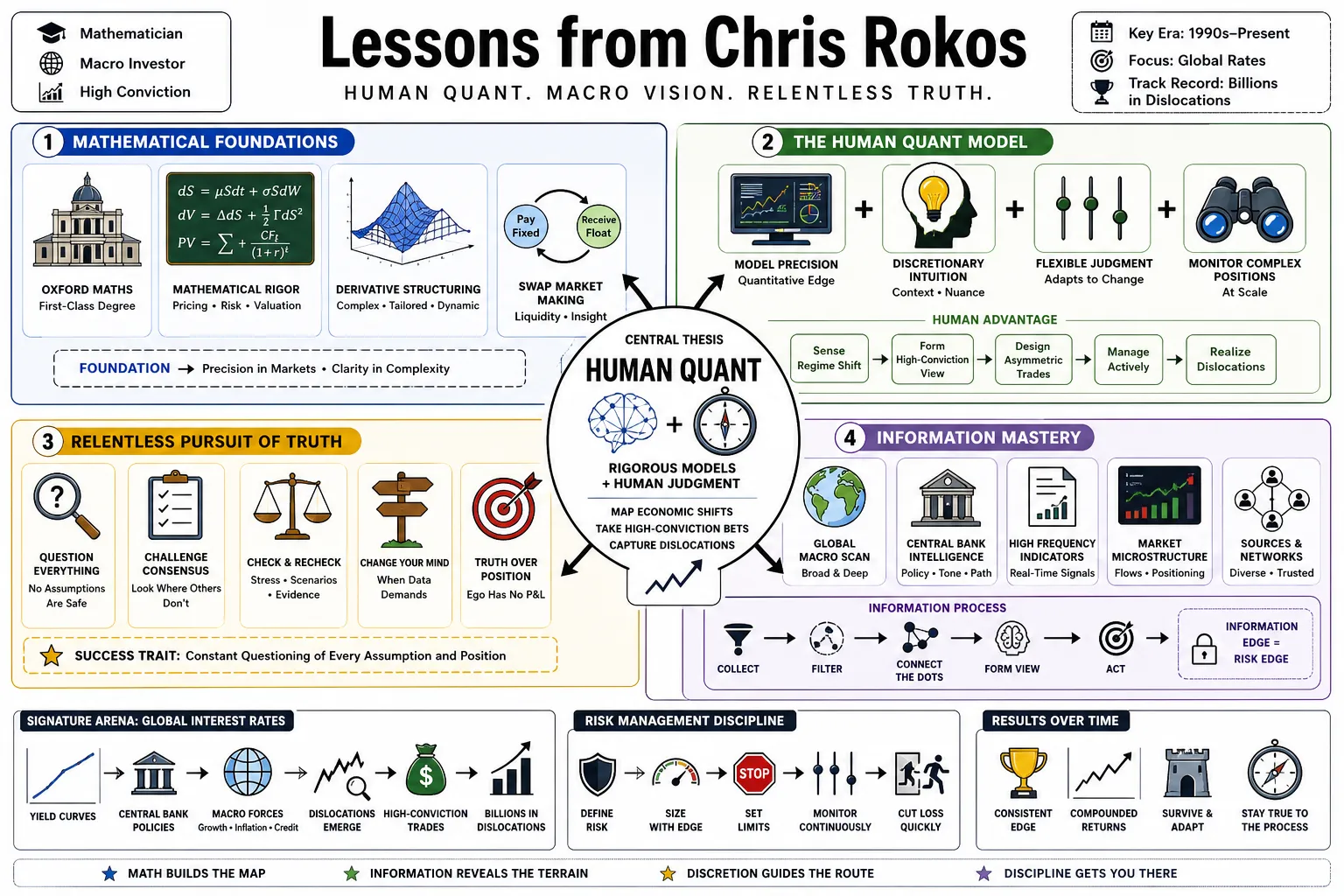
Part 1: Research Foundations & Macro Approach
- Integrated Research at RCM: RCM describes its investment process as combining macro and micro research with multi-asset trading; it also maintains dedicated quant and trading-operations teams. — RCM Company Profile.
- Mathematics at Oxford: Rokos read mathematics at Pembroke College, Oxford, and earned a First before beginning his career in finance. — Pembroke College.
- Global Multi-Asset Macro: RCM describes itself as a global multi-asset investment firm with deep macro foundations and integrated research. — RCM Company Profile.
- Opportunistic Public-Market Risk: In its tenth-anniversary statement, RCM described opportunistic risk-taking across public markets as part of its approach. — RCM Tenth-Anniversary Statement.
Part 2: Interest Rates & The Bond Market
- Developed-Market Fixed Income Focus: BMO's fund overview describes Rokos Global Macro as combining discretionary macro and relative-value strategies, with developed-market fixed income its primary focus. — BMO Fund Overview.
- Relative Value as One Strategy: BMO describes relative-value trading as one component of the fund's multi-asset approach, alongside discretionary macro trading; it does not identify a particular government-bond arbitrage rule. — BMO Fund Overview.
- The Initial Liquid-Market Mandate: At its 2015 launch, RCM expected to focus on foreign exchange, fixed income and equity-index products in developed markets and relatively liquid emerging markets. — Reuters Launch Report.
- A Wrong-Way Yield-Curve Bet: In October 2021, RCM lost money partly on wagers that the gap between short- and long-term UK and US government-bond yields would widen; the curves instead flattened. — Bloomberg Bond-Yield Report.
Part 3: Policy Expertise & Rates Views
- Policy Experience on the Research Team: RCM's chief economic strategist Lewis Alexander previously held roles at the U.S. Treasury and Federal Reserve Board. His background is documented, but no source establishes a privileged policy-prediction edge. — CFR Lewis Alexander Biography.
- A Dated US Rates Bet: Financial Times reporter Costas Mourselas said RCM was up 8.8% by February 2024 after a successful bet on US interest rates. — Financial Times Reporter.
- A 2024 Fed-Cut View: In May 2024, RCM's then-head of global markets Richard Tang said he considered Fed cuts that year unlikely and the later choice between easing and hiking uncertain. — Bloomberg TV Interview.
Part 4: Risk Management & Volatility Tolerance
- De-risking After the March 2023 Shock: After March 2023 bond-market turmoil, RCM told investors it had reduced risk; the firm said its profit-and-loss volatility subsequently declined. — Reuters Report.
- A CIO-Led Allocation Structure: At RCM's 2015 launch, sources told Reuters that Rokos would allocate most of the fund's money, while other portfolio managers would also run capital. — Reuters Launch Report.
- Why One Pension Fund Hired RCM: In 2017, Jersey's Public Employees Pension Fund appointed RCM and Capula to its alternatives allocation, seeking growth-like returns from assets uncorrelated with equities and more manager diversification. — Jersey Pension Fund 2017 Report.
- An Investor's 2021 Drawdown Review: Jersey's public pension fund reported an approximately 25% loss on its Rokos allocation in 2021. It put the manager on watch but said longer-term results and its assessment of risk processes supported continued holding. — Jersey Pension Fund 2021 Report.
- Dedicated Risk Oversight: RCM's 2024 disclosure describes a dedicated risk team measuring market and other exposures and using scenario analysis and stress testing. — RCM Risk Disclosure.
Part 5: Position Sizing & Convexity
- Structuring Risk and Reward: BMO says the fund uses options, other derivatives and trade structuring to optimize the risk-and-reward profile of its positions; the overview does not publish any specific option trade or payoff formula. — BMO Fund Overview.
- Concentration Can Increase Volatility: In reviewing its 2021 Rokos allocation, Jersey's pension committee noted that actively managed funds may take concentrated positions, producing volatility; it did not disclose an RCM position-size threshold. — Jersey Pension Fund 2021 Report.
- Consolidating the Portfolio: RCM consolidated separately managed trader portfolios into one pool in 2019, a change Bloomberg reported allowed larger bets. — Bloomberg 2020 Fund Report.
Part 6: Political Risk & Sterling
- A Reported Sterling Warning: In 2022, the Financial Times reported that RCM warned sterling was vulnerable to further falls. The publicly visible article does not show its underlying rationale or any related currency position. — Financial Times Sterling Report.
- Political Communications and Risk Premia: Hedge Fund Alpha reported that a year-end RCM investor letter expected elevated risk premia amid frequent Trump-administration communications. The original letter is not public in the accessible record, so this is the reporter's account rather than a verified personal quotation. — Hedge Fund Alpha Letter Report.
Part 7: AI & Fund Capacity
- AI Efficiency and Investment: Hedge Fund Alpha reported that Rokos saw more efficient AI models such as DeepSeek as a possible reason for greater AI investment, not necessarily less. The original investor letter was not available for direct inspection. — Hedge Fund Alpha Letter Report.
- The Jevons-Paradox Analogy: In the same reported investor-letter account, Rokos invoked the Jevons paradox: efficiency gains can increase total use of a resource. The accessible report describes the analogy but does not reveal a specific RCM AI trade. — Hedge Fund Alpha Letter Report.
- Capping Fund Size: In August 2025, Bloomberg reported that RCM planned to cap fund assets at $20 billion and return excess capital, with the amount dependent on full-year performance. — Bloomberg Report.
Part 8: Institutional Performance & Historical Lessons
- A 2008 Profit Contribution: Court records reviewed by Bloomberg showed that Rokos contributed $549 million to Brevan Howard's Master Fund profits in 2008. — Bloomberg Court-Record Report.
- A 2007 Profit Contribution: Court records reviewed by Bloomberg showed that Rokos contributed $1.11 billion, or 27% of Brevan Howard Master Fund profits, in 2007. — Bloomberg Court-Record Report.
- A Reported Brexit-Day Gain: Bloomberg reported that RCM gained about 3% on 24 June 2016 after the Brexit vote; the available account does not establish how its positions changed as results came in. — Bloomberg Brexit Report.
- A Private Brexit Poll: Bloomberg's investigation reported that RCM commissioned an ICM exit poll for the 2016 Brexit vote and that pollster John Curtice discussed the model's design with Rokos. — Bloomberg Brexit Investigation.
- A Post-Election Gain: Bloomberg reported that RCM made almost $1 billion on the day after the 2024 US election, with gains across asset classes; the report did not specify a three-market trade. — Bloomberg Election Report.
- The Reported 2022 Return: Fund investors told Reuters that RCM gained 51% in 2022; the report does not establish which specific inflation or rate trade produced the result. — Reuters 2022 Return Report.
- The Reported 2020 Return: Bloomberg reported that RCM's macro fund gained 44% in 2020, without attributing that performance to a specific stimulus or liquidity pivot. — Bloomberg 2020 Fund Report.
- A 2021 Yield-Curve Setback: Bloomberg reported that RCM lost 11% in October 2021 partly because UK and US government-bond yield curves flattened against the firm's steepener wagers. — Bloomberg Bond-Yield Report.