Chris Sacca built Lowercase Capital as an early-stage investor and later joined Crystal Sacca and Clay Dumas in Lowercarbon Capital, which backs businesses working on emissions reduction, carbon removal and ways to buy time against warming. The lessons below examine his investing, founder selection, pitching, money and climate views. — Tim Ferriss Show #790 Transcript.
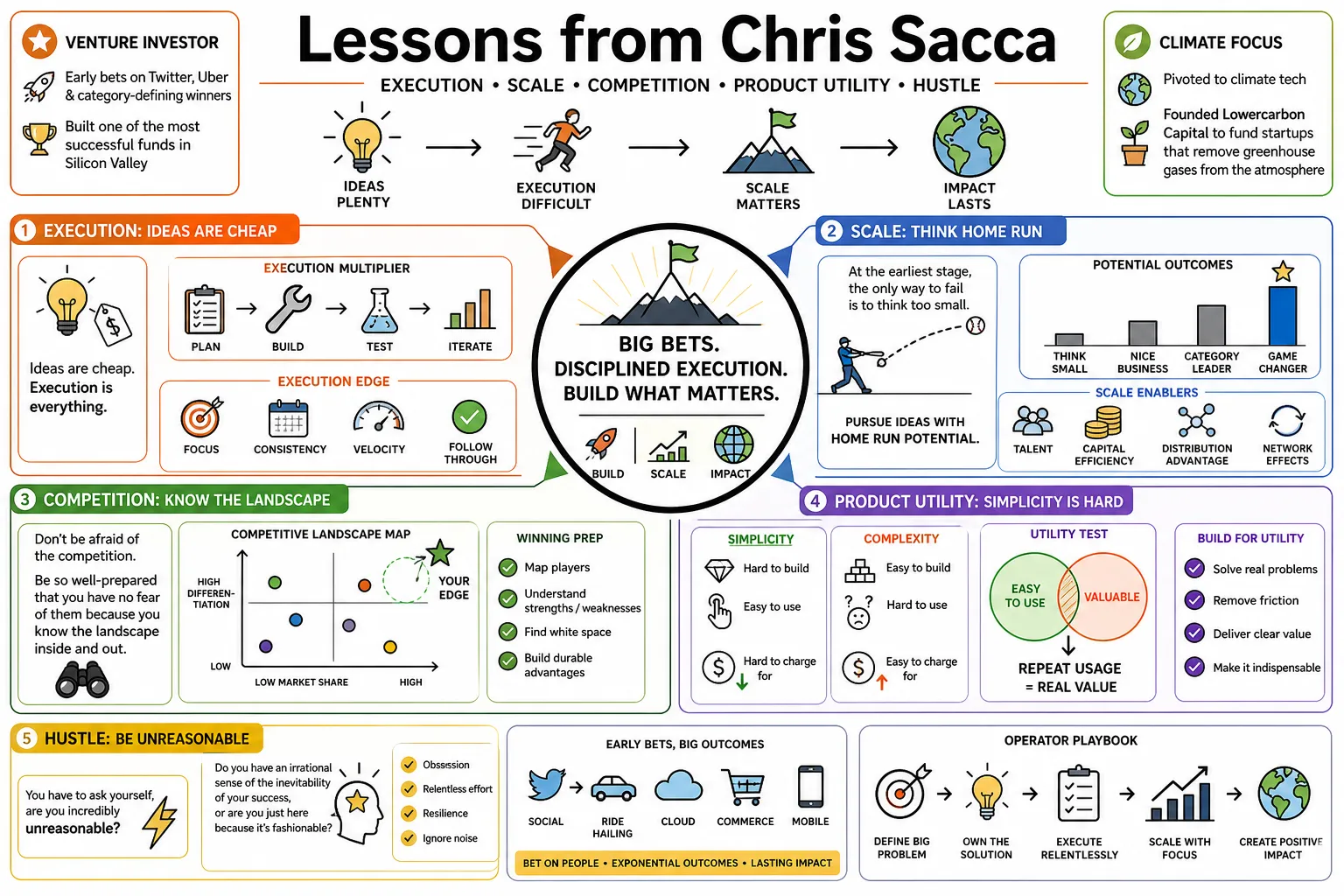
Part 1: Execution and Early-Stage Building
- Execution Beyond the Idea: Sacca says an idea alone is not what he invests in; the team's ability to execute is what matters. — Tim Ferriss Show #79 Transcript.
- Leave Room for Scale: In his investment rules, Sacca looks for a strong company at a price that still allows meaningful upside if it scales. — Tim Ferriss Show #79 Transcript.
- Assess a Rival's Execution: In weighing a possible Uber competitor, Sacca looked beyond the idea to Kalanick's demonstrated resourcefulness, product judgment and ability to learn a new market quickly. — Lowercase Capital — Why I Would Never Want to Compete With Travis Kalanick.
- Look for Founder Conviction: Sacca is wary when a founder seems to be trying to convince themselves; in founders he has backed, he has valued deep conviction about what they are building. — Tim Ferriss Show #79 Transcript.
- Work Together Before Investing: Sacca says he often lends a hand to a prospective team before discussing a deal, so both sides can learn whether they can get useful work done together. — Chris Sacca and Hampus Jakobsson — Copenhagen Fireside Chat.
- Let Young People Learn From Trouble: Sacca worries that younger people have fewer chances to make and recover from minor mistakes; he sees those experiences as formative. — Tim Ferriss Show #790 Transcript.
Part 2: The Art of the Pitch and Storytelling
- Distill the Company's Story: Sacca says one way he helped startups was to shape a clear account of the business that could be explained to investors, prospective hires and users. — Stanford eCorner — Cleantech 2.0.
- Build a Focused, Quantified Pitch: In coaching Alex Blumberg, Sacca cut a meandering explanation into a short account of customer demand, the founder's advantage, the funding needed and the numbers that could make the business scale. — This American Life — It's Not the Product, It's the Person.
- Show Why an Investor Might Miss Out: Sacca's missed investments in Airbnb and Dropbox illustrate why investors can fear passing on a strong opportunity; a founder still needs a credible case for exceptional potential, not merely pressure tactics. — This American Life — It's Not the Product, It's the Person.
- State a Specific Ask Confidently: When Blumberg hedged about how much money he needed, Sacca pushed him to name a specific funding amount rather than an uncertain range. — This American Life — It's Not the Product, It's the Person.
- Make the User-Facing Message Clear: Sacca describes simplifying a startup's front page and making its calls to action clearer so users can more easily understand what is offered. — Stanford eCorner — Cleantech 2.0.
- Avoid Believing Your Own Hype: Sacca says his cowboy shirts remind him not to take himself too seriously or believe his own hype. — Entrepreneur — Sacca on His Cowboy Shirts.
Part 3: Investing Discipline
- Default to No on Investments: For new investment opportunities, Sacca says his default stance is no: he starts with an already strong company rather than assuming he can rescue a weak one. — Tim Ferriss Show #79 Transcript.
- Invest Where You Can Make a Difference: Sacca says he gets involved only when he believes he can materially improve a company's chance of success; he does not claim he can guarantee the outcome. — Tim Ferriss Show #79 Transcript.
- Start With an Already Strong Company: Sacca prefers backing a company that is already strong and that he can help improve, rather than relying on his advice to turn a weak one around. — Tim Ferriss Show #79 Transcript.
- Be Proud of Every Deal: Sacca says he has passed on potentially profitable investments when he would not be proud to explain to his children how he made the money. — Tim Ferriss Show #79 Transcript.
- Choose Relationships Deliberately: Sacca says moving to Truckee helped him replace reactive Silicon Valley meetings with deliberate time spent getting to know founders and collaborators more deeply. — Tim Ferriss Show #79 Transcript.
- Probe Competition and Distribution Risk: When testing Blumberg's podcast startup, Sacca challenged its dependence on Apple and Google, changing attention habits and emerging rival shows. — This American Life — It's Not the Product, It's the Person.
- Make Time for Deeper Founder Relationships: After moving to Truckee, Sacca invited selected founders to spend time at his house and Jam Tub; he says the relationships helped catalyze some later investments. — Tim Ferriss — Sacca Interview Excerpt.
- Notice Founders Who Keep Learning: Asked what successful founders he knows have in common, Sacca points to their listening, reading, research and willingness to learn from others. — Tim Ferriss Show #79 Transcript.
Part 4: The Operator vs. The Idea
- Look for Demonstrated Operators: Sacca looks for evidence that a founding team can build, launch and put a product in users' hands, rather than judging an idea in isolation. — Tim Ferriss Show #79 Transcript.
- Match the Team to a Real Business: Sacca's investment screen combines a product already in use with evidence that the team can execute and founders who believe in the opportunity. — Tim Ferriss Show #79 Transcript.
- Keep a Truth-Teller Close: Sacca says success can leave leaders with fewer people willing to challenge them; he credits Crystal's candid daily pushback with helping him avoid that trap. — Dialectic — Chris Sacca: Drifting Back to Real.
- Notice How Founders Receive Help: Before investing, Sacca pays attention to whether founders welcome his contribution and whether the team can work productively with him. — Chris Sacca and Hampus Jakobsson — Copenhagen Fireside Chat.
- Commit Deeply to the Work: Sacca says his venture-investing practice required sustained, obsessive focus; trying to do it part-time left him frustrated and ineffective. — Lowercase Capital — Hanging Up My Spurs.
- Know Your Strengths and Gaps: Sacca says he took an honest inventory of where he was useful to startups and called on other experts for areas where he lacked an edge. — Stanford eCorner — Cleantech 2.0.
- Build Real Domain Knowledge: Sacca says he gets up to speed in unfamiliar technical fields by reading widely, talking with researchers and asking questions. — Stanford eCorner — Cleantech 2.0.
Part 5: Financial Realities, Debt, and Simplicity
- Live Below Your Means: Sacca argues that keeping spending and debt modest can make someone feel more financially secure even before they accumulate great wealth. — Entrepreneur — Sacca on Spending.
- Spending Restraint Creates Options: In Sacca's account, living below one's means can provide room to leave an unfulfilling job or try building something new. — Entrepreneur — Sacca on Spending.
- Possessions Demand Attention: After buying homes for relatives, Sacca found that managing those properties consumed unexpected time and attention, shaping his desire to simplify. — Tim Ferriss Show #790 Transcript.
- Work Back From a Deficit: After a leveraged trading loss left him millions in debt, Sacca says he worked his finances back to zero by 2005 before building his later investing career. — Tim Ferriss Show #79 Transcript.
- The Cost of a Leveraged Bet: Sacca recounts a highly leveraged public-market trade that erased about $12 million and left him owing roughly $4 million; the episode does not establish that he financed that trade with student loans. — Tim Ferriss Show #79 Transcript.
- Money Is Not Sacca's Measure of Success: In his 2011 commencement address, Sacca questioned whether maximizing money is a sound definition of success and criticized how wealth can affect character. — NPR — Sacca's 2011 Commencement.
- Create Distance From Reactive Meetings: Sacca says moving to Truckee helped him stop filling his days with unchosen Silicon Valley meetings and make more deliberate choices about whom to spend time with. — Tim Ferriss Show #79 Transcript.
- Define Success With the Founder: Sacca says a business that supports balanced hours, income and control over one's direction can be a successful outcome for its founder, even when it does not fit a venture investor's return goals. — Tim Ferriss Show — Sacca Follow-Up.
Part 6: Management and Influence
- Earn Influence by Being Useful: At Google, Sacca says he found ways to help people across the organization and volunteered for useful work before he held formal authority over those projects. — Stanford eCorner — Cleantech 2.0.
- Work Across Reporting Lines: Sacca credits part of his progress at Google to spotting problems that crossed departmental boundaries and working with people outside his own reporting line. — Stanford eCorner — Cleantech 2.0.
- Explain a Coherent Strategy to Stakeholders: In discussing Twitter, Sacca argues that even strong execution can be hard for outside investors to evaluate unless the company explains how its decisions fit a clear strategy. — Lowercase Capital — What Twitter Says and What We Hear.
- Set Culture Early: Sacca argues that a company's principles take shape among its first several dozen hires, making early choices about culture difficult to reverse later. — Stanford eCorner — Cleantech 2.0.
- Understand the End User's World: Sacca argues that product builders need familiarity with users' circumstances to make better decisions about features and pricing. — Tim Ferriss Show — Sacca Follow-Up.
- Give Specific, Candid Pitch Feedback: Coaching Blumberg's pitch, Sacca identified where the story wandered, asked for a precise funding request and demonstrated a tighter version before explaining the investment risks. — This American Life — It's Not the Product, It's the Person.
- Delegate to People Who Own the Work: Sacca says he looks for people who can take work off his plate and be trusted with broad responsibility instead of creating more coordination for him. — Stanford eCorner — Cleantech 2.0.
- Use a Uniform to Stay Grounded: Sacca says the cowboy shirts spare him clothing decisions, put people at ease and remind him not to take himself too seriously. — Entrepreneur — Sacca on His Cowboy Shirts.
Part 7: Climate Action and Lowercarbon Capital
- Lowercarbon's Investment Mission: Sacca describes Lowercarbon as backing businesses that cut emissions, remove carbon, or help buy time against climate risks while earning revenue. — Tim Ferriss Show #790 Transcript.
- Climate Investing, Not Charity: Sacca describes Lowercarbon as a for-profit investor in climate companies, distinct from his separate philanthropic donations. — Lowercarbon — Act II.
- Sell Beyond Climate-Conscious Buyers: Sacca argues that climate products need customers who choose them for cost or performance, including people who do not prioritize climate in their purchases. — Lowercarbon — Act II.
- Collaborate on Cleaner Industrial Products: Sacca says Lowercarbon works with oil-and-gas companies where their engineering capabilities can aid carbon work, and some of those companies buy cleaner industrial chemicals from a portfolio company. — Tim Ferriss Show #790 Transcript.
- Climate Risk Is a Business Problem: Sacca points to effects on ranching, utilities and insurance to argue that climate risk is a practical operating issue, not just an abstract environmental concern. — Tim Ferriss Show #790 Transcript.
- Make Climate Risk the Motivation: Sacca frames rising atmospheric carbon and heat as urgent reasons to cut emissions, remove carbon and explore ways to buy vulnerable communities more time. — Lowercarbon — Act II.
- Guilt Cannot Carry Mass Adoption: Sacca argues that policy and personal choices matter, but expecting enough buyers to pay extra out of guilt will not deliver the scale of climate adoption he seeks. — Lowercarbon — Act II.
- Back Technologies That Can Win on Merit: Sacca's climate-investing thesis is that lower-carbon products can reach mass markets when they are cheaper or better; he names frontier fields such as fusion and bioreactor-made chemicals as areas his portfolio explores. — Lowercarbon — Act II.
- Align Climate Impact and Returns: Lowercarbon's investment thesis is that cheaper, better low-carbon products can attract broad demand while offering profitable opportunities; Sacca presents the life-saving potential as an ambition, not a measured result. — Lowercarbon — Act II.
Part 8: Personal Philosophy and Being Weird
- Be Your Unusual Self: Sacca says the central message of his 2011 commencement speech was to be authentic about one's unusual qualities rather than shape a generic persona. — Tim Ferriss Show #132 Transcript.
- Experience Beyond Credentials: Sacca worries that optimizing only a resume and credentials can crowd out the varied experiences that make a person interesting and helpful. — Tim Ferriss Show #132 Transcript.
- Define Success Beyond Money: In his 2011 commencement address, Sacca described happiness as his own measure of success rather than equating success with financial metrics alone. — Sacca's Carlson Commencement Address.
- Become Internally Driven: Sacca says part of his personal work is becoming more internally driven, honest and authentic instead of relying on other people's approval. — Tim Ferriss Show #790 Transcript.
- Choose Your Own Priorities: Sacca urges people to identify work they chose for themselves rather than let other people's requests fill their entire agenda; he notes that being able to make those choices is a privilege. — Tim Ferriss Show — Sacca Follow-Up.
- Move Your Ideas Forward: Sacca says ideas and ventures he cares about will not happen unless he acts on them, so he tries to move promising work forward promptly. — Tim Ferriss Show #790 Transcript.