Lessons from Chris Walker
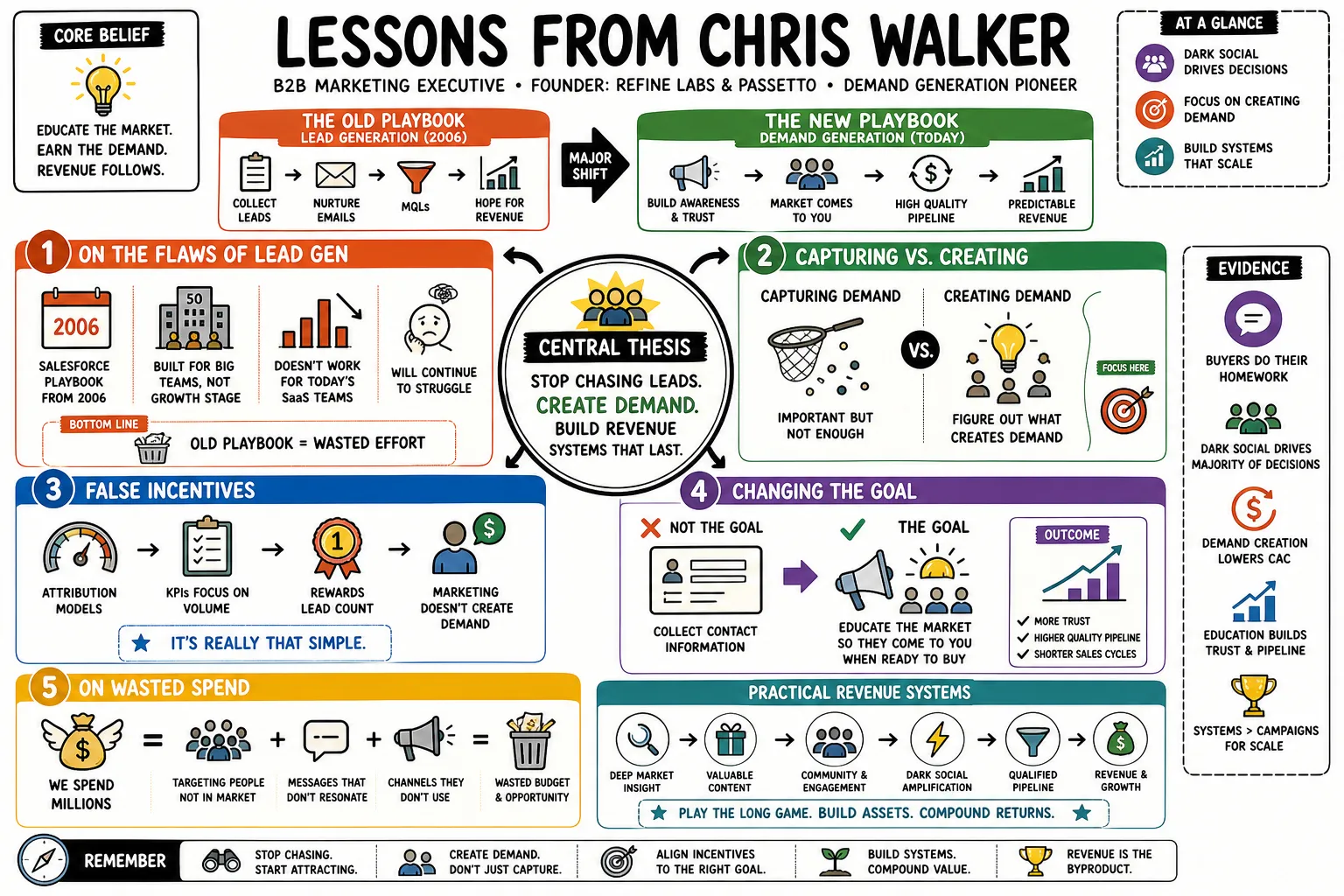
Chris Walker founded Refine Labs and later Passetto. His B2B go-to-market work contrasts collecting low-intent leads with creating demand through useful content, customer research and a better view of revenue performance. — FP&A Unlocked Interview.
Part 1: The Shift from Lead Generation to Demand Generation
- On the Flaws of Lead Gen: Walker argues that collecting contact information for Sales outreach often reaches buyers before they are ready. His alternative is to educate the market so informed buyers approach when a purchase becomes relevant. — Walker on Demand Creation.
- On Capturing vs. Creating: Attribution software can help show where a buyer converted, but Walker says that creating the demand leading to that conversion requires a different view of earlier education and discovery. — Marketing Operations Ops Cast.
- On False Incentives: Walker argues that marketing teams underinvest in demand creation when their KPIs credit only measurable website conversions, leaving education in third-party feeds and communities undervalued. — Walker on Demand Incentives.
- On Changing the Goal: Walker favors helping potential buyers understand the category and company before they are ready to purchase, rather than treating every collected contact as a sales-ready lead. — Walker on Demand Creation.
- On Wasted Spend: In his own paid-social testing, Walker says inexpensive gated-content leads created little sales value; he shifted toward ungated material that buyers could use before a sales conversation. — Walker on Ungated Content.
- On Defensive Marketing: Walker argues that marketing should help create future demand proactively, not operate only as a reactive support function for current sales activity. — Unlearn Podcast.
- On Gated Content: Walker's experiment led him to distribute educational material without requiring a form, so prospective buyers could learn before indicating purchase intent. — Walker on Ungated Content.
- On Educational Value: Walker says sharing substantive expertise in public helps an audience learn and assess the team's competence, even when that expertise is also part of paid client work. — How to Win Transcript.
- On Artificial Scarcity: Walker says buyers may want pricing and firsthand product information before a sales call. He recommends designing an easier self-directed path rather than forcing early contact. — Unlearn Podcast.
- On Volume over Quality: Walker criticizes volume-focused MQL targets when they reward contact collection without showing whether the program creates qualified pipeline or revenue. — Unlearn Podcast.
Part 2: Dark Social and The Attribution Mirage
- On the Attribution Mirage: Walker says attribution tools miss many word-of-mouth, community and cross-device interactions, so their reports give an incomplete picture of how buyers discovered a company. — Marketing Operations Ops Cast.
- On Trusting Peers: Walker describes buyers consulting peers and communities as part of researching vendors, often before those conversations become visible in company analytics. — Unlearn Podcast.
- On Blind Spots: When many influential touchpoints go untracked, Walker argues, teams can give too much weight to measurable lower-funnel channels and overlook earlier demand creation. — Marketing Operations Ops Cast.
- On Word of Mouth at Scale: Walker uses dark social to describe discovery through peer conversations, communities, referrals and social content that conventional attribution tools struggle to observe. — Marketing Operations Ops Cast.
- On Last-Touch Bias: In Walker's Refine Labs example, software credited search or direct traffic while customers described podcasts, communities and referrals that led them to inquire. — Marketing Operations Ops Cast.
- On Self-Reported Attribution: Walker says free-text self-reported attribution can quickly reveal what customers remember as the source of their interest; those answers complement rather than replace software data. — Unlearn Podcast.
- On Software Limitations: Walker recommends choosing a marketing strategy from primary customer research before selecting tools and attribution settings to measure it. — Walker on Customer-First Strategy.
- On Qualitative Data: Walker treats customer-reported discovery as a qualitative complement to software attribution: one helps explain demand creation, while the other better records where demand was captured. — Unlearn Podcast.
- On Misallocation of Budget: Walker warns that relying only on trackable conversion paths can steer budgets toward demand capture and away from earlier content, brand and community work. — Marketing Operations Ops Cast.
- On Asking the Customer: At Refine Labs, Walker added a required free-text ‘How did you hear about us?’ question to the main inquiry form and compared responses with software attribution. — Marketing Operations Ops Cast.
Part 3: Creating Meaningful B2B Content
- On In-House Expertise: Walker describes using conversations with people who know the customers and subject to create reusable content. The expertise and editorial judgment stay close to the business rather than being treated as a generic outsourced writing task. — Marketing Strategy Talk.
- On Point of View: Walker says Refine Labs' distinctive narrative developed through doing the work and talking with customers, rather than being invented as a finished slogan in a room. — How to Win Transcript.
- On Production Value: Walker argues that minor production imperfections should not keep a useful episode from being published; speed and consistency can matter more than polishing every small flaw. — Brands That Podcast.
- On Content Volume: Walker used frequent, consistent posting and deliberate experiments to learn what worked for his audience on LinkedIn, rather than waiting for a single polished campaign. — How to Win Transcript.
- On Authenticity: Walker's content approach emphasized knowledgeable people sharing useful ideas regularly; the original interview does not require elaborate production for every piece. — Brands That Podcast.
- On Finding Experts: Walker urges companies to involve their strongest subject-matter experts in public content, so buyers can hear from people with direct knowledge of the problem. — Brands That Podcast.
- On Repurposing: Refine Labs reused one live conversation as a video, podcast episode and several shorter LinkedIn clips, giving the same substantive discussion multiple useful formats. — Brands That Podcast.
- On Platform Formats: Walker adapts an idea to the platform where it appears; he warns that simply cross-posting identical content ignores how audiences consume each channel. — How to Win Transcript.
- On Personal Brands: Walker's public LinkedIn voice helped Refine Labs win early clients, and he later expanded the company's content beyond his own account to other team voices. — How to Win Transcript.
- On Writing for SEO: For the B2B motion he describes, Walker prioritizes useful native social and video content over treating SEO blogging as the main content strategy. He does not claim that every SEO article is bad for readers. — Walker on Modern B2B GTM.
Part 4: The Modern Buyer's Journey
- On Self-Education: Walker's buyer research found people learning about products from social content, podcasts and trusted users before they wanted a vendor sales conversation. — Unlearn Podcast.
- On Buying Committees: Walker notes that a B2B buyer may need colleagues to understand and support a problem before a purchase moves forward, so marketing cannot assume one contact decides alone. — Walker on Long-Term Marketing.
- On Customer Endorsements: Walker reports that some buyers wanted to hear from actual product users before talking to Sales, making genuine customer experience an important part of evaluation. — Unlearn Podcast.
- On Consumer Expectations: Walker's research led him to favor a lower-friction B2B buying experience, including access to pricing and product information before requiring a sales call. — Unlearn Podcast.
- On Prep Work: In Walker's own examples, customers had heard the podcast or encountered community discussion before submitting the website form that attribution software recorded. — Marketing Operations Ops Cast.
- On Sales Resistance: Walker says some buyers prefer to research price and hear from product users before a vendor sales conversation; he argues the buying path should respect that preference. — Unlearn Podcast.
- On Boardroom Blindness: Walker recommends asking customers how they learn and buy, rather than designing the whole go-to-market process around what is easiest for an internal team. — Unlearn Podcast.
- On Empathy: Walker says metrics require interpretation informed by empathy and common sense about what the buyer is experiencing, not just a surface reading of a dashboard. — Brands That Podcast.
- On Vendor Content: Walker's buyer interviews highlighted the role of trusted people and product users alongside vendor information during evaluation. — Unlearn Podcast.
Part 5: Sales, Marketing, and Revenue Alignment
- On Shared Metrics: Walker urges revenue teams to judge marketing against qualified pipeline, sales velocity and closed-won business, not merely the volume attributed to one department. — Walker on Marketing Metrics.
- On Marketing's Job: Walker sees marketing as building enough category and company understanding that qualified buyers can approach Sales already interested, rather than measuring success only by ad clicks. — Marketing Operations Ops Cast.
- On Sales Efficiency: Walker recommends giving qualified buyers who explicitly request a sales conversation a direct route to experienced reps, while prioritizing other outreach using tested signals rather than raw lead counts. — Walker on Allbound GTM.
- On Departmental Friction: Walker argues that department-specific credit and disconnected KPIs can set Sales, Marketing and SDR teams against each other instead of helping them optimize the whole buying path. — Walker on GTM Planning.
- On 'All-Bound' Measurement: Walker favors an integrated GTM view that distinguishes buyer intent and tracks the combined performance of Sales, SDR and Marketing motions instead of fighting over lead-source labels. — Walker on Allbound GTM.
- On Pipeline Quality: Walker says a content download does not by itself show purchase intent; marketing should assess whether programs bring qualified buyers into useful sales conversations. — Marketing Strategy Talk.
- On Outbound Saturation: Walker questions costly, undifferentiated outbound cadences, especially for young firms without an established brand, while explicitly stopping short of recommending that every company end outbound. — Walker on the SDR Model.
- On Sales Calls as Research: Walker argues that marketers need direct access to customers and prospective buyers for primary research; sales-call recordings and internal opinions alone cannot replace those conversations. — Walker's GTM Tenets.
- On Outdated SDR Models: Walker says the conventional SDR model deserves scrutiny against revenue and payback, especially when junior reps are sent to interrupt executives without sufficient buyer context. He does not propose eliminating every outbound motion. — Walker on the SDR Model.
Part 6: Rethinking Analytics and Metrics
- On Vanity Metrics: Walker prioritizes qualified pipeline, sales velocity and closed-won revenue over impression, click or download totals when judging marketing's business contribution. — Walker on Marketing Metrics.
- On Data vs. ROI: Walker argues that measurement should help a team choose better strategy, not merely produce a report that gives a tactic credit for revenue. — Walker on Customer-First Strategy.
- On Lifecycle Tracking: Walker says useful GTM analysis needs expense and revenue data across the customer lifecycle, rather than disconnected reports from each function or tool. — FP&A Unlocked Interview.
- On Channel Blame: Walker cautions against blaming a distribution channel automatically when results disappoint; first inspect the strategy, execution and buyer experience on that channel. — Brands That Podcast.
- On True Performance Arbiters: Walker uses revenue relative to marketing spend and CAC payback to test whether a demand program is economically credible to business leaders. — Marketing Operations Ops Cast.
- On Win Rates: Walker includes win rate and sales-cycle length in his sales-velocity view, making them useful checks on whether the pipeline a marketing program creates can convert efficiently. — Walker on Marketing Metrics.
- On Quantitative vs. Qualitative: Walker combines quantitative attribution with customer interviews and free-text responses to understand why buyers became interested; neither view tells the whole story alone. — Marketing Operations Ops Cast.
- On Intent Data: Walker distinguishes an observable engagement event from a useful purchase signal: each company should test whether a behavior actually correlates with qualified pipeline or deals won. — Common Room Interview.
- On Executive Reporting: Walker wants executive reporting to connect GTM investment with acquisition cost, growth and revenue outcomes, instead of relying on disconnected departmental decks. — FP&A Unlocked Interview.
Part 7: Designing a Signal-Based Go-To-Market Strategy
- On GTM Evolution: Walker argues that fragmented departmental GTM plans and credit-based reporting should be redesigned around shared data and unit economics. — Walker on GTM Planning.
- On Real Intent: Walker recommends testing which buyer behaviors predict useful pipeline for a particular company, then prioritizing outreach around those validated signals rather than generic lead scores. — Common Room Interview.
- On Marketing as Investment: Walker proposes treating GTM programs as a portfolio of investments whose costs and returns can be compared, with Finance helping leaders reallocate resources. — FP&A Unlocked Interview.
- On Real Estate Value: Walker treats a qualified buyer's request for a sales conversation as a valuable outcome and recommends making that path easy after the buyer has learned enough to be ready. — Marketing Operations Ops Cast.
- On Defining ICPs: When refining Refine Labs' ideal customer, Walker looked beyond industry and company size to buyers' mindset and organizational readiness, using conversations to test that fit. — How to Win Transcript.
- On Scaling Economics: Walker argues that scaling a GTM motion should include a clear view of acquisition cost and payback, not just a larger headcount or budget to meet a growth target. — FP&A Unlocked Interview.
- On Category Creation: Walker views category education as a gradual process: buyers must understand a problem, recognize it in their own business and align colleagues before a purchase becomes likely. — Walker on Long-Term Marketing.
- On GTM Bloat: Walker argues that teams built during growth-at-all-costs periods should be reviewed against revenue and payback so expensive GTM resources are used where they help buyers and growth. — Walker on the SDR Model.
Part 8: Execution, Experimentation, and Mindset
- On Speed of Learning: Walker favors testing GTM programs, learning from their outcomes and reallocating resources, rather than letting an inherited playbook run without scrutiny. — Unlearn Podcast.
- On Dropping Ego: Walker experimented with LinkedIn content and frequency to learn how the channel worked for his audience, then adjusted the content process as the business grew. — How to Win Transcript.
- On Strategy vs. Tactics: Walker puts customer understanding and a tested revenue strategy ahead of selecting new tactics or tools; the tools should serve the strategy once it works. — Walker on Customer-First Strategy.
- On Direct Conversations: Walker argues that marketers need direct conversations with customers and prospective buyers to guide strategy; internal opinions and sales-call recordings cannot fully substitute. — Walker's GTM Tenets.
- On First Principles: Walker recommends asking what buyers need before copying a conventional sales-development model, then designing a GTM approach from those first principles. — Walker on the SDR Model.
- On Planting Seeds: Walker says demand creation takes time because buyers must learn, recognize a problem and align colleagues before they are ready to act; short-term lead targets can obscure that work. — Walker on Long-Term Marketing.
- On Market Feedback: When a campaign underperforms, Walker's approach is to revisit what buyers actually do and want, test the strategy and update the measures instead of assuming the channel itself is the problem. — Walker on Customer-First Strategy.
- On Trusting Yourself: Walker recommends trusting primary buyer evidence and observed revenue over a ready-made playbook or tool-driven metric when choosing a GTM strategy. — Walker on Customer-First Strategy.