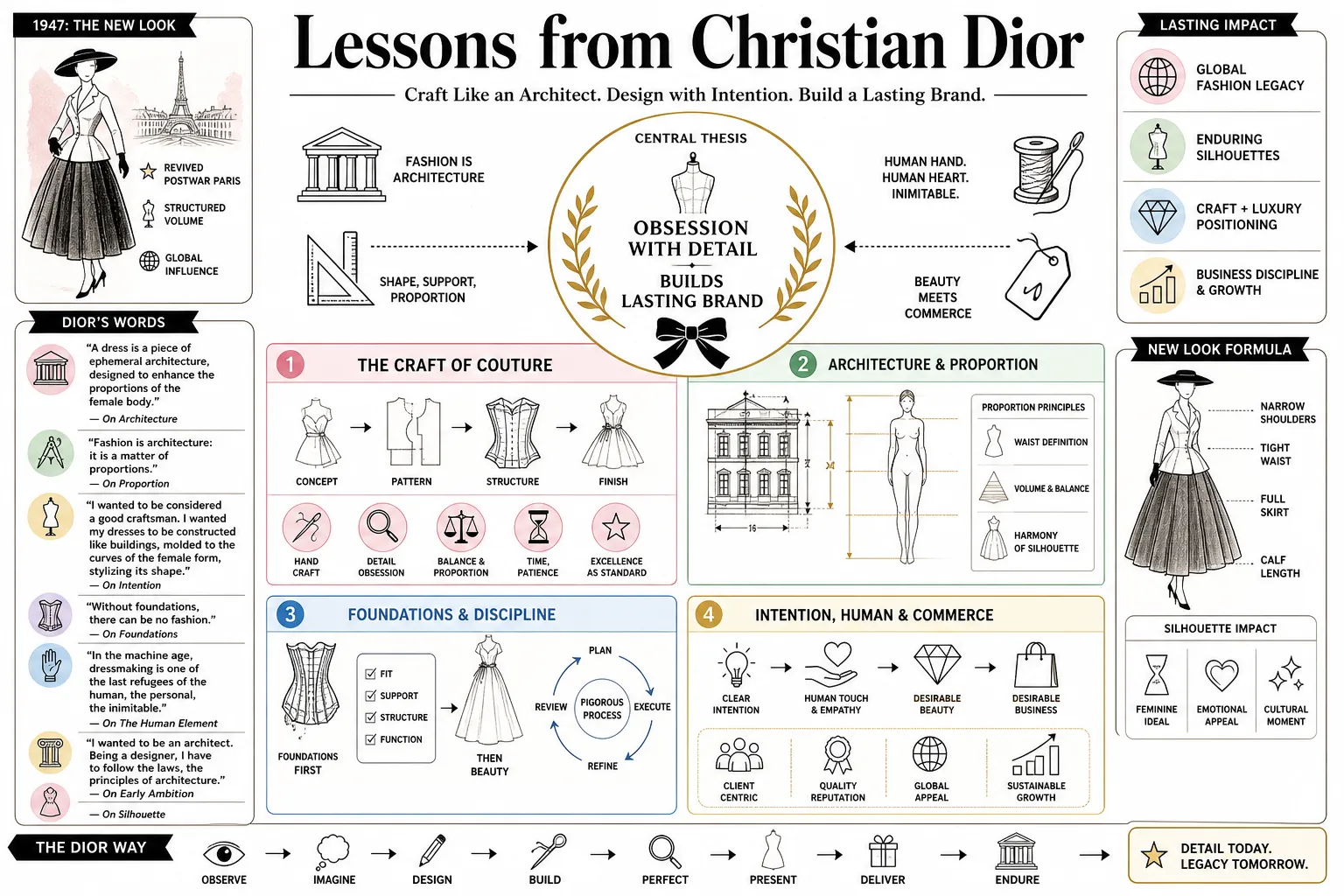
Lessons from Christian Dior
Christian Dior founded his couture house in 1946 and presented the first collection in February 1947. Its rounded shoulders, defined waist and full skirts became known as the New Look. In his autobiography and style dictionary, Dior explains the workmanship, material choices and judgment behind his designs. These lessons draw on those primary texts and the house archive. — La Galerie Dior History.
Part 1: The Craft of Couture
- On Architecture: Dior described couture as temporary architecture devoted to the form of the body; he used construction, not ornament alone, to shape a silhouette. — Dior by Dior.
- On Craftsmanship: Before his first show, Dior wanted above all to be judged a skilled craftsman; the line's impact grew out of that standard of workmanship. — Dior by Dior.
- On Foundations: Dior wrote that durable luxury needs strong materials, skilled workmanship and roots in sober, honest traditions. — Dior by Dior.
- On the Human Element: Dior imagined his new house as a craft workshop, where elaborate handwork could make clothes appear simple. — Dior by Dior.
- On an Architectural Vocation: Architecture was Dior's first ambition, and he later found a way to pursue that interest through the construction of clothes. — Dior by Dior.
- On Choosing Fabric: Dior generally began with the intended line and chose fabric for the texture, weight and body needed to realize it; the material could also reveal unexpected possibilities in the finished dress. — Dior by Dior.
- On Technique: A sketch was only a starting point: the atelier had to translate its line and movement into a toile, adjust the form, and solve the construction details. — Dior by Dior.
Part 2: Elegance and Simplicity
- On True Elegance: Dior defined elegance through distinction, naturalness, care and simplicity rather than pretension. — The Little Dictionary of Fashion.
- On Invisible Style: In the dictionary's discussion of lingerie, Dior argued that what is hidden still affects elegance and the wearer's sense of being well dressed. — The Little Dictionary of Fashion.
- On Authenticity: Dior advised finding what is distinctive in one's own personality and dressing naturally instead of imitating somebody else. — The Little Dictionary of Fashion.
- On Money and Taste: Dior said elegance does not depend on wealth; care in choosing, wearing and maintaining clothes matters more. — The Little Dictionary of Fashion.
- On Buying Less, Better: Dior recommended buying fewer accessories of good quality and selecting colours that work with several outfits. — The Little Dictionary of Fashion.
- On the Fundamentals: For Dior, simplicity, good taste and grooming were the foundations of good dressing, and none required a large budget. — The Little Dictionary of Fashion.
- On Independence: Dior advised ignoring a fashionable new line when it does not suit you; following fashion should still involve judgment. — The Little Dictionary of Fashion.
- On Individuality: Dior considered individuality part of real elegance, but distinguished it from eccentricity and urged choosing clothes suited to one's own personality. — The Little Dictionary of Fashion.
- On Polka Dots: Dior liked polka dots because they remained versatile and stylish, while advising different scales and colours for different figures and uses. — The Little Dictionary of Fashion.
Part 3: Women and Beauty
- On the Pleasure of Dressing: Dior believed his first collection succeeded partly by restoring the pleasure of clothes that were becoming, well made and appealing after wartime restrictions. — Dior by Dior.
- On Zest: At the close of his dictionary, Dior treated zest in both work and pleasure as part of beauty. — The Little Dictionary of Fashion.
- On Finding What Flatters: Rather than divide women into fixed categories of beauty, Dior advised studying one's own figure, needs and colouring to choose clothes that flatter. — The Little Dictionary of Fashion.
- On Flowers: Flowers shaped Dior's imagination from childhood and informed both the corolla-like silhouettes of his first collection and his perfumes. — Dior Couturier-Perfumer.
- On Pleasing Women: Dior described bringing back the neglected art of pleasing: his goal was clothing that women found becoming and enjoyable to wear. — Dior by Dior.
- On Postwar Joy: Dior deliberately reacted against years of rationing and limited imagination with long, full dresses and elaborate workmanship. — Dior by Dior.
- On Enhancing the Wearer: Dior argued that the couturier should begin with the female form and use material to enhance its natural beauty. — Dior by Dior.
Part 4: Details, Perfume, and Polish
- On Scent and Personality: Dior wrote that perfume, like clothing, can express personality and change with a person's mood. — The Little Dictionary of Fashion.
- On Grooming: Dior made grooming central to elegance, arguing that fine clothes and jewellery lose their effect without it. — The Little Dictionary of Fashion.
- On Meaningful Accents: Dior disliked fussy detail for its own sake; he preferred a few purposeful accents and attention to the whole outfit. — The Little Dictionary of Fashion.
- On Finishing Touches: Dior considered accessories especially important when a wardrobe is small, because the right choices can change and complete an outfit. — The Little Dictionary of Fashion.
- On Perfume as a Finishing Touch: The house's account of Dior's approach treats fragrance as the final accessory to a look, designed with the same care as couture. — Dior Couturier-Perfumer.
- On Cohesion: Dior advised choosing accessories that work with multiple garments rather than introducing colours that compete with the rest of an outfit. — The Little Dictionary of Fashion.
- On Hidden Construction: Dior emphasized that a suit's unseen interlining can matter more to its form than the visible outer cloth. — The Little Dictionary of Fashion.
- On Quiet Quality: Dior linked luxury to good materials and workmanship grounded in straightforward design, rather than extravagance alone. — Dior by Dior.
Part 5: Business, Success, and Failure
- On Loving the Work: Despite the demands of public reputation, Dior wrote that doing the work of turning an idea into a dress remained the part of his role he valued most. — Dior by Dior.
- On the Value of a Dress: Dior recounted his fittings supervisor Mme Linzeler's observation that a dress which pleases its wearer can be worth its price, while a failed one becomes costly in use. — Dior by Dior.
- On Living Spaces: Dior compared living in a house that does not fit your personality to wearing someone else's clothes; he chose objects that expressed his own taste. — Dior by Dior.
- On Professional Detours: After the collapse of his family's business, Dior moved from an art gallery to illustration and then couture apprenticeships before founding his own house. — La Galerie Dior History.
- On Teamwork: Dior credited specialist collaborators, including Mme Marguerite and Mme Bricard, with translating his drawings into garments and shaping the house. — Dior by Dior.
- On Growing a Craft House: Even as Dior planned a commercial house, he wanted its workrooms to uphold couture craftsmanship rather than operate as a clothes factory. — Dior by Dior.
Part 6: Innovation and The New Look
- On Timing: Dior said his own taste happened to coincide with the mood of 1947, when fashion was ready for a return to well-made, becoming clothes. — Dior by Dior.
- On Defying Austerity: Against the scarcity and uniforms of the war years, Dior used fuller skirts, rounded shoulders and construction that required substantial fabric. — Dior by Dior.
- On the New Silhouette: Dior described his first collection as a departure from wartime angularity, with rounded shoulders, defined waists and broad skirts. — Dior by Dior.
- On the Name New Look: Dior named the lines of his first collection Corolle and En 8; Harper's Bazaar editor Carmel Snow supplied the phrase New Look. — La Galerie Dior History.
- On International Reach: Dior's first collection drew international attention, and the house soon opened operations beyond Paris, including New York and Caracas. — La Galerie Dior History.
- On Evolution: Dior resisted simply copying a successful line; he allowed transitional designs to anticipate the following collection. — Dior by Dior.
Part 7: Creativity and Inspiration
- On Sleeping on a Decision: Dior waited until morning after a rehearsal to decide which designs truly worked, using that pause to identify the collection's main line. — Dior by Dior.
- On Reflection: Dior found that time away from Paris helped him sort the many images and ideas he had gathered before selecting designs for his first collection. — Dior by Dior.
- On Childhood Influence: Dior traced enduring colour preferences to the pink and grey of his childhood home in Granville, a place the house records as important to his imagination. — La Galerie Dior History.
- On Editing: Dior removed models that did not serve the unity of a collection, even when an individual dress might have sold well. — Dior by Dior.
- On Art and Fashion: Before becoming a couturier, Dior ran galleries showing artists he admired; that art-world experience preceded his work in fashion. — La Galerie Dior History.
- On Gathering Inspiration: Dior sketched in many settings, then assessed the ideas with his atelier; he did not treat a polished drawing as a finished dress. — Dior by Dior.
- On Starting Again: Dior described the pressure of preparing a new collection and the painful selection of which designs could survive to the show. — Dior by Dior.
- On Translation: For Dior, the craft challenge was turning an expressive sketch into a garment whose cut and movement preserved its intended character. — Dior by Dior.
- On Disciplined Construction: Dior's fragile-looking first silhouettes depended on deliberate structure and painstaking work by the atelier. — Dior by Dior.
Part 8: The Dual Life and Personal Identity
- On the Public Persona: Dior distinguished the private man from the public couturier and the enterprise that bore his name. — Dior by Dior.
- On the Pressure of Success: Dior described each presentation as an ordeal: expectations and criticism could make the next collection more anxious than the first. — Dior by Dior.
- On Solitude: After time in Paris, Dior needed the quiet of the country to reflect and select the ideas that would become a collection. — Dior by Dior.
- On Superstition: Dior recounted seeking Mme Delahaye's advice during his decision to found the house; he also described superstitious gestures before the first show. — Dior by Dior.
- On Modesty in Craft: Dior said he initially aimed to be considered a good craftsman, emphasizing workmanship and integrity over the idea of a planned revolution. — Dior by Dior.
- On Trusted Friends: Dior brought long-standing friends and trusted specialists into the early house, assigning them distinct roles in its operation. — Dior by Dior.
- On Everyday Pleasure: Dior's memoir shows his affection for food and convivial meals, even as he joked about the prospect of a business lunch. — Dior by Dior.
- On a Later Breakthrough: Dior founded his house in his early forties after work in galleries and other couture houses, a reminder that his signature achievement came after several earlier careers. — La Galerie Dior History.
- On the Weight of a House: Dior described the strain of organizing the business, hiring staff and making his first collection at the same time. — Dior by Dior.
- On a Living Legacy: The house continued after Dior's death under a succession of designers who worked with and reinterpreted its early couture heritage. — La Galerie Dior History.