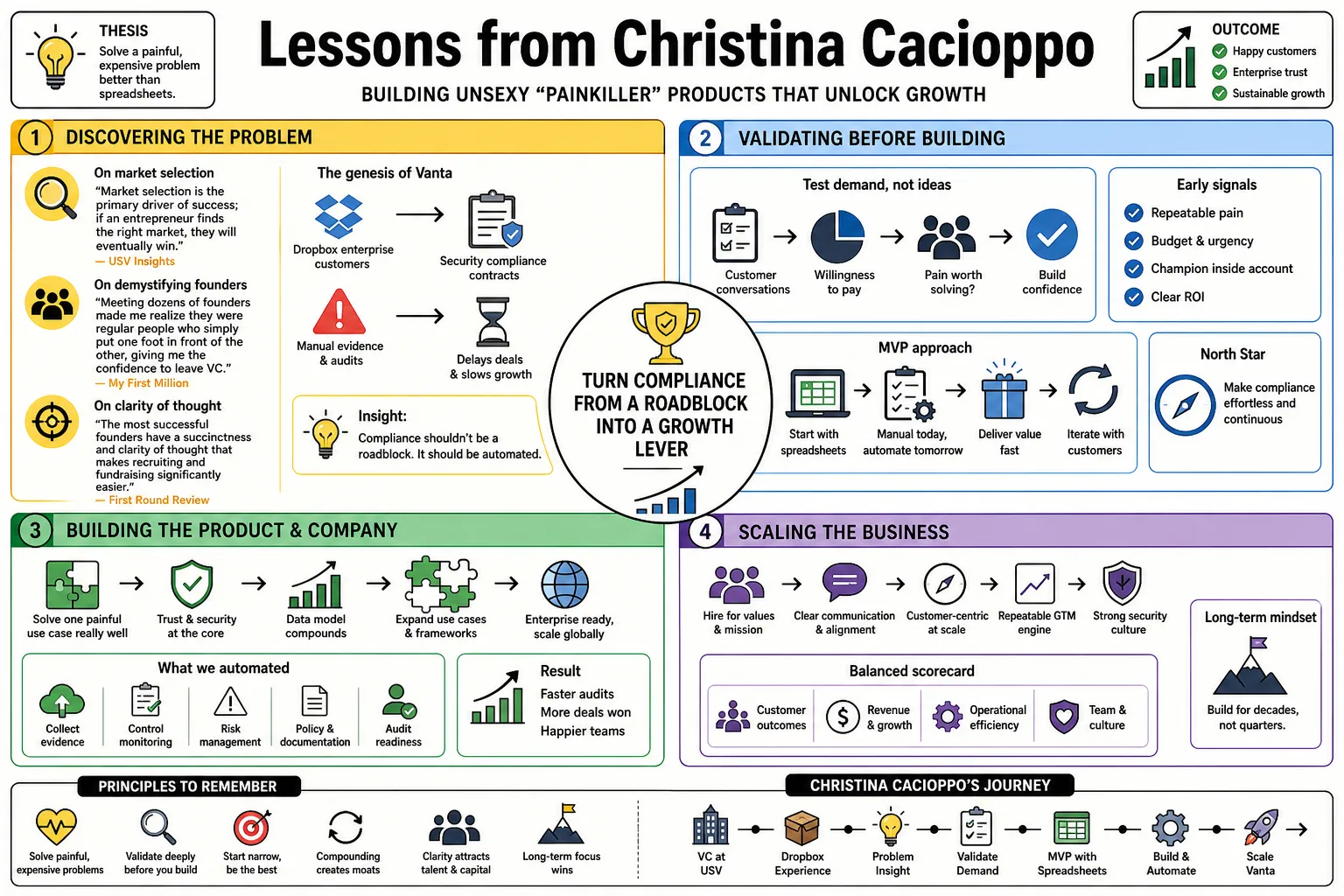
Christina Cacioppo co-founded Vanta to simplify security compliance for growing software companies. Her time at Dropbox exposed her to demanding security promises, and later customer interviews showed that startups would prioritize compliance when it helped them sell to larger buyers. The lessons below examine how she tested demand, built the first product, sold it and scaled the organization. — Unusual Ventures — Startup Field Guide.
Part 1: Discovering the Problem
- On market selection: Cacioppo learned from early failed projects to look for a substantial customer problem and a market that could grow, rather than assume an idea would succeed because she could build it. — Sequoia Capital — Christina Cacioppo Spotlight.
- On demystifying founders: At Union Square Ventures, meeting many different founders helped Cacioppo see there was no single founder type and made starting a company feel possible for her. — Unusual Ventures — Startup Field Guide.
- On clarity of thought: Customer interviews became clearer once Cacioppo could predict much of what prospects would say about their work and problems; she used that as a test of understanding before building. — First Round Review — Vanta's Path to Product-Market Fit.
- On the genesis of Vanta: Working on Dropbox Paper exposed Cacioppo to Dropbox contract promises about security and compliance that a new product also had to satisfy, a lesson she later recalled while exploring startup security. — Cheeky Pint — Christina Cacioppo Transcript.
- On accidental contract violations: The Dropbox Paper experience showed Cacioppo that a product team cannot treat a new feature's security as separate from contractual promises made to existing customers. — Cheeky Pint — Christina Cacioppo Transcript.
- On building painkillers: Cacioppo found that compliance was a problem startups needed solved, even when they would have deferred optional security work; she contrasted a must-do purchase with a nice-to-have. — Cheeky Pint — Christina Cacioppo Transcript.
- On the buying trigger: For early startup customers, a request for compliance proof from a larger buyer made security work urgent and created a concrete purchasing moment. — Cheeky Pint — Christina Cacioppo Transcript.
- On unsexy problems: Cacioppo saw strong demand in work customers needed done but disliked doing themselves, including audit preparation and evidence gathering. — Masters of Scale — Solving Start-up Puzzles.
- On security culture: Dropbox's internal emphasis on security, including its Trustober program, left Cacioppo alert to how much coordinated work trustworthy products require. — Sequoia Capital — Christina Cacioppo Spotlight.
- On isolation vs integration: Cacioppo concluded Dropbox Paper would serve users better if it moved closer to the core Dropbox product rather than remain a separate team. — First Round In Depth Podcast.
Part 2: The Value of Quantity and Experimentation
- On learning through making: Before Vanta, Cacioppo taught herself to code and built many unsuccessful products; those repetitions helped her prototype ideas and develop technical confidence. The old artwork quote is from Art & Fear, not an authenticated Cacioppo quotation. — Unusual Ventures — Startup Field Guide.
- On gaining technical confidence: Cacioppo spent roughly two and a half years teaching herself to code and building a series of small products; most went nowhere, but the experience let her test her own ideas. — Unusual Ventures — Startup Field Guide.
- On exploring failed ideas: Several pre-Vanta projects failed to reveal a company-worthy opportunity, which Cacioppo later described as an upsetting period rather than a neat straight-line journey. — Masters of Scale — Solving Start-up Puzzles.
- On founder readiness: Meeting many different founders at Union Square Ventures helped Cacioppo realize that not having coded since childhood did not disqualify her from founding a company. — Sequoia Capital — Christina Cacioppo Spotlight.
- On learning to code: Although nontechnical founders can start software companies, Cacioppo personally wanted enough coding ability to prototype and test ideas herself. — Unusual Ventures — Startup Field Guide.
- On public experiments: Cacioppo lists earlier projects on her personal site and has described the failed attempts as part of learning to build, not as evidence of an overnight success. — Christina Cacioppo — Things Made.
- On overcoming skepticism: After validating demand with customers, Cacioppo kept pursuing startup SOC 2 compliance even though some investors doubted that startups would seek the reports. — First Round Review — Vanta's Path to Product-Market Fit.
- On confidence through doing: Cacioppo says learning to code and manually testing compliance workflows gave her confidence grounded in practical understanding rather than simply pretending to be ready. — Unusual Ventures — Startup Field Guide.
Part 3: Validating Before Building
- On extreme validation: After earlier products found no market, the Vanta founders postponed coding and interviewed prospective users until they had a reliable mental model of their jobs and problems. — First Round Review — Vanta's Path to Product-Market Fit.
- On the Wizard of Oz prototype: Before automation, the team presented customer-specific security reports as though software generated them while Cacioppo actually prepared them by hand. — Unusual Ventures — Startup Field Guide.
- On manual automation: Cacioppo manually wrote early customer reports to test their usefulness before automating the workflow; an early interview reports that she set a 5:45 a.m. alarm to send them. — Forbes — Christina Cacioppo Interview.
- On a revealing typo: An early report contained the wrong customer name, exposing how manual the supposedly automated emails still were; the team used that phase to learn before writing code. — Forbes — Christina Cacioppo Interview.
- On the spreadsheet phase: Vanta's first SOC 2 gap assessments were customized spreadsheets for Segment and then Front; reusing the same underlying controls tested whether the service could become repeatable software. — First Round Review — Vanta's Path to Product-Market Fit.
- On the hardest part of building: Cacioppo's early failures taught her that writing code was easier than finding a problem customers actually wanted solved. — First Round Review — Vanta's Path to Product-Market Fit.
- On talking to customers: Cacioppo used concrete questions about customers' calendars, best and worst work moments, and daily routines to find an urgent problem. — First Round Review — Vanta's Path to Product-Market Fit.
Part 4: Finding Product-Market Fit
- On recognizing product-market fit: Cacioppo says Vanta began to feel different from her earlier projects when customers started finding the team through word of mouth despite its barebones website. — First Round Review — Vanta's Path to Product-Market Fit.
- On solving a pressing problem: Preparing startups for SOC 2 addressed an immediate obstacle to selling software to larger customers, unlike abstract advice about better security. — Unusual Ventures — Startup Field Guide.
- On pivoting from checklists: Founders welcomed Vanta's early security checklist but rarely implemented it; offering help toward a needed SOC 2 drew a much stronger response. — Unusual Ventures — Startup Field Guide.
- On the worst part of the week: Asking a Dropbox security lead which parts of his work were best and worst exposed tedious reporting and customer explanations as a concrete problem to solve. — First Round Review — Vanta's Path to Product-Market Fit.
- On alignment with customer goals: Cacioppo framed compliance as a way to demonstrate existing security and unlock larger customers or new markets, giving startups a business reason to prioritize it. — Unusual Ventures — Startup Field Guide.
- On TAM as a distraction: Cacioppo argues that sizing only the existing SOC 2 market in 2018 would have missed demand that lower time and cost could create among startups. — Cheeky Pint — Christina Cacioppo Transcript.
- On building the right features: The first product turned a spreadsheet of concrete SOC 2 requirements into a simple, color-coded roadmap showing each customer's gaps. — Unusual Ventures — Startup Field Guide.
- On legacy processes: Cacioppo noticed the disconnect between software security work and the manual, accountant-led process of proving it to buyers; Vanta translated between engineers and auditors. — Masters of Scale — Solving Start-up Puzzles.
Part 5: Founder-Led Sales and Go-To-Market
- On early revenue generation: Cacioppo personally sold Vanta's first $500,000 of revenue through founder-led customer conversations; the direct interview does not support the old 'roughly 50 customers' figure. — Unusual Ventures — Startup Field Guide.
- On knowing when to hire sales: She waited until her calls began to feel repeatable, even boring, before handing a working sales motion to a specialist. — Unusual Ventures — Startup Field Guide.
- On doing what the product promises: Vanta's first hire was a compliance expert so the team could deliver the audit preparation it promised customers, not merely sell a convincing story. — Masters of Scale — Solving Start-up Puzzles.
- On compliance as a growth enabler: Vanta linked SOC 2 readiness to the customer goal of closing enterprise deals and entering new markets, rather than pitching security only as risk avoidance. — Unusual Ventures — Startup Field Guide.
- On the 101 billboard: Vanta used a memorable Highway 101 compliance billboard as a brand tactic; Cacioppo praised the campaign but did not present it as a plan to create inevitability. — Cheeky Pint — Christina Cacioppo Transcript.
- On demonstrating product differentiation: Cacioppo says product differentiation can be obscured by weak explanation, and Vanta sometimes lets prospects trial rival products side by side so the product can demonstrate its value. — This Week in Fintech Interview.
- On finding the buying moment: The decisive trigger was a larger customer's request for proof of security, whether a questionnaire or a SOC 2, which could block a startup's sale. — Cheeky Pint — Christina Cacioppo Transcript.
- On scrappy growth: Before a substantial website or marketing team, Vanta received unsolicited inquiries by word of mouth, which convinced Cacioppo the product was gaining pull. — First Round Review — Vanta's Path to Product-Market Fit.
Part 6: Hiring for Impact and Ambiguity
- On working before hiring: Cacioppo and her co-founder worked on Vanta quietly for about a year and a half before hiring anyone. — Sequoia Capital — Christina Cacioppo Spotlight.
- On stage-appropriate hiring: Early attempts to recruit established-company colleagues failed because the pay and uncertainty did not fit their career stage; Vanta then found people willing to take the startup ride. — Masters of Scale — Solving Start-up Puzzles.
- On transparency as a hiring filter: Vanta's interviews use real current problems and candidly describe what is difficult, letting candidates opt in with fewer first-month surprises. — Masters of Scale — Solving Start-up Puzzles.
- On engineering profiles: Vanta has sought engineers who like talking with customers, using that contact to shorten the product feedback loop as the business expanded. — Forbes — Christina Cacioppo Interview.
- On the growth mindset: Cacioppo has described seeking early hires who can work through unfamiliar tasks and tolerate the uncertainty of an early startup. — Masters of Scale — Solving Start-up Puzzles.
- On filling skill gaps: Cacioppo learned sales and other go-to-market jobs herself until she understood them well enough to hire specialists, instead of assuming a technical product background covered every founder role. — Unusual Ventures — Startup Field Guide.
- On fast feedback loops: Cacioppo favored accessible early startup customers because they could give quick feedback on a rough product, which she considered essential while refining Vanta. — Unusual Ventures — Startup Field Guide.
Part 7: Scaling Teams and Leadership
- On the year-four slog: Cacioppo viewed an underperforming startup with investors and employees as a harder downside than a quick failure, so she wanted conviction before committing to a company. — Masters of Scale — Solving Start-up Puzzles.
- On chaotic hypergrowth: When Vanta grew from about 50 to 150 employees during 2021, Cacioppo described onboarding and management as chaotic despite the team working hard to adapt. — Masters of Scale — Solving Start-up Puzzles.
- On management capacity: Cacioppo later regretted dismissing advice to hire leaders earlier: as revenue grew quickly, too much work remained single-threaded and the organization began to strain. — This Week in Fintech Interview.
- On maintaining focus: Vanta's early product effort stayed on a concrete SOC 2 roadmap and customer feedback, rather than expanding the first release beyond the job customers urgently needed done. — Unusual Ventures — Startup Field Guide.
- On evolving the company: As Vanta grew, Cacioppo found that a small founder-run team needed leaders and more explicit coordination; she wishes she had started building that structure sooner. — Masters of Scale — Solving Start-up Puzzles.
- On repeating direction: At a much larger Vanta, Cacioppo says she repeats the company's few strategic initiatives constantly so teams keep the same priorities in view. — Masters of Scale — Solving Start-up Puzzles.
Part 8: Investor Dynamics and Fundraising
- On waiting for a Series A: Vanta raised a seed round in 2018, then operated near cash-flow break-even for roughly three years and reached about $10 million ARR before raising its Series A. — First Round Review — Vanta's Path to Product-Market Fit.
- On fundraising as a false signal: Cacioppo distinguishes the publicity of raising money from the underlying work of winning and retaining happy customers; capital alone does not create product-market fit. — Unusual Ventures — Startup Field Guide.
- On the purpose of capital: When Vanta's early bottlenecks were hiring and execution rather than cash, Cacioppo preferred to keep selling customers instead of spending time on another fundraise. — First Round Review — Vanta's Path to Product-Market Fit.
- On maintaining leverage: As Vanta's recurring revenue grew, investor conversations became easier; the firm did not 'bootstrap' from zero, because it had already raised seed capital. — First Round Review — Vanta's Path to Product-Market Fit.
- On the danger of early money: Cacioppo thought having a large bank balance before product-market fit could worsen the gap between apparent momentum and actual customer growth. — Unusual Ventures — Startup Field Guide.
- On investor alignment: Cacioppo advises founders to interview prospective investors and speak with founders the investor did not introduce, because board relationships can be very hard to unwind. — This Week in Fintech Interview.
- On avoiding the spotlight: Vanta kept a minimal website and little marketing while proving the product; Cacioppo said that also bought time before potential copycats noticed the market. — First Round Review — Vanta's Path to Product-Market Fit.