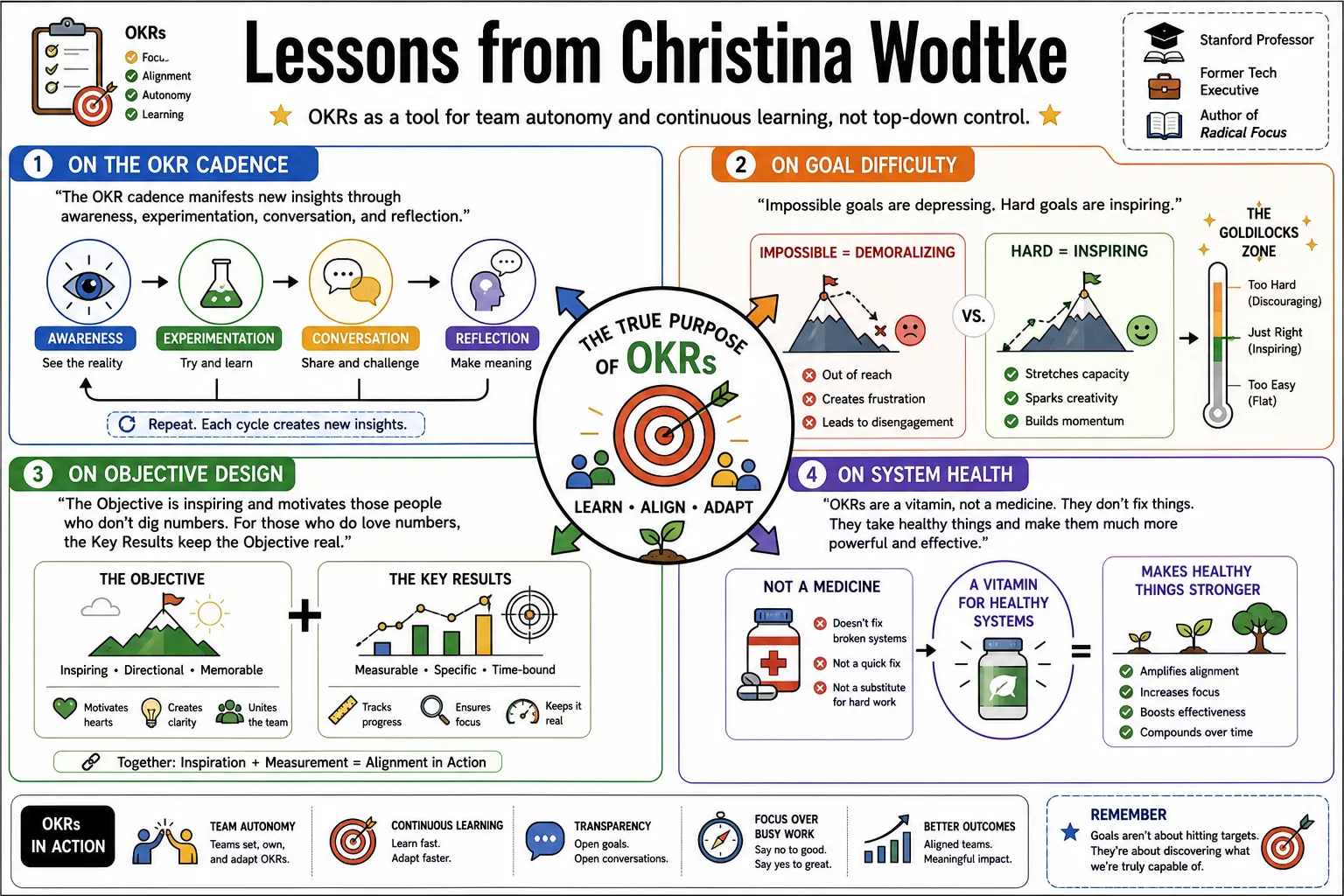
Lessons from Christina Wodtke
Christina Wodtke is a Stanford HCI lecturer, former technology executive, and author of Radical Focus, The Team that Managed Itself, Pencil Me In, and Information Architecture: Blueprints for the Web. Her writing and teaching connect goal-setting, team autonomy, visual thinking, and information architecture. The lessons below examine those ideas in her own essays and interviews. — Christina Wodtke — About.
Part 1: Objectives and Key Results
- On the OKR cadence: A weekly rhythm of discussing progress, testing approaches, and reflecting helps teams keep strategic goals visible and learn from their work. — Are You Sure You Want to Use OKRs?.
- On the true purpose of goals: Stretch OKRs are not merely pass-or-fail targets; missed key results can show what a team learned and what it is capable of next. — The Art of the OKR.
- On goal difficulty: Set key results that are difficult enough to stretch a team without being so unlikely that the team feels doomed. — The Art of the OKR.
- On objective design: An objective should give the team an inspiring qualitative direction; measurable key results specify what achieving it would look like. — The Art of the OKR.
- On system health: OKRs can strengthen a healthy team, but they do not supply a missing strategy or repair a dysfunctional organization. — Product Thinking — Christina Wodtke.
- On prerequisites: Before adopting OKRs, establish a crisp strategy, psychological safety, and teams with enough autonomy to act on their goals. — Are You Sure You Want to Use OKRs?.
- On good key results: Use stretch key results that feel uncertain but possible, rather than targets a team already knows it can reach. — The Art of the OKR.
- On limiting scope: Start with one company objective and one supporting OKR set per team so people can remember and work toward the priority. — The Art of the OKR.
- On directed autonomy: An OKR can align a team on a desired outcome while leaving the team room to determine its own contribution and tactics. — Product Thinking — Christina Wodtke.
- On control: OKRs are poorly suited to command-and-control management; teams need ownership of their goals and the work that advances them. — Product Thinking — Christina Wodtke.
Part 2: Focus and Prioritization
- On arrival: Meaningful goals require more than wanting them: set a clear direction, commit to weekly action, and learn from what does not work. — Are You Sure You Want to Use OKRs?.
- On remembering: A team-level OKR keeps its single most important strategic effort visible amid day-to-day distractions. — Product Thinking — Christina Wodtke.
- On the enemy of execution: Weekly OKR check-ins counter the tendency to set a quarterly goal and then lose it among competing requests. — The Art of the OKR.
- On doing the right things: Focus the team on the work most likely to advance its chosen objective, rather than listing every task completed. — Monday Commitments and Friday Wins.
- On clear objectives: Make the objective inspirational, time-bound, and actionable by the team so it can guide choices during the quarter. — The Art of the OKR.
- On lacking strategy: If a team cannot identify its most important work, OKRs will not create that priority or substitute for strategy. — Product Thinking — Christina Wodtke.
- On health metrics: Alongside a stretch goal, monitor a small number of health measures—such as customer relationships, stability, or team well-being—that the push must not damage. — Monday Commitments and Friday Wins.
- On weekly commitments: In the Monday check-in, choose the few tasks that will move the objective forward that week and discuss confidence and blockers. — Monday Commitments and Friday Wins.
Part 3: Team Dynamics and Autonomy
- On team empowerment: Empowered teams need a clear goal and enough control over their work to decide how they will contribute. — Product Thinking — Christina Wodtke.
- On collective pushes: Team OKRs should connect a team’s work to the company objective rather than merely turn leadership’s priorities into a chore list. — The Art of the OKR.
- On delegating outcomes: Tell capable team members what outcome is needed, then let them determine how to reach it while building effective working norms. — The Understanding Group — Christina Wodtke.
- On cascading goals: Do not mechanically turn a manager’s key result into a team’s objective; let the team choose a meaningful contribution it can own. — Are You Sure You Want to Use OKRs?.
- On upward contribution: A product team can use a business-unit objective to decide what its own charter allows it to contribute. — Product Thinking — Christina Wodtke.
- On humanity at work: Team performance depends on recognising people’s values and needs and discussing how they want to work together. — Voltage Control — Christina Wodtke Interview.
- On self-management: Leaders can build teams that learn to manage themselves by setting expectations, giving feedback, and learning together. — Christina Wodtke — Books.
- On collective inspiration: Choose a qualitative objective that motivates the team, not just a numerical target that interests management. — The Art of the OKR.
- On Friday rituals: End the week by letting teams demonstrate work, share progress, and celebrate wins across disciplines. — Monday Commitments and Friday Wins.
Part 4: Visual Thinking and Prototyping
- On prototyping speed: A sketch on paper is a fast, inexpensive way to prototype an idea before building it. — Christina Wodtke — Books.
- On natural communication: Simple pictures can communicate an idea quickly even when the person sketching has little drawing skill. — Christina Wodtke — Books.
- On finding clarity: Sketching can make a problem that was hard to explain in words easier for a team to see and discuss. — Christina Wodtke — Books.
- On navigating possibility: Use a rough concept sketch to explore possible relationships before turning the idea into a polished explanatory model. — A Visual Vocabulary for Concept Models.
- On discovery: Sketching is a way to explore an idea before it is fully formed, not only a way to present a finished thought. — A Visual Vocabulary for Concept Models.
- On concept models: A concept model can use words and shapes to make a system’s relationships visible so others can discuss the same idea. — A Visual Vocabulary for Concept Models.
- On visual models: Choose a model that reveals the relationships the audience needs to understand, rather than treating every system as the same diagram. — A Visual Vocabulary for Concept Models.
Part 5: Information Architecture
- On making sense: Information architecture can be a way to make complex information findable and understandable, not only a navigation exercise. — Towards a New Information Architecture.
- On the north star: Understanding is the aim of information architecture; organizing and clarifying information are means to that end. — Towards a New Information Architecture.
- On feature complexity: Organize and label complex website content so people can find it and understand the interface. — Christina Wodtke — Books.
- On IA as design: Information architecture is design: it involves making and refining structural choices, not merely documenting research. — Fear of Design.
- On research as preparation: Research prepares a designer to make choices, but it cannot remove the judgment and risk involved in creating the design. — Fear of Design.
- On system influence: Design cannot control people, but it can shape an environment that encourages or discourages behaviour. — The Elements of Social Architecture.
- On data navigation: Information architects help people find, understand, and use information within complex systems. — The Understanding Group — Christina Wodtke.
Part 6: Strategy and Execution
- On making ideas real: Turn an idea into a time-bound objective, measurable outcomes, and a weekly rhythm of work and learning. — The Art of the OKR.
- On protecting time: Use a focused OKR to keep important but nonurgent strategic work from disappearing beneath routine activity. — Are You Sure You Want to Use OKRs?.
- On impact: Define key results as outcomes you want to change, rather than simply counting features or other outputs delivered. — Are You Sure You Want to Use OKRs?.
- On mission: A clear mission gives objectives a purpose and scope; OKRs do not replace the underlying mission and strategy. — The Art of the OKR.
- On contextless numbers: Do not use OKR numbers alone as a substitute for the conversations and judgment required to manage people. — The Only Silver Bullet.
- On success traps: When reviewing a goal, discuss contribution and learning as well as the result rather than turning a missed number into a punitive performance test. — Are You Sure You Want to Use OKRs?.
- On staying humble: Treat management practices as something to keep questioning and improving rather than assuming the team has solved them. — The Product Experience — Christina Wodtke.
- On constant improvement: Keep asking how the team’s work could be better, even when the current approach appears to be working. — The Product Experience — Christina Wodtke.
- On positive reviews: Balance corrective feedback with appreciation so team members know what is working as well as what needs to change. — The Only Silver Bullet.
Part 7: Leadership and Coaching
- On giving answers: In one-on-ones, use John Whitmore’s GROW coaching questions to help a report develop their own solution instead of supplying every answer. — Working the Weekly 1:1.
- On the job of management: A manager creates conditions for people to make decisions and ask for help when they need it, rather than controlling each move. — Working the Weekly 1:1.
- On reality checks: Ask what facts, insights, and hunches a teammate has about their present situation before discussing solutions. — Working the Weekly 1:1.
- On securing commitment: Close a coaching conversation by clarifying next steps and asking how the manager can help. — Working the Weekly 1:1.
- On managerial obsolescence: A manager should build the team’s capacity to make decisions and solve problems without depending on constant direction. — Working the Weekly 1:1.
- On finding options: Let the teammate propose possible solutions before offering your own advice. — Working the Weekly 1:1.
- On defining success: Set an objective the team can act on independently and let the team choose the work that reaches it. — The Art of the OKR.
- On stepping back: Once a team understands the goal, support its independent decisions and offer coaching when needed instead of micromanaging. — Working the Weekly 1:1.
- On protecting team focus: A manager can use a focused goal and weekly check-ins to help the team keep strategic work visible amid everyday requests. — The Art of the OKR.
Part 8: Feedback and Culture
- On depersonalizing critique: Give feedback about specific work behaviours and their effect, not a judgment about someone’s character. — Feedback for Teams.
- On actionable feedback: A recipient can consider feedback as information, then decide which observations to accept and which to discard. — Feedback for Teams.
- On framing feedback: Offer feedback as information a teammate can use to grow, not as a command or verdict about who they are. — Feedback for Teams.
- On defining culture: Culture consists in part of the norms that govern how people behave together. — Voltage Control — Christina Wodtke Interview.
- On unspoken rules: Make the team’s usually unspoken behavioural norms explicit so people can examine them together. — Voltage Control — Christina Wodtke Interview.
- On validating norms: Once norms are visible, decide together which behaviours the team wants to keep and which it wants to change. — Voltage Control — Christina Wodtke Interview.
- On trust and growth: Create psychological safety before using OKRs to ask teams to take on stretching work. — Are You Sure You Want to Use OKRs?.
- On enduring culture: Keep revisiting and shaping team norms; a culture left unexamined can drift away from the behaviours the team intends. — Voltage Control — Christina Wodtke Interview.