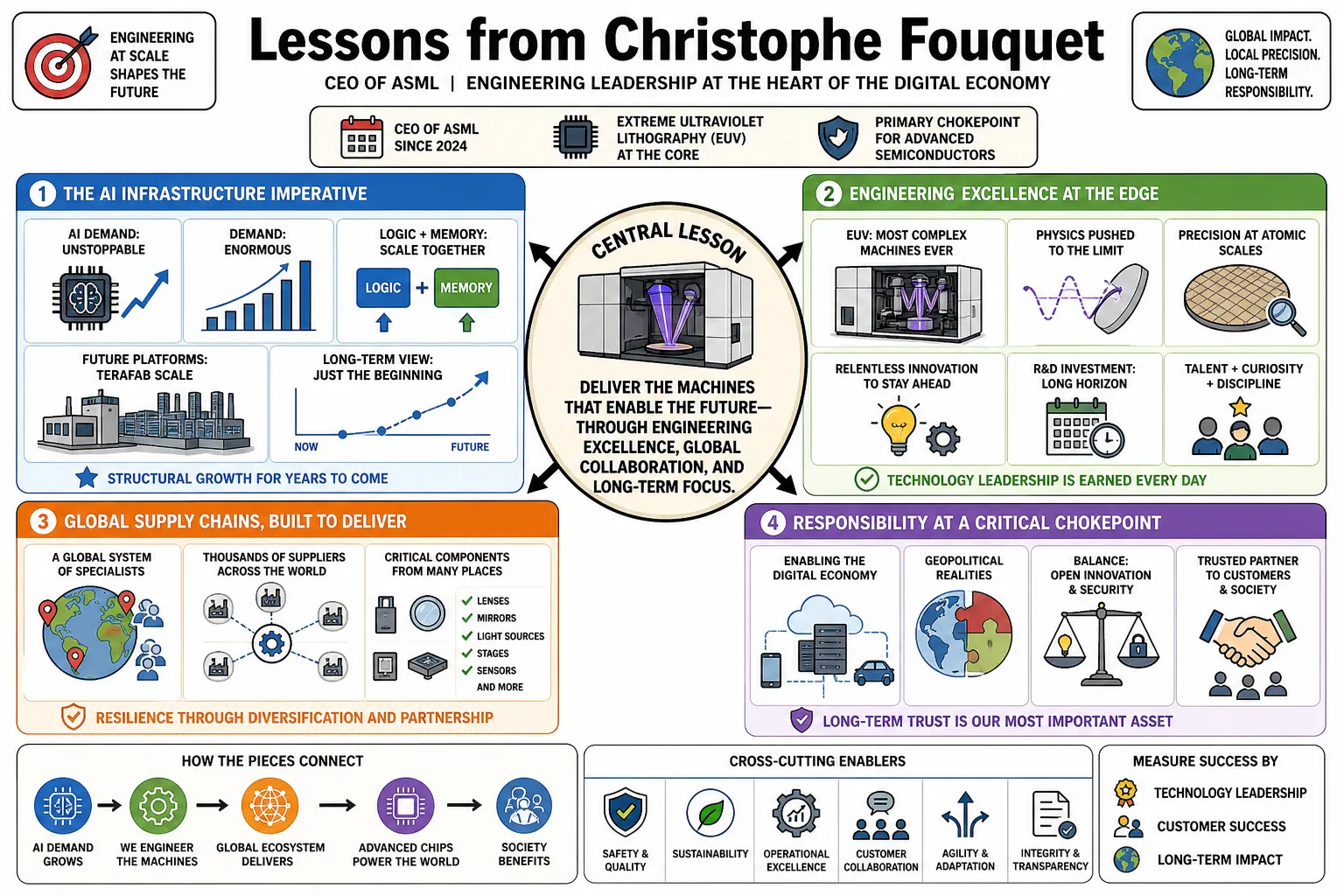
Lessons from Christophe Fouquet
Christophe Fouquet is the CEO of ASML, the Dutch manufacturer of the extreme ultraviolet lithography machines required to make advanced semiconductors. After a career in applied physics and the chip equipment industry, he took the top job in 2024 amid surging computing demand and geopolitical tension. This collection outlines his views on engineering, global supply chains, and the realities of managing a primary chokepoint for the digital economy.
Part 1: The AI Infrastructure Imperative
- On AI demand: "The development of AI is unstoppable, creating a massive, sustained need for advanced lithography." — Source: [ASML Earnings Call]
- On the scale of AI infrastructure: "The demand for AI infrastructure remains enormous, driving the entire semiconductor industry forward." — Source: [Bloomberg Television]
- On memory chip requirements: "AI requires massive logic and massive memory capacity, meaning both segments must scale simultaneously." — Source: [ASML Financial Results]
- On future compute platforms: "We have to prepare for infrastructure projects on a scale previously unseen, supporting initiatives like major AI terafabs." — Source: [Bloomberg Technology]
- On long-term AI growth: "We are only at the beginning of the AI transition; the structural demand for compute will outpace supply for the foreseeable future." — Source: [ASML Earnings Call]
- On data center evolution: "The energy and space requirements for AI mean we must look at radically new architectures and locations for data centers." — Source: [Bloomberg Television]
- On energy efficiency: "Delivering higher performance per watt is the most essential metric for the future of AI hardware." — Source: [IMD CEO Dialogue]
- On node progression: "Moving to the next advanced node is no longer simply about shrinking; it is the only way to meet the energy and performance targets AI requires." — Source: [ASML Earnings Call]
- On market cycles: "While traditional tech cycles exist, the underlying AI megatrend provides a steady upward trajectory for semiconductor demand." — Source: [ASML Financial Results]
- On technological readiness: "The industry cannot afford to slow down its roadmap; AI models will consume whatever compute we can provide." — Source: [Norges Bank Podcast]
Part 2: Geopolitics and Global Trade
- On US export controls: "If you look at the geopolitical environment, it's clear that the US will continue to apply pressure on their allies for more restrictions." — Source: [Bloomberg Tech Summit]
- On navigating national interests: "The core question for our company is always: What is right for the Netherlands? What is right for Europe?" — Source: [Bloomberg Tech Summit]
- On China's semiconductor focus: "Much of our current business in China is focused on mainstream, mature technology, which remains essential for global manufacturing." — Source: [South China Morning Post]
- On technology fragmentation: "A fragmented global semiconductor market is highly inefficient and drives up costs for everyone involved." — Source: [Hello Tomorrow Summit]
- On institutional knowledge: "You cannot easily replicate our technological lead. It is built on decades of collaboration and institutional knowledge, beyond simple blueprints." — Source: [Silicon Canals]
- On trade dependencies: "The semiconductor industry is deeply intertwined globally; no single country can realistically build a completely isolated, bleeding-edge supply chain." — Source: [IMD CEO Dialogue]
- On managing geopolitical risk: "We must remain a neutral technology provider, serving our global customers within the bounds of the laws and regulations imposed upon us." — Source: [Norges Bank Podcast]
- On the pace of regulation: "Regulations can shift quickly, but semiconductor development takes years. We have to plan for multiple geopolitical scenarios." — Source: [Bloomberg Technology]
- On mature node importance: "The world cannot run on AI chips alone; everyday electronics rely heavily on the mature technologies produced globally, including in China." — Source: [South China Morning Post]
- On maintaining technology leadership: "The best defense against geopolitical friction is to simply run faster and maintain our unquestionable technology leadership." — Source: [Norges Bank Podcast]
Part 3: The Reality of Deep Tech and Extreme Engineering
- On High-NA EUV: "Bringing High-NA EUV from concept to a functioning product required solving physics and engineering problems that many thought were impossible." — Source: [Bits & Chips]
- On the complexity of lithography: "We build more than machines; we control light, plasma, and mechanics at a sub-atomic level with unprecedented precision." — Source: [IMD CEO Dialogue]
- On deep tech timelines: "Deep tech requires deep patience. The investments we make today are for machines that will define the market in a decade." — Source: [Hello Tomorrow Summit]
- On pushing the limits of physics: "Every new generation of lithography brings us closer to the fundamental limits of physics, requiring entirely new engineering paradigms." — Source: [Norges Bank Podcast]
- On continuous innovation: "In our industry, standing still means falling behind instantly. You have to constantly destroy your previous benchmarks." — Source: [ASML Financial Results]
- On High-NA commercialization: "We expect the first commercial products made using high-NA EUV lithography systems to appear within months, marking a major milestone." — Source: [Bits & Chips]
- On R&D conviction: "When you are pursuing extreme engineering, you must have the conviction to sustain massive R&D budgets even before the market fully understands the need." — Source: [IMD CEO Dialogue]
- On systems engineering: "The true magic lies in how we integrate millions of parts to operate flawlessly in a vacuum." — Source: [Norges Bank Podcast]
- On Moore's Law: "Moore's Law is alive; it simply requires exponentially more effort, capital, and engineering creativity to sustain." — Source: [Hello Tomorrow Summit]
- On failing forward: "When you operate at the bleeding edge of physics, failures in the lab are necessary data points." — Source: [IMD CEO Dialogue]
Part 4: Supply Chain Constraints
- On capacity bottlenecks: "Our customers are effectively sold out for 2026, and capacity constraints for advanced logic and memory will likely persist beyond that." — Source: [ASML Earnings Call]
- On being the chokepoint: "Our primary operational goal is simple: ASML must avoid becoming a bottleneck for the semiconductor industry." — Source: [Bits & Chips]
- On scaling production: "Ramping up production of our most advanced systems requires our suppliers to scale with us, which is a massive logistical challenge." — Source: [ASML Financial Results]
- On supplier relationships: "We cannot succeed without a capable network of specialized suppliers who are willing to take technological risks alongside us." — Source: [IMD CEO Dialogue]
- On supply chain transparency: "To manage constraints effectively, we need absolute transparency and long-term planning with both our customers and our suppliers." — Source: [Norges Bank Podcast]
- On manufacturing flexibility: "Building complex lithography systems is outside standard assembly line practices; we need the flexibility to adapt to late-stage engineering changes." — Source: [Bloomberg Technology]
- On inventory strategy: "Given current logistical uncertainties, running a strictly just-in-time supply chain for essential deep tech components is no longer viable." — Source: [Hello Tomorrow Summit]
- On customer roadmaps: "Our capacity planning is dictated by our customers' technology roadmaps; if they accelerate, we have to find a way to meet them." — Source: [ASML Earnings Call]
- On long lead times: "The lead times for our equipment reflect the sheer complexity of the optics and mechatronics involved; you cannot simply rush perfection." — Source: [Bits & Chips]
Part 5: Leadership and Long-Term Vision
- On long-term thinking: "My role as CEO is to ensure we make the long-term decisions today that will secure our technological leadership in the 2030s." — Source: [IMD CEO Dialogue]
- On corporate culture: "The ASML culture is built on engineering excellence, open debate, and a shared understanding that we are solving the world's hardest problems." — Source: [IMD CEO Dialogue]
- On workforce diversity: "To solve complex physics problems, you need cognitive diversity. We actively recruit talent from across the globe to bring different perspectives." — Source: [IMD CEO Dialogue]
- On CEO transition: "Taking over as CEO is about maintaining the company's momentum while quietly adjusting the rudder to navigate an increasingly complex world." — Source: [Norges Bank Podcast]
- On managing technical talent: "You don't manage brilliant engineers by telling them what to do; you give them an impossible target and the resources to hit it." — Source: [Hello Tomorrow Summit]
- On staying humble: "Despite our market position, complacency is our biggest threat. We must operate with the hunger of a challenger." — Source: [Norges Bank Podcast]
- On strategic focus: "It is easy to get distracted by short-term market fluctuations; true leadership requires staying anchored to the long-term technology roadmap." — Source: [ASML Financial Results]
- On continuous learning: "The technology moves so fast that if you stop learning, your expertise becomes obsolete in a matter of years." — Source: [IMD CEO Dialogue]
- On defining success: "Success for us goes beyond financial returns; it is defined by whether we successfully delivered the tools the world needed to advance computing." — Source: [ASML Earnings Call]
Part 6: Corporate Responsibility
- On market position: "Our sense of responsibility towards the industry is enormous. We understand the critical place we have, and if you are in a critical place, you need to be responsible for it." — Source: [IMD CEO Dialogue]
- On sustainable manufacturing: "We are heavily focused on reducing the energy consumption and environmental footprint of our machines as they become more powerful." — Source: [ASML Financial Results]
- On systemic importance: "When the entire digital economy relies on your machines, reliability is an economic imperative." — Source: [Norges Bank Podcast]
- On ethical technology: "We must remain conscious of how our technology shapes the world, ensuring our advancements support sustainable and positive global development." — Source: [Hello Tomorrow Summit]
- On community impact: "As we grow rapidly, we have a deep responsibility to the local communities where we operate, ensuring our presence is a net positive." — Source: [IMD CEO Dialogue]
- On knowledge sharing: "While we protect our core IP, we also recognize the need to contribute to the broader scientific community to keep the ecosystem healthy." — Source: [Norges Bank Podcast]
- On stakeholder trust: "Trust is our most valuable currency—trust from our customers, our suppliers, and the governments in the regions where we operate." — Source: [ASML Earnings Call]
- On managing expectations: "Because our technology is heavily relied upon, everyone wants more of it faster. Part of our responsibility is setting realistic, transparent expectations." — Source: [Bloomberg Technology]
- On the legacy of ASML: "We are building more than a company; we are stewarding an essential piece of human technological progress." — Source: [IMD CEO Dialogue]
Part 7: Collaboration and the Ecosystem
- On open innovation: "The complexities of EUV lithography were not solved in isolation; they were solved through decades of deep collaboration across borders and disciplines." — Source: [Hello Tomorrow Summit]
- On customer partnerships: "Our customers are essentially our co-developers. We design our future roadmaps based entirely on their long-term silicon architectures." — Source: [ASML Earnings Call]
- On research institutes: "Institutions like IMEC are vital to our success; pre-competitive collaboration reduces the risk of extreme engineering for the whole industry." — Source: [Bits & Chips]
- On cross-disciplinary engineering: "To build our machines, software engineers, optical physicists, and materials scientists must speak the same language and work as a single unit." — Source: [IMD CEO Dialogue]
- On industry standardization: "Standardizing interfaces and processes across the ecosystem is necessary to ensure that new lithography generations can be adopted smoothly." — Source: [Hello Tomorrow Summit]
- On ecosystem fragility: "The semiconductor ecosystem is incredibly strong, but also highly fragile because of the deep dependencies we all have on single points of failure." — Source: [Norges Bank Podcast]
- On collaborative risk-taking: "When moving to a new node, the financial risk is too large for one company; the entire ecosystem must hold hands and jump together." — Source: [ASML Financial Results]
- On fostering startups: "We actively support deep tech startups because the next breakthrough in materials or optics might come from outside our own labs." — Source: [Hello Tomorrow Summit]
- On software integration: "Hardware is only half the battle. Our computational lithography software is what actually allows customers to print viable chips." — Source: [ASML Earnings Call]
Part 8: European Industrial Strategy
- On EU supply chains: "If you don't have your own supply chain, then how do you intervene in the supply chain?" — Source: [Financial Times]
- On 'Buy European' policies: "I think 'buy European' is great, but you have got to have something to buy from." — Source: [Financial Times]
- On European competitiveness: "Europe must focus on its unique technological strengths rather than trying to replicate supply chains that already exist efficiently elsewhere." — Source: [Bloomberg Tech Summit]
- On the EU Chips Act: "Legislation can help catalyze investment, but it must be matched by a genuine structural ability to execute and scale manufacturing." — Source: [Norges Bank Podcast]
- On tech sovereignty: "True technological sovereignty comes from holding irreplaceable intellectual property, beyond building generic domestic fabs." — Source: [Hello Tomorrow Summit]
- On talent retention in Europe: "To remain globally competitive, Europe must ensure it is the most attractive place in the world for deep tech engineers to live and work." — Source: [IMD CEO Dialogue]
- On regulatory burdens: "We must ensure that European regulations foster innovation rather than slowing down the pace of R&D with unnecessary bureaucracy." — Source: [Financial Times]
- On global alliances: "Europe's strategy cannot be isolationist; we must build strong, reciprocal alliances with tech hubs in the US and Asia." — Source: [Bloomberg Tech Summit]
- On the future of European tech: "Europe has the academic foundation and the engineering heritage to lead in deep tech, but we need the political will to let companies scale rapidly." — Source: [IMD CEO Dialogue]