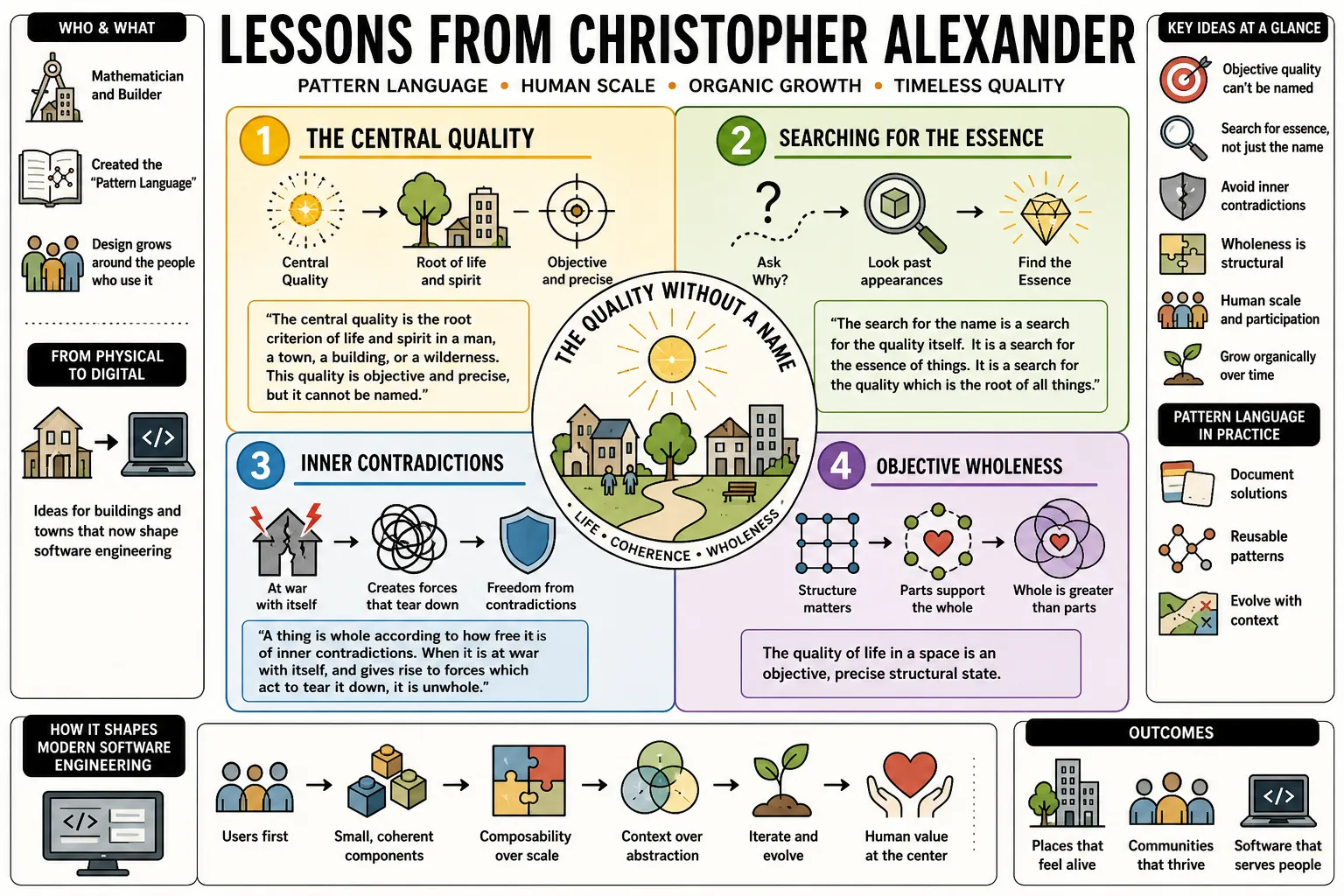
Christopher Alexander was a mathematician and builder who created the "pattern language" to document how humans naturally solve spatial problems. He argued that towns and buildings should grow organically around the people who actually use them. This collection tracks his ideas on design and feeling, detailing how theories built for physical architecture ended up shaping modern software engineering.
Part 1: The Quality Without a Name
- On The Central Quality: "There is a central quality which is the root criterion of life and spirit in a man, a town, a building, or a wilderness. This quality is objective and precise, but it cannot be named." — Source: [The Timeless Way of Building]
- On Searching for the Essence: "The search for the name is a search for the quality itself. It is a search for the essence of things. It is a search for the quality which is the root of all things." — Source: [The Timeless Way of Building]
- On Inner Contradictions: "A thing is whole according to how free it is of inner contradictions. When it is at war with itself, and gives rise to forces which act to tear it down, it is unwhole." — Source: [Wikiquote]
- On Objective Wholeness: The quality of life in a space is an objective, precise structural state, rather than a subjective aesthetic preference. — Source: [The Nature of Order]
- On System Harmony: "A system has this quality when it is at one with itself; it lacks it when it is divided. It has it when it is true to its own inner forces; lacks it when it is untrue to its own inner forces." — Source: [The Timeless Way of Building]
- On Feeling Alive: True architecture occurs only when the space makes the people within it feel alive and deeply connected to their own humanity. — Source: [Biourbanism]
- On Creating Wholeness: "People are deeply nourished by the process of creating wholeness." — Source: [The Timeless Way of Building]
- On Freedom: A space possesses the quality without a name when it lets our inner forces loose and sets us free, rather than keeping us locked in conflict. — Source: [The Timeless Way of Building]
- On Simplicity of Heart: "Everything essential has been left; nothing extraneous is left... it is only inner simplicity, true simplicity of heart, which creates it." — Source: [The Nature of Order]
- On The Root of All Things: The effort to name this quality leads to an understanding that it is the fundamental root of everything that has life, spirit, and meaning. — Source: [The Timeless Way of Building]
Part 2: The Pattern Language
- On Recurring Problems: "Each pattern describes a problem which occurs over and over again in our environment, and then describes the core of the solution to that problem, in such a way that you can use this solution a million times over, without ever doing it the same way twice." — Source: [A Pattern Language]
- On Embedded Patterns: "In short, no pattern is an isolated entity. Each pattern can exist in the world, only to the extent that is supported by other patterns: the larger patterns in which it is embedded, the patterns of the same size that surround it, and the smaller patterns which are embedded in it." — Source: [A Pattern Language]
- On Repairing the World: "When you build a thing you cannot merely build that thing in isolation, but must also repair the world around it, and within it, so that the larger world at that one place becomes more coherent, and more whole." — Source: [A Pattern Language]
- On Shared Languages: "Towns and buildings will not be able to become alive, unless they are made by all the people in society, and unless these people share a common pattern language." — Source: [The Timeless Way of Building]
- On The Web of Nature: Anything made must take its place within the broader web of nature, linking naturally to the elements already present. — Source: [A Pattern Language]
- On Light in Rooms: "When they have a choice, people will always gravitate to those rooms which have light on two sides, and leave the rooms which are lit only from one side unused and empty." — Source: [A Pattern Language]
- On Entrance Transitions: Buildings require a graceful transition between the public street and the private inside to establish a sense of tranquility. — Source: [A Pattern Language]
- On Workplaces: "If you spend eight hours of your day at work, and eight hours at home, there is no reason why your workplace should be any less of a community than your home." — Source: [A Pattern Language]
- On Patterns of Events: "Every place is given its character by certain patterns of events that keep on happening there. These patterns of events are locked in with certain geometric patterns in the space." — Source: [The Timeless Way of Building]
- On Atoms of Space: Buildings and towns are ultimately constructed out of patterns of human events interacting with spatial geometry, making these patterns the fundamental atoms of design. — Source: [The Timeless Way of Building]
Part 3: The Process of Unfolding
- On Embryonic Growth: "Every individual act of building is a process in which space gets differentiated. It is not a process of addition, in which preformed parts are combined to create a whole, but a process of unfolding, like the evolution of an embryo, in which the whole precedes the parts." — Source: [The Timeless Way of Building]
- On Morphogenesis: The blueprint model of planning fails because spaces must unfold organically, with each step adapting to the reality of what was just built. — Source: [Tricycle Magazine]
- On Step-by-Step Refinement: "Nature never assembles pieces together, it always refines from the inside out." — Source: [The Nature of Order]
- On Adaptive Building: Traditional builders succeeded because they adapted dimensions and placements on site, adjusting continuously until the space felt correct. — Source: [Prince of Wales Institute Lecture]
- On The Timeless Way: "There is one timeless way of building. It is a thousand years old, and the same today as it has ever been." — Source: [The Timeless Way of Building]
- On Generative Processes: Rather than using a checklist, designers must use generative processes that allow a structure to grow in response to the specific forces of its environment. — Source: [OOPSLA Keynote 1996]
- On Unpredictability: True organic order cannot be master planned; it emerges gracefully through small, localized adaptations over time. — Source: [The Oregon Experiment]
- On Splitting Spaces: The act of building is a matter of splitting existing space to create definition, rather than bringing external, disconnected pieces together. — Source: [The Timeless Way of Building]
- On Unfolding as Worship: "My own experience as a builder is that you cannot do this unfolding unless you do it as an act of worship." — Source: [Tricycle Magazine]
Part 4: The Fundamental Properties
- On Centers: "The world is made of centers, each with their own centers. It's recursive, rather than atomic." — Source: [The Nature of Order]
- On Levels of Scale: "In any system where there is good functional order it is necessary that there be functional coherence at different levels, hence necessary that there are recognizable hierarchies." — Source: [The Nature of Order]
- On Boundaries: "Wherever two very different phenomena interact, there is also a 'zone of interaction' which is a thing in itself, as important as the things which it separates." — Source: [The Nature of Order]
- On Alternating Repetition: "In nature most of the repetitions which occur are alternating... The alternation of these elements breaks monotony and banality." — Source: [The Nature of Order]
- On Positive Space: "The positiveness of the space... is the outward manifestation of internal coherence in the physical system." — Source: [The Nature of Order]
- On Good Shape: "It is easiest to understand good shape as a recursive rule... the elements of any good shape are good shapes themselves." — Source: [The Nature of Order]
- On Local Symmetries: "In general these symmetries occur in nature because there is no reason for asymmetry; an asymmetry only occurs when it is forced." — Source: [The Nature of Order]
- On Roughness: "Living wholes have some local irregularities within them... caused by adapting to irregularities in the environment... not by arbitrary decisions." — Source: [The Nature of Order]
- On Gradients: "Any time that a quantity varies systematically, through space, a gradient is established... These gradients are caused by responding to the natural variation of the circumstance." — Source: [The Nature of Order]
- On The Void: "In the most profound centers which have perfect wholeness there is at the heart a void, which is like water, in infinite depth... The calm is needed to alleviate the buzz." — Source: [The Nature of Order]
Part 5: The Critique of Modernism
- On The Failure of Professional Architecture: "With the invention of a teachable discipline called 'architecture,' the old process of making form was adulterated and its chances of success destroyed." — Source: [Notes on the Synthesis of Form]
- On Mechanistic Environments: Modernist architecture operates as a fashion industry prioritizing abstract geometric images over the lived, sensory reality of the inhabitants. — Source: [The Nature of Order]
- On High-Rise Buildings: "High buildings have no genuine advantages, except in speculative gains for banks and land owners. They... destroy social life, they promote crime, they make life difficult for children." — Source: [A Pattern Language]
- On Totalitarian Order: "But in practice master plans fail because they create totalitarian order, not organic order. They are too rigid; they cannot easily adapt to the natural and unpredictable changes that inevitably arise." — Source: [The Oregon Experiment]
- On Image vs. Reality: "Images in the 20th century had a unique power where image became divorced from reality, and often more important than reality." — Source: [The Nature of Order]
- On Ugly Buildings: "I have little good to say about modernist, postmodernist, and deconstructivist architectures, which I lambast as ugly, strange buildings that do not preserve the structure of the Earth." — Source: [The Nature of Order]
- On Institutionalized Ugliness: The global economy produces dead, soulless objects because it treats buildings as mechanical commodities rather than adapting them as living environments. — Source: [Biourbanism]
- On The Ego: A successful builder must suppress their personal ego to observe and execute the patterns that the specific location actually requires to thrive. — Source: [First Things]
- On Lost Order: "Everyone is aware that most of the built environment today lacks a natural order, an order which presents itself very strongly in places that were built centuries ago." — Source: [The Timeless Way of Building]
Part 6: Architecture and Human Nature
- On The Human Instinct: "Each one of us has, somewhere in his heart the dream to make a living world, a universe... that one day, somewhere, somehow, we shall build one building which is wonderful, beautiful, breathtaking." — Source: [The Timeless Way of Building]
- On Makers of Beauty: "Most of the wonderful places in the world were not made by architects but by the people." — Source: [A Pattern Language]
- On Harmony with Surroundings: "The fact is, a person is so formed by his surroundings, that his state of harmony depends entirely on his harmony with his surroundings." — Source: [The Timeless Way of Building]
- On Low Standards: "In my life as an architect, I found that the single thing which inhibits young professionals, new students most severely, is their acceptance of standards that are too low." — Source: [Wikiquote]
- On Designing for Joy: "I am trying to make a building which is like a smile on a person's face; and which has that kind of rightness about it, and which is really like that and not just saying it is like that." — Source: [The Nature of Order]
- On Building and Society: To build environments that support human life, the authority to design must be returned to the people who inhabit the spaces daily. — Source: [A Pattern Language]
- On Nourishment: Creating wholeness in one environment is an act that deeply and directly nourishes the human spirit. — Source: [The Timeless Way of Building]
- On The Power to Create: "Imagine the greatest possible beauty and harmony in the world—the most beautiful place you have ever seen or dreamt of. You have the power to create it, at this very moment, just as you are." — Source: [The Timeless Way of Building]
- On Self-Reflection: When a space is truly whole, we recognize ourselves within it, as the architecture resonates with our own internal emotional life. — Source: [The Nature of Order]
Part 7: The Software Engineering Inheritance
- On Computers as Clerks: "A digital computer is essentially a huge army of clerks, equipped with rule books, pencil and paper, all stupid and entirely without initiative, but able to follow millions of precisely defined operations. The difficulty lies in handing over the rule book." — Source: [Notes on the Synthesis of Form]
- On Software and Morality: "I do not know whether that sort of moral component exists in computer science, or in software engineering, or in the way in which you do things." — Source: [OOPSLA Keynote 1996]
- On Missing the Point of Patterns: Software engineers often adopted the neat formatting of patterns to exchange ideas, while entirely ignoring their moral and generative capacity to produce living structures. — Source: [OOPSLA Keynote 1996]
- On Profound Functionality: "The objects that are the most profound, functionally, are the ones that also promote the greatest feeling in us." — Source: [Solving For Pattern]
- On Generative Instructions: "In more recent times my colleagues and I have written things that are much more like what you call 'code'. They're generative processes which are more like sets of instructions that produce things." — Source: [OOPSLA Keynote 1996]
- On Habitability of Code: The concept of the quality without a name translates to software as the elegance and habitability of code, making a system liveable for the developers who maintain it. — Source: [Medium]
- On Replacing Architects: Alexander suggested to software engineers that just as car manufacturers replaced buggy builders, developers writing generative code might eventually replace traditional architects in defining physical environments. — Source: [OOPSLA Keynote 1996]
- On Broken Processes: "If a process doesn't go in the structure-preserving way that I'm talking about, the result is never living structure... The poor son-of-bitches who designed and built this convention center were stuck with something lifeless." — Source: [OOPSLA Keynote 1996]
- On Empowering Users: "One of the efforts of the pattern language was not merely to try to identify structural features which would make the environment positive... but also to do it in a fashion which could be in everybody's hands." — Source: [OOPSLA Keynote 1996]
Part 8: The Luminous Ground
- On The "I" in Art: "What I call 'the I' is that interior element in a work of art, which makes one feel related to it. It may occur in a leaf, or in a picture, in a house, in a wave, even in a grain of sand." — Source: [The Nature of Order]
- On The Blazing One: "It becomes visible when the structure of a strong field of centers gently raises the lid, lifts the veil, and through the partial opening, we see, or sense, the glow of the Blazing One beyond." — Source: [The Nature of Order]
- On Pleasing the True Self: "It is hard, so terribly hard to please yourself. Far from being the easy thing it sounds like, it is almost the hardest thing in the world because we are not always comfortable with that true self that lies deep within us." — Source: [The Nature of Order]
- On The Test of Wholeness: "Comparing A and B, which one makes me feel the most wholeness in myself, which allows me to come closest to my own life, which makes me experience life most deeply?" — Source: [The Nature of Order]
- On A Gift to God: He framed design choices around ultimate purpose, asking: "Which of these is closest to my own soul? Which is the most fitting gift to God? Which of them could best make a person whole?" — Source: [Tricycle Magazine]
- On The Rift of Science and Spirit: "It is this ongoing rift between the mechanical-material picture of the world (which we accept as true) and our intuitions about self and spirit (which are intuitively clear but scientifically vague) that has destroyed our architecture." — Source: [The Nature of Order]
- On Windows to the Ground: A living structure acts as a window that reveals the whole beneath all things, making the concept of God directly linked to physical and geometric wholeness. — Source: [The Nature of Order]
- On Awakening Matter: "This unfolding of the field of centers and the self is the most fundamental awakening of matter." — Source: [The Nature of Order]
- On Following the Evidence: "The trained scientist in me, with the prejudices of an earlier era, cannot quite believe it. But as a hard-bitten scientist who goes where the evidence goes, I believe it must be true." — Source: [The Nature of Order]