Christopher Nolan taught himself filmmaking through small hands-on projects before making Following with friends on weekends. His later films combine planned narrative structures, actor-focused directing, physical photography and large-format exhibition. — DGA Nolan Interview.
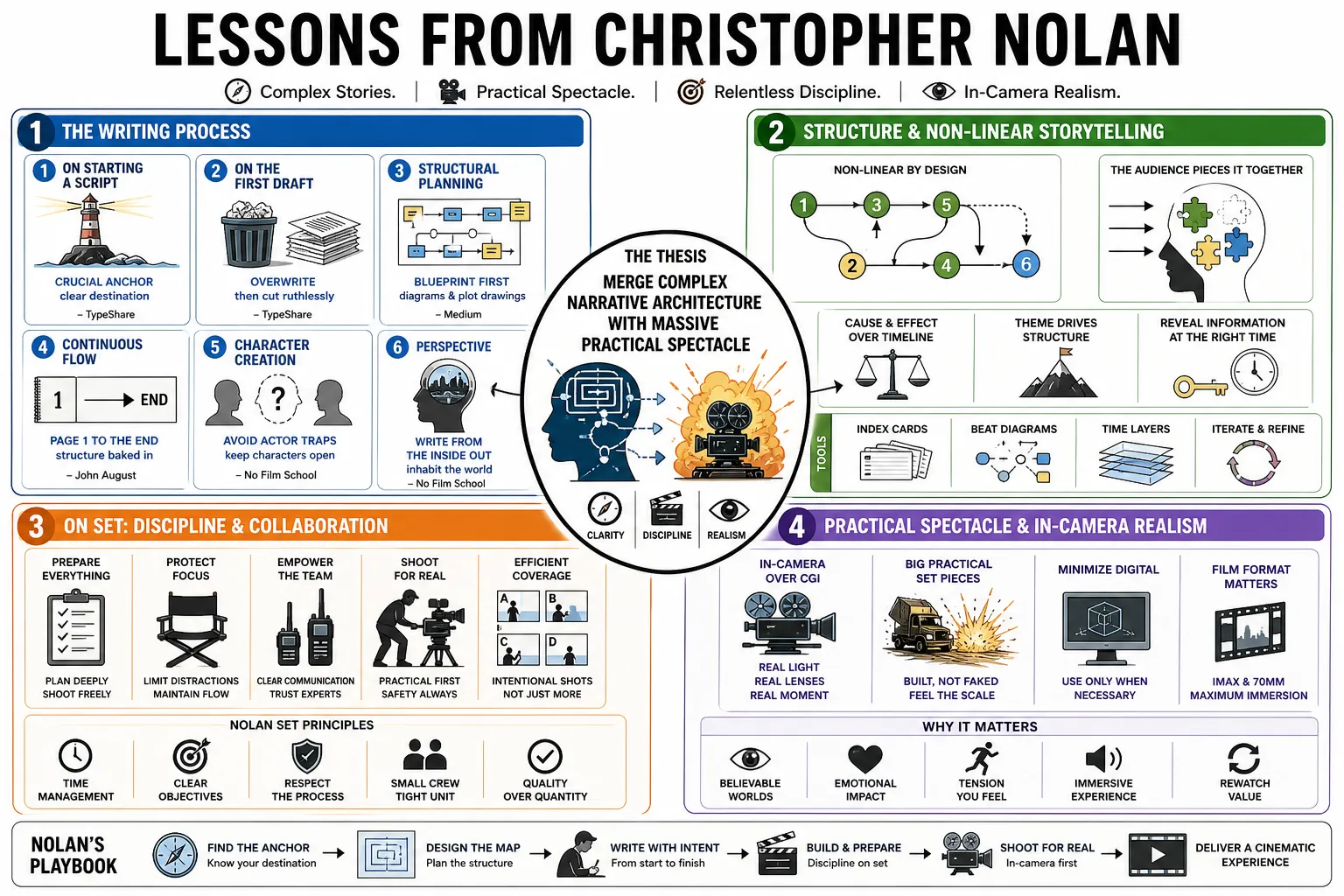
Part 1: The Writing Process
- On overwriting and editing: Nolan often overwrites and then edits the screenplay, much as he later edits images and dialogue. — Scriptnotes Episode 622.
- On planning structure: Nolan spends months thinking through a film and its narrative structure before he starts the screenplay. — Scriptnotes Episode 622.
- On writing in viewing order: After the difficult rearrangement of Following, Nolan writes a nonlinear script from its first audience-facing image to its last, with the structure built into the draft. — Scriptnotes Episode 622.
- On writing characters before casting: Nolan almost never writes a role for a particular actor: he tries to write the character first, rather than reproduce a performance he has already seen. — BAFTA A Life in Pictures.
- On point of view: Nolan works out whose perspective a scene belongs to before he shoots or cuts it, even moving the camera physically with a character to bring viewers into that experience. — DGA Nolan Interview.
- On emotional stakes: Inception only came together for Nolan once Cobb’s journey home to his children supplied emotional stakes alongside the film’s intricate dream rules. — WIRED Nolan Interview.
- On curiosity as a teacher: Nolan says his self-taught filmmaking skills grew from passion and curiosity, which made the technical lessons stick. — DGA Nolan Interview.
- On editing while writing: Nolan thinks about how adjacent images can create an idea in the viewer’s mind and tries to suggest that editorial experience on the screenplay page. — Scriptnotes Episode 622.
- On testing a formal experiment: Nolan showed Jonathan Nolan part of his Oppenheimer draft as a specific gut check on its unusual first-person approach. — Scriptnotes Episode 622.
Part 2: Narrative Architecture
- On cinematic time: Nolan says literary and cinematic works taught him that a film need not tell its story strictly from beginning to end. — BFI Sight and Sound Interview.
- On subjective chronology: Memento’s reverse chronology withholds recent events from viewers, bringing their knowledge closer to the amnesiac protagonist’s. — BAFTA A Life in Pictures.
- On finding narrative shape: Before drafting Oppenheimer, Nolan chose the paired hearing timelines to make the protagonist’s subjective story converse with a later, more objective account. — Scriptnotes Episode 622.
- On the chronological-draft trap: Nolan tried writing Following chronologically before rearranging it, but the resulting rewrite burden persuaded him to script later nonlinear films in viewing order from the outset. — Scriptnotes Episode 622.
- On orienting the audience: For nonlinear films Nolan often simplifies the opening in the edit so viewers can connect with the characters and format before the timeline becomes more intricate. — Scriptnotes Episode 622.
- On intercutting for dramatic contrast: Nolan braided Oppenheimer’s private security hearing with Strauss’s public confirmation hearing after finding revealing parallels between the two records. — Scriptnotes Episode 622.
- On distinguishing narrative threads: To make Inception’s intercut dream levels legible, Nolan and his cinematographer gave them visibly different weather, light and settings in the script and design. — WIRED Nolan Interview.
- On choosing form for the film: Nolan says cinematic form should respond to the particular film: he chose handheld images for the everyday quality of Inception’s dreams but IMAX for the operatic Batman films. — DGA Nolan Interview.
- On home video and narrative density: Nolan argues that home video let viewers own and revisit films, helping make denser visual and nonlinear narratives viable. — BFI Sight and Sound Interview.
Part 3: Directing and Leadership
- On making a first feature with available means: Nolan financed Following himself and shot it with friends on weekends while they held full-time jobs. — DGA Nolan Interview.
- On the risk of an original project: Nolan and Emma Thomas saw Inception as a challenging studio gamble, even after The Dark Knight; the studio ultimately backed its distinct script. — BFI Sight and Sound Interview.
- On offering a distinct film: For Nolan, an independent film should offer something fundamentally different from a cheap imitation of a studio movie; Memento was built around that distinction. — BFI Sight and Sound Interview.
- On studio communication: Nolan says Soderbergh advised him to communicate with producers instead of assuming a defensive posture, which helped him earn studio trust. — Guardian NFT Interview.
- On expert collaborators: When constraints challenged Dunkirk, Nolan turned to department heads in special effects, cinematography and stunts; their combined solution made the scene more dramatic. — BFI Sight and Sound Interview.
- On a world beyond the frame: Nolan tries to give each film a coherent world and atmosphere that suggests more is happening beyond the exact image shown. — DGA Nolan Interview.
- On scientific collaboration: Nolan brought physicist Kip Thorne together with visual-effects supervisor Paul Franklin so Interstellar’s black-hole imagery could grow from physical equations. — BAFTA A Life in Pictures.
- On learning every part of production: Nolan credits the hands-on demands of making Following with giving him practical knowledge of sound recording, editing, music and other film crafts. — DGA Nolan Interview.
- On large-format immersion: Nolan values IMAX film’s large negative and detailed image but says the format’s cumbersome camera changes how he blocks and frames scenes. — DGA Nolan Interview.
- On precise shot selection: Nolan generally shoots dramatic scenes with one camera, visualizes shots in advance and watches dailies to know the material he can later cut together. — DGA Nolan Interview.
Part 4: The Actor's Environment
- On a quiet, focused set: Nolan relies on his assistant director to keep a quiet, phone-free set while helping the cast and crew feel at ease and focused. — DGA Nolan Interview.
- On accommodating actors: Nolan adapts his process to each actor and tries to give performers what they need to explore a scene comfortably. — DGA Nolan Interview.
- On giving actors the story need: Nolan says he tells actors what a character must accomplish for the story while respecting their own interpretations and discussing the scene’s logic. — Guardian NFT Interview.
- On a tangible performance environment: For Interstellar, Nolan used projected imagery outside spacecraft windows so actors could react to visible surroundings and real light on set. — BAFTA A Life in Pictures.
- On repeat collaborators: Nolan says repeat work with an actor can ease communication and make him excited to offer that performer a different challenge. — BAFTA A Life in Pictures.
- On adapting IMAX for intimate acting: For The Odyssey, Nolan’s team and IMAX developed camera sound insulation and a mirror arrangement to record dialogue and preserve close actor eyelines. — 60 Minutes IMAX Interview.
Part 5: Practical Filmmaking
- On photographing a practical base: Nolan prefers to photograph real elements and use computer graphics to enhance them, rather than build a realistic-looking scene from nothing. — DGA Nolan Interview.
- On maintaining a realistic look: For films with a realistic visual texture, Nolan says computer-generated imagery needs to be matched carefully to photographed material or it can stand out. — DGA Nolan Interview.
- On using CGI as enhancement: Nolan uses digital tools to extend stunt work and floor effects, including removing wires or rigs, while matching the original filmed elements. — DGA Nolan Interview.
- On constraint-led practical solutions: Nolan says departments working within Dunkirk’s budget developed practical effects that sometimes made the result more dramatic than a costlier approach. — BFI Sight and Sound Interview.
- On consistent visual and sound texture: For Interstellar, Nolan linked naturalistic handheld photography and limited green screen to similarly restrained sound design and production sound. — BFI Sight and Sound Interview.
- On making limits part of the design: Nolan designed Following for its tiny budget and says the resulting constraints gave the film a distinctive uncanny quality. — BFI Sight and Sound Interview.
Part 6: Soundscapes and Scores
- On scoring the emotional story: For Interstellar, Nolan described the film’s emotional fable to Hans Zimmer before revealing its science-fiction setting so the first music would come from the story’s heart. — BAFTA A Life in Pictures.
- On composing before the film is shot: Nolan invited Zimmer to write an Interstellar theme before the screenplay was finished, then listened to that music while writing. — BAFTA A Life in Pictures.
- On combining score and sound design: Nolan has sound designers and composers exchange material so sound effects and music can be mixed as parts of one rhythmic soundtrack. — BAFTA A Life in Pictures.
- On inversion in Tenet’s score: Composer Ludwig Göransson experimented with reversed orchestral parts and made passages of Tenet’s score that can sound the same in both directions. — Göransson Tenet Interview.
- On music as a narrative voice: Göransson describes music in Nolan’s films as almost a character, contributing to the audience’s emotional route through a complex story. — Göransson Tenet Interview.
- On an unexpected instrument: Nolan wanted the organ in Interstellar because its scale and history suited the film better than a conventional science-fiction sound. — BAFTA A Life in Pictures.
- On sound that feels lived in: For Interstellar, Nolan asked the sound team to build from production sound and simple physical noises so the spacecraft would feel less artificially designed. — BFI Sight and Sound Interview.
- On rhythmic escalation: Nolan asked Zimmer to reinforce Dunkirk’s rising narrative intensity with musical and rhythmic ideas, including a sequence of peaks. — BAFTA A Life in Pictures.
Part 7: Editing and Post-Production
- On editing within a planned structure: Nolan plans much of a film’s structure in the screenplay, then uses the edit to explore the photographed material and refine how viewers receive it. — Scriptnotes Episode 622.
- On reviewing the viewer’s experience: Nolan says he often simplifies the opening of a nonlinear film during editing because viewers need time to find their feet before later timeline jumps. — Scriptnotes Episode 622.
- On emotional engagement first: Nolan says viewers are more likely to follow a complex narrative when they are engaged by its characters and emotional situation rather than asked to solve only an intellectual puzzle. — Husam Asi Nolan Interview.
- On dynamic context through intercutting: Nolan’s paired Oppenheimer timelines let public and private hearings illuminate each other rather than deliver all the context in one chronological account. — Scriptnotes Episode 622.
- On cutting for clarity: Nolan says he and his editor sometimes remove overwritten exposition and try radical cuts; shortening a film can also make its central point clearer. — DGA Nolan Interview.
Part 8: Philosophy and Experience
- On chasing reality: In his Princeton Class Day address, Nolan urged graduates to pursue reality as the foundation of their dreams, not treat it as their dreams’ poor cousin. — Princeton Class Day Address.
- On subjective reality: Nolan frames Inception through Cobb’s subjective viewpoint and makes the closing uncertainty about dream or waking life part of the film’s substance. — WIRED Nolan Interview.
- On making room for new voices: After a decade making Batman films, Nolan said that world needed new voices and that he wanted to pursue different stories himself. — Los Angeles Times Nolan Interview.
- On existential stakes beneath structure: Nolan connects Inception’s dream-world design to memory, desire and uncertainty about what follows death, rather than treating its structure only as a puzzle. — WIRED Nolan Interview.
- On respecting the audience: Nolan says filmmakers are audience members too and should take viewers’ expectations seriously without simply repeating familiar forms. — BAFTA A Life in Pictures.
- On cinema as a theatrical experience: Nolan and Emma Thomas design films with theatrical exhibition in mind; for him narrative information and the form in which viewers experience it are not separate. — BFI Sight and Sound Interview.