Lessons from Chuck Yeager
Chuck Yeager was a U.S. Air Force test pilot and the first person to break the sound barrier. He approached flying with mechanical mastery and emotional control rather than recklessness. This collection pulls his thoughts on fear, duty, and flight directly from his autobiography, interviews, and public statements.
Part 1: The Pilot's Mindset
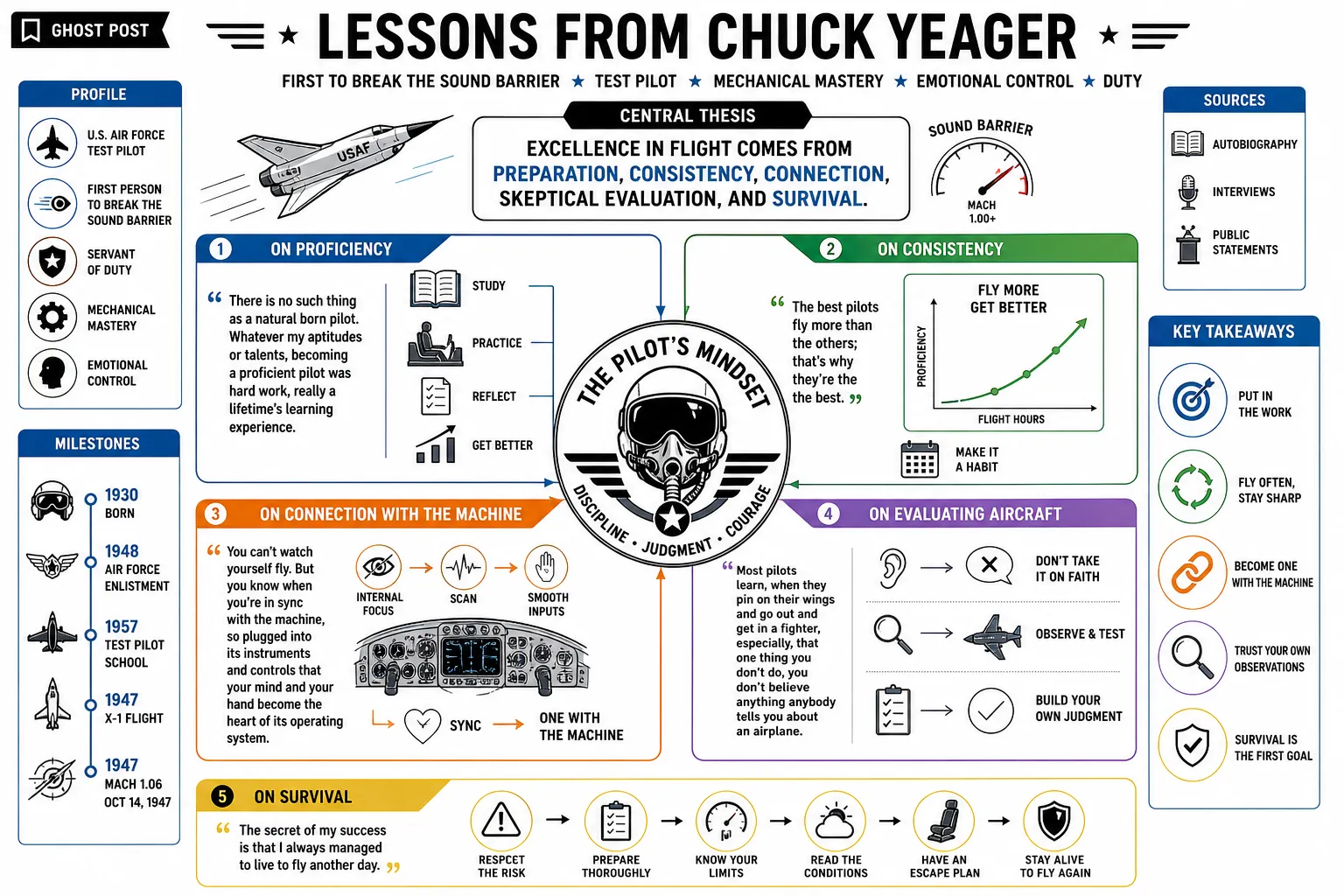
- On Proficiency: "There is no such thing as a natural born pilot. Whatever my aptitudes or talents, becoming a proficient pilot was hard work, really a lifetime's learning experience." — Source: [Yeager: An Autobiography]
- On Consistency: "The best pilots fly more than the others; that's why they're the best." — Source: [ChuckYeager.org]
- On Connection With the Machine: "You can't watch yourself fly. But you know when you're in sync with the machine, so plugged into its instruments and controls that your mind and your hand become the heart of its operating system." — Source: [AZQuotes]
- On Evaluating Aircraft: "Most pilots learn, when they pin on their wings and go out and get in a fighter, especially, that one thing you don't do, you don't believe anything anybody tells you about an airplane." — Source: [Aviation Quotations]
- On Survival: "The secret of my success is that I always managed to live to fly another day." — Source: [ChuckYeager.org]
- On Hubris: "Arrogance got more pilots in trouble than faulty equipment." — Source: [Goodreads]
- On Professionalism: "If you are going to fly, do it right. What I really admire in a flyer is professionalism and consistency." — Source: [AZQuotes]
- On Human Limits: "If you want to grow old as a pilot, you've got to know when to push it, and when to back off." — Source: [Aviation Quotations]
- On Instinct Versus Intelligence: A deep understanding of an airplane's mechanical systems allows a pilot to fly by instinct, making the pilot and the machine function as a single unit. — Source: [Yeager: An Autobiography]
- On Landings: "If you can walk away from a landing, it's a good landing. If you use the airplane the next day, it's an outstanding landing." — Source: [AZQuotes]
Part 2: Fear and Survival
- On Acknowledging Fear: "I was always afraid of dying. Always." — Source: [Yeager: An Autobiography]
- On Leveraging Fear: "It was my fear that made me learn everything I could about my airplane and my emergency equipment, and kept me flying respectful of my machine and always alert in the cockpit." — Source: [ChuckYeager.org]
- On the Utility of Panic: "What good does it do to be afraid? It doesn't help anything. You better try and figure out what's happening and correct it." — Source: [AZQuotes]
- On Mechanical Understanding: "You've got to understand systems. Even in today's airplanes, you have to understand systems. The better you understand them, the better off you are in case an emergency arises." — Source: [Goodreads]
- On Survival Priorities: In an emergency, managing the immediate physical realities of the aircraft takes priority over calculating the statistical odds of survival. — Source: [Yeager: An Autobiography]
- On Managing the Unknown: The most dangerous elements in flight are frequently the internal systems of the aircraft that the pilot fails to fully understand before taking off. — Source: [ChuckYeager.org]
- On Perceived Fearlessness: Observers often mistake a test pilot's extreme focus and intense preparation in high-risk environments for a total lack of fear. — Source: [Academy of Achievement]
- On Staying Alert: Complacency is far more dangerous than fear; fear keeps a pilot studying the manuals and constantly checking the dials. — Source: [Yeager: An Autobiography]
- On Test Flight Objectives: The objective of test flying is never to demonstrate bravery, but to extract accurate data and bring both the pilot and the aircraft back intact. — Source: [Academy of Achievement]
Part 3: The Sound Barrier and The X-1
- On Approaching Mach 1: "Just before you break through the sound barrier, the cockpit shakes the most." — Source: [ChuckYeager.org]
- On Supersonic Flight: "We were flying supersonic. And it was as smooth as a baby's bottom; Grandma could be sitting up there sipping lemonade." — Source: [Aviation Quotations]
- On the Anticlimax of the Barrier: "It took a damned instrument meter to tell me what I'd done. After all the anticipation to achieve this moment, it really was a letdown." — Source: [Yeager: An Autobiography]
- On the Missing Physical Wall: "There should've been a bump in the road, something to let you know that you had just punched a nice, clean hole through the sonic barrier." — Source: [Aviation Quotations]
- On the Nature of the X-1: "You concentrate on what you are doing, to do the best job you can, to stay out of serious situations. And that's the way the X-1 was." — Source: [AZQuotes]
- On the Real Barrier: "Later on, I realized that this mission had to end in a letdown because the real barrier wasn't in the sky but in our knowledge and experience of supersonic flight." — Source: [Yeager: An Autobiography]
- On the Danger of the X-1: "It wasn't that the X-1 would kill you, it was the systems in the X-1 that would kill you." — Source: [ChuckYeager.org]
- On the First Radio Transmission: "Hey Ridley, that Machometer is acting screwy. It just went off the scale on me." — Source: [Aviation Quotations]
- On Assigning Names to History: Naming the X-1 "Glamorous Glennis" continued a wartime tradition of honoring his wife during his most dangerous assignments. — Source: [ChuckYeager.org]
- On Duty and the X-1 Assignment: "When I was picked to fly the X-1, it was my duty to fly it, and I did." — Source: [Academy of Achievement]
Part 4: Combat and World War II
- On Seeing His First Jet: "The first time I ever saw a jet, I shot it down." — Source: [Aviation Quotations]
- On the Ethics of Air Combat: "Not very sportsmanlike — but what the hell?" — Source: [Aviation Quotations]
- On Flying the Mustang: "It’s almost impossible to describe the feeling: it’s as if you were one with that Mustang, an extension of the throttle." — Source: [Yeager: An Autobiography]
- On the Pilot Versus the Equipment: "It's the man, not the machine." — Source: [ChuckYeager.org]
- On Dogfighting Intensity: "You were so wired into that airplane that you flew it to the limit of its specs, where firing your guns could cause a stall." — Source: [Yeager: An Autobiography]
- On Combat Instinct: "Maximum power, lift, and maneuverability were achieved mostly by instinctive flying…. Concentration was total." — Source: [Yeager: An Autobiography]
- On Being Shot Down: Evading capture in occupied territory required the exact same methodical problem-solving and reliance on instinct as flying a damaged aircraft. — Source: [Academy of Achievement]
- On the P-51 Mustang: The Mustang acted as a fighter pilot's dream, an aircraft that rewarded a pilot who learned exactly how far its capabilities could be safely pushed. — Source: [Yeager: An Autobiography]
- On Wartime Motivation: The primary driver in combat was doing the job you were specifically trained for and ensuring the survival of your squadron. — Source: [Academy of Achievement]
Part 5: Leadership and Duty
- On Setting the Standard: A leader in a high-stakes environment cannot ask their team to take physical risks they are unwilling to take themselves. — Source: [Academy of Achievement]
- On Self-Reliance: "I have found that those who do it on their own do it best." — Source: [Men's Journal]
- On Remaining Calm: A leader's visible coolness under pressure serves as a stabilizing force that prevents a team from panicking during a crisis. — Source: [Yeager: An Autobiography]
- On Discomfort and Growth: Continual improvement requires pushing past comfort zones and embracing the uncomfortable realities of a difficult job. — Source: [ChuckYeager.org]
- On Taking Orders: When assigned to a highly experimental aircraft program, a pilot must view the mission as a basic matter of duty rather than a quest for personal glory. — Source: [Academy of Achievement]
- On Following Rules: "Rules are made for people who aren't willing to make up their own." — Source: [AZQuotes]
- On Trusting Subordinates: Effective leadership involves expecting individuals to understand their equipment thoroughly without needing constant oversight from superiors. — Source: [Yeager: An Autobiography]
- On Task Completion: "My father taught me to finish anything I started. And I think that carries throughout your adult life." — Source: [ChuckYeager.org]
- On Doing the Work: "There is no kind of ultimate goal to do something twice as good as anyone else can. It's just to do the job as best you can." — Source: [Goodreads]
Part 6: Risk and Results
- On Evaluating Risk: "You don't concentrate on risks. You concentrate on results." — Source: [AZQuotes]
- On Necessary Risks: "No risk is too great to prevent the necessary job from getting done." — Source: [Goodreads]
- On Overcoming Obstacles: "You do what you can for as long as you can, and when you finally can't, you do the next best thing. You back up, but you don't give up." — Source: [AZQuotes]
- On Relentless Forward Motion: The philosophy of "Press On!" dictates maintaining a full-out and straight-ahead approach to life's challenges regardless of setbacks. — Source: [ChuckYeager.org]
- On Calculating Odds: Dwelling on the statistical probability of failure only detracts from the focus required to execute a complex task successfully. — Source: [Yeager: An Autobiography]
- On Test Flying Limits: The purpose of pushing an aircraft to its absolute limit is to find the exact boundary between high performance and catastrophic failure. — Source: [Academy of Achievement]
- On Managing the Unknown: The unknown is often perceived as a solid barrier, but it is frequently just a threshold of human knowledge that can be pierced with data and testing. — Source: [Aviation Quotations]
- On Safety Margins: Knowing exactly when to push an experimental aircraft is equally as important as knowing exactly when to pull the throttle back. — Source: [Aviation Quotations]
- On Inevitable Failures: Accepting that equipment will occasionally fail allows a professional to focus immediately on emergency procedures rather than reacting with surprise. — Source: [Yeager: An Autobiography]
Part 7: Life, Work, and Philosophy
- On Enjoying Work: "Everybody that I've ever seen that enjoyed their job was very good at it." — Source: [ChuckYeager.org]
- On Choosing a Career: "Do something that you like. Forget about the pay for Christ's sakes." — Source: [ChuckYeager.org]
- On Living Within Means: "Regulate your style of living to fit your income. Just have fun in your job, that's the main thing." — Source: [ChuckYeager.org]
- On Broad Horizons: "Don't be too narrow in your goals. That's the one thing. You say, 'I'm going to be an astronaut when I grow up.' He sits there and doesn't see all kinds of good opportunities go by him." — Source: [ChuckYeager.org]
- On Prioritizing Fun: "Unfortunately, many people do not consider fun an important item on their daily agenda. For me, that was always a high priority in whatever I was doing." — Source: [AZQuotes]
- On Dealing With Limitations: When an original plan fails or physical limits are reached, the only rational response is to immediately find the next viable option. — Source: [Yeager: An Autobiography]
- On Legacy: The value of a career is not measured by the public accolades, but by the private knowledge that a difficult job was done correctly. — Source: [Academy of Achievement]
- On Receiving Advice: The most valuable lessons are rarely handed down in formal advice; they are learned through direct, often painful, personal experience. — Source: [Men's Journal]
- On Staying Grounded: High achievements in the sky do not exempt a person from the practical, everyday requirements of living a responsible life on the ground. — Source: [Yeager: An Autobiography]
- On Pressing On: Setbacks are a guaranteed part of any ambitious undertaking; the defining factor of success is the refusal to stop moving forward. — Source: [Goodreads]
Part 8: Roots and Reflections
- On His Origins: "I was born so far up a holler, they had to pipe daylight in." — Source: [AZQuotes]
- On Fame in His Hometown: "There wasn't a pigeon in Hamlin until they erected a statue of me." — Source: [AZQuotes]
- On His First Wife, Glennis: Naming his most dangerous aircraft "Glamorous Glennis" was a tribute to the woman whose steadiness grounded his high-risk lifestyle. — Source: [ChuckYeager.org]
- On Rural Upbringing: Growing up in West Virginia taught him the mechanical aptitude and self-reliance that would later keep him alive in experimental aircraft. — Source: [Academy of Achievement]
- On Gender: "It makes no difference what a pilot's reproductive organs are shaped like." — Source: [Aviation Quotations]
- On Aging: The transition from active test flying to an advisory role requires accepting physical limitations without losing the analytical mindset of a pilot. — Source: [Yeager: An Autobiography]
- On the Evolution of Aviation: Watching the transition from propeller planes to supersonic jets reinforced the idea that the only constant in aerospace is rapid technological change. — Source: [Academy of Achievement]
- On His Father's Influence: The work ethic instilled by a demanding father in a rural environment provided the foundational discipline required for a career in the military. — Source: [ChuckYeager.org]
- On Looking Back: A lifetime of flying is best viewed not as a series of distinct records, but as a continuous, hard-earned education in surviving the sky. — Source: [Yeager: An Autobiography]