Claude Shannon established the mathematical rules for digital communication, proving that any data could be encoded as zeros and ones and transmitted flawlessly. Known for riding a unicycle through the halls of Bell Labs and building mechanical mice, he treated scientific questions and whimsical gadgets as equally worthy puzzles. This profile collects his methods for breaking down complex systems, investing in the stock market, and maintaining relentless curiosity.
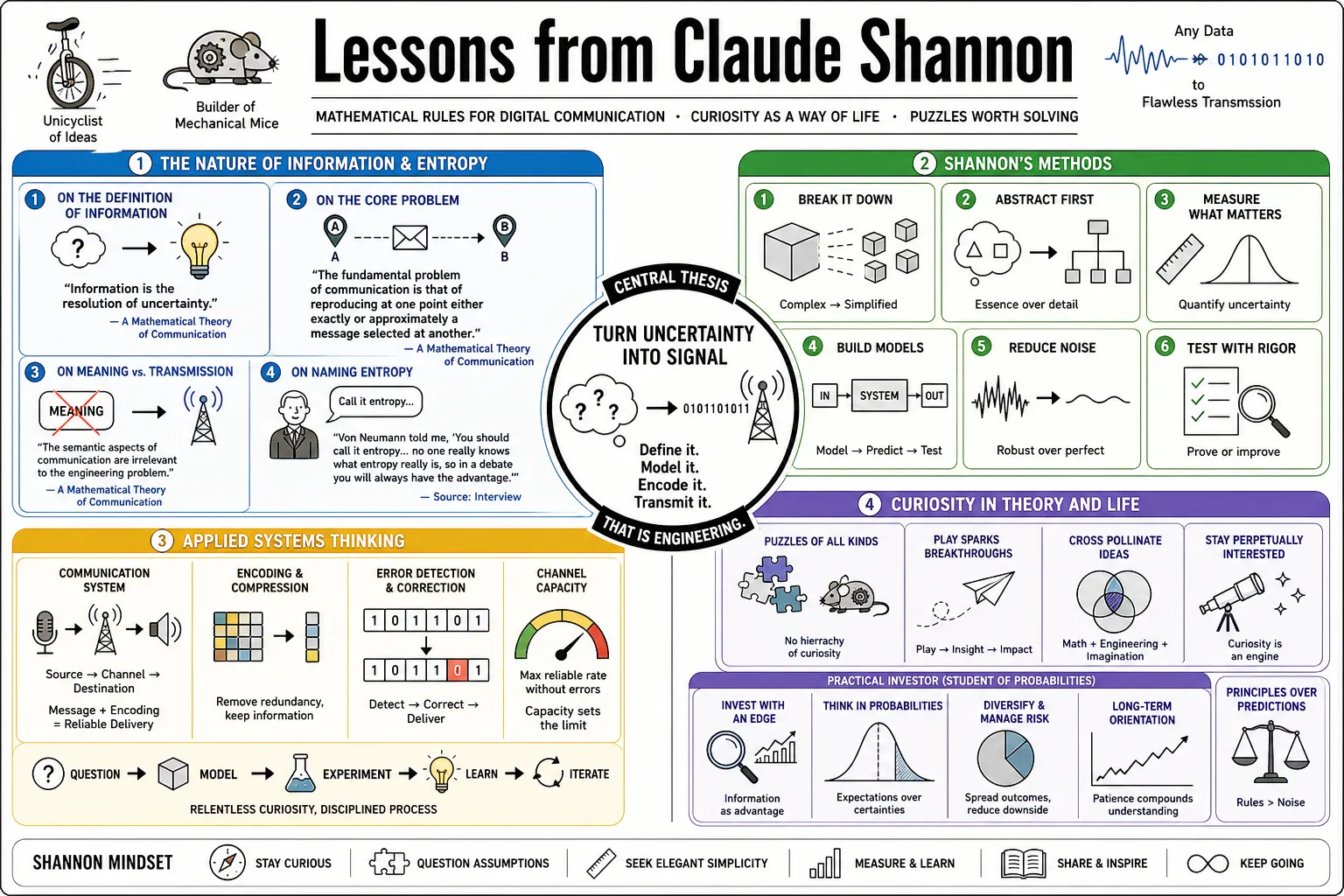
Part 1: The Nature of Information and Entropy
- On the Definition of Information: "Information is the resolution of uncertainty." — Source: A Mathematical Theory of Communication
- On the Core Problem: "The fundamental problem of communication is that of reproducing at one point either exactly or approximately a message selected at another point." — Source: A Mathematical Theory of Communication
- On Meaning vs. Transmission: "The semantic aspects of communication are irrelevant to the engineering problem." — Source: A Mathematical Theory of Communication
- On Naming Entropy: "Von Neumann told me, 'You should call it entropy... no one really knows what entropy really is, so in a debate you will always have the advantage.'" — Source: Scientific American
- On the Bit: He introduced the "bit" as the fundamental unit of data, proving that information could be transmitted without error regardless of physical noise. — Source: A Mind at Play
- On Signals and Noise: "A series of letters, or, simpler still, a series of zeros and ones, is the core of getting a wave form from one point to another." — Source: Medium
- On Redundancy: Language redundancy is not a flaw; it is the mathematical feature that allows communication to survive in the presence of noise. — Source: A Mind at Play
- On the Limit of Communication: He established the "Shannon limit," the theoretical maximum rate at which data can be transmitted over a given channel without introducing errors. — Source: IEEE Spectrum
- On Cybernetics: "Use the word 'cybernetics', Norbert, because nobody knows what it means. This will always put you at an advantage in arguments." — Source: Scientific American
- On Measuring Uncertainty: "Information measures the uncertainty we overcome. It measures our chances of learning something we haven't yet learned." — Source: The CEO Library
Part 2: The Art of Problem Solving
- On Problem Definition: "A problem well stated is a problem half-solved." — Source: Creative Thinking Paper
- On Simplification: "Attempt to eliminate everything from the problem except the essentials; that is, cut it down to size." — Source: Creative Thinking Paper
- On Restatement: "Try to restate it in just as many different forms as you can. Change the words. Change the viewpoint. Look at it from every possible angle." — Source: Creative Thinking Paper
- On Small Steps: "If you can't solve the problem as a whole, try to break it down into smaller parts... It seems to be much easier to make two small jumps than the one big jump in any kind of mental thinking." — Source: Creative Thinking Paper
- On Working Backward: "If I inverted the problem, it would have been very easy to do... start with the required result and run it back until it matches the given input." — Source: Creative Thinking Paper
- On Generalization: "If it was in two dimensions, do it in N dimensions; or if it was in the field of real numbers, change it to a general algebraic field." — Source: Creative Thinking Paper
- On Mental Blocks: "You can't break loose from certain mental blocks which are holding you in certain ways of looking at a problem." — Source: Creative Thinking Paper
- On the Beginner's Mind: "Someone who is quite green to a problem will sometimes come in and look at it and find the solution like that... someone else comes in and sees it from a fresh viewpoint." — Source: Creative Thinking Paper
- On Analogy: "If you are trying to solve a problem, you may find that someone else has already solved a similar problem... you can use their results to help you solve yours." — Source: Creative Thinking Paper
- On Elegance: "I am very seldom interested in applications. I am more interested in the elegance of a problem. Is it a good problem, an interesting problem?" — Source: Omni Magazine Interview
Part 3: Artificial Intelligence and Machines
- On Machine Capability: "I see no limit to the capabilities of machines. As microchips get smaller and faster, I can see them getting better than we are." — Source: Wikiquote
- On Human Nature: "I believe in evolutionary theory and that we are basically machines but of a very complex type, far more so than any machine that man has made yet." — Source: Wikiquote
- On the Future Hierarchy: "I visualize a time when we will be to robots what dogs are to humans. And I am rooting for the machines." — Source: Omni Magazine Interview
- On Machine Progress: "I am not depressed by machines getting better. I am rooting for the machines! I have always been on the machines' side." — Source: John Horgan Interview
- On Thinking Systems: "I’m a machine, and you’re a machine, and we both think, don’t we?" — Source: John Horgan Interview
- On Timelines: "It is certainly plausible to me that in a few decades machines will be beyond humans." — Source: John Horgan Interview
- On Natural Mechanics: "We are the extreme case: a natural mechanical device." — Source: Wikiquote
- On Exceeding Creators: "The thought that a machine could never exceed its creator was just foolish logic, wrong and incorrect logic. You can make a thing that is smarter than yourself." — Source: Chess Programming Wiki
- On Defining Thought: "If we regard thinking as a property of external actions rather than internal method, the machine is surely thinking." — Source: Chess Programming Wiki
Part 4: The Playful Mind and Useless Pursuits
- On Useless Hobbies: "I’ve always pursued my interests without much regard for financial value or value to the world... I’ve spent lots of time on totally useless things." — Source: A Mind at Play
- On Juggling Theory: "Juggling can be thought of as the art of controlling patterns in time and space." — Source: International Jugglers' Association
- On the Juggling Equation: He proved that for any juggling pattern, the flight time plus hand dead time multiplied by the number of hands equals empty hand time plus dead time multiplied by the balls. — Source: Scientific American
- On Juggling Robots: "The greatest numbers jugglers of all time cannot sustain their record patterns for more than a few minutes, but my little clowns juggle all night and never drop a prop!" — Source: International Jugglers' Association
- On Mischief: "I am a unicycle devotee... Since retiring from MIT, I have been getting into all kinds of mischief." — Source: Time Magazine
- On Peculiar Motions: He rode a unicycle while juggling through the halls of Bell Labs because he considered it a peculiar physical motion that challenged his coordination. — Source: Juggle.org
- On Retirement Priorities: "Since our retirement, Betty doesn't do windows, and I don't give talks. I am a unicycle devotee." — Source: Time Magazine
- On Jugglers' Plight: "Jugglers are surely the most vulnerable of all entertainers." — Source: Medium
- On Doing What Comes Naturally: "I do what comes naturally, and usefulness is not my main goal. I like to solve new problems all the time." — Source: A Mind at Play
- On Impossible Physics: He designed a unicycle with a square tire and verified mathematically that it could be ridden as long as the ground was molded into inverted catenary curves. — Source: Advisor Perspectives
Part 5: Chess and Strategic Complexity
- On Machine Strategy: "It is not being suggested that we should design the strategy in our own image. Rather it should be matched to the capacities and weaknesses of the computer." — Source: Motley Bytes
- On Ideal Test Beds: "The chess machine is an ideal one to start with, since... it is neither so simple as to be trivial nor too difficult for satisfactory solution." — Source: INFN.it
- On Game Complexity: He mapped the game-tree complexity of chess to 10^120, showing why a pure brute-force calculation to the end of the game was mathematically impossible. — Source: Wikipedia
- On Perfection in Chess: "If both sides play correctly the game will end in a draw." — Source: INFN.it
- On Chance: "In chess, there is no chance element apart from the original choice of which player has the first move." — Source: Medium
- On Tackling Larger Problems: "Thinking rigorously about the construction of a chess-playing computer might act as a wedge in attacking other problems of a similar nature and of greater significance." — Source: Chess Programming Wiki
- On Good Advice: "'Always investigate a check, it may lead to mate' is sound advice for any player." — Source: Medium
- On Bad Advice: "'Always give check, it may be mate' is tongue-in-cheek advice given to beginners aimed at their predilection for useless checks." — Source: Medium
- On Artificial Evaluation: He proposed the first evaluation function for computer chess algorithms, applying mathematical weights to specific material and positional advantages. — Source: Chess.com
Part 6: Investing and Fundamentals
- On Business Fundamentals: "The most important thing in my view is to find companies that have good growth of earnings per year, which sounds so simple." — Source: The Smart Investor
- On the Noise of Prices: "A lot of people look at the stock price, when they should be looking at the basic company and its earnings." — Source: Medium
- On Technical Analysis: "I think that the technicians who work so much with price charts... are working with what I would call a very noisy reproduction of the important data." — Source: The Smart Investor
- On Real Assets: The true value of a company is not plotted on a stock chart; rather, it is found entirely in the company's people and products. — Source: The Smart Investor
- On Short-Term Randomness: "There is a lot more randomness there [in the short term] and things happen which you cannot predict which cause people to sell or buy a lot of stock." — Source: The Smart Investor
- On Long-Term Strategy: "My general feeling is that it is easier to choose companies which are going to succeed, than to predict short-term variations, things which last only weeks or months." — Source: Medium
- On Portfolio Rebalancing: "We have not at any time in the past 30 years attempted to balance our portfolio." — Source: The Smart Investor
- On Simplicity in Finance: "Complicated formulas mattered a great deal less" than evaluating the fundamental health of the underlying business. — Source: The Smart Investor
- On Shannon's Demon: Though he demonstrated mathematically that one could yield positive returns by constantly rebalancing random assets, his actual fortune came from buying and holding exceptional companies for decades. — Source: Deciphr.ai
Part 7: Curiosity, Motivation, and Genius
- On Pure Curiosity: "I was never motivated by the notion of winning prizes or the desire for financial gain. My motivation in science has always been curiosity about something: How is it put together?" — Source: Medium
- On the Big Bang of Discovery: "If I've been trying to prove a mathematical theorem for a week or so and I finally find the solution, I get a big bang out of it." — Source: Creative Thinking Paper
- On Constructive Dissatisfaction: Real innovation stems from a productive discontent that says, "This is OK, but I think things could be done better. I think there is a neater way to do this." — Source: Creative Thinking Paper
- On the Drive to Know: Raw intelligence requires an internal engine to be effective; the true researcher simply wants to know the answers and is curious how things tick. — Source: Creative Thinking Paper
- On Idea Multipliers: Using an analogy of uranium mass, he noted some minds hit a critical threshold: "There are other people who are beyond this point at which they produce two ideas for each idea sent in." — Source: James Clear
- On Publishing Quality: "A few first rate research papers are preferable to a large number that are poorly conceived or half-finished." — Source: Wikiquote
- On Ignoring Critics: "He never argued his ideas. If people didn't believe in them, he ignored those people." — Source: Wikipedia
- On Breadth and Depth: "In these days, when there is a tendency to specialize so closely, it is well for us to be reminded that the possibilities of being at once broad and deep did not pass with Leonardo da Vinci." — Source: Goodreads
- On Intuition Over Equations: "I think I’m more visual than symbolic. I try to get a feeling of what’s going on. Equations come later." — Source: A Mind at Play
Part 8: Knowledge, Time, and Reality
- On Time's Arrow: "We know the past but cannot control it. We control the future but cannot know it." — Source: Medium
- On Cryptographic Security: "The enemy knows the system." — Source: John Horgan Interview
- On Mathematical Secrecy: He cemented the foundations of modern cryptography by mathematically proving that the one-time pad is the only theoretically unbreakable encryption method. — Source: Wikipedia
- On Pushing Strings: Observing a tangled mechanical assembly, he remarked it was "as easy as pushing a string," reflecting his acceptance that some problems are inherently intractable by nature. — Source: Wikipedia
- On Logical Foundations: His master's thesis proved that Boolean logic could map directly to electromechanical relays, laying the architectural groundwork for all modern computing. — Source: Medium
- On the Pace of Mathematics: "Most great mathematicians have done their finest work when they were young." — Source: John Horgan Interview
- On Quiet Confidence: He developed his groundbreaking theory of communication in near-total isolation over a decade, unleashing it on the scientific community fully formed. — Source: Wikipedia
- On the Illusion of Difficulty: He had an uncanny ability to stare at a vastly complicated problem and physically reorganize how to look at it until the mechanics became completely simple. — Source: Wikipedia
- On Freedom Over Status: He fundamentally valued personal freedom above formal status, choosing to store his most prestigious academic medals in a dusty room scattered with unicycles and homemade toys. — Source: Medium