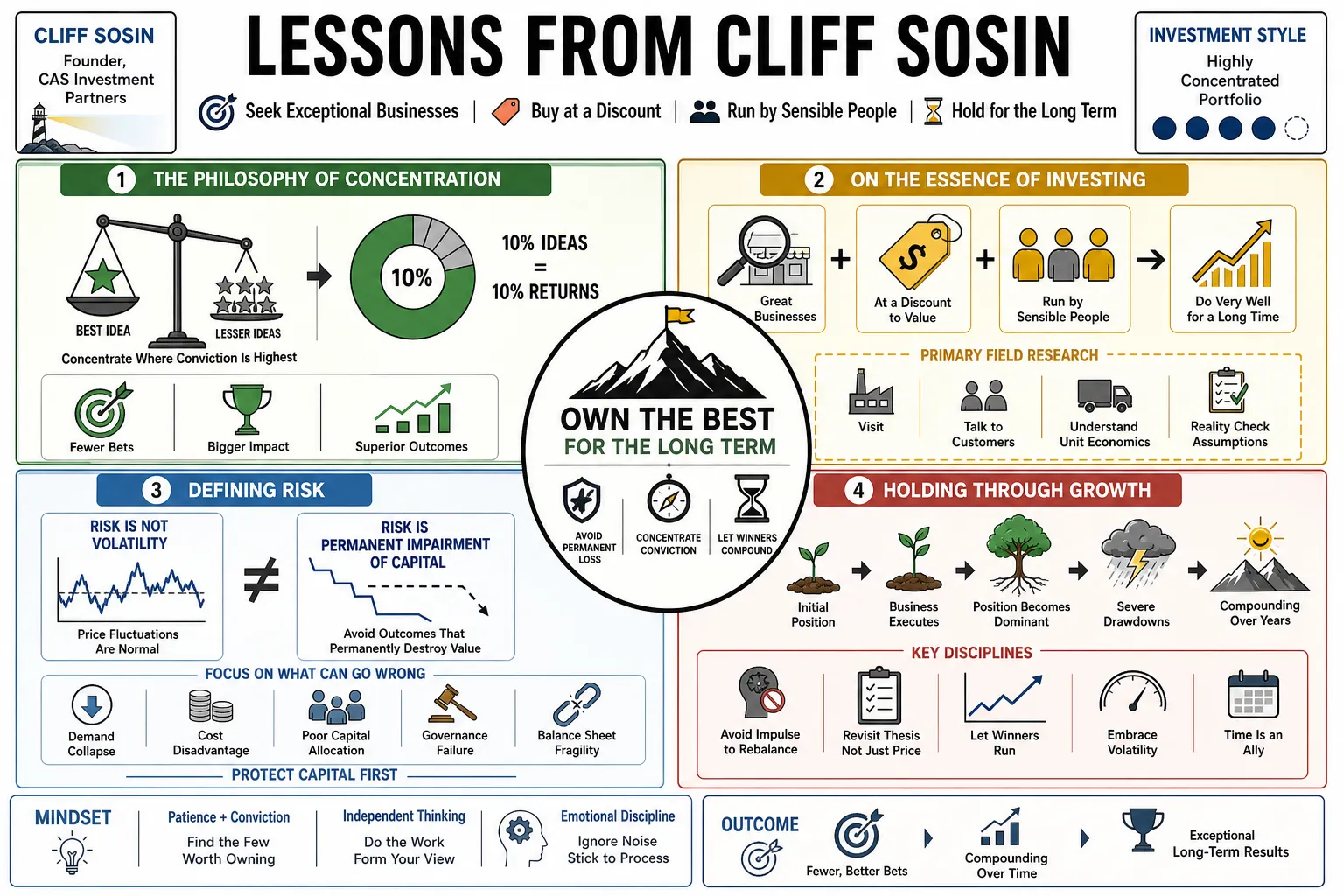
Lessons from Cliff Sosin
Cliff Sosin founded CAS Investment Partners in 2012. His investing approach combines a concentrated portfolio, direct research into how businesses work, and a willingness to distinguish short-term stock-price moves from evidence about a company's long-term prospects. — Graham & Doddsville Interview.
Part 1: The Philosophy of Concentration
- On the Essence of Investing: Sosin looks for businesses he expects to do well for a long time, at prices that do not fully reflect those prospects, run by sensible people. — Good Investing Interview.
- On Defining Risk: Sosin separates the risk of financial distress before a thesis can play out from the risk that the thesis itself is wrong; a concentrated portfolio and its investors need to withstand adverse paths. — Graham & Doddsville Interview.
- On Holding Through Growth: CAS had a rule against buying more after a position exceeded 25% of its portfolio, but Sosin did not automatically sell Carvana as appreciation lifted its weight toward 40%; he kept comparing its prospects with other holdings. — Good Investing Carvana Interview.
- On Sizing: Sosin approaches position size by asking how large a loss the long-term portfolio could withstand, while allowing for an unforeseen event that could make a holding worthless. — Graham & Doddsville Interview.
- On Diversification: In Sosin's view, a handful of holdings can capture substantial diversification against company-specific price moves while keeping attention on the few ideas he considers exceptional; he does not claim there is one ideal number of positions. — Graham & Doddsville Interview.
- On Opportunity Cost: Before replacing a holding, Sosin compares the range of possible outcomes for the newcomer with the position already owned over a five-to-ten-year horizon; if prospects are similar, he says more diversification may be preferable. — Graham & Doddsville Interview.
- On Finding Outliers: Sosin says CAS looks for very few extraordinary investments, so an unusual business tends to interest him more than one that looks like many others—though uniqueness alone does not make it a good investment. — Good Investing Interview.
- On Portfolio Structure: A portfolio of only a few substantial positions forces Sosin to examine trade-offs carefully; he says he tries to invalidate a clear investment hypothesis before buying even a starter position. — Graham & Doddsville Interview.
Part 2: Seeking Ground Truth
- On Scuttlebutt: Sosin says speaking with former employees, competitors and customers has been his best way to understand how a business works on the ground. — Good Investing Culture Interview.
- On Financials vs. Reality: Sosin treats 10-K reading as necessary groundwork, but says a differentiated view also requires gathering information from people who have seen the business operate. — Good Investing Culture Interview.
- On Primary Research: CAS uses expert networks to find people with relevant experience, but Sosin conducts the expert interviews himself, asking about actual projects and decisions. — Good Investing Culture Interview.
- On Customer Behavior: To test whether LifeLock customers would still renew after understanding the product's limits, Sosin describes a survey that gave some respondents an explicit explanation before asking about renewal intent. — Good Investing LifeLock Interview.
- On Employee Perspectives: Sosin interviews former employees who served for a meaningful period and left on good terms, then asks how projects and decisions were handled to understand the organization beyond its formal description. — Good Investing Culture Interview.
- On Competitive Dynamics: For a long-term investment, Sosin looks for both a compelling customer proposition and concrete reasons competitors cannot easily reproduce it or erode the economics. — Good Investing Culture Interview.
- On Discarding Noise: Sosin filters information by asking whether an event will still matter to the business ten years later; he also cautions that some events do pass that test and deserve attention. — Good Investing Culture Interview.
- On Validating Claims: When weighing competing explanations for LifeLock's results, Sosin combined public statistics, conversations with former call-center staff, advertising review and a customer survey rather than accepting either narrative at face value. — Good Investing LifeLock Interview.
- On Synthesis: Sosin starts with mental models that imply observable predictions, tests those predictions through research, and lets unexpected observations reshape the model. — Good Investing Process Interview.
Part 3: Enduring Market Volatility
- On Drawdowns: During CAS's 2022 decline, Sosin wrote that stocks do not rise in straight lines and that substantial drawdowns can be expected in long-term investing without becoming enjoyable. — CAS April 2022 Letter.
- On Mark-to-Market Contradictions: Sosin noted a tension in judging a partnership premised on market mispricing by near-term market prices; he said this was especially visible during CAS's 2022 losses. — CAS July 2022 Letter.
- On Price vs. Value: In Sosin's process, a falling stock price by itself does not disprove the business hypothesis; disconfirmation must come from evidence about the mechanism expected to create value. — Graham & Doddsville Interview.
- On Volatility as a Toll: Sosin acknowledges that large drawdowns are painful even when they are expected; his fund therefore needs investors and an operating structure able to sustain a long horizon through them. — Graham & Doddsville Interview.
- On Market Perception: In July 2022, Sosin argued that Carvana's lower sales and logistics troubles did not necessarily erase the long-term consumer proposition he saw; he called this his assessment and said he would change it if new facts warranted. — CAS July 2022 Letter.
- On Holding Periods: Sosin designed CAS for investors seeking long-term compounding who could tolerate a steep interim decline without forcing the partnership to abandon its process. — Graham & Doddsville Interview.
- On Averaging Down: Sosin reported nearly doubling CAS's Carvana holdings during the 2022 decline after further research reinforced his thesis, while explicitly leaving room to change the position if his assessment changed. — CAS July 2022 Letter.
- On Retrospective Clarity: During Carvana's 2022 setbacks, Sosin observed that challenges in building a business can look solvable in hindsight yet feel severe while they are unfolding; this was his contemporary interpretation, not a guaranteed outcome. — CAS April 2022 Letter.
Part 4: Evaluating Management and Culture
- On Ideal Managers: Sosin looks for managers who can explain business choices with sound reasoning, while recognizing that the right leader depends on the particular company and its problems. — Good Investing Management Interview.
- On Humility: Sosin cautions against judging management only by outcomes: a failed decision can still reveal capable leadership if managers can explain the reasoning and what they learned. — Good Investing Management Interview.
- On Capital Allocation: To evaluate a management team's judgment, Sosin asks why it chose a market, supplier or investment and listens for a rationale consistent with long-term business value. — Good Investing Management Interview.
- On Cultural Durability: Sosin sees an energized organization where people trust one another, exchange ideas and ask for help as a favorable sign when evaluating management and culture. — Good Investing Management Interview.
- On the Operator Mindset: In his Carvana conversations, Sosin valued managers who had thought through detailed operating questions and could give practical reasons for their decisions. — Good Investing Carvana Interview.
Part 5: Loyalty Economics and Unit Economics
- On Loyalty Economics: In his World Acceptance thesis, Sosin described an economic loop involving experienced employees, longstanding customers, repeat borrowing and referrals; he treated these as business-specific evidence to test, not an automatic law. — Graham & Doddsville Interview.
- On Customer Acquisition: In his April 2022 Carvana model, Sosin estimated contribution margin by starting with gross profit per vehicle and subtracting customer-acquisition and fulfillment costs; he explicitly called the result assumption-dependent. — CAS April 2022 Letter.
- On Hidden Moats: Sosin saw World Acceptance's long-serving local branch managers, returning borrowers and customer referrals as signs that relationships could support its economics; this was his historical investment thesis. — Graham & Doddsville Interview.
- On Operating Leverage: Sosin examined Carvana's 2020 monthly sales and operating costs to test whether a large increase in vehicle volume could come with a smaller increase in overhead; this supported his estimated margin thesis at the time. — CAS April 2022 Letter.
- On Logistics as a Moat: Sosin's Carvana thesis emphasized reconditioning centers, pooled national inventory and a hub-and-spoke transport network that he believed a competitor would find difficult to reproduce. — Good Investing Carvana Interview.
- On Friction Reduction: Sosin argued that Carvana could offer buyers broader selection and a more convenient transaction than visiting and negotiating with several local dealerships; this was part of his customer-value thesis. — Good Investing Carvana Interview.
- On Cohort Analysis: In his Carvana cost model, Sosin compared advertising expense per sale across markets of different ages, using mature-market experience to assess how acquisition costs might change as newer markets developed. — CAS April 2022 Letter.
- On Scale Advantages: In Sosin's account, pooling cars nationally expands selection and a denser transport network can spread logistics costs across more deliveries; these were proposed Carvana advantages, not a promise that every cost always falls. — Good Investing Carvana Interview.
Part 6: Hypothesis Testing and Conviction
- On Disproving Ideas: Sosin turns an investment idea into testable predictions and looks for observations that would invalidate the hypothesis, rather than collecting only confirming examples. — Good Investing Process Interview.
- On Conviction Building: Before starting a position, Sosin wants a hypothesis he has seriously tried to disprove and an expected payoff large enough to justify what the portfolio would give up. — Graham & Doddsville Interview.
- On Updating Priors: If field evidence conflicts with the predictions from a working investment hypothesis, Sosin says to revise the hypothesis or discard it. — Good Investing Process Interview.
- On Contrarianism: CAS looks for businesses it can understand that trade below Sosin's estimate of their worth; he says these opportunities are uncommon and require a view of the business beyond its current price. — Graham & Doddsville Interview.
- On Thesis Drift: Sosin says the reasons for owning a business may be refined as facts change, but an investor should not keep inventing excuses when the original mechanism no longer fits the evidence. — Graham & Doddsville Interview.
- On the Null Hypothesis: The most common reason Sosin passes on an idea is that the business is reasonably understandable but already priced about right; apparent comprehensibility alone does not create an edge. — Good Investing Process Interview.
- On Information Asymmetry: Sosin says public filings are necessary reading, but direct conversations with employees, customers and competitors can yield a more differentiated understanding of a company's operations. — Good Investing Culture Interview.
Part 7: Mental Models and Psychological Fortitude
- On Inversion: Before investing, Sosin tries to specify what evidence would disprove the thesis, stress the assumptions and run a pre-mortem on how it could fail. — Graham & Doddsville Interview.
- On Second-Order Effects: In analyzing Carvana, Sosin used both a trust-based business model and a separate competitive-economics model to reason about how customer and rival behavior might interact over time. — Good Investing Mental Models Interview.
- On Cognitive Biases: Sosin warns that holding only a few positions for years can magnify decision biases; he recommends recording contrary evidence and considering how the thesis could fail. — Graham & Doddsville Interview.
- On Stamina: Sosin says investing can demand the temperament to do substantial research and then discard the idea when the evidence does not justify owning it. — Graham & Doddsville Interview.
- On Rationality: Sosin did not describe drawdowns as painless: in 2022 he paired an acknowledgment of severe losses with further tests of his Carvana thesis and said he could change course if the facts changed. — CAS July 2022 Letter.
- On Probabilistic Thinking: Sosin compares ranges of possible outcomes for holdings over years, and says he cannot assess their probabilities without understanding the business mechanism that would produce them. — Graham & Doddsville Interview.
- On Focus: Sosin says an investment thesis often has one central condition that must prove true; he focuses research on whether the underlying mechanism can support that condition. — Graham & Doddsville Interview.
Part 8: Long-Term Horizons and Value Creation
- On Compounding: CAS aims to buy understandable businesses below Sosin's estimate of value and hold them over years, while keeping an explicit, testable account of why the business should succeed. — Graham & Doddsville Interview.
- On Margin Expansion: In April 2022, Sosin modeled Carvana's potential margin by separating estimated per-vehicle costs from corporate and growth spending; he stressed that the resulting profit estimate depended on assumptions. — CAS April 2022 Letter.