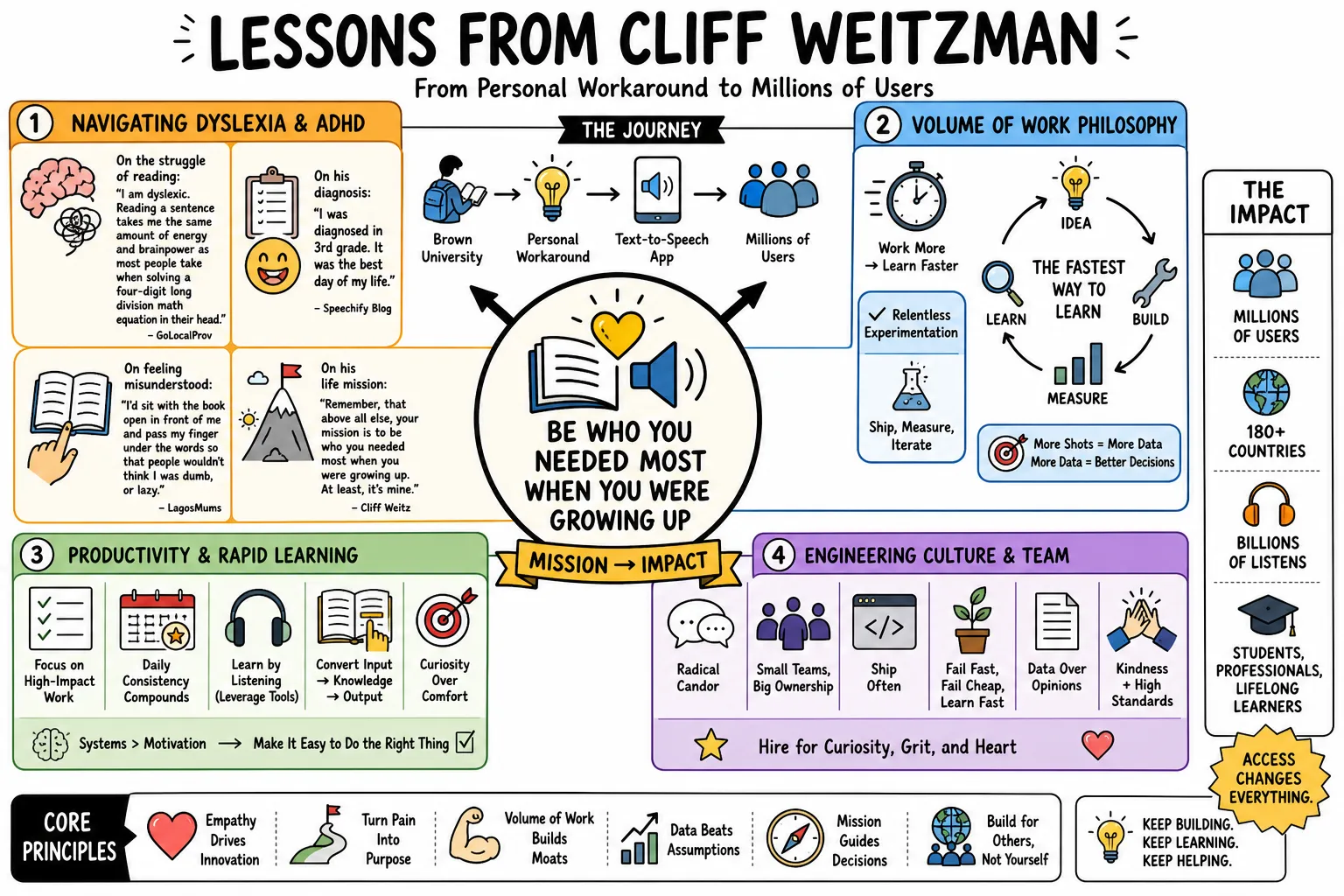
Lessons from Cliff Weitzman
Cliff Weitzman originally built Speechify as a personal workaround to read his coursework at Brown University after a dyslexia diagnosis. He scaled the text-to-speech app to millions of users through a "Volume of Work" philosophy that treats relentless experimentation as the fastest way to learn. This profile gathers his approaches to productivity, engineering culture, and rapid learning.
Part 1: Navigating Dyslexia and ADHD
- On the struggle of reading: "I am dyslexic. Reading a sentence takes me the same amount of energy and brainpower as most people take when solving a four-digit long division math equation in their head." — Source: GoLocalProv
- On his diagnosis: "I was diagnosed in 3rd grade. It was the best day of my life. Before that, I would pretend to read in elementary school." — Source: Speechify Blog
- On the feeling of being misunderstood: "I'd sit with the book open in front of me and pass my finger under the words so that people wouldn't think I was dumb, or lazy." — Source: LagosMums
- On his life mission: Weitzman frames Speechify as a personal mission: build the support he needed when reading, school, and self-belief were hardest. — Reference: Medium essay on his dyslexia mission
- On overcoming academic barriers: He recognized early on that dyslexia was a barrier in traditional settings but leveraged audiobooks like Harry Potter to maintain his curiosity. — Source: Cliff's Substack
- On designing for neurodivergence: Speechify was built to bridge the gap for those who struggle with traditional reading, turning a personal deficit into a technological advantage. — Source: Made For Us Podcast
- On the emotional weight of learning differences: Weitzman treats dyslexia as both a learning challenge and an identity challenge; the work is helping people feel capable while they find the right tools. — Reference: Dyslexia Journey episode notes
- On ADHD and productivity: Weitzman’s productivity system starts from fit: audio, speed control, and text-to-speech let people work with their attention patterns instead of fighting them. — Reference: Speechify recap of CNBC Fortt Knox interview
- On early accommodations: Before Speechify, he hacked his own education by manually recording readings and using early text-to-speech tools to survive his coursework at Brown. — Source: Brown University News
Part 2: The Volume of Work Philosophy
- On the core formula: The ultimate strategy in uncertain domains is "Volume × Leverage = Output." — Source: Speechify Blog
- On winning through experimentation: The individual or organization that runs the most experiments is mathematically favored to win. — Source: Speechify Blog
- On ad testing: Speechify turns marketing into a high-volume learning system, generating roughly 1,300 AI ads per day and letting performance data decide which messages earn spend. — Reference: BigGo summary of 20VC interview
- On volume as a choice: "Volume" is not a personality trait; it is a conscious, deliberate strategy chosen to accelerate learning. — Source: Speechify Blog
- On college applications: As a high school student, he applied the volume principle by applying to 26 colleges instead of the standard six. — Source: Speechify Blog
- On relentless editing: Weitzman’s volume philosophy predates Speechify: he applied the same repetition-and-improvement loop to college applications, including 48 drafts of one essay. — Reference: BigGo summary of volume philosophy
- On maximizing AI leverage: Weitzman wants AI usage to become visible operating leverage, even pushing engineers toward heavy daily coding-agent use rather than treating AI as optional tooling. — Reference: BigGo summary of AI token strategy
- On removing the fear of failure: Running a massive volume of tests naturally dilutes the sting of any single failure, turning it into mere data. — Source: BeFreed AI
- On adversity quotient: Weitzman hires for the ability to stay with a hard problem after the easy effort is gone; AQ matters because the company-moving work sits on the far side of sustained difficulty. — Reference: BigGo summary of AQ hiring framework
- On execution speed: Weitzman sees speed as a compound advantage: as tools commoditize more work, the edge shifts to how quickly teams learn, decide, and ship. — Reference: BigGo summary of speed as advantage
Part 3: Radical Learning and Information Consumption
- On mastering a domain: "Read 100 books on the topic, identify 100 experts, and go have a conversation with them." — Source: Speechify Blog
- On bottom-up knowledge: Information compounds much faster when you gather it directly from practitioners in the trenches rather than relying solely on theory. — Source: Speechify Blog
- On the 100 audiobook challenge: In 2015, he pushed his learning capacity by listening to approximately 100 audiobooks, drastically accelerating his competence. — Source: Cliff's Medium
- On Speed Listening: Listening to texts at high speeds is described as a "superpower" that allows for rapid information processing. — Source: Deep Dive with Ali Abdaal
- On optimizing idle time: True productivity means converting mundane tasks like commuting, walking, or chores into active learning sessions using audio. — Source: Cliff's Medium
- On seeking out experts: He actively identified the founders of the top 100 consumer subscription companies and traveled to meet them to learn their growth strategies firsthand. — Source: Speechify Blog
- On learning from below: Weitzman does not only seek advice from CEOs; he looks for the practitioners closest to the work because they often know the real growth mechanics. — Reference: BigGo summary of practitioner learning
- On the multidisciplinary mindset: At Brown University, he built his own major, combining computer science, engineering, and physics to synthesize distinct fields. — Source: Wikipedia
- On reading a book a day: He leverages text-to-speech technology to consume long-form PDFs and books in a single day, breaking the traditional speed limit of reading. — Source: Cliff's Medium
- On curiosity over curriculum: His learning system is designed to bypass the friction of traditional studying so he can pursue pure curiosity unhindered. — Source: University of Michigan Engineering
Part 4: Engineering Culture and Execution Speed
- On the obsession with production: Work has absolutely no value unless it is live in production; it’s like having the best milk in the world but never delivering it to the doorstep. — Source: AudioScrape
- On performance management: Weitzman replaces formal review theater with tighter operating loops: daily priorities, production output, and fast feedback from the work itself. — Reference: BigGo summary of Speechify meeting and review culture
- On the 60-second rule: Speechify treats unblocking teammates as urgent operating hygiene; even a quick response prevents silence from slowing the whole system. — Reference: BigGo summary of Speechify response culture
- On cross-pollination in codebases: Weitzman encourages engineers to learn beyond their home repo by fast-tracking useful pull requests into other teams’ codebases. — Reference: BigGo summary of engineering cross-team learning
- On hiring independent owners: Weitzman looks for people who can be trusted with hard ownership, ship real work, and keep pushing when the problem stops being straightforward. — Reference: BigGo summary of Speechify hiring filters
- On the traits of a great hire: Weitzman screens for hunger, trustworthiness, high signal, and a specific reason to join Speechify rather than generic career ambition. — Reference: BigGo summary of hiring signals and red flags
- On QA as a primary skill: In Weitzman’s AI-heavy engineering culture, shipping faster raises the value of verification: candidates and teams have to prove they can use AI without losing correctness. — Reference: BigGo summary of AI-assisted engineering culture
- On repositioning struggling engineers: If an engineer falters in core development, he tests them in a QA function to see if their true strength lies in verification before letting them go. — Source: AudioScrape
- On AI-assisted engineering: Weitzman pushes engineering toward active AI use: reading large codebases, shipping under time pressure, and making coding agents part of the normal workflow. — Reference: BigGo summary of Claude Code adoption
Part 5: Entrepreneurial Mindset and Goal Setting
- On accountability: "Tell People Your Goals!"—sharing ambitions publicly is a critical mechanism for manufacturing accountability and forcing follow-through. — Source: Deep Dive with Ali Abdaal
- On early entrepreneurial reps: Before Speechify, he built his entrepreneurial muscle by launching multiple collegiate projects like BoardBrake and StarterPack. — Source: Wikipedia
- On winning pitch competitions: He honed his ability to sell a vision by aggressively participating in and winning startup pitches at MIT and Stanford during his undergrad. — Source: Brown University News
- On the utility of goals: Goals are less about the final destination and more about creating a relentless framework for daily execution. — Source: Deep Dive with Ali Abdaal
- On relentless pursuit: Building a company requires an unnatural level of persistence, a trait he actively trains for and expects in his leadership team. — Source: Deep Dive with Ali Abdaal
- On navigating early failures: You have to view every early failed project not as a waste, but as the necessary tuition paid to learn how to build the one that scales. — Source: The Kara Goldin Show
- On the value of speed: Weitzman designs culture around speed, from response norms to meeting discipline, because slow internal loops quickly become strategic drag. — Reference: BigGo summary of speed as culture
- On seeking mentors: Identifying the right experts and convincing them to share their playbooks is a vital shortcut for any first-time founder. — Source: Speechify Blog
- On maintaining momentum: Speechify removes friction by default: fewer meetings, faster unblocking, clearer priorities, and less tolerance for anything that slows execution. — Reference: BigGo summary of friction-removal practices
Part 6: AI and the Future of Productivity
- On AI token spending: Weitzman expects token spend to become a major line item for AI-native companies, with Speechify already approaching the point where tokens rival salary spend. — Reference: BigGo summary of token-versus-salary prediction
- On the AI-first culture: Integrating AI is not just about using new tools; it requires a fundamental shift to an "AI-first" operational culture. — Source: 20VC Substack
- On AI in advertising: Speechify uses AI to expand creative surface area, then lets the market sort through many ad variants instead of pretending the team can predict every winner upfront. — Reference: BigGo summary of AI ad experimentation
- On the commoditization of code: Weitzman believes AI shifts the bottleneck away from basic production and toward speed, judgment, endurance, and the ability to keep testing. — Reference: BigGo summary of AI and competitive advantage
- On testing boundaries: Weitzman discovers tool limits by putting them into demanding workflows, not by theorizing from the outside; volume exposes what actually breaks. — Reference: BigGo summary of high-volume AI workflows
- On scaling personalized media: Weitzman’s product vision extends beyond basic text-to-speech toward more flexible, human-sounding, user-controlled ways to consume written content. — Reference: Speechify recap of CNBC Fortt Knox interview
- On overcoming traditional limits: AI tools allow individuals with learning differences to simply bypass the biological bottlenecks of traditional reading and writing. — Source: Speechify Blog
- On the evolution of software: We are moving from software that simply stores information to AI that actively synthesizes and spoon-feeds it to us optimally. — Source: Speechify Blog
- On embracing the new toolset: Weitzman treats AI tools as a required part of modern engineering leverage; resistance has to be explained, not quietly accepted. — Reference: BigGo summary of AI adoption expectations
Part 7: Building Speechify
- On the origin: Speechify wasn't born in a boardroom; it was built in a dorm room at Brown University out of sheer personal desperation to survive reading assignments. — Source: Brown University News
- On mission alignment: The company’s core mission remains intensely personal: making reading accessible for anyone who struggles with text. — Source: Speechify Blog
- On scaling to 60 million users: Speechify’s scale came from expanding beyond a niche accessibility product into a broader productivity habit for millions of listeners. — Reference: BigGo summary of Speechify scale
- On early validation: He validated the product not by running surveys, but by building it for himself and then watching his friends beg to use it. — Source: Forbes
- On the Forbes 30 Under 30: Being recognized on the Forbes list in 2017 provided early validation that accessibility tech could be a massive, venture-scale category. — Source: Forbes
- On converting experts to investors: By cold-outreaching the founders of successful subscription apps to learn from them, he naturally converted many into Speechify's earliest investors. — Source: Speechify Blog
- On user-centric design: The best features in Speechify were developed by obsessively watching how neurodivergent users actually interacted with their phones. — Source: Made For Us Podcast
- On pricing and value: A successful consumer subscription must deliver obvious, daily ROI that far exceeds its monthly cost, especially in the productivity space. — Source: Speechify Blog
- On the importance of audio quality: For a text-to-speech app to achieve mass adoption, the synthetic voices must cross the uncanny valley and sound genuinely human. — Source: Speechify Blog
- On building a global team: Weitzman’s hiring lens is global and pragmatic; he weighs talent, loyalty, hunger, and attrition risk rather than defaulting to one startup labor market. — Reference: BigGo summary of Speechify hiring geography
Part 8: Personal Growth and Relationships
- On building confidence: Weitzman treats confidence as something built through love, self-belief, growth mindset, and repeated evidence that effort can change the outcome. — Reference: Medium essay on confidence and dreams
- On hacking human connection: Weitzman is deliberate about the emotional environment around ambition: people need support, affirmation, and relationships that let them attempt hard things. — Reference: Medium essay on support and confidence
- On the value of advice: "All The Most Valuable Advice I Have" boils down to reducing friction between your current state and your curiosity. — Source: Cliff's Medium
- On giving back: Serving as a Peer Entrepreneur-in-Residence at Brown allowed him to institutionalize the mentorship he actively sought out as a student. — Source: Brown University News
- On decision-making: Weitzman orients choices around the person he is trying to become: big dreams create a why, and that why makes hard work easier to sustain. — Reference: Medium essay on dreams and motivation
- On transparency: Weitzman’s public dyslexia story turns a private struggle into a teaching asset, giving other families a clearer model for how dyslexic people can thrive. — Reference: Dyslexia Journey episode notes
- On the immigrant experience: His journey from Israel to the U.S. instilled an early resilience that became foundational to his entrepreneurial drive. — Source: The Kara Goldin Show
- On continuous self-improvement: You must constantly update your mental models; the frameworks that got you to a million users will break at ten million. — Source: Deep Dive with Ali Abdaal
- On defining success: True success is having the freedom to ruthlessly pursue your curiosity while building tools that alleviate the exact pain you once felt. — Source: Speechify Blog