Gabrielle “Coco” Chanel brought supple jersey and practical, simplified silhouettes into luxury fashion at a time when women’s clothing was often restrictive. Her work paired comfort and movement with a distinctive visual language of black dresses, tailored suits, costume jewelry and the hands-free bag. — V&A — What Makes CHANEL Iconic.
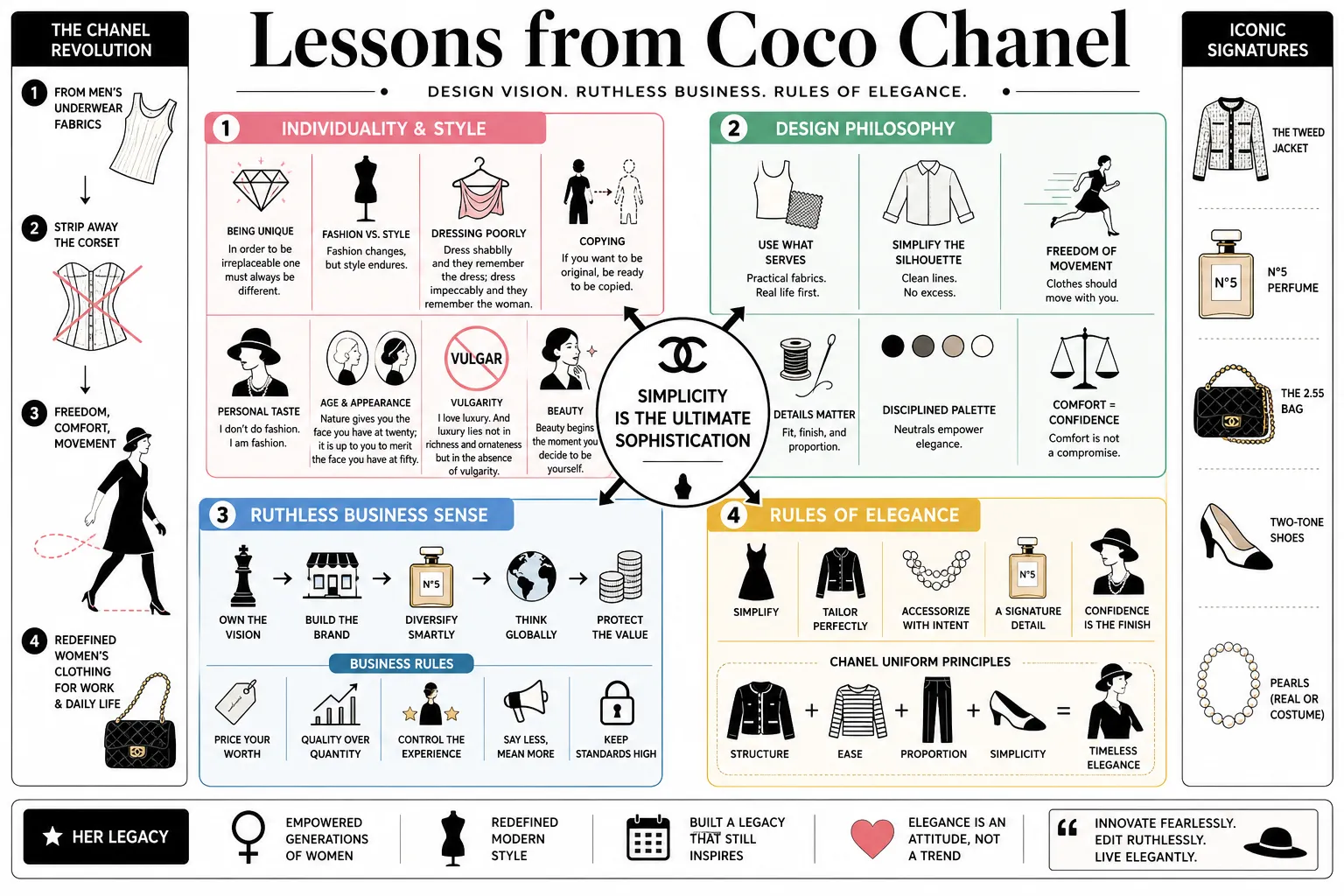
Part 1: Individuality & Style
- On Being Unique: Chanel built a recognizable design vocabulary from jersey, simple silhouettes, black dresses and practical accessories; the surviving objects show the distinctive result without establishing this popular aphorism. — Met — Chanel Exhibition.
- On Fashion vs. Style: Chanel repeatedly refined a small set of recognizable garments and accessories over decades, giving her work continuity beyond one season. — V&A — What Makes CHANEL Iconic.
- On Copying: Chanel welcomed copies of her designs as a compliment and publicity, rather than treating imitation itself as proof of failure. — TIME — Gabrielle Chanel, 1960.
- On Personal Taste: She said she designed sports clothes for herself because she lived an active outdoor life; her own use helped shape the wardrobe she sold. — CHANEL — Gabrielle Chanel.
- On Age and Appearance: In a 1969 interview she criticized the fashion industry’s cult of youth, keeping a distinctive view of women and age rather than the unverified English face maxim. — INA — Chanel Interview, 1969.
- On Vulgarity: In a 1960 interview Chanel distinguished luxury from ostentation and described vulgarity, not poverty, as its opposite. — TIME — Gabrielle Chanel, 1960.
- On Beauty: Her style grew from her own choices of sportswear, menswear and an independent way of life, not from a verified instruction to “decide to be yourself.” — CHANEL — Gabrielle Chanel.
- On Being Copied: Contemporaneous reporting says Chanel saw copies as publicity that spread a look beyond the clients who could afford couture originals. — New Yorker — 31, Rue Cambon.
Part 2: Business & Strategy
- On Independence: Boy Capel helped finance Chanel’s early Paris and Deauville shops, and the house records that she repaid him to preserve her independence. — CHANEL — Gabrielle Chanel.
- On Licensing: The 1924 perfume agreement transferred rights to a separate company in exchange for a 10% stock interest; Chanel later contested the arrangement in court. — 1947 Chanel Court Decision.
- On Reading the Market: Janet Flanner’s 1931 profile describes Chanel recognizing a postwar appetite for simpler dress and making workmanlike forms chic. — New Yorker — 31, Rue Cambon.
- On Focus: Chanel closed her couture operation in 1939 as war approached; the old claim that she did so to protect brand integrity has no support in the contemporaneous account. — TIME — Gabrielle Chanel, 1960.
- On Marketing: In 1931 Chanel agreed to dress American film actresses, saying cinema could impose fashion; the old “walking billboards” motive goes beyond the evidence. — CHANEL — Gabrielle Chanel.
- On Practicality: Her use of supple jersey, sportswear separates and simpler construction made movement and ordinary daily wear central to her designs. — Met — Chanel Exhibition.
- On Success: Flanner reported that Chanel doubled her first season’s investment at Deauville and continually tried to improve her own business performance; the old failure-inevitability quote is not verified. — New Yorker — 31, Rue Cambon.
- On Pricing: Contemporaries observed that Chanel sold deliberately simple, workmanlike gowns at couture prices; their cost did not follow from visual ornament. — New Yorker — 31, Rue Cambon.
Part 3: Innovation & Constraint
- On Materials: Chanel used knitted jersey, previously common in underwear and sportswear, for supple garments suited to movement; a 1916 silk-jersey blouse survives. — V&A — What Makes CHANEL Iconic.
- On Perfume: Perfumer Ernest Beaux used aldehydes in N°5 to blend many ingredients into an abstract scent rather than a recognizable single flower. — V&A — What Makes CHANEL Iconic.
- On Black: Chanel repeatedly promoted black as versatile modern daywear, including the 1926 dress highlighted by Vogue; she did not invent women’s use of black. — V&A — What Makes CHANEL Iconic.
- On Pockets: The 2.55 bag included multiple practical pockets, a lipstick compartment and red lining to make its contents easier to find; utility was part of the accessory’s design. — V&A — What Makes CHANEL Iconic.
- On Jewelry: Chanel paired pared-back garments with abundant costume jewelry and imitation pearls, challenging the assumption that adornment had to display precious materials. — V&A — What Makes CHANEL Iconic.
- On Pants: Her collections included beach and evening pajamas and other practical garments, but the archive does not support crediting her alone with normalizing trousers for all women. — Met — Chanel Exhibition.
- On Tanning: A contemporaneous TIME profile credits Chanel’s bronzed Riviera appearance with popularizing a tan; the Duke of Westminster yacht story is not established there. — TIME — Gabrielle Chanel, 1960.
- On Handbags: The 1955 2.55 handbag used a soft sliding chain that let its wearer carry it on the shoulder and keep her hands free. — CHANEL — 1950s History.
- On Form: A surviving 1916 sailor blouse uses a flat T-shaped construction and a non-constricting tie belt, showing how Chanel simplified the garment’s form. — V&A — What Makes CHANEL Iconic.
Part 4: Resilience & Overcoming Adversity
- On Her Upbringing: After an orphaned childhood, Chanel built her own shop and later independent company, though the circulated “I created my life” wording is not established by this record. — CHANEL — Gabrielle Chanel.
- On Childhood: After her mother’s death, Chanel grew up in an orphanage and later learned sewing at a convent; the archive traces that skill into her early hat business. — INA — Chanel Archive Retrospective.
- On Fiction: A 1931 New Yorker profile presented Chanel’s childhood as an upbringing by a rural aunt. That contemporaneous account documents her public story at the time; it should not be mistaken for a verified childhood record. — New Yorker — 31, Rue Cambon.
- On Comebacks: At 71, Chanel presented a new couture collection in 1954 after a fifteen-year absence; the surviving mid-1950s suit shows her practical relaunch. — V&A — 1956 Chanel Suit.
- On Competition: Her comeback challenged the formality of prevailing couture, including Dior-era complexity, through comfortable tweed and jersey suits. — V&A — 1956 Chanel Suit.
- On Criticism: The 1954 relaunch initially met a mixed reception, yet her practical suits became a defining part of the house’s postwar work; the insulting quote attributed to her is unverified. — V&A — 1956 Chanel Suit.
- On Hard Work: A 1960 TIME reporter observed Chanel revising a single suit 35 times and continuing to adjust small details after it was made. — TIME — Gabrielle Chanel, 1960.
Part 5: Elegance & Simplicity
- On Editing: Chanel told TIME that she began with a more elaborate “dream dress” and then removed elements; the mirror-and-jewelry saying is not needed to state her actual practice. — TIME — Gabrielle Chanel, 1960.
- On Subtlety: She often stripped black garments of decoration to bring the silhouette and cut into focus; the old claim that every garment was merely a frame for the face is too absolute. — V&A — What Makes CHANEL Iconic.
- On Good Taste: Chanel told TIME that luxury was not the opposite of poverty but of vulgarity, making restraint a question of taste rather than cost alone. — TIME — Gabrielle Chanel, 1960.
- On Proportion: Later Chanel jackets replaced conventional hem weights with a gold-toned chain so the garment hung correctly from the shoulders. — Met — 1957 Chanel Suit.
Part 6: Women & Independence
- On Women’s Roles: Chanel’s archival account describes freeing women’s bodies from corsets and padding with garments that allowed easier movement; the old English first-person wording is not verified. — INA — Chanel Archive Retrospective.
- On Self-Sufficiency: Chanel never married; her career and financial independence are documented, but the private motive assigned to her unmarried status is not. — TIME — Gabrielle Chanel, 1960.
- On Fragrance: Chanel made N°5 an extension of her fashion house and a lasting commercial pillar, rather than proving the unsourced dictum that a woman without perfume has no future. — V&A — What Makes CHANEL Iconic.
- On Financial Independence: Chanel pursued ownership beyond her shops: the house archive records the Bel Respiro villa, the La Pausa house and her rue Cambon property, without supporting the old Ritz-payment anecdote. — CHANEL — Gabrielle Chanel.
Part 7: Life & Philosophy
- On Money: TIME reported that Chanel valued money for the freedom it gave her, a narrower principle than the circulating “money versus rich” saying. — TIME — Gabrielle Chanel, 1960.
- On Friendship: Artists including Cocteau, Stravinsky, Diaghilev and Picasso belonged to Chanel’s circle, and she contributed costumes and financial support to artistic work. — CHANEL — Gabrielle Chanel.
- On Reading: Her rue Cambon apartment held a large library spanning classical and modern authors; the collection is documented, but the claimed self-education motive is not. — CHANEL — Gabrielle Chanel.
- On Luck: Chanel attached meaning to the number five in naming her perfume and kept symbols such as wheat, stars and lions in her personal and design vocabulary; the “date with destiny” quotation remains unverified. — CHANEL — Gabrielle Chanel.
Part 8: Work & Creativity
- On Routine: A 1931 on-site profile describes a twice-yearly collection cycle of hundreds of designs and Chanel’s direct review of work across her sewing ateliers, rather than the unverified noon ritual. — New Yorker — 31, Rue Cambon.
- On Creation: Chanel worked directly on models through repeated fittings, revising cut and proportion in the intended material; the “fashion is architecture” wording is not verified here. — New Yorker — 31, Rue Cambon.
- On Retirement: Chanel continued designing until her death at 87 in January 1971, and a collection appeared posthumously; the precise claim that she finalized it on her last day is unsupported. — CHANEL — 1970s History.
- On Inspiration: Chanel borrowed from menswear and sportswear, including tweed and jersey, to create women’s garments with a looser, more practical line. — Met — Chanel Exhibition.
- On Legacy: Chanel explicitly wished her legend a long life in conversations transcribed by Paul Morand, as the house’s founder record attributes it. — CHANEL — Gabrielle Chanel.