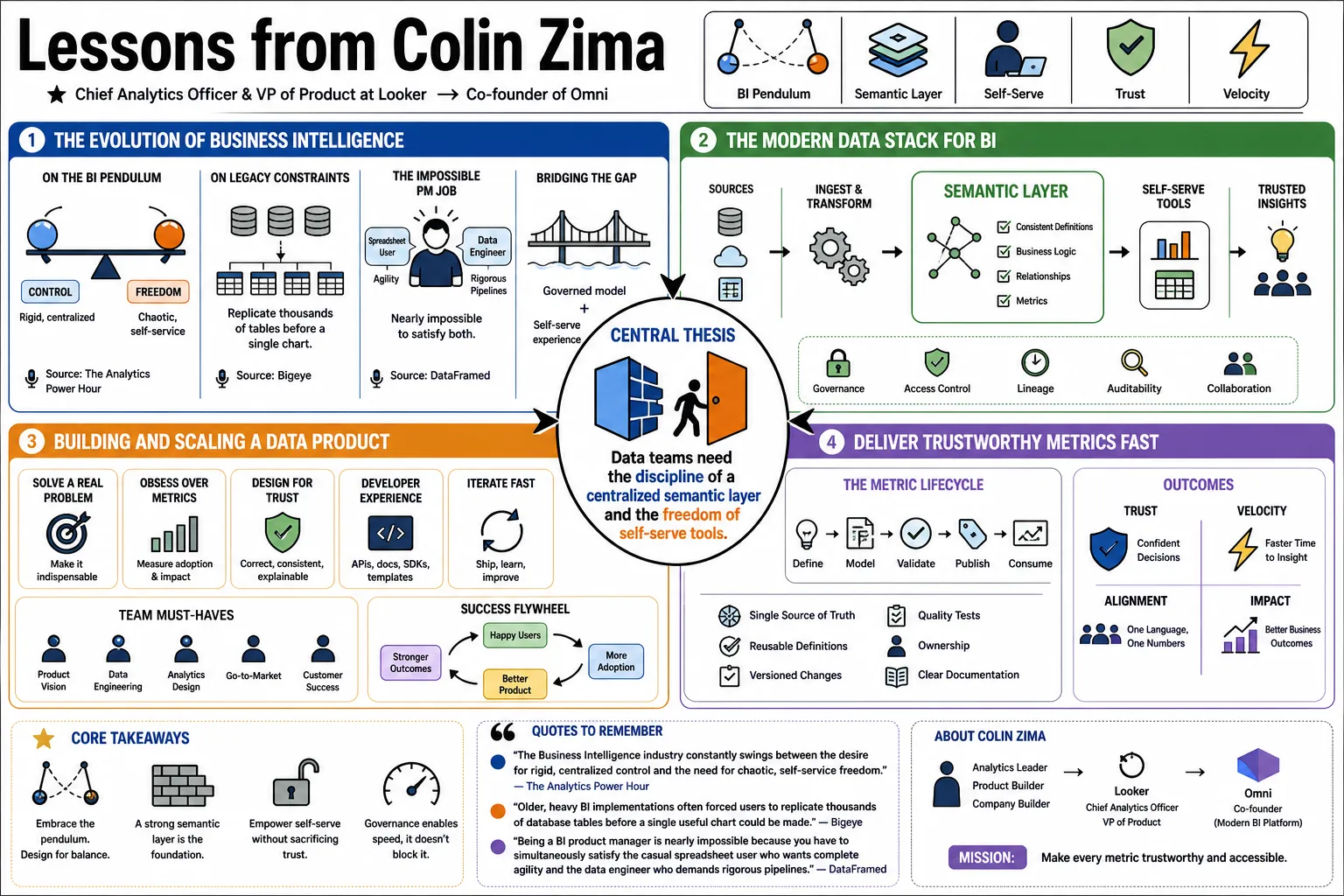
Lessons from Colin Zima
Colin Zima served as Chief Analytics Officer and VP of Product at Looker before co-founding Omni, a business-intelligence platform. In interviews and his own writing, he explores how governed definitions can coexist with fast self-service analysis. These lessons cover BI design, metrics, the data stack, AI, customer support, and building Omni. — DataFramed Interview.
Part 1: The Evolution of Business Intelligence
- On the BI Pendulum: Zima describes a recurring tension between centralized governance and self-service analysis. The useful design question is how to preserve shared definitions without stopping users from exploring. — Office Hours with Tomasz Tunguz.
- On Legacy Constraints: Zima says traditional BI tools can make it hard to move between governed models and quick SQL or spreadsheet work. When the workflow forces a user out of the tool, useful ad-hoc analysis becomes harder to promote into a reusable model. — DataFramed Interview.
- On the Product Manager’s Job: Zima argues that product leaders need a strong strategy and direct understanding of how customers use the tool; customer requests alone cannot determine the roadmap. — First Round Review Interview.
- On Bridging the Gap: Omni was designed to let analysts write SQL or work in a spreadsheet-like mode while retaining underlying semantic structure that can later be governed and reused. — Measure Pod Interview.
- On Looker’s Impact: Zima says Looker’s modeled SQL building blocks helped teams reuse definitions across analyses. His later Omni work kept that semantic foundation while addressing the friction of switching to ad-hoc tools. — DataFramed Interview.
- On Breaking Rigid Patterns: Zima argues that a BI tool should not force a choice between a governed semantic layer and ad-hoc SQL or spreadsheet work. Omni tries to keep those modes connected so an exploratory result can become a shared model. — Measure Pod Interview.
- On Self-Service Reality: Zima distinguishes what different users need: many business users should start from modeled data, while data-team members often need direct SQL access. Administrators need controls that support both workflows. — Measure Pod Interview.
- On BI’s Core Goal: Zima argues that analytics should help people solve actual business questions. He advises analysts to understand how the business works and build a sales dashboard as though they were responsible for sales. — DataFramed Interview.
- On Modern Workflows: Zima’s product work at Looker and Omni includes embedded reporting so customers can bring analytics into the applications where people already work, instead of treating BI as a separate destination. — Introducing Embedded Analytics.
Part 2: The Semantic Layer and Governance
- On Defining the Semantic Layer: Zima describes a semantic layer as the translation between database tables and the business terms people use in questions, including joins, column meanings, and aggregate definitions. — DataFramed Interview.
- On Metric Drift: Zima notes that even terms such as revenue, customer, and last quarter mean different things in different companies. Those definitions need to be written down and reused rather than left as tribal knowledge. — Four Years of Omni.
- On Speed and Governance: Zima says some analyses need quick, messy exploration while others need centralization. He wants a workflow where useful ad-hoc work can become governed without starting over in another tool. — DataFramed Interview.
- On Looker’s Modeling Legacy: Zima credits Looker’s reusable SQL building blocks for letting teams model common concepts once. Omni extends that approach so spreadsheet-like and raw-SQL work can feed the model too. — DataFramed Interview.
- On Organizational Trust: Zima says shared definitions and permissions must apply across dashboards, SQL, spreadsheets, and AI answers. The same business question should not silently change meaning with the interface. — Four Years of Omni.
- On the Cost of Rigidity: When a structural model change would interrupt a quick question, Zima says analysts sometimes need to explore first and formalize the result later. A tool should support that progression. — DataFramed Interview.
- On Reusable Analytics: Zima describes a semantic layer as a place to define metrics and business logic once so that many interfaces and users can rely on the same context. — Four Years of Omni.
- On Managing Complexity: Zima argues that a curated, understandable dataset can help nontechnical users, but reducing options too far limits the questions they can answer. BI design has to balance simplicity with range. — DataFramed Interview.
- On Sensitive Metrics: Zima distinguishes directional product analysis from financial reporting: the latter requires stronger controls. His broader point is to match governance to the consequences of an error. — DataFramed Interview.
Part 3: Building Effective Metrics
- On Useful Metrics: Zima advises dashboard builders to start from what users are trying to do, then test whether each tile helps them reach that outcome. — DataFramed Interview.
- On Starting Small: Zima says a tightly curated dataset is easier for a new user to understand, though it necessarily answers fewer questions. Start with useful scope and broaden it when the work demands more context. — DataFramed Interview.
- On Business Ownership: Zima tells analysts to build a sales dashboard as if they were responsible for sales. That stance makes them ask the next question and notice what the dashboard omits. — DataFramed Interview.
- On Actionable Behavior: Zima says the right reporting cadence depends on how often the business changes and what action a user can take. Omni moved one internal metrics meeting from weekly to monthly when the numbers barely changed over three weeks. — DataFramed Interview.
- On Overwhelming the Team: Zima recounts receiving a 25-tile dashboard for a Looker pricing decision that did not answer what pricing should be. More charts did not substitute for understanding the decision. — DataFramed Interview.
- On Shared Metric Meaning: For Zima, a metric such as customer count needs an explicit business definition, not merely a raw database count. That definition lets colleagues ask questions against the same meaning. — DataFramed Interview.
- On Metric Curation: Zima recommends trimming the data and options shown to a user so that the starting point is understandable, while keeping a path to more complex analysis when needed. — DataFramed Interview.
- On Focusing on Impact: Zima urges analysts to understand what drives the business before choosing what to report. A technically correct chart is not enough if it leaves the underlying business decision unanswered. — DataFramed Interview.
- On Follow-up Questions: Zima says taking ownership of a dashboard means asking the next question about each result and finding what is missing, not simply fulfilling the original request. — DataFramed Interview.
Part 4: The Reality of Dashboards
- On the Dashboard Debate: Zima still sees dashboards as useful for curated, repeatable consumption, but argues that they should be designed around what users actually need rather than treated as a pile of charts. — DataFramed Interview.
- On Dashboard Readability: Zima distinguishes a quickly built four-tile dashboard for an individual operator from a carefully designed executive dashboard. The audience and job determine how much polish and complexity are needed. — DataFramed Interview.
- On Repeatable Reporting: Zima says dashboards remain part of the analytics toolkit even as AI adds faster ways to ask ad-hoc questions. Routine reporting and open-ended exploration need not use the same interface. — Four Years of Omni.
- On the Shift from Clicks to Intent: Zima argues that AI lets users start from the question they mean to ask, rather than first navigating datasets, joins, and fields. — Analytics for the AI Era.
- On Data as a Product: Zima advises treating dashboards as products: ask what the user is trying to accomplish, design the path to that outcome, and remove tiles that do not help. — DataFramed Interview.
- On Interface Design: A dashboard for a CEO may need carefully controlled layout, labels, and visual design, while a self-service dashboard should be quick to assemble. Zima argues that good BI must support both. — DataFramed Interview.
- On Embedding BI: Zima describes embedded analytics as a way to put reporting inside a product, with governed data and permissions behind the customer-facing interface. — Introducing Embedded Analytics.
- On Reliability: Zima notes that the BI layer bears the visible blame when an upstream data change breaks a dashboard. Lineage, coordinated changes, and monitoring help keep published reporting dependable. — DataFramed Interview.
- On Beyond Reporting: Zima says a curated dashboard should help users grasp the situation and then provide a path to investigate the next question, rather than ending at static charts. — DataFramed Interview.
Part 5: Rethinking the Modern Data Stack
- On a Pragmatic Data Stack: Zima recommends building the data stack the current business and team need, starting with data movement, a warehouse, transformation, and BI rather than adopting every available tool. — Things to Think About When Building a Data Stack.
- On Right-Sizing Infrastructure: Zima advises starting with a measurable business case and the minimum viable stack, then adding capabilities as volume, reliability, or team needs justify them. — Things to Think About When Building a Data Stack.
- On Bridging Technical and Business Work: Zima describes BI as the last mile of a modular data stack: it must work with engineering changes upstream while presenting usable answers to business users. — DataFramed Interview.
- On Fluid Experiences: Zima wants SQL, spreadsheet-like calculations, modeled data, and visual exploration to coexist so an analysis can move from one-off work to a shared asset. — DataFramed Interview.
- On Pipeline Changes: When an upstream table or column changes, Zima argues that BI tools need lineage and coordinated release workflows so dependent dashboards can be repaired or updated in step. — DataFramed Interview.
- On Evolving Transformations: Zima suggests starting with simple transformations where they are convenient and moving them into dedicated tools when control or scheduling needs grow. The stack should evolve with the workload. — Things to Think About When Building a Data Stack.
- On the Analyst’s Role: Zima says data analysts increasingly create production-like assets. They must understand the business question and take responsibility for the quality of the data delivered to users. — DataFramed Interview.
- On Data as Software: For production analytics, Zima describes coordinated changes across the warehouse, transformation layer, model, and dashboard, including branch-based workflows and monitoring. — DataFramed Interview.
- On Stack Costs: Zima recommends considering pricing models and the shape of the data as the stack grows, while delaying cost optimization that is not yet warranted by the workload. — Things to Think About When Building a Data Stack.
- On Embracing Flexibility: Zima says the data environment will change as a company scales. Choose interoperable components and make transitions when the business actually needs them. — Things to Think About When Building a Data Stack.
Part 6: AI and the Future of Analytics
- On AI as an Interface: Zima treats natural language as an additional way to work with data, alongside SQL, spreadsheets, and dashboards, not a blanket replacement for every visual control. — DataFramed Interview.
- On Solid Foundations: Zima argues that a model cannot infer company-specific meanings such as revenue or customer from tables alone. Those definitions and permissions have to be encoded as context. — Four Years of Omni.
- On Governed AI Answers: Zima says AI analytics should use shared business definitions and enforce the requester’s permissions. A plausible answer is insufficient if it ignores the company’s agreed context. — Four Years of Omni.
- On Natural Language Queries: Omni says its AI uses the same semantic definitions, joins, business logic, and permissions as other analytics workflows, giving natural-language questions a governed foundation. — Omni AI.
- On Human-in-the-Loop AI: Zima describes monitoring AI answers, correcting mistakes in the shared model, and using expert context so later answers improve for everyone. — Analytics for the AI Era.
- On AI-Assisted Analysis: Zima sees AI as useful for focused tasks such as writing a spreadsheet formula or building part of an analysis. He cautions against treating a one-shot answer as an uneditable endpoint. — DataFramed Interview.
- On Agentic Analytics: Omni describes agents that can reason through multi-step questions and use governed analytics outside its own application through APIs and an MCP server. — Four Years of Omni.
- On Business Context: Zima says an LLM does not know a company’s business language on day one. Experts must teach it distinctions such as whether closed deals means won deals. — Analytics for the AI Era.
- On Trust in AI: Zima frames reliable AI analytics as an ongoing process: encode context, inspect outputs, correct errors, and retain a way for users to understand the answer. — Analytics for the AI Era.
Part 7: Founder-Led Sales and Growth
- On Finding an Advantage: Zima says a founder should identify the advantage they already possess. For Omni, that included his data expertise, product-user perspective, and network of former colleagues. — First Round Review Interview.
- On Leveraging Direct Networks: In SaaStr’s account of the interview, Zima describes using direct and warm second-degree relationships to recruit experienced BI colleagues, test Omni early, and reach prospective customers. — SaaStr CRO Confidential.
- On Early-Stage Momentum: SaaStr reports that Omni drew on Looker and Stitch alumni and talked with prospective users before the product was mature. The network supplied both experienced builders and early feedback. — SaaStr CRO Confidential.
- On Selling What You Know: Zima says his advantage in data is being a user of the product and knowing the problem deeply. He also reports doing hundreds of Omni demos to learn what prospective customers wanted. — First Round Review Interview.
- On Building Customer Empathy: At Looker, Zima visited customers and asked them to show how they actually used the product, including what they liked and disliked. Engaged listening helped reveal both value and friction. — First Round Review Interview.
- On Support as an Advantage: Zima says Looker’s high-touch support became a reason customers renewed and recommended the product. He sees support as a way to understand users as well as solve their problems. — First Round Review Interview.
- On Practitioner Networks: SaaStr describes Omni’s early network as people who had built or sold technical BI products. Their domain knowledge helped the team recruit, test its product, and approach relevant buyers. — SaaStr CRO Confidential.
- On High-Touch Onboarding: Zima says he visited roughly 75 of Looker’s first 100 customers in person. Seeing their real workflows informed customer success, support, and product work. — First Round Review Interview.
- On Founder Involvement: Zima says he personally ran hundreds of Omni demos while the product was young. Those conversations tested the messaging and exposed what the minimum useful product needed to do. — First Round Review Interview.
Part 8: The Anti-Org Chart and Leadership
- On Minimal Bureaucracy: In the HR Heretics episode, the hosts describe Zima running a 65-person Series A company without a dedicated HR or G&A team. The discussion centers on when that hands-on arrangement stops being appropriate. — HR Heretics Interview.
- On Doing the Work: The HR Heretics episode frames Zima’s approach around founders doing operational work themselves before adding administrative layers. Its listed topics include learning by doing and the benefits of doing the work. — HR Heretics Interview.
- On High Expectations: Zima says caring and initiative matter in early employees: people who understand the wider business, raise their hands, and do work beyond their formal role raise the pace for everyone. — First Round Review Interview.
- On Staying Close to the Product: Zima says being a superuser of his own product is a major founder advantage. His customer demos and support work keep him close to how people actually experience Omni. — First Round Review Interview.
- On Hiring for Initiative: Zima favors early hires who care enough to investigate and act without waiting for a narrow assignment. He describes a candidate whose persistent outreach and detailed product notes demonstrated that trait. — First Round Review Interview.