Cornelius Vanderbilt rose from a Staten Island ferry business to major steamboat and railroad enterprises. He challenged established operators with lower fares, expanded to California travel through Nicaragua, and later consolidated railroads into some of America's first large corporations. His career illustrates both the competitive opportunities and the concentration of power in nineteenth-century transportation. — T.J. Stiles Historical Essay.
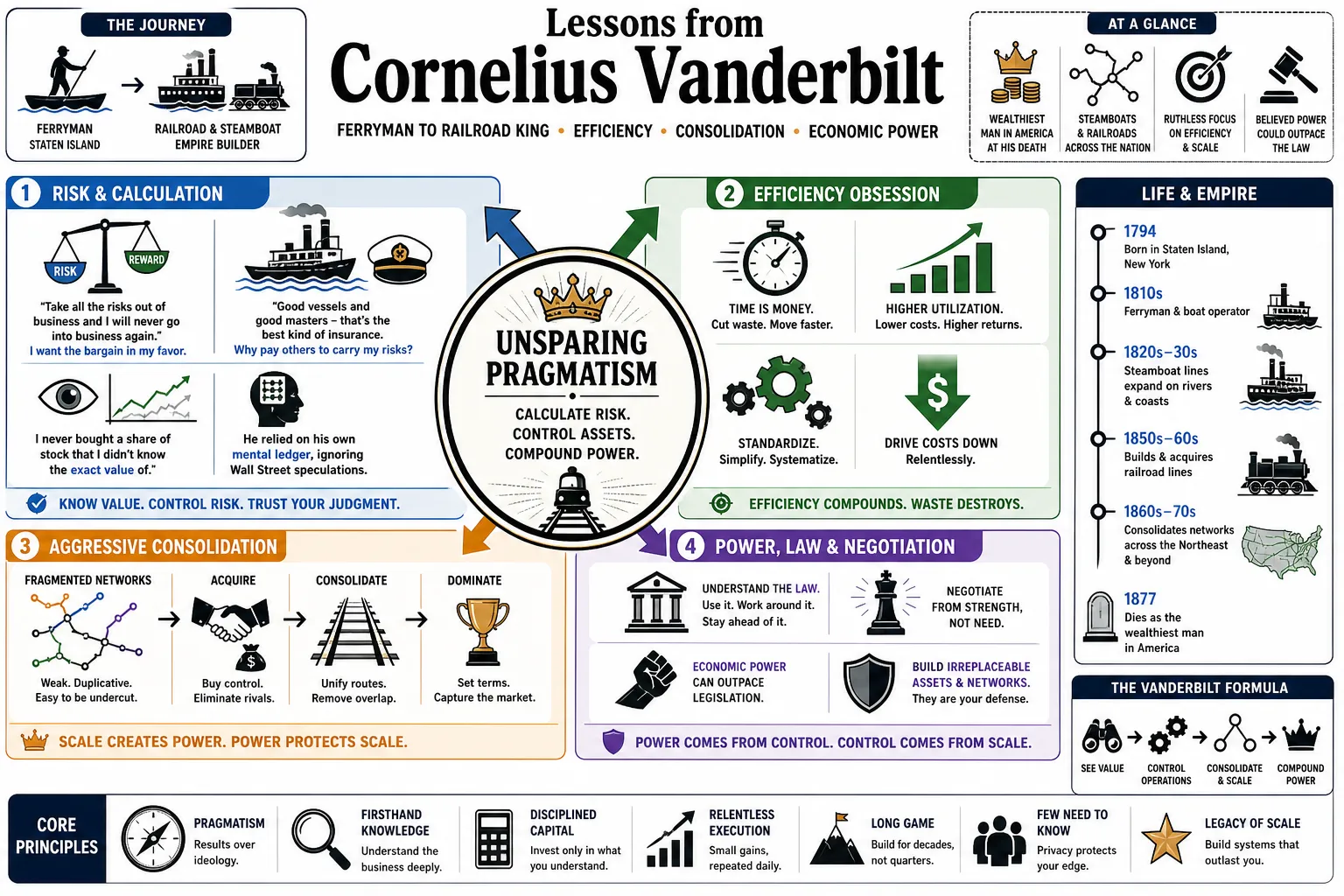
Part 1: Risk & Calculation
- On self-insurance: A contemporary biographer reported that Vanderbilt generally did not insure his vessels or cargoes, relying instead on well-built ships and trusted commanders. — L. P. Brockett, Men of Our Day.
- On keeping the big picture in his head: Biographer W. A. Croffut reported that Vanderbilt kept few formal books for his larger affairs, carried much of the business in his head, and used a small personal notebook for reckoning. — Croffut, The Vanderbilts.
- On competitive pressure: Vanderbilt used lower fares to challenge established California steamship lines. After war closed his Nicaragua route, Pacific Mail and US Mail paid him not to compete by way of Panama. — T.J. Stiles Historical Essay.
- On the risk of short selling: In an 1870 account of Wall Street, William Worthington Fowler reports Vanderbilt advising a distressed trader not to sell shares he did not own. Fowler introduces the episode as a story, and Vanderbilt himself later used short selling in another campaign. — Fowler, Ten Years in Wall Street.
- On working independently: After working for steamboat operator Thomas Gibbons, Vanderbilt returned to business on his own in 1829 and established a New York–Philadelphia steamboat line. — NYC Landmarks Report.
Part 2: Competition & Rivals
- On competitive fares: Vanderbilt used lower fares, departure times and cost control to undercut rival transport operators. — T.J. Stiles Author Interview.
- On conflict and accommodation: Vanderbilt could retaliate against a former ally, as he did in the Erie stock conflict with Daniel Drew. But in his railroad years he also sought accommodation, and after an earlier dispute he eventually became friends with Charles Morgan and Cornelius Garrison. — T.J. Stiles Research Notes.
- On strategic routes: Vanderbilt looked for routes and railroads with lasting transport advantages, then worked to control important channels of commerce. — T.J. Stiles Author Interview.
- On gaining rail control: In the 1860s Vanderbilt gained control of the New York and Harlem and Hudson River railroads, then became president of the New York Central in 1867, bringing the lines into a unified system. — NYC Landmarks Report.
- On California steamship traffic: Vanderbilt sought control of California steamship traffic and ultimately reached an arrangement with Pacific Mail that divided the Pacific and Atlantic routes between them. — T.J. Stiles Research Notes.
- On service improvements: Across New York-centered routes, Vanderbilt combined lower fares with faster and better service as he developed connections to other cities. — T.J. Stiles Author Interview.
Part 3: Wealth & Wealth Retention
- On public service and commercial interest: In testimony about a disrupted railroad connection, Vanderbilt argued that serving the public and minimizing inconvenience also served his own commercial interest, according to historian Alvin F. Harlow's reproduction of the hearing. — Alvin F. Harlow, The Road of the Century.
- On inheritance: Vanderbilt's will left the bulk of his fortune to his eldest son, William Henry Vanderbilt; the ensuing family lawsuit produced disputed accounts of his intentions and state of mind. — T.J. Stiles Author Interview.
- On personal display: Croffut described Vanderbilt as avoiding ostentation in his ordinary business routine—he drove himself without an attendant—while also recording his costly European yacht voyage. His habits were more nuanced than a blanket rejection of luxury. — Croffut, The Vanderbilts.
- On philanthropy: Cornelius Vanderbilt and his wife Frank gave $1 million to found the university that bears his name. Vanderbilt University describes it as his only major philanthropy before his death in 1877. — Vanderbilt University History.
- On investing in capacity: For his California steamship operations, Vanderbilt purchased and expanded a New York shipyard and steam-engine works, building capacity beyond the vessels themselves. — T.J. Stiles Historical Essay.
- On financial resilience: Before the Panic of 1873, Vanderbilt reduced his market exposure. When it struck, he held no stock on margin and maintained cash reserves, as did his corporations. — T.J. Stiles Author Interview.
Part 4: Efficiency & Management
- On operating costs: T.J. Stiles reports that Vanderbilt judged his transport operations against rivals by whether he could run a ship or railroad at about 20 percent lower cost. — T.J. Stiles Author Interview.
- On operational knowledge: Until late in life, Vanderbilt maintained a close personal grasp of the technical details of his transport businesses; later he demanded similar attention to savings and competitiveness from subordinates. — T.J. Stiles Author Interview.
- On integrating railroads: Vanderbilt merged the New York Central and Hudson River Railroads in 1870, replacing a fragmented network with a large enterprise operating across New York State. — T.J. Stiles Author Interview.
- On a faster route: Vanderbilt's Nicaragua transit line, inaugurated in 1851, competed for California travelers by offering a faster passage and lower fares than the established Panama connection. — T.J. Stiles Historical Essay.
- On a shared terminal: Grand Central Depot opened in 1871 as a predecessor of today's Grand Central Terminal, serving rail lines in Vanderbilt's New York network. — NYC Landmarks Report.
Part 5: Independence & Autonomy
- On proving a railroad could thrive: At 69, Vanderbilt took on the nearly bankrupt Harlem Railroad partly to demonstrate that he could make it a thriving company, drawing on years of prior rail finance and management experience. — T.J. Stiles Historical Essay.
- On corporate control: The emerging corporate structure let Vanderbilt exert managerial influence over railroad systems that reached beyond his direct stockholdings. — T.J. Stiles Historical Essay.
- On selective partnerships: Vanderbilt was not categorically opposed to partners. He and Daniel Drew quietly invested in each other's businesses so both had reason to avoid direct competition. — T.J. Stiles Research Notes.
- On social acceptance: Despite later stories that cast him as a permanent outsider, Vanderbilt came to be accepted by New York's patrician society in the final years of his life. — T.J. Stiles Research Notes.
- On practical education: Vanderbilt spent much of his childhood working in his father's ferry business rather than at school, then bought his own boat at 16 with a loan from his mother. The historian T.J. Stiles rejects the later myth that Vanderbilt was illiterate. — NYC Landmarks Report.
Part 6: Dealing with the Law & Government
- On using commercial leverage: In a January 1867 dispute with the New York Central, Vanderbilt briefly stopped through trains at Albany, using his control of a connection to press the conflict. — T.J. Stiles Historical Essay.
- On a remedy in his own hands: During the 1867 Albany railroad dispute, Vanderbilt defended using control of the connection instead of waiting for a court remedy; historian Alvin F. Harlow reproduced his testimony that the legal process moved too slowly for him. — Alvin F. Harlow, The Road of the Century.
- On challenging a monopoly: While operating Thomas Gibbons's steamboat, Vanderbilt ran against New York's steamboat monopoly. Gibbons's case led the Supreme Court to strike the conflicting state law in 1824; Vanderbilt also pursued a separate challenge, Vanderbilt v. Livingston. — T.J. Stiles Research Notes.
- On state-granted monopolies: In his early steamboat years, Vanderbilt opposed privileged monopolies and adopted the competitive, laissez-faire rhetoric of Jacksonian Democrats. — T.J. Stiles Research Notes.
Part 7: Technological Shifts & Adaptability
- On changing transport modes: Vanderbilt's business career moved from New York steamboats to international steamships and, in his later years, to a large railroad system. — T.J. Stiles Author Interview.
- On redeploying capital: Beginning in 1863, Vanderbilt sold some of his steamship interests to buy large amounts of railroad stock, building on earlier experience in railroad finance and management. — T.J. Stiles Historical Essay.
- On applying rail experience: When Vanderbilt took over the Harlem Railroad in 1863, he was not a newcomer to the technology or business: he had led another railroad in 1847 and had helped finance and restructure lines in the 1850s. — T.J. Stiles Historical Essay.
- On the corporate transition: Vanderbilt's career spanned the era of individual transport proprietors and the rise of large, professionally managed corporations. His railroad consolidations made him a central figure in that change. — T.J. Stiles Historical Essay.
- On professional management: As Vanderbilt consolidated railroads, he and his son William Henry reorganized the companies and brought in professional managers to operate the larger system. — T.J. Stiles Historical Essay.
Part 8: Focus & Silence
- On keeping plans private: Two nineteenth-century writers report Vanderbilt advising that a business plan should not be announced before it is carried out; William Worthington Fowler gives the maxim in an 1870 account of Wall Street. — Fowler, Ten Years in Wall Street.
- On attending to the business: Biographer W. A. Croffut reported Vanderbilt's practical advice to focus on one's business and proceed with the work, rather than look for a secret formula for success. — Croffut, The Vanderbilts.
- On interests beyond business: Vanderbilt's business focus did not exclude other pursuits: he enjoyed horses and harness racing, spent summers in Saratoga Springs, and toured Europe. — T.J. Stiles Author Interview.