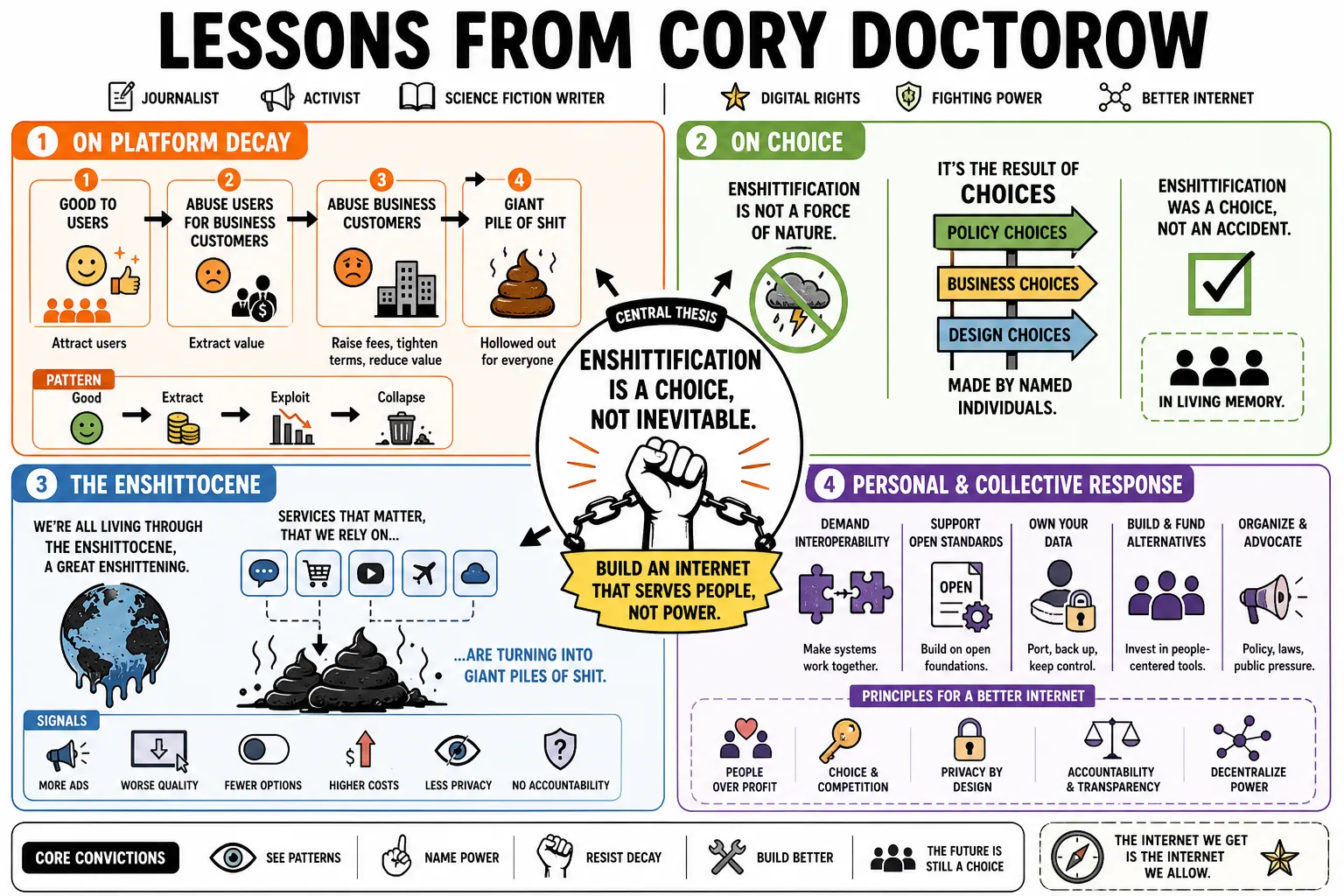
Lessons from Cory Doctorow
Cory Doctorow is a journalist, activist and science-fiction writer whose work critiques digital monopolies and restrictive copyright rules. He coined 'enshittification' to describe a pattern of online-platform decay, and argues that policy and interoperability can help reverse it. This profile collects his views on digital rights, corporate power and the internet. — Doctorow's McLuhan lecture.
Part 1: Enshittification
- On Platform Decay: Doctorow describes a three-stage pattern: a platform attracts users with a good service, shifts value toward business customers, then extracts value from those customers for itself. This is a theory of platform behavior, not an unavoidable law. — McLuhan Lecture on Enshittification.
- On Choice: Doctorow uses Kagi's alternative presentation of search results to argue that Google's degraded search experience reflects business choices, not a technical inability to return useful results. — Too Big to Care.
- On the Enshittocene: Doctorow calls the broad deterioration of services people rely on the 'enshittocene'—his shorthand for a period of widespread platform decay. — McLuhan Lecture on Enshittification.
- On Personal Responsibility: Privacy tools and repairable devices can improve an individual's experience, but Doctorow argues that personal purchasing choices alone cannot reverse platform degradation at scale. — You Can't Fight Enshittification.
- On Structural Causes: Doctorow locates platform decay in policy choices that weakened competition and enabled concentrated firms to resist regulation, pressure workers and use intellectual-property law against user alternatives. — You Can't Fight Enshittification.
- On Two-Sided Markets: Doctorow argues that a digital platform can adjust the value it gives users and business customers, then extract more from each side once both depend on the marketplace. — Tiktok's Enshittification.
- On Hostage Dynamics: Network effects can keep users together even as a service worsens; sellers or publishers then depend on access to those same users. Doctorow calls this mutual dependence a hostage dynamic that platforms can exploit. — Tiktok's Enshittification.
- On Manufacturer Control: Doctorow connects routine profit-seeking in connected products with laws that make it risky to alter devices against manufacturers' wishes. The problem is not merely a bad interface; it is control reinforced by law. — Enshittification Author Page.
- On Reversing the Decay: Doctorow's framework is not just descriptive. He argues that competition, regulation and interoperability can change the conditions that let platforms worsen while users and business customers remain locked in. — RSA Conversation with Cory Doctorow.
Part 2: Copyright & Intellectual Property
- On Doctorow's First Law: Doctorow's First Law cautions that when a third party locks something you own and withholds the key, the lock serves that party's interests rather than yours. — Doctorow's First Law.
- On Digital Locks: Doctorow likens digital locks to a roach motel: works enter a distributor's system, while creators and readers struggle to move them elsewhere. He argues that anti-circumvention rules strengthen the intermediary rather than the artist. — Information Doesn't Want to Be Free Excerpt.
- On Artificial Ecosystems: Doctorow compares DRM-locked ebooks to a store that can dictate not just which books you buy, but the surrounding equipment you must keep using. His point is that anti-circumvention rules can strengthen a retailer's control over customers and publishers. — Publishing Perspectives Keynote Report.
- On Modifying Property: Doctorow and EFF argue that DRM backed by anti-circumvention law can obstruct lawful product modifications and deter people from offering tools or advice to bypass manufacturer locks. The exemptions are limited and uncertain. — EFF Request on DRM-Limited Products.
- On Cultural Participation: Doctorow argues that copyright should encourage broad participation in culture: more creators making more kinds of work for more audiences, not merely maximize aggregate revenue to a few creators. — What Do We Want Copyright to Do?.
- On Intellectual Property Terminology: Doctorow warns that calling knowledge and creative work 'intellectual property' imports assumptions from ownership of physical objects that can mislead copyright policy. — You Can't Own Knowledge.
- On IP as Control: Doctorow argues that dominant tech and media firms can acquire creators' copyrights and then use those exclusive rights to defend their market position against competitors. More copyright for individual creators does not necessarily mean more bargaining power when they must assign those rights to gatekeepers. — Announcing The Shakedown.
- On Corporate Terms: Doctorow argues that extending exclusive rights across more of the creative process does not necessarily improve creators' position when a few distributors can demand those rights as a condition of reaching audiences. — Copyright Won't Solve Creators' AI Problem.
- On Technological Change: Doctorow notes that computers necessarily copy information to function. When books, music and other media became digital goods, that technical reality challenged older assumptions about what buyers own and how copyright licenses should work. — How Copyright Broke.
- On Voluntary Reader Support: Doctorow says some readers choose to buy his books even though he makes them available free, either to compensate him or for the convenience of a retail purchase. His observation is narrower than a general claim about all fans. — Doctorow's First Law.
Part 3: Interoperability & Lock-In
- On Interoperability's Nature: Doctorow describes interoperability as making a new service work with an existing one. For social media, that could let someone leave a platform without losing contact with friends who stay behind. — How to Ditch Facebook Without Losing Friends.
- On Switching Costs: Switching costs are what users must give up to move to a rival service. Doctorow argues that lowering those costs makes it harder for a platform to mistreat users without risking their departure; it does not guarantee the platform will improve. — How to Ditch Facebook Without Losing Friends.
- On Self-Determination: Doctorow values interoperability not only for competition or efficiency, but because it lets people decide how to use and repair their own tools when a vendor's design fails their needs. — Everything Is Always Broken, and That's Okay.
- On Adversarial Interoperability: Adversarial interoperability means making a new product compatible with an incumbent's product without the incumbent's cooperation. Doctorow points to Apple's reverse-engineered Office compatibility as an example of how entrants can challenge a dominant platform. — EFF: Adversarial Interoperability.
- On Contempt of Business Model: Doctorow borrows Jay Freeman's phrase 'felony contempt of business model' to criticize the way digital locks and anti-circumvention rules can protect manufacturer-imposed restrictions, even when customers or rivals want to offer lawful alternatives. The phrase names a critique, not a separate criminal offense. — How to Fix Cars by Breaking Lock-In.
- On Incumbent Hypocrisy: Doctorow argues that firms such as Apple and Facebook benefited from compatibility with established products while growing, yet today's dominant technology firms use legal and technical barriers to make similar challenges harder for newcomers. — EFF: Adversarial Interoperability.
- On Mandates as Ceilings: Doctorow supports rules that require dominant services to interoperate, but warns that a mandate limited to specified interfaces could become a ceiling if firms can block new, unanticipated ways for competitors to connect. — EFF Submission to House Antitrust Subcommittee.
- On Retaining Users: Doctorow argues that digital services are technically capable of connecting to rivals, but dominant firms can use legal action and access restrictions to keep users' friends, purchases and data difficult to carry elsewhere. That raises the cost of leaving even when a rival offers a better service. — Technological Self-Determination.
- On Apps and User Self-Help: Doctorow contrasts the open web, where users can install ad blockers, with app environments where digital locks and related rules can make independent modifications and alternative clients harder to offer. That weakens a practical check on platform abuse. — My McLuhan Lecture on Enshittification.
Part 4: Surveillance Capitalism
- On Monopoly vs. Mind Control: Doctorow argues that the largest technology firms' monopoly power is a more concrete danger than their claims to have highly effective data-driven persuasion. He does not deny harms from surveillance; he questions whether supposed mind-control capabilities explain the firms' dominance. — CIGI Interview with Cory Doctorow.
- On Surveillance Systems: Doctorow says large platforms use personal data to identify potentially receptive audiences and design interfaces that coax more disclosure. He considers these practices harmful without accepting the stronger claim that their ads can reliably override people's judgment. — CIGI Interview with Cory Doctorow.
- On Privacy First: Doctorow argues that a broad, enforceable privacy law would cut off the surveillance data used for targeted ads and other abuses. He calls this 'privacy first,' while acknowledging that labor, civil-rights and antitrust protections remain necessary too. — Privacy First.
- On Policy Choices: Doctorow argues that pervasive online surveillance was not dictated by the technology: strong encryption was available, but policy left companies able to collect and use customer data. He treats this as a remediable policy failure, not a technical inevitability. — The Internet Was Made for Privacy.
- On Predistribution: Doctorow favors preventing firms from collecting or transmitting data in the first place—for example through stronger privacy rules and user-controlled tools—over relying only on compensation or limits imposed after data has already been taken. — Predistribution vs. Redistribution.
- On Security: Privacy is difficult because it depends on the combined effects of technology, law, markets and social norms. Doctorow argues that defaults hostile to privacy across all four make it hard for individuals to protect themselves. — Guardian — Internet Spying.
- On The War on Terror: Doctorow opposes indiscriminate surveillance even apart from disputes about its effectiveness against terrorism: constant observation erodes the private space people need to experiment, think and dissent. — Guardian — Cybersecurity and Surveillance.
- On Business Practices: Commercial surveillance persists not because it is technologically inevitable, but because companies can profit from data-intensive advertising when expected penalties and other constraints are weak. — Ad-Tech Is Fascist Tech.
- On Information: Doctorow rejects the idea that information itself has wants. His concern is that people need access to reliable networked information to exercise freedom in a society organized around it. — Circulating Ideas Interview.
Part 5: Antitrust & Monopoly Power
- On Unchecked Power: Doctorow defines monopoly by a firm's power to act without having to heed the usual responses of competitors, customers, workers or even government—not merely by being the only seller in a market. — Monopolies Produce Billionaires.
- On The Flywheel Effect: Doctorow argues that monopoly rents can reinforce monopoly power: concentrated firms use their excess profits to lobby, litigate and influence the regulators meant to constrain them. — Small Government.
- On Redistribution: Doctorow argues that antitrust can shift rents away from dominant firms and toward workers and smaller businesses, whose interests are often overlooked when monopoly profits accrue to shareholders. — The Most Remarkable Thing About Antitrust.
- On The Long Game of Deregulation: Doctorow argues that reversing decades of permissive monopoly policy is necessarily a long campaign: preventing concentrated power is easier than dismantling it once firms have become entrenched. — The Long Game.
- On Structural Separation: Structural separation asks firms to choose between operating a platform and competing with the businesses that depend on it, avoiding a conflict in which a company referees its own market. — Maintaining Monopolies With the Cloud.
- On Chokepoint Capitalism: Doctorow describes chokepoint capitalism as monopsony as well as monopoly: gatekeepers can control access to audiences and use that leverage to pay creators and suppliers less. — Jacobin Interview.
- On Squeezing Workers: A consumer-price-only view of monopoly can miss how a powerful buyer squeezes the people who produce or supply its goods. Doctorow applies this critique to creators forced through platform chokepoints. — Jacobin Interview.
- On Fixing the Internet: Doctorow argues that interoperability can give people a way to leave or work around a dominant platform without relying on its owner's goodwill or waiting for it to reform. — Interoperability: Fix the Internet.
- On Scale: Doctorow argues that making technology firms smaller limits how widely the errors and blind spots of any one firm's leaders can affect everyone else. — Make Big Tech Smaller.
Part 6: Activism & Internet Freedom
- On Determination: In Little Brother, a young hacker's success against a locked-down game system illustrates how resource-constrained people can use time, skill and persistence to work around technical barriers. — Little Brother.
- On Persistence: In For the Win, organizer Big Sister Nor argues that even an initially losing campaign can gain supporters and make the next fight less lopsided. The lesson is incremental movement-building, not guaranteed victory. — For the Win.
- On Taking Freedom: Little Brother dramatizes the choice between hiding indefinitely and acting for civil liberties: its fictional protagonist chooses to take risks rather than wait for freedom to be handed back. — Little Brother.
- On Political Engagement: Doctorow argues that digital-rights activists must organize politically before laws and platform controls make the internet less useful for organizing other causes. Technical ingenuity alone cannot secure those rights. — Twenty Years After My DRM Talk.
- On Making Issues Concrete: Doctorow uses metaphors, parables and other framing devices to make technical digital-rights problems tangible enough that people will care and act before the harms become entrenched. — Democracy Now! Interview.
- On Winning Better Tech: Doctorow argues that a free, fair and open internet helps people coordinate fights over the climate, labor, civil rights and other causes. He does not rank internet freedom above those fights; he sees it as infrastructure they rely on. — Twenty Years After My DRM Talk.
Part 7: Writing & Science Fiction
- On Sci-Fi as Allegory: Doctorow uses science fiction as a diagnostic tool: a plausible imagined world can bring one present-day technology's social effects into focus without pretending to predict the future. — Writing Excuses — Worldbuilding Science Fiction.
- On The Luddite Lens: Doctorow argues that the key question about a technology is not simply what it can do, but who benefits from it and who bears its costs. — Science Fiction Is a Luddite Literature.
- On Futuristic Parables: For Doctorow, a futuristic parable works when its imagined setting feels plausible enough to let readers compare it with the present; plausibility does not make it a prediction. — Writing Excuses — Worldbuilding Science Fiction.
- On the Writing Process: Doctorow writes regularly even when time is fragmented. He cautions writers against needing a particular room, music or other ritual before they can begin. — Advice to Writers Interview.
- On Daily Targets: Doctorow recommends a modest daily word target because a repeatable habit matters more than waiting for inspiration. A small target lowers the threshold for showing up every day. — Advice to Writers Interview.
- On Stopping Mid-Sentence: Doctorow suggests ending a writing session in the middle of a sentence so the next day's first few words are easy to type and momentum is easier to regain. — Advice to Writers Interview.
- On Worldbuilding: Doctorow often centers one real technology or phenomenon in a near-future story, exaggerating its importance just enough to make its possible social effects easier to examine. — Writing Excuses — Worldbuilding Science Fiction.
- On Economic Fiction: Doctorow treats everyday economic plausibility as part of worldbuilding: even a familiar apartment setting invites the question of how its occupants could afford to live there. — Writing Excuses — Worldbuilding Science Fiction.
- On Obscurity: Doctorow says his free ebook releases addressed a problem he saw as more pressing for his books than piracy: many potential readers had never heard of them. He credits Tim O'Reilly for the broader obscurity aphorism. — Guardian — Why Free Ebooks.
Part 8: Technology Policy & Society
- On Conversation: In his Share or Die foreword, Doctorow argues that people gather online to converse with each other; content matters partly because it gives them something to talk about. — Share or Die — Doctorow Foreword.
- On Repurposing Computing: In Makers, a character imagines discarded computers as material for ambitious new projects. The junkyard-and-space-program line is fictional hyperbole, not a measured claim about available computing power. — Makers — Author-Hosted Novel.
- On General-Purpose Computing: Doctorow argues that users need control over what their computers run; laws and technical locks that make general-purpose devices obey only manufacturers' rules threaten that freedom. — The Coming Civil War over General-Purpose Computing.
- On Security Overreaction: In Little Brother, Marcus mocks an extreme response to a remote risk with an umbrella-and-lightning analogy. It is fictional commentary on security overreaction, not a nonfiction Doctorow quotation. — Little Brother — Author-Hosted Novel.
- On Private Corners: Little Brother's narrator argues that having a private part of life is valuable even when one has nothing shameful to hide. — Little Brother — Author-Hosted Novel.
- On Technology and Power: In Little Brother, Marcus describes a laptop that serves and protects him instead of spying on him. The scene illustrates the power of technology controlled by its user. — Little Brother — Author-Hosted Novel.