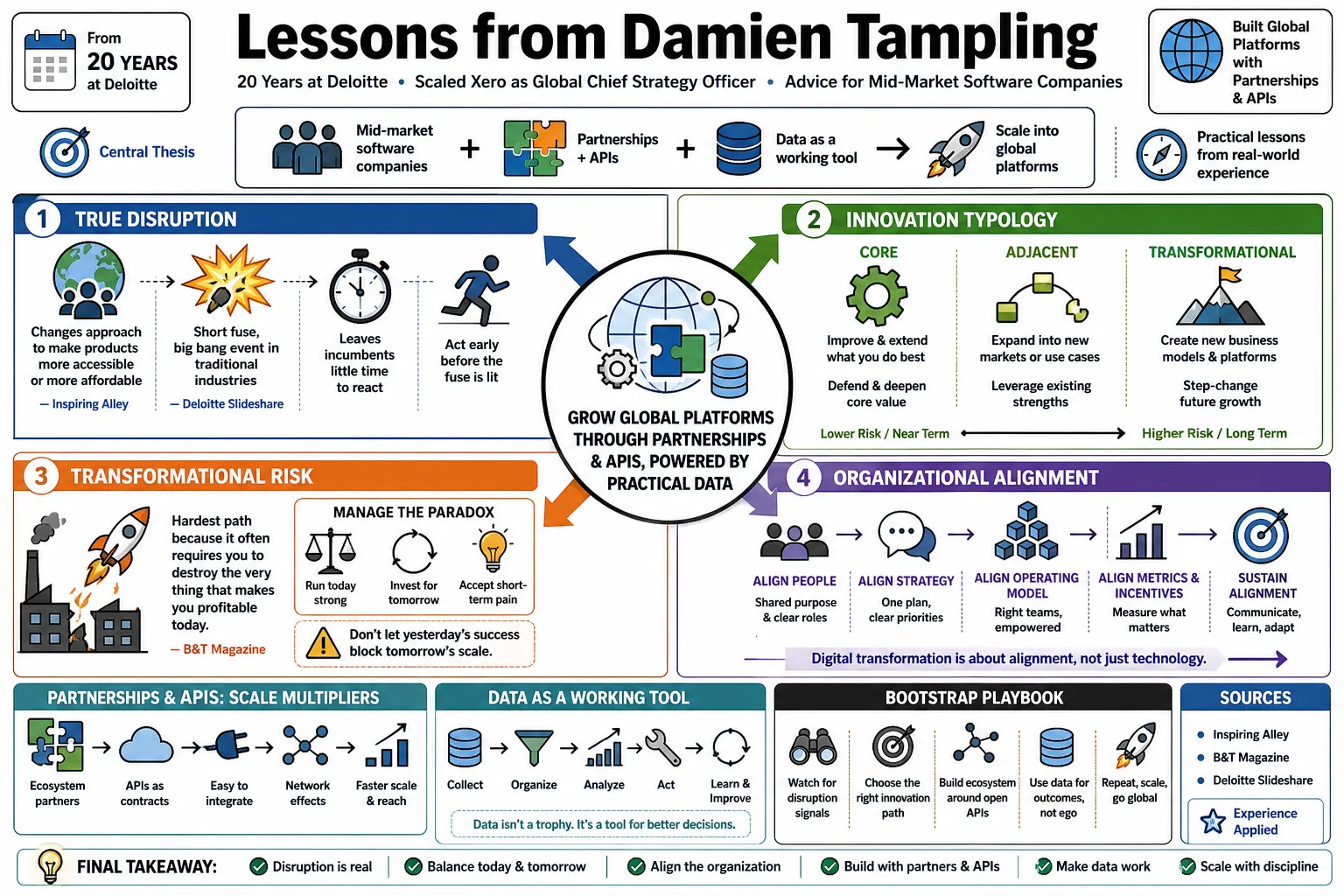
Lessons from Damien Tampling
After nearly two decades at Deloitte, Damien Tampling led strategy and corporate development at Xero. These lessons examine his thinking on building a platform for small businesses. — The Platform Journey — Xero Interview.
Part 1: Digital Disruption & Innovation
- On accessible disruption: Tampling describes disruption as making a product or service available to a broader audience; he applies that idea to software and services for small businesses. — Damien Tampling — The Future of Platforms.
- On innovation types: He distinguishes core, adjacent and transformational innovation, arguing that leaders should recognize which kind they are pursuing. — B&T — Daze of Disruption Talk.
- On incumbent transformation: Transformational innovation is especially difficult for incumbents because it may threaten the structures and products that made them profitable. — B&T — Daze of Disruption Talk.
- On the disruption horizon: Deloitte’s short-fuse, big-bang framework asks leaders to consider both how soon digital change may arrive and how large its impact could be. — Deloitte — Short Fuse, Big Bang.
- On organizational constraints: For an incumbent, responding to disruptive innovation means confronting existing capabilities, structures and culture, not merely adding a new technology. — B&T — Daze of Disruption Talk.
- On incumbent blind spots: Tampling cautions incumbents that digital challengers can rapidly undermine a profitable model, so leaders should challenge inherited assumptions. — B&T — Daze of Disruption Talk.
- On reducing manual work: Connected cloud tools can save small-business owners time by joining workflows that would otherwise require more manual administration. — Damien Tampling — Cloud Technology in Asia.
Part 2: Platform Strategy & Ecosystems
- On opening an API: Tampling says an open platform needs both an attractive proposition for developers and governance around building, security certification and app-store presentation. — The Platform Journey — Xero Interview.
- On shared platform value: A platform should create value with partners by connecting complementary capabilities and data around a customer need, rather than treating the ecosystem as a one-way channel. — Damien Tampling — The Future of Platforms.
- On partner onboarding: Tampling says Xero became more deliberate about onboarding and supporting partners as its ecosystem grew, while checking that the customer experience works. — The Platform Journey — Xero Interview.
- On partner incentives: He emphasizes making Xero an efficient customer-acquisition channel for app partners so that both sides benefit from the relationship. — The Platform Journey — Xero Interview.
- On regional ecosystem fit: As Xero entered different geographies, local apps emerged to serve market-specific needs; Tampling argues that expansion also requires a full commitment to customer and partner support. — The Platform Journey — Xero Interview.
- On choosing platform boundaries: He recommends being explicit about what belongs near the core product and which adjacent needs are better served by external partners. — The Platform Journey — Xero Interview.
- On scaling platform decisions: As an ecosystem grows, platform choices need clearer principles and organizational scaffolding instead of relying on a few informal decision-makers. — The Platform Journey — Xero Interview.
- On partner go-to-market: Tampling describes Xero events, content and app-store discovery as ways to help partners reach customers more efficiently. — The Platform Journey — Xero Interview.
Part 3: Scaling and Growth
- On changing growth stages: The problems of a company at a few million dollars in revenue differ from those at $20 million, $50 million or $100 million; leaders should adapt rather than assume one operating model fits all. — SaaStr — Global Platform Talk.
- On differentiation: As a company scales, founders should keep asking what genuinely differentiates it beyond the product’s features, including network, business model and experience. — SaaStr — Global Platform Talk.
- On hiring discipline: Tampling urges founders to define hiring standards early and maintain a talent pipeline, even before they can afford a dedicated people leader. — SaaStr — Global Platform Talk.
- On market entry: Do not let a single sales opportunity pull a young company into a new geography; Tampling urges deliberate commitment to local needs and operational support. — SaaStr — Global Platform Talk.
- On operational scaffolding: As Xero grew from hundreds to thousands of people, Tampling says it needed clearer processes and principles so partner decisions no longer depended on a few individuals. — The Platform Journey — Xero Interview.
- On saying no: With many plausible opportunities, leaders should concentrate on a few priorities and explicitly name what they will not pursue. — SaaStr — Global Platform Talk.
- On a north-star measure: Choose a durable measure of customer value and align the organization around it instead of accumulating unrelated performance targets. — SaaStr — Global Platform Talk.
Part 4: Data Strategy & "Big Data"
- On useful data: Tampling sees value in joining accounting data with complementary app data so small businesses can get a fuller, more timely view of operations. — Damien Tampling — The Future of Platforms.
- On production data complexity: In production, an AI agent must handle information access, context, integrations and governance alongside the model itself. — SuperAI — The AI Agent Iceberg.
- On sensitive information: When deploying customer-facing agents, teams need to design for personally identifiable information and payment handling as part of the live workflow. — SuperAI — The AI Agent Iceberg.
- On real-time insights: Connecting the accounting ledger to complementary apps can give small businesses more timely insights for day-to-day decisions. — Damien Tampling — The Future of Platforms.
- On access to business insight: Tampling argues that connected cloud tools can make integrated data and live business insight available to small firms, rather than only large enterprises. — Damien Tampling — The Future of Platforms.
- On complementary data: An accounting ledger tells only part of a business’s story; information from CRM, inventory and other partner apps can make the picture more complete. — Damien Tampling — The Future of Platforms.
Part 5: M&A and Corporate Strategy
- On acquisition fit: Tampling describes acquisitions as one way to bring important capabilities close to Xero’s platform while preserving the customer’s choice of other partners. — The Platform Journey — Xero Interview.
- On build, buy or partner: Platform strategy requires explicit choices about what Xero should build or acquire and what ecosystem partners can better provide. — The Platform Journey — Xero Interview.
Part 6: Startups vs. Corporates
- On execution: Tampling left a strategy-only consulting role because he wanted to see ideas implemented; he says good strategy is tested in execution. — InvestSMART — Deloitte’s Digital Deal-Maker.
- On corporate–startup collaboration: A larger platform can help a smaller app reach customers and new markets, while the app brings specialized capabilities that the platform need not build itself. — Damien Tampling — Cloud Technology in Asia.
- On disrupting an incumbent model: Tampling observes that established companies may struggle to pursue transformations that threaten a profitable legacy business. — B&T — Daze of Disruption Talk.
Part 7: Artificial Intelligence and AI Agents
- On real AI calls: Production voice agents must handle noise, changing intent, accents and shifts between languages, not just the clean path in a polished demo. — SuperAI — The AI Agent Iceberg.
- On shipping agents: Moving an agent from demo to live deployment requires testing failure modes, authentication, retries, sensitive information and payment flows. — SuperAI — The AI Agent Iceberg.
- On the agent iceberg: The visible conversation is only the tip of an enterprise agent; much of the work lies in orchestration, context, compliance and operational reliability. — SuperAI — The AI Agent Iceberg.
- On human handoffs: He advises planning for appropriate handoffs to a human when an agent cannot complete a customer journey safely or effectively. — SuperAI — The AI Agent Iceberg.
- On more than prompting: Tampling says production agent quality depends on workflow design, testing and optimization after launch—not just an impressive initial prompt or demo. — SuperAI — The AI Agent Iceberg.
- On outcome-based AI: At Sierra, Tampling says customers are charged for agreed successful outcomes rather than tokens, seats or agent count, making the definition of success central to deployment. — SuperAI — The AI Agent Iceberg.
- On failure modes: Teams deploying agents should test what happens when a call drops, information is sensitive or a payment step fails, and design recovery paths. — SuperAI — The AI Agent Iceberg.
- On conversational workflows: Tampling demonstrates simulated voice calls and argues that useful conversational agents must handle changes of mind, language shifts, payments and human handoffs. — SuperAI — The AI Agent Iceberg.
Part 8: Leadership and Operational DNA
- On deliberate focus: Tampling asks leaders to review the next month, six months and year, then select the few priorities they can execute well. — SaaStr — Global Platform Talk.
- On protecting platform choice: As Xero expanded and acquired products, Tampling says it still had to uphold transparent principles and preserve customers’ ability to choose third-party apps. — The Platform Journey — Xero Interview.