Dan Roam is an author and visual-thinking educator whose books include The Back of the Napkin, Blah Blah Blah and Draw to Win. His method uses simple drawings to examine business problems and communicate ideas, while treating words and pictures as complementary tools. The lessons below separate his documented approach from the many unverified quotations in the original profile. — The Back of the Napkin — Author Preview.
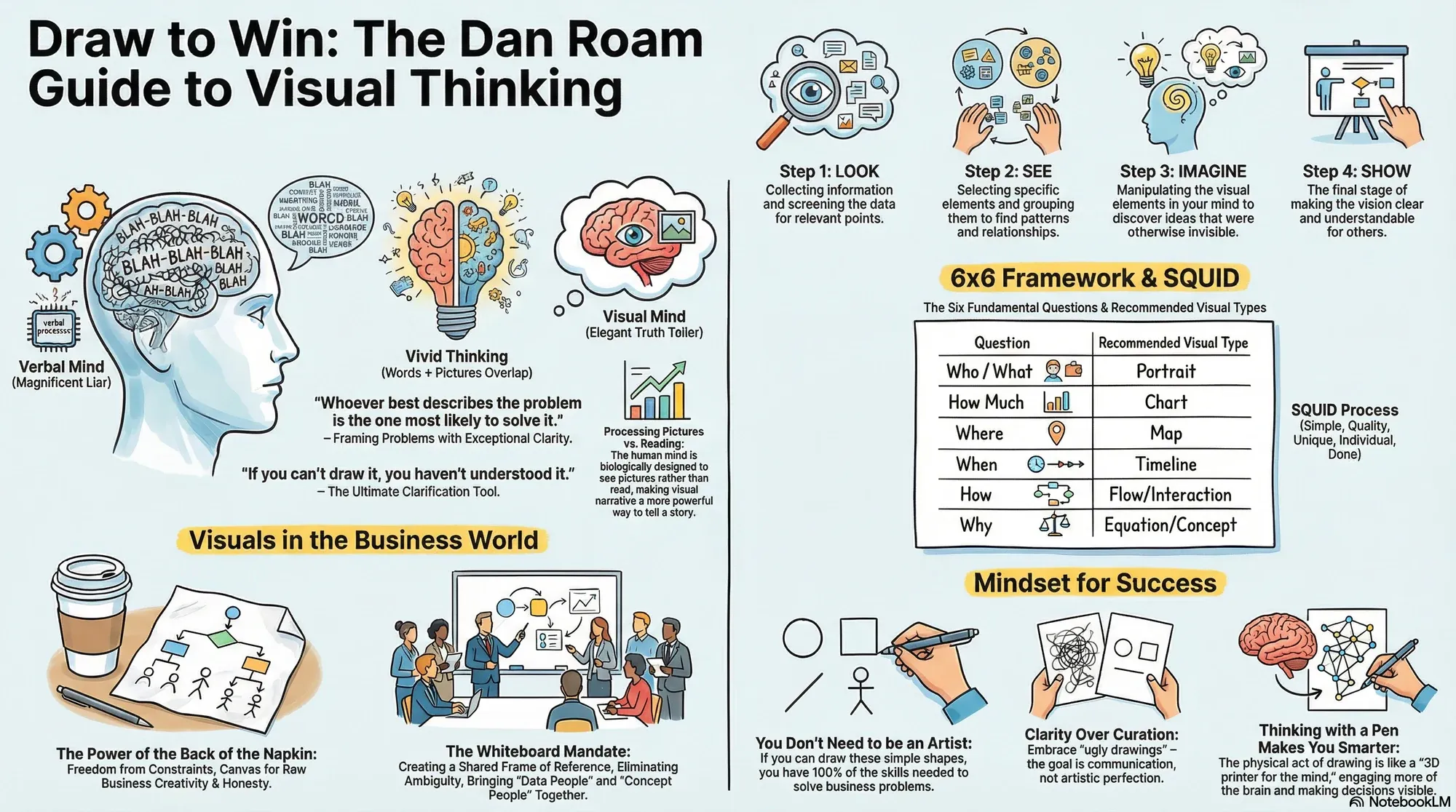
On the Power and Simplicity of Visual Thinking
- Use words and pictures together: Roam argues that words alone can leave part of an idea unexplored; adding a simple picture gives an audience another way to understand it. — Bob Morris Interview — Dan Roam.
- Show the story: Roam uses pictures to make a story or explanation more concrete for an audience, alongside the words that give it meaning. — Roam — Visual Storytelling White Paper.
- Start with simple shapes: Roam says boxes, circles, arrows and stick figures are enough to begin sketching many business ideas; artistic polish is not the prerequisite. — Roam — Visual Thinking Commandments.
- Draw the problem before solving it: Roam recommends sketching the parts of a problem to see its structure and possible solutions more clearly. — Roam — Visual Thinking Commandments.
- Get ideas out of your head: A rough drawing puts the pieces of an idea where you and others can inspect, question and rearrange them. — Brainfluence Podcast — Dan Roam.
- Check pictures for truth, too: Roam values drawings for revealing gaps in verbal reasoning, but warns that a misleading picture can make a problem worse; a visual is not automatically truthful. — Roam — Visual Thinking Commandments.
- Use visual thinking without dismissing words: Roam argues that people process the visual world in ways words alone do not capture, while explicitly valuing reading, writing and conversation. — How We Future — Dan Roam.
- Pair a picture with a few useful words: Roam recommends narrating a drawing and keeping the words that explain its meaning rather than replacing language altogether. — Roam — Visual Thinking Commandments.
- Discover, develop and share ideas visually: Roam defines visual thinking as using sight and the mind’s eye to discover hidden ideas, develop them and share them in a form others can grasp. — The Back of the Napkin — Author Preview.
- Drawing is for thinkers, not just artists: Roam separates useful problem sketches from artistic training: people can learn to draw simple representations to think more clearly. — The Back of the Napkin — Author Preview.
On the Process of Visual Thinking
- Follow four visual-thinking steps: Roam presents visual thinking as a four-step process: look, see, imagine and show. — Roam — Four Steps Video.
- Move from observation to explanation: In Roam’s process, a person first examines what is present, then identifies important patterns, imagines possibilities and finally shows the idea to someone else. — Roam — Visual Thinking Commandments.
- Ask six visual questions: Roam organizes a problem around who or what, how much, where, when, how and why, each suited to a different kind of picture. — Roam — Visual Thinking Commandments.
- Match the picture to the question: Use a portrait for who or what, a chart for how much, a map for where, a timeline for when, a flowchart for how and a multivariable plot for why. — Roam — Visual Thinking Commandments.
- Use SQVID, not SQUID: Roam calls his applied-imagination framework SQVID; the old post’s “SQUID” spelling and claimed expansion are incorrect. — The Back of the Napkin — Author Preview.
- Build a visual explanation in stages: Roam suggests moving from the people and quantities involved through place, timing and interactions toward the larger reason or takeaway. — Roam — Visual Storytelling White Paper.
- Use a drawing to find clarity: Roam says drawing a problem can reveal important aspects or possible solutions that were hard to see when the problem remained verbal. — Roam — Visual Thinking Commandments.
- Choose clarity over polish: For a problem-solving sketch, Roam prioritizes what the picture shows over whether it looks like finished art. — Roam — Visual Thinking Commandments.
On Communication, Clarity, and "Blah Blah Blah"
- Diagnose the “blah”: Roam uses different levels of “blah” to distinguish merely verbose messages from communication that obscures a missing or misleading idea. — Bob Morris Interview — Dan Roam.
- Think vividly: Roam’s alternative to verbal clutter is Vivid Thinking: combining verbal and visual methods so an idea can be both articulated and seen. — Bob Morris Interview — Dan Roam.
- Treat verbal and visual as complementary: Roam uses verbal and visual “minds” as a practical metaphor; relying on only one can leave a business idea insufficiently examined. — Bob Morris Interview — Dan Roam.
- Test an idea in both forms: Roam recommends talking or writing about an idea and then drawing it, using the tension between the two representations to expose gaps. — Bob Morris Interview — Dan Roam.
- Clarify rather than decorate: Roam treats a useful business picture as a way to make the underlying idea clearer, not merely an attractive illustration. — Conversation Factory — Dan Roam.
- Let the sketch reveal what is missing: If a spoken or written idea seems complete, drawing it can expose holes that the verbal explanation concealed. — Conversation Factory — Dan Roam.
- Design a presentation for understanding: Roam argues that a visual story should lead its audience through a beginning, middle and end rather than display disconnected charts. — Roam — Visual Storytelling White Paper.
- Draw to persuade, not to win automatically: Roam uses drawings as a tool for explaining and persuading in business, while treating a successful outcome as something to test rather than assume. — Brainfluence Podcast — Dan Roam.
On Business, Meetings, and Problem-Solving
- Give concepts and data a common picture: Roam combines data visuals with a story so people can discuss both the quantities and the larger idea they represent. — Roam — Visual Storytelling White Paper.
- Try a picture on difficult problems: Roam argues that even when a sketch does not solve a problem, drawing it can make the situation clearer. — Roam — Visual Thinking Commandments.
- Make thinking visible in meetings: Roam describes using a whiteboard or sheet of paper to turn a meeting’s abstract discussion into a visible model people can challenge together. — Conversation Factory — Dan Roam.
- Keep a surface for rough ideas: Roam favors the immediacy of a napkin, small notebook or other scrap of paper for exploring an idea before it becomes formal. — Roam — Visual Thinking Commandments.
- Create a shared frame of reference: A sketch can give meeting participants a common visible model of the idea they are discussing, making disagreement more concrete. — Brainfluence Podcast — Dan Roam.
- Turn reports into visual narratives: Roam warns that a collection of correct data visualizations does not necessarily make a coherent story; connect the visuals into a sequence an audience can follow. — Roam — Visual Storytelling White Paper.
- Use clarity to improve alignment: Roam says a visible sketch can shift a business meeting from vague talk toward a shared discussion of the actual model and its implications. — Brainfluence Podcast — Dan Roam.
- Simplify the picture, not the problem: When a problem feels complex, Roam recommends breaking it into elemental visual questions and pictures so its parts can be examined. — How We Future — Dan Roam.
- A picture can also mislead: Roam cautions people to review a completed drawing for distortion: the persuasive power of images makes an inaccurate visual especially risky. — Roam — Visual Thinking Commandments.
On Mindset and Practice
- Relearn the permission to draw: Roam says people often lose confidence in drawing as schooling privileges words, even though simple sketches remain accessible to adults. — Conversation Factory — Dan Roam.
- Observe before polishing: Roam’s visual-thinking approach starts with noticing and making sense of what is seen; artistic refinement is secondary to the thinking. — The Art Of — Dan Roam Video.
- Practice basic visual tools: Roam recommends repeated practice with simple picture types so they are available when a meeting calls for a quick explanation. — Brainfluence Podcast — Dan Roam.
- Use the mind’s eye: Roam includes imagination—the mind’s eye—alongside ordinary sight and a sketching hand in his account of visual problem solving. — The Back of the Napkin — Author Preview.
- Begin before the picture is perfect: Roam advises putting down a first labeled circle to overcome the difficulty of starting, then developing the picture through thought and revision. — Roam — Visual Thinking Commandments.
- Make decisions visible amid information overload: A sketch can make choices and relationships visible when a problem is crowded with information; Roam presents visual thinking as a useful response to growing complexity, not as a guaranteed survival skill. — Roam — Visual Thinking Commandments.
- Embrace rough sketches: Roam says hand-drawn imperfections can invite participation; the point is to communicate and think, not curate a polished artifact. — Roam — Visual Thinking Commandments.
- Break a problem into visible parts: Roam’s six visual questions can help a group identify the people, quantities, locations, timing, mechanisms and reasons within a difficult problem. — How We Future — Dan Roam.
- Draw when verbal reasoning stalls: Roam recommends trying a simple sketch when a business problem remains hard to understand through discussion alone. — Roam — Visual Thinking Commandments.
- Think with a pen: Roam treats the physical act of sketching as a way to inspect and clarify ideas, not as proof that drawing universally makes a person smarter. — Conversation Factory — Dan Roam.
- Draw for someone else: Showing a rough visual model to another person forces the drawer to expose assumptions and invites a concrete response. — Brainfluence Podcast — Dan Roam.