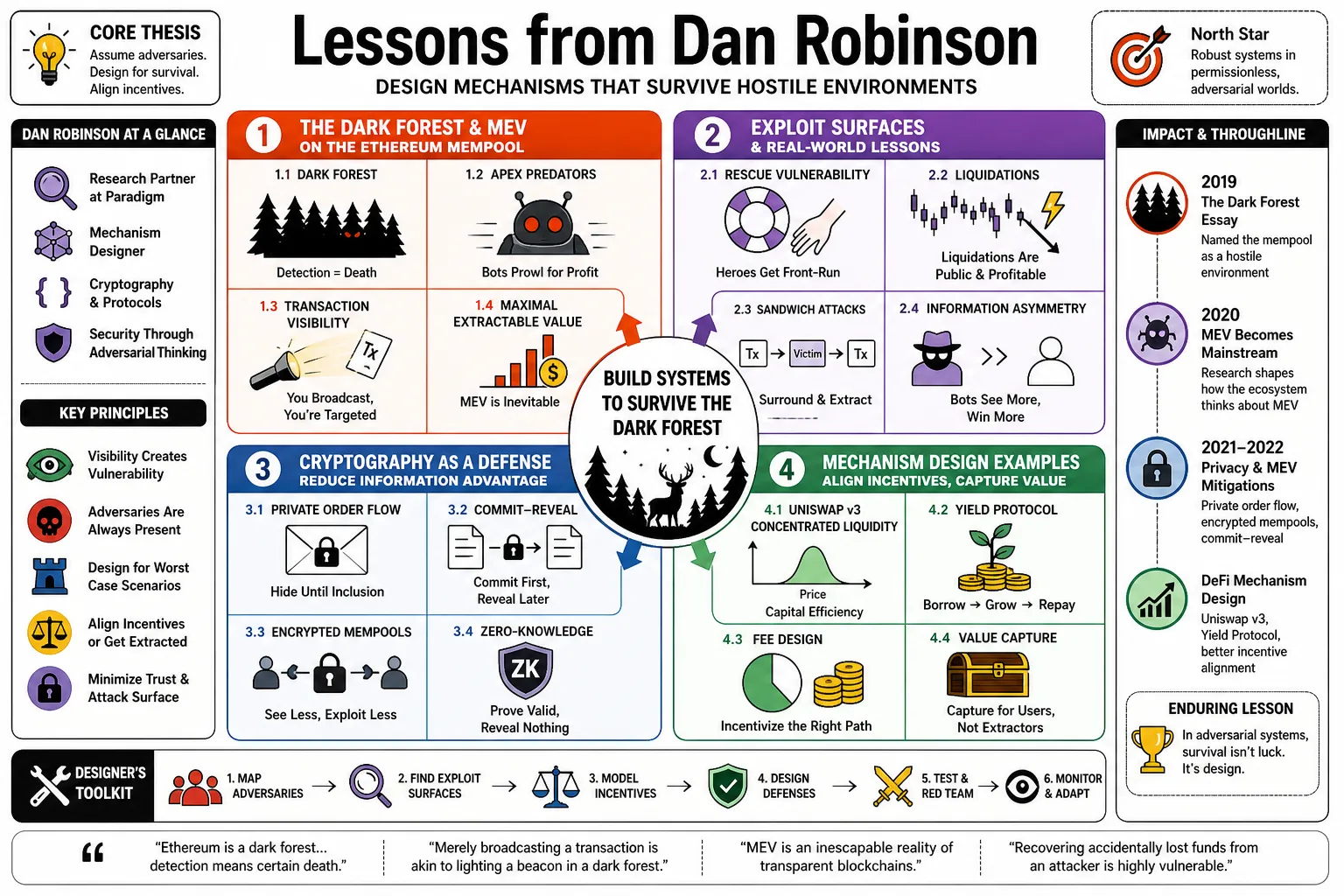
Lessons from Dan Robinson
As a Research Partner at Paradigm, Dan Robinson helped design DeFi mechanisms like Uniswap v3's concentrated liquidity and the Yield Protocol. He is perhaps best known for identifying the Ethereum "Dark Forest," detailing how bots prey on vulnerable mempool transactions. This compilation tracks his work across cryptography and mechanism design, showing how he builds systems to survive hostile environments.
Part 1: The Dark Forest and MEV
- On the Ethereum Mempool: "Ethereum is a dark forest... an environment where detection means certain death." — Source: Paradigm
- On Apex Predators: "The public mempool is actively prowled by advanced arbitrage and front-running bots that monitor for any profitable transaction they can exploit." — Source: Paradigm
- On Transaction Visibility: "Merely broadcasting a transaction is akin to lighting a beacon in a dark forest, immediately inviting attack from automated searchers." — Source: CoRecursive
- On Maximal Extractable Value: "MEV is an inescapable reality of transparent blockchains that fundamentally alters how smart contracts must be designed." — Source: Uncommon Core
- On the Vulnerability of Rescues: "Recovering accidentally locked funds on-chain is difficult because bots will simulate the rescue transaction, copy it, and substitute their own receiving address." — Source: Paradigm
- On Front-Running: "The competitive structure of gas auctions allows predatory bots to guarantee their transactions execute before a regular user's simply by paying higher fees." — Source: Flashbots
- On the Need for Coordination: "The predatory dynamics of mempools demonstrated the necessity for private transaction relays to protect users from exploitation." — Source: Bankless
- On Mempool Transparency: "Transparent pending transactions create an asymmetric advantage for automated searchers over ordinary human operators." — Source: The Bitcoin Podcast
- On the Evolution of MEV: "What began as simple arbitrage quickly evolved into a sophisticated ecosystem of specialized actors competing for micro-efficiencies." — Source: Uncommon Core
- On Systemic Risk: "Unchecked value extraction poses risks to blockchain consensus if miners or validators are financially incentivized to reorg the chain." — Source: Paradigm
Part 2: Uniswap and AMM Mechanism Design
- On Concentrated Liquidity: "Uniswap v3 lets liquidity providers concentrate liquidity in specific positions. By combining multiple positions, LPs can approximate arbitrary curves." — Source: Uniswap
- On Universal AMMs: "The v3 design acts as a universal automated market maker where any static curve can be implemented and aggregated with the rest of the pool's liquidity." — Source: Paradigm
- On Capital Efficiency: "Concentrated liquidity increases the capital efficiency of automated market makers, especially for tightly correlated assets like stablecoin pairs." — Source: U.S. Senate
- On v3's Design: "I think it’s the best DEX design on the planet. If you’ve heard me cryptically address a problem by saying that 'Uniswap v3 fixes this,' now I can finally explain why." — Source: Substack
- On Customization in v4: "Uniswap v4 enables developers to build custom pools with hooks, which are arbitrary pieces of code that execute at specific points in the pool's lifecycle." — Source: Uniswap
- On AMM Rigidity: "While earlier versions prioritized strict efficiency, v4 was engineered to solve the rigidity of static pools by introducing a highly modular architecture." — Source: Bankless
- On Loss-Versus-Rebalancing (LVR): "Reducing losses to informed order flow while maximizing revenue from uninformed traders remains a core unsolved problem in AMM design." — Source: arXiv
- On Auction-Managed AMMs: "The am-AMM model represents a shift toward mitigating LVR by relying on competitive auctions to update pool prices." — Source: Paradigm
- On Just-in-Time Liquidity: Uniswap v3's concentrated-liquidity design created a much larger strategy surface for liquidity providers, including narrow, event-driven approaches like just-in-time liquidity that sit on top of the protocol rather than being hardcoded into it. — Reference: Dan Robinson on Uniswap v3 as a universal AMM
- On the Infinite Game: Robinson framed Uniswap v3 as an opening move rather than a finished endpoint: the protocol expanded the AMM design space, but he also highlighted the practical limitations and follow-up work still needed to approximate new curves efficiently in production. — Reference: Dan Robinson on Uniswap v3 as a universal AMM
Part 3: Yield Protocol and Fixed-Rate Lending
- On fyTokens: "Fixed-yield tokens function similarly to traditional zero-coupon bonds, enabling fixed-rate borrowing and lending on-chain." — Source: Yield Protocol
- On Interest Rate Discovery: "The Yield Protocol introduced a framework for decentralized, on-chain interest rate discovery without relying on centralized oracles." — Source: The Block
- On Lending Mechanics: "Users buy fyTokens at a discount and redeem them at maturity for a one-to-one ratio with the underlying asset, capturing the spread as fixed interest." — Source: Bankless
- On Borrowing with Collateral: "Borrowers deposit collateral to mint fyTokens, sell them for the base asset today, and repay the principal at maturity to close the loan." — Source: GitHub
- On YieldSpace: "The YieldSpace AMM utilizes a specialized constant power sum invariant designed specifically for trading tokens with a fixed maturity date." — Source: Yield Protocol
- On Time-to-Maturity: "Unlike standard constant-product AMMs, YieldSpace explicitly accounts for the time-to-maturity of tokens to provide stable interest rates and minimize price impact." — Source: Tim Roughgarden
- On Foundational Primitives: "On-chain fixed-rate lending serves as a fundamental building block for constructing complex structured financial products." — Source: Medium
- On the Paradigm Incubation: "Yield Protocol represented one of the first major incubations by Paradigm, focusing on advancing theoretical mechanism design into practical application." — Source: Paradigm
- On Predictable Costs: "Fixed-rate protocols expand the utility of decentralized finance by providing users with predictable borrowing costs required for mature financial planning." — Source: Substack
Part 4: Quantum Security and PACTs
- On Future Quantum Threats: "As quantum computing advances, older Bitcoin public keys may eventually become vulnerable to having their private keys derived." — Source: CryptoRank
- On the Dilemma of Sunsetting: "If Bitcoin implements an emergency hard fork to freeze quantum-vulnerable addresses, dormant holders would be forced to move their funds and compromise their privacy." — Source: Paradigm
- On the Purpose of PACTs: "Provable Address-Control Timestamps let Bitcoin holders protect themselves from a post-quantum sunset without publicly moving their coins." — Source: Paradigm
- On Cryptographic Commitments: "The PACT mechanism allows a user to create a secret, off-chain commitment that cryptographically proves they control the vulnerable private key." — Source: Cryptopolitan
- On On-Chain Timestamping: "Proof of ownership is timestamped on the Bitcoin blockchain using existing infrastructure to establish control before any quantum compromise occurs." — Source: CryptoNews
- On Preserving Privacy: "The timestamping mechanism ensures that the holder does not have to reveal their identity or specific address ownership prematurely." — Source: Phemex
- On Future Claims: "If a quantum emergency forces a network upgrade, holders could use their pre-existing PACTs via zero-knowledge proofs to securely reclaim their funds." — Source: Paradigm
- On Proactive Standardization: "Adopting a standard for these cryptographic proofs today maximizes the time holders have to secure their coins before any forced transition." — Source: Bankless
- On Separating Concerns: "PACTs provide a technical safeguard now while deferring the complex political decision of whether a sunset fork is desirable until later." — Source: Paradigm
Part 5: Crypto as Programmable Money
- On the Core Appeal: "What drew me to crypto was the concept of fully programmable money, something that had never really been possible before." — Source: U.S. Senate
- On Self-Executing Logic: "The launch of Ethereum shifted the technical environment by enabling financial and legal logic to be codified directly into self-executing software." — Source: U.S. Senate
- On Disintermediation: "Programmable money allows users to trade, borrow, and lend assets globally without giving up custody or relying on traditional financial intermediaries." — Source: Paradigm
- On Counterparty Risk: "The deterministic nature of smart contracts heavily reduces counterparty risk because the rules of financial engagement are enforced by cryptographic consensus." — Source: U.S. Senate
- On Legal Background: "A background in securities litigation provides a framework to view smart contracts as a more efficient, automated form of legal agreements." — Source: U.S. Senate
- On Open Innovation: "Fully programmable money lowers the barrier to entry, allowing developers to build and deploy global financial services without seeking permission." — Source: Bankless
- On the Speed of Settlement: "Unlike traditional finance where settlement takes days, programmable blockchains enable instant, atomic settlement of multiparty transactions." — Source: Uncommon Core
- On Financial Access: "Interacting directly with decentralized protocols democratizes access to financial tools that were previously restricted to institutional players." — Source: The Bitcoin Podcast
- On the Shift in Engineering: "The transition to smart contract development requires a mindset shift toward building highly resilient, immutable financial infrastructure." — Source: Paradigm
Part 6: Market Structures and Game Theory
- On Intent-Based Architectures: "Protocols like UniswapX change how assets are swapped by allowing users to declare their intents rather than specifying the exact execution path." — Source: Bankless
- On Dutch Auctions: "Utilizing mechanisms like Dutch auctions in decentralized trading can efficiently match orders while mitigating the value lost to front-running bots." — Source: Xangle
- On Order Flow Dynamics: "The future of decentralized exchange depends heavily on optimizing how order flow is routed and monetized between users, solvers, and liquidity providers." — Source: Paradigm
- On Solver Competition: Intent-based execution works best when multiple executors can compete to satisfy a user's constraints; without that competition, users face weaker execution quality and more room for opaque middlemen to capture value. — Reference: Paradigm essay on intents and execution competition
- On the Limits of Constant Product: "Simple constant-product AMMs are resilient but leave significant value on the table for arbitrageurs at the expense of passive liquidity providers." — Source: Paradigm
- On MEV Mitigation: "The shift toward intent-based and auction-driven market structures is a direct response to the need to internalize value and return it to the swapper." — Source: Bankless
- On Protocol Composability: "The strength of decentralized market structures lies in their composability, where independent primitives can be stacked to create new financial utilities." — Source: Uncommon Core
- On Rational Actors: "Designing secure DeFi protocols requires assuming that all actors in the system are rational, profit-maximizing agents who will exploit any available inefficiency." — Source: Paradigm
- On the Evolution of Liquidity: "As AMM designs become more sophisticated, the role of the liquidity provider transitions from a passive participant to an active, strategic market maker." — Source: Uniswap
Part 7: Smart Contract Rescue and The Mempool
- On the Anxiety of Rescues: "Executing a high-stakes smart contract rescue in the public mempool requires trying to outsmart automated adversaries in real-time." — Source: CoRecursive
- On Obfuscation Techniques: "When attempting to recover vulnerable funds, developers must employ complex, custom smart contracts to obfuscate their intent from generalized front-running bots." — Source: Paradigm
- On the Speed of Bots: "Arbitrage bots do not need to understand the underlying logic of a transaction; they merely simulate its outcome and front-run it if it results in a net positive balance." — Source: The Bitcoin Podcast
- On the Cost of Failure: "In the dark forest, a single mistake in a rescue operation results in permanently losing the funds to an apex predator." — Source: CoRecursive
- On Miner Extraction: "The entities with the absolute most power in the mempool are the block builders and miners, who have the final say over transaction inclusion and ordering." — Source: Uncommon Core
- On the Rise of Flashbots: "The reality of mempool front-running catalyzed the development of private transaction pools as essential tools for safely executing complex transactions." — Source: Flashbots
- On Generalized Front-Runners: "Generalized front-runners are protocol-agnostic; they blindly copy any profitable payload, substitute the caller's address, and bid higher gas." — Source: Paradigm
- On Security via Obscurity: "In a fully transparent ledger, security via obscurity is impossible because any profitable exploit will eventually be found and executed by an automated system." — Source: CoRecursive
- On Real-Time Game Theory: "A live smart contract rescue is a practical application of game theory played against opponents who execute at the speed of computation." — Source: Medium
- On the Value of Post-Mortems: "Publicly documenting the mechanics of failed and successful rescues educates the broader ecosystem on the hidden dangers of the mempool." — Source: Paradigm
Part 8: The Philosophy of Decentralized Finance
- On Financial Infrastructure: "DeFi is not merely about speculation; it is about rebuilding global financial infrastructure on an open, permissionless bedrock." — Source: U.S. Senate
- On the Role of Research: "The pace of development in crypto requires a tight feedback loop between theoretical economic research and practical smart contract engineering." — Source: Paradigm
- On Protocol Sovereignty: "Successful decentralized protocols operate as sovereign financial entities, governed by code and math rather than human discretion." — Source: Bankless
- On the Inevitability of Innovation: "The transition to programmable money is a technological shift comparable to the transition from physical to digital communications." — Source: U.S. Senate
- On Designing for Hostility: "Building for the blockchain requires an adversarial mindset, assuming the environment is hostile and unforgiving of errors." — Source: The Bitcoin Podcast
- On the Power of Open Source: "The rapid evolution of AMMs and lending protocols is only possible because the underlying code and mathematics are openly verifiable and forkable." — Source: Uniswap
- On Reducing Friction: "The goal of mechanism design in DeFi is to systematically reduce the friction and costs associated with financial intermediation." — Source: Paradigm
- On Trust Minimization: "By replacing trusted intermediaries with verifiable cryptographic proofs, decentralized protocols eliminate single points of failure and censorship." — Source: Uncommon Core
- On the Long-Term Vision: "Despite short-term adversarial dynamics, the long-term trajectory of the industry is toward a more transparent, efficient, and equitable global financial system." — Source: Paradigm