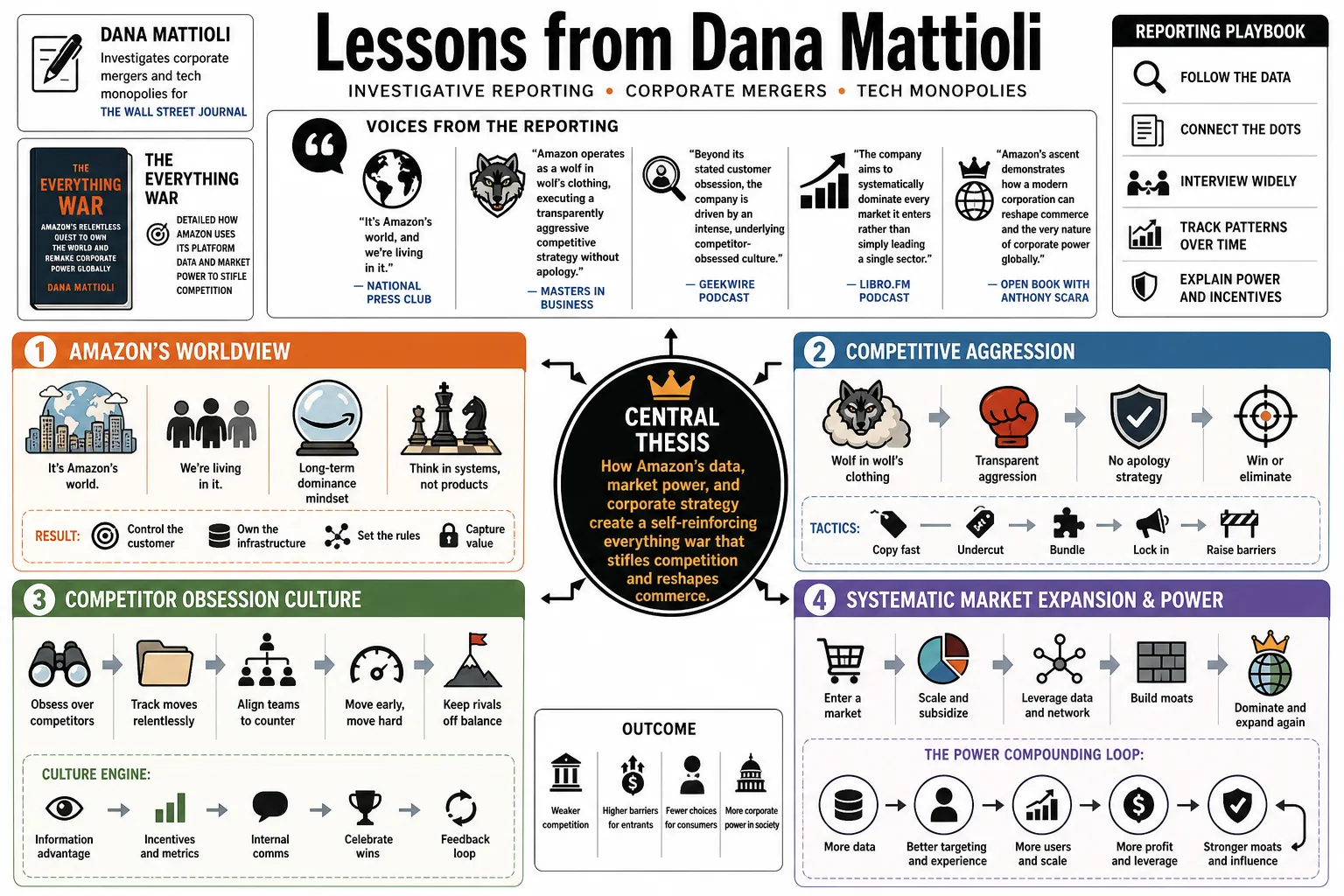
Lessons from Dana Mattioli
Dana Mattioli is a Wall Street Journal investigative reporter and author of The Everything War. Her reporting examines Amazon’s treatment of sellers and startups, its internal culture, and the public consequences of its reach across multiple markets. — GeekWire Interview.
Part 1: The Everything War and Corporate Strategy
- Amazon touches many markets: Mattioli says Amazon’s reach is so broad that people and businesses interact with it even outside online shopping. — National Press Club Talk.
- Aggressive competition is overt: Mattioli recounts a venture investor describing Amazon as a “wolf in wolf’s clothing”: its competitive tactics are often plain to see rather than hidden. — Masters in Business Transcript.
- Competition obsession sits beside customer obsession: After 18 years covering companies, Mattioli called Amazon the most competitor-obsessed company she had reported on. — Masters in Business Transcript.
- Growth across industries compounds power: Mattioli describes Amazon’s expansion beyond retail into cloud computing, logistics, advertising and other markets, creating many points of leverage. — Motley Fool Interview.
- The book examines the remaking of corporate power: The Everything War traces how Amazon expanded across industries and what that reach means for companies that must deal with it. — Publishers Weekly Interview.
- Below-cost pricing can pressure rivals: Mattioli describes Amazon’s diaper price cuts during its contest with Quidsi as an example of aggressive pricing pressure on a smaller rival. — Masters in Business Transcript.
- Advertising becomes a gate to visibility: Mattioli says sellers may need to buy Amazon ads to appear in search, giving the platform another lever over its marketplace. — Masters in Business Transcript.
- Convenience can obscure the tradeoffs: Mattioli wrote the book to reveal tactics behind Amazon’s apparent convenience and its power over sellers and competitors. — National Press Club Talk.
- Prioritize growth before near-term profit: Mattioli describes how Bezos persuaded investors to emphasize growth over immediate profitability as Amazon expanded. — Motley Fool Interview.
- Cross-industry reach is the strategic issue: For Mattioli, Amazon’s significance is not just its online retail share but its simultaneous scale in cloud, logistics and advertising. — Motley Fool Interview.
Part 2: Data Exploitation and Third-Party Sellers
- Seller data can inform rival products: Mattioli reports that Amazon teams accessed marketplace sellers’ data to identify products they could make under Amazon’s own brands. — Marketplace Interview.
- Private-label teams had granular information: In her investigation, Mattioli obtained records with item sales, expenses and margins that private-label employees used when assessing competing products. — Wall Street Journal Investigation.
- Sellers rely on a competing platform: Mattioli describes sellers depending on Amazon for access to customers while Amazon also sells competing private-label goods. — Masters in Business Transcript.
- The platform can restrict rival advertising: Mattioli says Amazon barred some rival device makers from buying ads for competing products, a distinct lever from selling its own private labels. — Masters in Business Transcript.
- Marketplace fees can rise with dependence: Mattioli says sellers’ need to reach Amazon shoppers has enabled the platform to charge more fees. — GeekWire Interview.
- Seller fees may raise prices elsewhere: Mattioli explains that fees and pricing constraints can lead sellers to raise prices for shoppers, including across other channels. — Motley Fool Interview.
- Bookstores were an early warning: Mattioli identifies independent bookstores as an early group harmed by Amazon’s expansion, before its reach extended across industries. — Publishers Weekly Interview.
- Search visibility can become pay-to-play: With millions of sellers competing for attention, Mattioli says buying Amazon advertising has become important for appearing in search. — Masters in Business Transcript.
- Seller-data firewalls were not consistently enforced: Mattioli’s investigation found that stated restrictions on access to individual seller data were sometimes bypassed or weakly enforced. — Wall Street Journal Investigation.
Part 3: Startups, Mergers, and the Residuals Clause
- Read the residuals clause: Mattioli found contract language allowing Amazon to use information retained in executives’ memories after startup deal meetings, undermining founders’ assumptions about confidentiality. — Masters in Business Transcript.
- An investment meeting may reveal a competitor’s plans: Mattioli reports founders shared proprietary details with Amazon’s Alexa Fund while Amazon could also be a current or future competitor. — Screaming in the Cloud Interview.
- Founders reported a meeting-then-copy pattern: Mattioli recounts companies giving Amazon detailed information, then being ghosted before a similar Amazon product appeared. — National Press Club Talk.
- Pitching a powerful rival is a dilemma: She describes founders seeking Amazon investment while worrying that other Amazon teams might see their proprietary data. — GeekWire Interview.
- An internal venture fund can expose opportunities: Mattioli reports that the Alexa Fund gave Amazon access to startup product plans in industries where it also competed. — Motley Fool Interview.
- A build-or-buy threat can change negotiations: In the Quidsi/Diapers.com case, Mattioli says Amazon intensified diaper price cuts after the startup rejected its acquisition offer. — Masters in Business Transcript.
Part 4: Antitrust Enforcement and Lina Khan
- Show how power operates: Mattioli said her aim was to lift the veil on practices she viewed as anti-competitive and on Amazon’s ability to tilt commerce. — National Press Club Talk.
- Khan challenged the old antitrust frame: Mattioli explains that Lina Khan’s 2017 law-review article argued existing interpretations of antitrust law failed to address Amazon’s platform power. — Masters in Business Transcript.
- Low prices once dominated enforcement thinking: Mattioli contrasts older consumer-welfare reasoning centered on shopper prices with the broader platform-power concerns raised by Khan. — Screaming in the Cloud Interview.
- A combative stance can damage government relations: Mattioli says Amazon’s past posture toward both government and public criticism helped make the company enemies on both sides of U.S. politics. — Democracy Now! Interview.
- The FTC alleged illegal monopoly conduct: Mattioli discusses the FTC’s 2023 suit alleging Amazon maintained monopoly power; this remains an allegation, not a final judicial finding. — Marketplace Interview.
- The price theory matters: Mattioli notes that the FTC’s Amazon case used consumer-price arguments, including concern that marketplace practices can raise prices. — Screaming in the Cloud Interview.
- A breakup was a possible remedy, not an outcome: Mattioli says the FTC’s suit raised the possibility of splitting Amazon if the agency prevailed; she did not report that a breakup had occurred. — Masters in Business Transcript.
- Big Tech scrutiny crossed party lines: In a direct interview, Mattioli described unusual Republican and Democratic agreement on concern about Amazon’s scale. — Motley Fool Interview.
- The lawsuit creates strategic uncertainty: Mattioli treated the FTC case as an uncertain factor for Amazon’s future growth, while observing that the company largely continued its existing course. — Marketplace Interview.
Part 5: Internal Culture and Leadership Dynamics
- Leaders can develop a defensive narrative: From interviews with senior leaders, Mattioli found a feeling that press and government scrutiny unfairly overlooked Amazon’s benefits. — Screaming in the Cloud Interview.
- Defensiveness can obstruct correction: She says some executives reacted to criticism by denying and deflecting rather than fixing the underlying conduct that drew it. — Screaming in the Cloud Interview.
- Performance pressure shapes behavior: Mattioli links forced ranking and backloaded compensation to pressure on employees to hit targets, sometimes encouraging conduct they knew was wrong. — Marketplace Interview.
- Backloaded pay raises the cost of leaving: Mattioli describes how delayed stock vesting and forced ranking intensify the pressure on employees to survive in Amazon’s culture. — Masters in Business Transcript.
- Leadership tone changed under Jassy: Mattioli contrasts Bezos’s combative approach with Jassy’s more diplomatic government relations, while noting continued ambitions to expand. — Marketplace Interview.
Part 6: Cloud Computing and Infrastructure Dominance
- AWS became a separate source of power: Mattioli describes AWS emerging from Amazon’s own computing needs into a large business used by startups and major organizations. — Masters in Business Transcript.
- AWS generated substantial profits: Mattioli calls AWS an enormous source of profit for Amazon; the source does not prove a precise subsidy from AWS to retail pricing. — Masters in Business Transcript.
- Even competitors can become cloud customers: Mattioli notes that companies competing with Amazon elsewhere have nevertheless relied on AWS infrastructure. — Masters in Business Transcript.
- Cloud services can be sticky: Mattioli says AWS is entrenched with customers and that organizations rarely leave once they depend on its services. — Masters in Business Transcript.
- Reusable infrastructure lowered startup barriers: Mattioli describes Amazon turning its own computing capabilities into AWS services that new companies could buy instead of building server infrastructure from scratch. — Masters in Business Transcript.
- Multiple businesses create negotiating leverage: Mattioli and a colleague reported Amazon seeking data from Ecobee in connection with Alexa, illustrating leverage across product and platform relationships. — Wall Street Journal Cross-Business Investigation.
- Cloud dependence can prompt oversight: A congressional letter citing Mattioli’s AWS reporting asked regulators to examine whether large cloud providers posed financial-stability risks. — Congressional Cloud-Oversight Letter.
Part 7: Investigative Journalism and Reporting
- Scale investigations beyond one account: Mattioli says she spent three years on the book, spoke with hundreds of sources and assembled internal records to test the story. — GeekWire Interview.
- Documents can test corporate denials: Her seller-data investigation paired employee accounts with internal records showing practices that conflicted with Amazon’s stated restrictions. — Wall Street Journal Investigation.
- Confirm a major deal before publication: Mattioli’s Berkshire–Precision Castparts scoop reported a pending transaction through people familiar with the matter rather than presenting it as finalized. — Wall Street Journal Deal Scoop.
- Complex investigations take time: Mattioli says The Everything War took three years to report and required hundreds of pages of internal documents. — GeekWire Interview.
- Include the human consequences: Mattioli says founders described job and livelihood losses from the competitive tactics she reported, which shaped her book’s account. — Masters in Business Transcript.
- Use reporting to make opaque practices visible: Mattioli says she wanted the book to reveal how a secretive company wins and to show readers instances where she found the scales tilted. — GeekWire Interview.