Daniel Loeb built Third Point LLC into one of the most formidable hedge funds in the world by pairing rigorous, fundamental financial analysis with an unapologetically aggressive approach to corporate activism. Known early in his career for writing caustic "poison pen" letters that dismantled underperforming executives, Loeb’s strategy has continually evolved over three decades to encompass macro forecasting, structural tech shifts like AI, and significant philanthropic reform in education. This profile collects his core principles on how to accurately price risk, identify value in chaos, and force accountability in the boardroom.
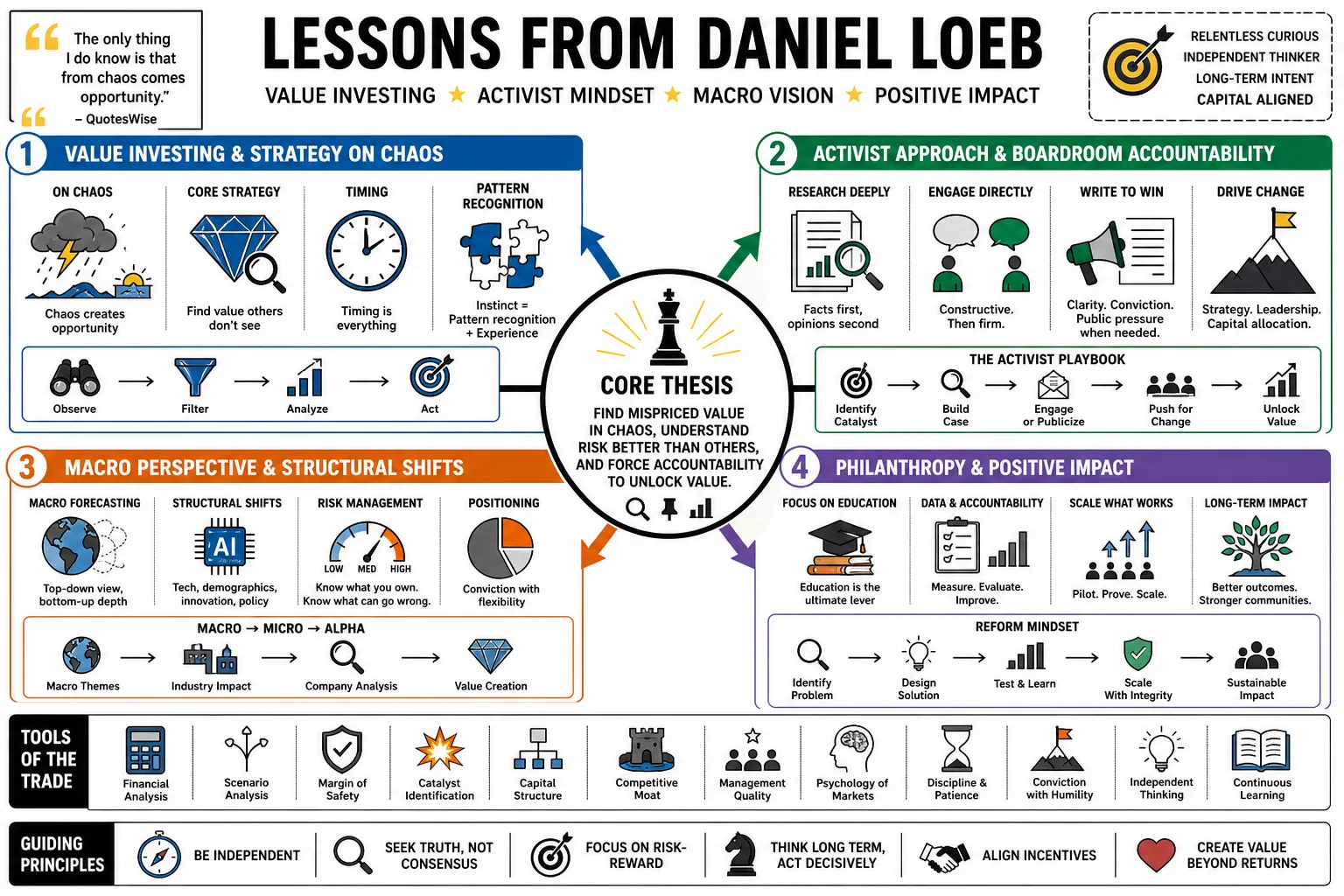
Part 1: Value Investing & Strategy
- On Chaos: "The only thing I do know is that from chaos comes opportunity." — Source: QuotesWise
- On Core Strategy: "The entire concept of value investing... is to be opportunistic and invest in companies which are not discovered by others." — Source: Hedge Fund Alpha
- On Timing: "Timing is everything in these markets." — Source: Hedge Fund Alpha
- On Pattern Recognition: "I don't like the word 'instinct,' because it just sounds like a gut thing. I think what we call instinct is really a type of pattern recognition, which comes from experience looking at the companies and industries and situations that work." — Source: QuotesWise
- On Short Selling: "Some of the best returns on the short side tend to arise in situations where management responds to fundamental deterioration... by misallocating capital and aggressively adjusting reported earnings metrics in ways that, to our read, obscured the underlying problems." — Source: Business Insider
- On Top-Down vs Bottom-Up: "Third Point LLC identifies investment opportunities using a combination of top-down asset allocation decisions and a bottom-up, value-oriented approach to single security analysis." — Source: Substack
- On Passion for the Craft: "I’ve seen too many people go into this because they’ve done the math on the business model... I’ve never seen anyone with that approach really make it as an investor." — Source: Institutional Investor
- On The Golden Age: "The current environment is a golden age for event-driven investing like M&A, spin-offs, and activism as competitors have exited the space." — Source: Institutional Investor
- On Unlevered Analysis: "To accurately assess downside risk, investments should be analyzed on an unlevered basis. Leverage doesn't increase returns; it only increases risk and the threat of a steep downside." — Source: Substack
- On Information Arbitrage: "The most successful modern analysts are no longer just spreadsheet modelers, but domain experts who understand the nuances of an industry." — Source: AI Takeaway
Part 2: Activism & Shareholder Rights
- On Modern Activism: "Activists today are very different from corporate raiders of the '80s... Our activist investments... have been some of our most complex and have been held for well over the one-year threshold identified as offensive by the critics." — Source: Business Insider
- On Hit and Run Tactics: "Lately, a varied chorus... have asserted that activism is short term in nature, engaged in by 'hit and run' investors... It might surprise people to hear that we agree completely that the sort of activism they describe is abominable. Luckily, it does not really exist, and certainly not at Third Point." — Source: Business Insider
- On Manufactured Catalysts: "Great investors wait for opportunities. Elite activists manufacture them." — Source: Financial News
- On Value Destruction: "Since you ascended to your current role of Chief Value Destroyer... the shares have dropped over 45 percent, a destruction of shareholder value in excess of $520 million." — Source: Substack
- On Unqualified Heirs: "The 'lucky sperm club' refers to heirs of company founders who sit on boards without merit or applicable competence." — Source: IB Times
- On Misplaced Priorities: "Do what you do best: Retreat to your waterfront mansion in the Hamptons where you can play tennis and hobnob with your fellow socialites." — Source: Business Insider
- On Board Entrenchment: "Sweetheart deals and poison pills serve only to entrench management and the current board while massively disenfranchising public shareholders." — Source: Business Insider
- On Litigation: "Someone once told me that 'litigation is the sport of kings' and indeed, it is one that I seem to relish as I become more expert in its nuances." — Source: Business Insider
- On Aligning Interests: "Only in an illogical Alice-in-Wonderland world would a shareholder be deemed to be conflicted from representing the interests of other shareholders because he is, well, a shareholder too." — Source: Business Insider
- On Evolving Approaches: "We prefer to invest in high-quality companies with excellent management that are doing the right things across the board and support them, rather than seek out companies that 'would be worth more if not for poor management'." — Source: Futunn
Part 3: Corporate Governance & Board Management
- On The Capitalist System: "The American capitalist system has a beautiful feature—it establishes boards of directors within the framework of capitalism and democracy: boards are accountable to shareholders and responsible for holding management accountable." — Source: Futunn
- On Board Dysfunction: "Governance problems typically arise when board members forget their fiduciary duties, or when the board’s composition renders it incapable of holding management accountable." — Source: Futunn
- On Management Capture: "It is further apparent that the current Board of Directors represents the narrow interests of the management instead of the shareholder base as the law requires of fiduciaries." — Source: Business Insider
- On Board Entitlement: "I believe all board members carry a sense that merely occupying the seat confers status—an assumption that itself needs to be dismantled." — Source: Futunn
- On Blind Loyalty: "While the decision to hire an underperforming CEO alone is grounds for questioning the Board’s competence, its willingness to turn a blind eye to these serious problems is even more troubling." — Source: Futunn
- On Compensation Red Flags: "An outsized pay package without performance alignment is a red flag for shareholders and signals a massive governance failure." — Source: Futunn
- On Personal Accountability: "If you, as board members, undertake the current course of action, Third Point will hold you personally responsible for such a flagrant violation of your duty of loyalty." — Source: Business Insider
- On Board Refreshment: "A board often just needs refreshment and more shareholder directors—people who support management in implementing their plan but hold them accountable if they fail." — Source: Futunn
- On Good Ol' Boy Networks: "A 'good ol' boy' set of ethics prevailing at a company over standards dictated by fairness and good judgment is a clear warning sign." — Source: Business Insider
- On Imperial Perks: "Outdated corporate perks, like excessive country club fees and car allowances, invoke the long-gone era of imperial CEOs and misalign focus." — Source: IB Times
Part 4: Market Psychology & Risk Management
- On Process vs. Outcome: "I'd rather have somebody working for me who had a good process and a bad outcome in a given year than somebody with a bad process and a good outcome." — Source: QuotesWise
- On Overconfidence: "A manager that has become overconfident by using a bad process is like somebody who plays Russian roulette three times in a row without the gun going off... The fourth time, they blow their brains out." — Source: QuotesWise
- On Humility: "The only thing we are 100% confident in is that we are fallible, we don't have all the answers, and we will make some mistakes." — Source: QuotesWise
- On Management Excuses: "It is too convenient to hide behind the mama's apron of 'challenging market environments' and 'black swan events' while exhorting clients to ignore poor performance." — Source: Business Insider
- On Flawed Assumptions: "You should probably revise your model assumptions, as the basis for your argument is flawed." — Source: Business Insider
- On Survival: "A hedge fund earns its reputation during bull markets. It earns its survival during bear markets." — Source: Financial News
- On The Illusion of Safety: "The market doesn't care about how smart you are; it cares about whether you're right." — Source: Financial News
- On High-Risk Trades: "Losing money in high-risk trades can be a vital educational experience for young investors, teaching them the importance of rigorous fundamental analysis over speculation." — Source: Traders Union
- On Investigative Research: "Risk management involves deep-dive detective work into executive backgrounds, expense accounts, and personal habits to identify hidden risks or deceptions in management's narrative." — Source: New Republic
- On Confronting Mistakes: "Where we've made the mistake is that we thought we knew better... This has been a key investment lesson over the past year." — Source: Business Insider
Part 5: Artificial Intelligence & Technology
- On the Sector of the Future: "Unless you are really draconian or negative and you think that somehow the AI world is going to roll over in '31 or '32, I think it's the most attractive sector right now." — Source: Morningstar
- On Evolving Portfolios: "There was a time when you could say, 'I'll just skip tech stocks and focus exclusively on industrials.' But today, you must become a technology investor." — Source: Business Insider
- On Practical AI: "The only way to get good at this is just to use it... AI can make employees very autonomous." — Source: Business Insider
- On AI Value Models: "The most reliable way to identify value in companies is to analyze them through an 'AI stack' model, starting from energy and semiconductor infrastructure up to foundational models and software." — Source: AI Takeaway
- On the AI Bubble: "Despite market fears, we have barely scratched the surface of AI's ultimate economic impact." — Source: Business Insider
- On Foundational Shifts: "Technology is no longer a standalone sector but a foundational layer of the economy affecting every traditional industry." — Source: AI Takeaway
- On Unrecognized Disruption: "Legacy information services businesses will face existential disruption from AI if they do not aggressively adapt their data monetization models." — Source: Business Insider
- On Infrastructure vs Software: "We are currently finding the most compelling AI opportunities in the infrastructure layer—power, cooling, and compute—rather than purely consumer-facing applications." — Source: Morningstar
- On AI Monetization: "We are moving from a theoretical AI cycle to a real monetization phase, where early infrastructural investments are generating tangible cash flow." — Source: Morningstar
Part 6: Macro Trends & Crypto
- On Analyzing Headlines: "It has never been more important to employ second-order thinking about news headlines and policy announcements." — Source: Investing.com
- On Policy and Economics: "There is a growing interconnection between economics and policy that creates periodic market dislocations for event-driven funds to exploit." — Source: Investing.com
- On Regime Change: "There is one thing I fear the most as a business leader: regime change. Whether it's a coup d'état or a democratic election, private businesses are always the first target." — Source: Masters Invest
- On Crypto's Disruption: "While crypto is popularly viewed as an alternative and speculative asset class, we are most intrigued by its potential to become a disruptive technology." — Source: Wealth Advisor
- On Blockchain vs Due Diligence: "The hardest investment lesson came from relying solely on verifiable blockchain data while overlooking the fundamental failure of traditional due diligence regarding misappropriation of funds." — Source: Financial News
- On Digital Infrastructure: "In the digital asset space, it is often better to own the toll road than necessarily the car." — Source: Financial News
- On Capitalist Innovation: "Perhaps our leaders will awaken to the fact that free market capitalism is the best system to allocate resources and create innovation, growth and jobs." — Source: Hedge Fund Alpha
- On Government Regulation: "Unpredictable government regulations have a massive impact on individual companies, industries and the economy as a whole." — Source: Hedge Fund Alpha
- On Rate Cycles: "Looking past sensationalist inflation fears, sustained technological investment supported by a normalizing rate cycle will provide a long-term tailwind for equities." — Source: Hedge Fund Alpha
Part 7: Philanthropy & Education
- On Strategic Giving: "One must work at giving, search for and support causes and organizations that address structural problems, advance social progress, and transform people's lives." — Source: Substack
- On Opportunity through Education: "There is nothing more urgent for our city and our country than giving kids the opportunities in life that only great schools can provide." — Source: Patch
- On the Educational Divide: "If you truly believe that education is the dividing line, then you must recognize and take up the fight against the forces standing in the way of quality education." — Source: Patch
- On Scalable Solutions: "Philanthropic support for education must focus on models that are scalable and can sustainably reach thousands of underserved children." — Source: Patch
- On Parental Demand: "The true driving force behind education reform is the sheer demand of parents who are desperate to find a high-quality school for their children." — Source: Wikipedia
- On Aligning Capital with Values: "Philanthropy must align with personal values, even if that means redirecting capital away from traditional legacy institutions that lose their relevance." — Source: Patch
- On Breaking Monopolies: "A free market approach to education breaks bureaucratic monopolies and allocates resources toward genuine innovation." — Source: Hedge Fund Alpha
- On Board Service: "Serving on the board of a transformative charter network requires the same dedication to governance and accountability as managing a corporate enterprise." — Source: Wikipedia
- On Long-Term Commitment: "Fixing structural societal issues cannot be achieved with passive donations; it requires active, long-term operational involvement." — Source: Substack
Part 8: Life, Philosophy & Mindset
- On the Philosopher Investor: "In order to be a really good investor, you need to be a little bit of a philosopher as well." — Source: QuotesWise
- On Capitalism vs. Failure: "Capitalism without bankruptcy is like Christianity without hell." — Source: QuotesWise
- On Imposter Syndrome: "The night before starting my fund, I absolutely panicked. I thought, 'Oh my God. What am I doing? I'm a fraud.'" — Source: Business Insider
- On Scrappy Culture: "We are a bunch of scrappy guys from diverse backgrounds who enjoy outwitting pompous asses in financial markets globally." — Source: Stansberry Research
- On the Power of Story: "The narrative we tell ourselves about our business and personal lives ultimately dictates our destiny; identifying dysfunctional stories is the first step to fixing them." — Source: New Republic
- On Spiritual Congruence: "Maintaining clarity in volatile markets requires deep congruence between spiritual discipline and professional execution." — Source: Wikipedia
- On Hiring the Right Talent: "When I interview, I ask for your largest position and why in 30 seconds. I want to drill down and see if you truly know the details." — Source: Business Insider
- On The Ultimate Goal: "The highest form of investing isn't predicting change. It's creating it." — Source: Financial News