Daryl Katz built a multi-billion dollar empire starting with the acquisition of the rights to the Rexall pharmacy brand in Canada. He later purchased the Edmonton Oilers and used the construction of Rogers Place as a catalyst to develop ICE District, reshaping downtown Edmonton. The insights below capture his approach to aggressive business consolidation, sports ownership, urban real estate, and navigating severe health challenges.
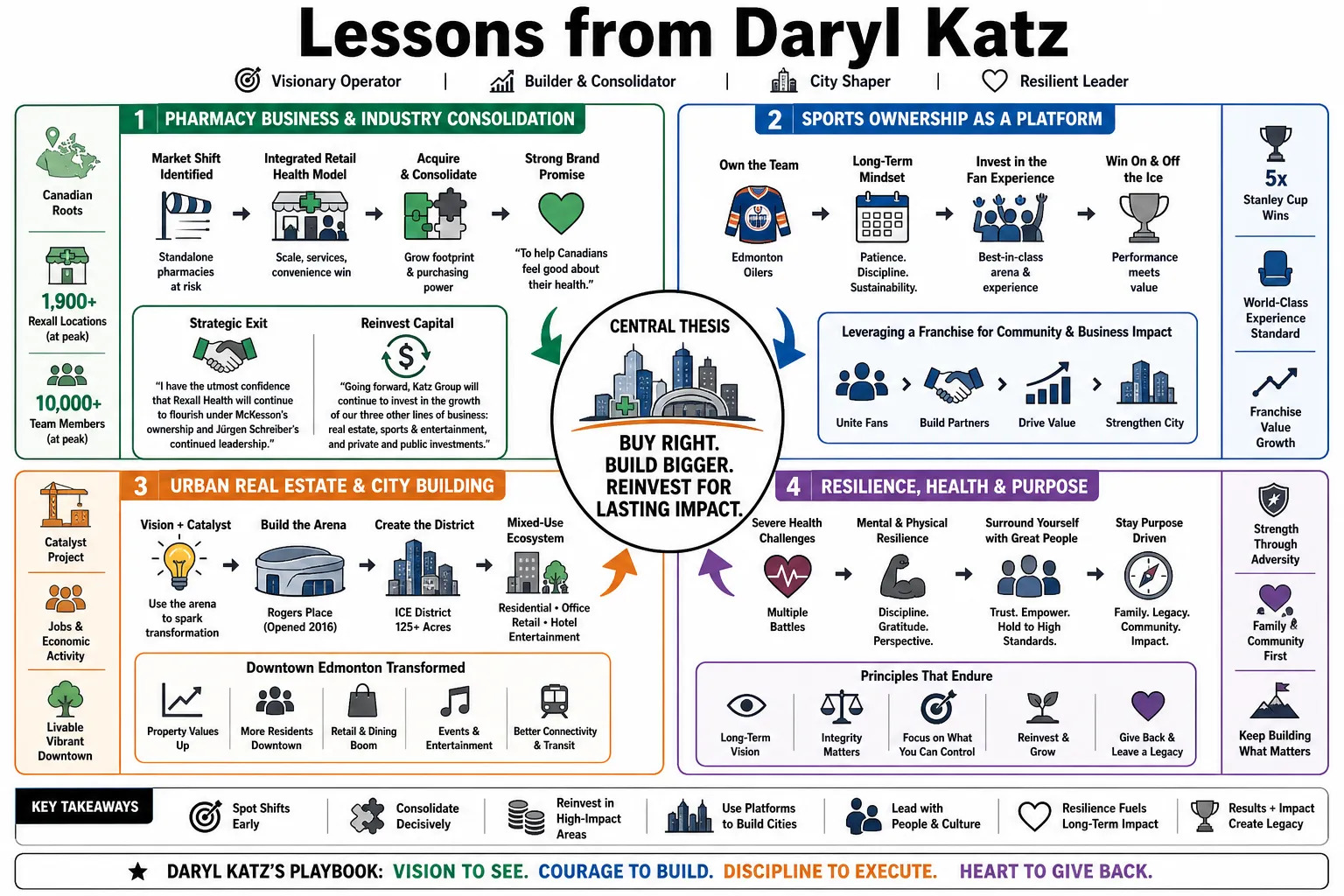
Part 1: The Pharmacy Business and Industry Consolidation
- On identifying market shifts: "He foresaw a shift in the winds of the pharmaceutical business, recognizing that standalone pharmacies would struggle against integrated retail health offerings." — Source: [Everyday Entrepreneur]
- On the Rexall mission: "To help Canadians feel good about their health." — Source: [Katz Group]
- On strategic exits: "I have the utmost confidence that Rexall Health will continue to flourish under McKesson's ownership and Jürgen Schreiber's continued leadership." — Source: [Global News]
- On reinvesting capital: "Going forward, Katz Group will continue to invest in the growth of our three other lines of business: real estate, sports & entertainment, and private and public investments." — Source: [Global News]
- On scaling through acquisition: "His initial strategy with Pharma Plus and Rexall involved acquiring underperforming stores, rebranding them, and standardizing their retail footprint to create a cohesive national presence." — Source: [The Globe and Mail]
- On retail pharmacy economics: "He understood early on that the front-of-store retail items subsidized the pharmacy counter, driving the push to make Rexall stores larger and more consumer-focused." — Source: [National Post]
- On competing with giants: "Katz competed with Shoppers Drug Mart not by matching them store-for-store in urban centers initially, but by aggressively consolidating independent pharmacies in underserved markets." — Source: [Canadian Business]
- On branding rights: "Acquiring the exclusive Canadian rights to the American Rexall brand gave his disparate regional acquisitions immediate national credibility." — Source: [Everyday Entrepreneur]
- On operational autonomy: "Even after selling Rexall Health, he ensured the deal allowed the Katz Group to retain its real estate holdings where many of those pharmacies operated." — Source: [Financial Post]
- On timing the market: "He sold the pharmacy chain precisely when regulatory pressures on generic drug pricing in Canada began to squeeze profit margins across the industry." — Source: [The Globe and Mail]
Part 2: Real Estate and Urban Revitalization
- On the catalyst model: "The arena was the cornerstone of what was needed to build ICE District. People can now see the broader vision and how we utilize the arena to feed into the other commercial elements of the project." — Source: [NHL.com]
- On civic progress: "Edmonton is a great, great city... but if we don't move forward we will fall behind. It's that simple." — Source: [Daryl Katz speaks to City Council]
- On symbiotic development: "There really is a symbiotic relationship between the arena and the ICE District development. Both need the other to succeed." — Source: [Edmonton Journal]
- On quality over speed: "And it's not just the development. I believe we have the greatest arena in the world. We took great time to determine what to put in the building." — Source: [NHL.com]
- On transforming downtowns: "I saw the city’s need for a new arena as an opportunity to transform our city for the better." — Source: [CityNews]
- On public-private partnerships: "I believe we have a once-in-a-generation opportunity through the Oilers and through the need for a new arena to do something transformative for downtown and for our city." — Source: [CBC News]
- On urban vibrancy: "As a champion of Edmonton and a resident of the core, I value more culture, community, recreation, safety and vibrancy in our downtown, and know this new Event Park can be a key piece in that progress." — Source: [DarylKatz.com]
- On mixed-use density: "The ICE District was designed not just as a sports destination, but as a dense, mixed-use community where commercial offices, luxury residential towers, and public plazas feed off each other's foot traffic." — Source: [Benchmark Journal]
- On anchor tenants: "He leveraged the Oilers as the ultimate anchor tenant, ensuring that the surrounding retail and hospitality properties had a guaranteed influx of millions of visitors annually." — Source: [Edmonton Journal]
Part 3: Sports Ownership and Franchise Rebuilding
- On intent and expectation: "I know it has been frustrating, but I want to assure everybody that we did not get in this to fail. We got into this to return the Oilers into what you call an elite status in the NHL." — Source: [CBC News]
- On patience during a rebuild: "The good news, if you can call it that, is that other teams that committed to fundamental rebuilds went through the same kind of droughts... It just means we have to stay the course." — Source: [CBC News]
- On doing it right: "If we’re going to rebuild, we want to do it right and we only want to do it once." — Source: [Global News]
- On franchise longevity: "What's exciting to me is to build longevity and a franchise that fans can be proud of year after year." — Source: [Global News]
- On the mutual bond with the city: "The simple fact is that the Oilers need Edmonton, and Edmonton needs the Oilers. Each is an integral part of the fabric and identity of the other." — Source: [Global News]
- On the goal of ownership: "Our objective has to be to be competitive year in and year out and that's what builds an elite team." — Source: [Global News]
- On reasons for buying the team: "He cited his primary reasons for buying the team as securing a new arena, ensuring the franchise's financial sustainability, and giving back to the city he grew up in." — Source: [Sportsnet]
- On past ownership groups: "As much as we wouldn't have the Oilers but for the E.I.G., we wouldn't have had all the Stanley Cups and we wouldn't have had the Oilers as we know them today without Peter [Pocklington]... He got kind of a raw deal." — Source: [Edmonton Journal]
- On fan frustration: "We know it’s been tough sledding for Oilers fans, both on the ice and off the ice... I haven’t given up hope, and we are going to be absolutely relentless in pursuit of that goal." — Source: [CTV News]
Part 4: Deal-Making and Negotiation
- On personal communication styles: "Public communications is not in my nature. Chalk that up as a personal shortcoming." — Source: [CTV News]
- On navigating difficult negotiations: "I’m an entrepreneur and I own a hockey team so I guess I have to be optimistic... This is not the first deal I’ve done and I can tell you it’s always darkest before the dawn." — Source: [CBC News]
- On capital commitment: "I expect I will invest no less than $400 million with the aim of ensuring the long-term sustainability of the Oilers in Edmonton, creating a major catalyst in the ongoing revitalization of downtown." — Source: [Edmonton Journal]
- On assessing risk: "Now this is not an amount of money I invest casually or without regard for risk. But to make it happen we need the city of Edmonton to be our partner." — Source: [Daryl Katz speaks to City Council]
- On mutual benefit: "And like any partnership, we understand that the deal has to work for both sides." — Source: [Daryl Katz speaks to City Council]
- On leveraging alternatives: "During the tense 2012 arena negotiations, Katz made a highly publicized visit to Seattle, a move widely interpreted as signaling his willingness to relocate the franchise if a deal could not be reached." — Source: [National Post]
- On apologizing to the public: "He later issued a full-page newspaper apology for the Seattle trip, recognizing that the hardball tactic had alienated the fanbase he needed to support the arena." — Source: [CBC News]
- On private versus public markets: "He historically favored keeping his enterprises privately held, allowing him to execute long-term, capital-intensive strategies without the quarter-to-quarter pressure of public shareholders." — Source: [The Globe and Mail]
- On vertical integration: "His approach to deal-making often involves capturing value across the entire supply chain, from owning the team, to the arena they play in, to the adjacent hospitality venues fans visit afterward." — Source: [Benchmark Journal]
- On maintaining leverage: "He rarely speaks to the media during active negotiations, preferring to let the financial realities and his designated executives do the talking at the bargaining table." — Source: [Edmonton Journal]
Part 5: Navigating Adversity and Health Crises
- On revealing his diagnosis: "Following intense public speculation about his appearance, he authorized the Oilers to disclose his battle with a life-threatening, antibiotic-resistant sinus infection." — Source: [Global News]
- On facing steep odds: "The severe infection he contracted reportedly carried a 50 percent survival rate, requiring aggressive and experimental medical interventions." — Source: [OilersNation]
- On enduring chronic treatment: "During the worst of his illness, he was forced to carry an intravenous drip bag 24 hours a day, including during the Oilers' 2017 playoff run." — Source: [Edmonton Sun]
- On undergoing multiple procedures: "His path to recovery involved at least three major surgeries within a brutal 10-month window to clear the entrenched infection." — Source: [CBC News]
- On turning the corner: "I’m relieved to tell you the worst is behind me and I’m going to be just fine." — Source: [Global News]
- On operating while ill: "Even while carrying a 24/7 IV bag, he remained actively involved in high-level decisions regarding the completion of the ICE District and the hockey operations of the Oilers." — Source: [Sportsnet]
- On public scrutiny: "His health struggles highlighted the intense, often unforgiving physical scrutiny placed on public figures, even those who actively avoid the spotlight." — Source: [Edmonton Journal]
- On relying on his executive team: "During his extended medical absences, his reliance on a trusted inner circle of executives proved crucial to maintaining the momentum of his real estate and sports ventures." — Source: [The Globe and Mail]
- On the fragility of success: "His battle with a rare pathogen served as a stark reminder within his organization that wealth and influence cannot entirely insulate a person from arbitrary health crises." — Source: [OilersNation]
Part 6: Philanthropy and Community Investment
- On healthcare philanthropy: "Katz and his wife Renee donated $20 million to Mount Sinai Hospital to establish the Daryl A. Katz Centre for Urgent and Critical Care." — Source: [JewAge]
- On supporting local education: "He provided a $20 million gift to the University of Alberta, which at the time was the largest single donation in the institution's history." — Source: [DarylKatz.com]
- On pediatric care: "The Katz family directed $7 million to the Stollery Children’s Hospital Foundation to advance specialized pediatric care in Northern Alberta." — Source: [Everyday Entrepreneur]
- On broad community impact: "Between 2005 and 2010, Katz and his family quietly distributed over $50 million to various Canadian healthcare, educational, and cultural institutions." — Source: [DarylKatz.com]
- On targeted giving: "His philanthropic strategy mirrors his business approach: making concentrated, high-dollar investments in foundational institutions rather than spreading capital thinly." — Source: [The Globe and Mail]
- On legacy beyond business: "The naming of the Katz Group Centre for Pharmacy and Health Research at the University of Alberta cemented his family's legacy in the specific field where he built his initial fortune." — Source: [University of Alberta]
- On civic duty: "He viewed the initial purchase of the financially struggling Oilers not just as a business venture, but as an act of civic philanthropy to prevent the team from leaving his hometown." — Source: [CBC News]
- On localized focus: "Despite his national and international business reach, the vast majority of his public philanthropic efforts remain heavily concentrated in Edmonton and Toronto." — Source: [Edmonton Journal]
- On quiet charity: "Unlike many billionaires who publicize every donation, Katz often makes significant charitable contributions through private family foundations without accompanying press tours." — Source: [National Post]
- On supporting the arts: "Alongside healthcare and sports, the Katz family has been a consistent financial backer of the Art Gallery of Alberta and local cultural festivals." — Source: [DarylKatz.com]
Part 7: Diversification and Capital Allocation
- On pivoting industries: "He successfully transitioned a fortune built entirely on retail pharmacy into sports, entertainment, and commercial real estate, ensuring his wealth was decoupled from a single regulatory environment." — Source: [Everyday Entrepreneur]
- On the entertainment sector: "Through the Katz Group, he expanded into film and television production, backing projects through Silver Pictures Entertainment." — Source: [Variety]
- On identifying undervalued assets: "When he bought the Oilers, the franchise was struggling financially in an aging building; he saw the underlying value of the brand if paired with modern infrastructure." — Source: [Sportsnet]
- On capital redeployment: "The $3 billion liquidity event from the Rexall sale allowed him to rapidly accelerate the construction timelines and scope of the ICE District without relying entirely on external financing." — Source: [Financial Post]
- On sports as a media property: "He recognized early that owning a professional sports team was transitioning from a ticket-sales business to a massive live-media and broadcasting property." — Source: [The Globe and Mail]
- On geographic focus: "While he diversified his industries, he intentionally kept his largest real estate bets geographically concentrated in downtown Edmonton, believing in the area's untapped potential." — Source: [Benchmark Journal]
- On public equities: "Beyond private companies, the Katz Group maintains a significant portfolio of public investments, allowing them to remain agile when private deal flow slows." — Source: [Katz Group]
- On brand partnerships: "He leveraged the Oilers' massive regional following to secure lucrative, long-term naming rights and sponsorship deals, most notably with Rogers Communications." — Source: [Edmonton Journal]
- On resilience through scale: "By building multiple billion-dollar verticals—Rexall, the Oilers, and ICE District—he insulated his broader holding company from inevitable cyclical downturns in any one sector." — Source: [Canadian Business]
Part 8: Long-Term Vision and Leadership
- On the power of a single catalyst: "He proved that a single, highly emotional asset—a hockey team—could be used as the political and financial lever to execute a multi-billion dollar urban master plan." — Source: [National Post]
- On hiring executives: "His leadership style involves hiring high-profile veterans, such as Ken Holland in hockey operations or Bob Black in real estate, and giving them the mandate to execute his overarching vision." — Source: [Sportsnet]
- On ignoring short-term criticism: "Throughout the years-long, highly controversial arena negotiations, he absorbed intense local criticism without abandoning the core requirement that the project be a public-private partnership." — Source: [CBC News]
- On loyalty to roots: "Despite having the wealth to relocate anywhere globally, he remained fiercely loyal to Edmonton, anchoring his corporate headquarters and legacy projects in his hometown." — Source: [Edmonton Journal]
- On the value of patience: "He waited out multiple failed attempts to acquire the Oilers from the Edmonton Investors Group, showing a willingness to play a multi-year waiting game for an asset he truly wanted." — Source: [The Globe and Mail]
- On structuring ownership: "He prefers sole ownership or majority control, avoiding the gridlock of large syndicates that hampered the Oilers before he purchased them." — Source: [Sportsnet]
- On embracing scale: "He didn't just want to build an arena; he wanted to build Canada's largest mixed-use sports and entertainment district, a testament to his preference for massive scale." — Source: [Benchmark Journal]
- On staying behind the scenes: "He leads quietly. By deliberately limiting his public speaking engagements, his rare statements carry significantly more weight with local government and the public." — Source: [Edmonton Sun]
- On defining success: "For Katz, ultimate success is not just financial return, but physical, permanent legacy—buildings, districts, and institutions that permanently alter the skyline and culture of his city." — Source: [Global News]