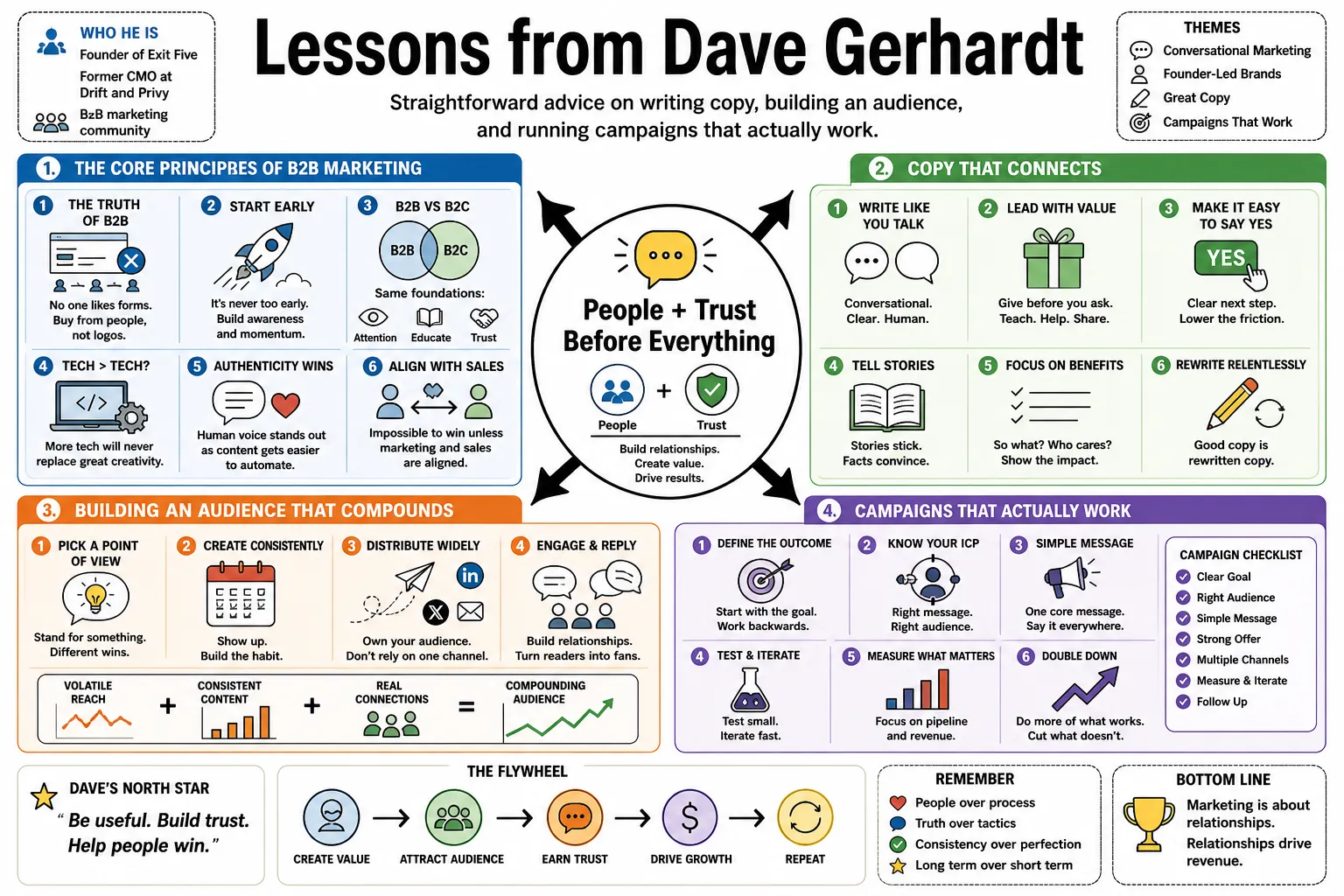
Lessons from Dave Gerhardt
Dave Gerhardt founded the B2B marketing community Exit Five after working in marketing at Drift and Privy. His writing and interviews focus on copywriting, audience building, founder visibility and practical B2B marketing. — Exit Five — Content and Community.
Part 1: The Core Principles of B2B Marketing
- Make buying easier: Use marketing to help people buy and give sales useful materials, rather than treating form fills as the end goal. — Exit Five — Brand vs. Demand Q&A.
- Start before launch: Gerhardt says it is never too early to start marketing. — Dave Gerhardt — 10 Commandments.
- Remember the same human buys B2B and B2C: Gerhardt asks B2B teams to consider how they themselves like to buy as consumers. — Marketing Insider Group — Dave Gerhardt Interview.
- Creativity earns attention: Find campaign ideas that give people a reason to pay attention, rather than relying on tools alone. — Exit Five — Brand vs. Demand Q&A.
- Show real personality: Even enterprise buyers are people; use a human tone, real employees and customers, and appropriate personality. — Exit Five — Brand vs. Demand Q&A.
- Connect work to company goals: Choose marketing initiatives that advance the company's actual goals; saying no is part of the job. — Exit Five — Brand vs. Demand Q&A.
- Test before scaling: Make informed marketing bets without waiting for perfect attribution data, then learn from the results. — Exit Five — 16 Leadership Lessons.
- Differentiate with a point of view: When features look similar, a distinct story and philosophy give buyers a reason to choose you. — Exit Five — Brand vs. Demand Q&A.
- Create momentum with campaigns: Gerhardt describes regular marketable moments as a way for marketing to create company momentum. — Exit Five — Brand vs. Demand Q&A.
Part 2: Copywriting and Communication
- Write like a human: Gerhardt calls conversational, human-sounding writing an essential marketing skill. — The Secret to Writing Killer Product Copy.
- Avoid corporate prose: Explain a product the way you would to a friend, in language customers can understand and care about. — The Secret to Writing Killer Product Copy.
- Keep copy short: Use short, choppy copy to earn and hold attention. — The 10 Laws of Copywriting.
- Use customers' words: Mine customer-development notes and public customer language instead of inventing jargon internally. — The Secret to Writing Killer Product Copy.
- Be specific: Make claims concrete enough for the reader to picture what you mean. — The 10 Laws of Copywriting.
- Address objections: Surface likely objections in the copy rather than hiding them. — The 10 Laws of Copywriting.
- Tell a story: Use a coherent story to make the message memorable. — The 10 Laws of Copywriting.
- Earn the next line: Treat the headline and opening as an invitation to read further. — The 10 Laws of Copywriting.
- Use AI as a writing aid: Gerhardt used ChatGPT to break writer's block and develop an explainer outline, then rewrote the script himself. — How I Use AI to Help Me Write.
- Explain one problem clearly: An explainer should use customer language and a clear next step rather than packing in every feature. — The Secret to Writing Killer Product Copy.
Part 3: The Power of the Founder Brand
- Build reputation through work: Gerhardt describes a personal brand as a reputation earned through work and public sharing of lessons. — How To Build a Personal Brand.
- Give buyers a human face: A founder or leader's visible expertise can complement a company's own marketing. — Why LinkedIn Is the Best PR Tool.
- Tell the lived story: Write about actual work and experience rather than ghostwritten, force-fed opinions. — Exit Five — Content and Community.
- Publish consistently: Gerhardt recommends recurring niche-specific posts over months, not a universal three-to-five-post rule. — LinkedIn for Startup Founders.
- Let expertise create opportunities: Public writing can lead to speaking invitations and partnerships; it is an outcome, not a mandate for every founder. — How To Build a Personal Brand.
- Consider owned executive publishing: Gerhardt suggests founders test their own LinkedIn voice before assuming paid PR placements are the best channel. — LinkedIn for Startup Founders.
- Use personal and company voices together: Personal publishing can extend a company brand; it does not make the company channel obsolete. — Why LinkedIn Is the Best PR Tool.
- Learn from audience response: Use comments and audience questions as signals for future posts and content. — Exit Five — Content and Community.
Part 4: Conversational Marketing and Lead Generation
- Meet high-intent buyers now: Conversational marketing was designed to reach buyers ready for an answer while they are on the site. — Marketing Insider Group — Dave Gerhardt Interview.
- Do not equate a gated PDF with demand: Gerhardt argued that a short gated PDF should not automatically count as a qualified sales lead. — Marketing Insider Group — Dave Gerhardt Interview.
- Let visitors ask questions: A form cannot answer a buyer's question; a live conversation can clarify intent or misconceptions. — Marketing Insider Group — Dave Gerhardt Interview.
- Recognize visitor intent: A B2B visitor often arrives with prior knowledge and a specific reason; do not treat everyone as uninformed. — Marketing Insider Group — Dave Gerhardt Interview.
- Use bots for paperwork: Gerhardt proposed bots for routine qualification while keeping humans available for meaningful conversations. — Marketing Insider Group — Dave Gerhardt Interview.
- Design around buying behavior: Look at how you prefer to buy, then test whether your B2B process creates needless friction. — Marketing Insider Group — Dave Gerhardt Interview.
- Add chat alongside forms first: Gerhardt advised starting with a contained conversational experiment in addition to existing forms before wider replacement. — Marketing Insider Group — Dave Gerhardt Interview.
- Do not let attribution make every decision: Gerhardt says attribution data cannot tell you what to do next; marketers still make informed bets. — Exit Five — 16 Leadership Lessons.
Part 5: Audience Building and Content Strategy
- Build a niche audience: Gerhardt found that becoming known for a specific area helped his audience grow. — Exit Five — Content and Community.
- Help the audience first: Create content around relevant questions and experience, not only the product pitch. — Exit Five — Content and Community.
- Document real work: Write about lessons from meetings and inside the company instead of manufacturing generic hot takes. — Exit Five — Content and Community.
- Use podcasts as a content engine: Gerhardt used interviews as raw material for newsletter, clips, social posts and website articles. — Exit Five — Content and Community.
- Observe more than one content signal: Gerhardt uses community questions, guests and social response to decide what to cover. — Exit Five — Content and Community.
- Publish useful expertise: A team can publish its own ideas and examples without waiting for third-party coverage. — Exit Five — 16 Leadership Lessons.
- Give the audience time: Choose a niche, write lessons consistently, and allow months for a reputation to develop. — How To Build a Personal Brand.
- Feature practitioner voices: Gerhardt's interview format brings expert voices into the content and surfaces audience-relevant insights. — Exit Five — Content and Community.
Part 6: Brand Strategy and Differentiation
- Name the idea: Gerhardt says an idea begins to feel real and usable once the team names it. — Exit Five — Brand vs. Demand Q&A.
- Make the narrative tangible: A name can package a broader philosophy, as Drift did with conversational marketing. — Exit Five — Brand vs. Demand Q&A.
- Compete on philosophy: When feature lists converge, a distinctive narrative can give buyers a reason to choose you. — Exit Five — Brand vs. Demand Q&A.
- Find attention gaps: Look beyond standard industry tactics for moments that help your story get noticed. — Exit Five — Brand vs. Demand Q&A.
- Use real imagery: At Drift, Gerhardt says the team used real employees and customers rather than stock photos. — Exit Five — Brand vs. Demand Q&A.
- Back claims with proof: Gerhardt's copywriting laws ask marketers to support messages with social proof. — The 10 Laws of Copywriting.
Part 7: Customer Empathy and Psychology
- Study how buyers decide: Gerhardt opens his copywriting laws with understanding how people make decisions. — The 10 Laws of Copywriting.
- State the reader's benefit: Show the customer what they gain, rather than centering the company. — The 10 Laws of Copywriting.
- Match buyer awareness: Gerhardt advises adapting copy to whether the prospect knows the problem, solution or product, citing Eugene Schwartz. — How To Become a Master-Level Copywriter.
- Consider the visitor's context: Ask why a visitor came and what information they need, rather than pushing an immediate demo. — Marketing Insider Group — Dave Gerhardt Interview.
- Listen to customer language: Use notes from sales, product and customer conversations to write in customers' own words. — The Secret to Writing Killer Product Copy.
- Show the human behind the message: A real face, human tone and specific personal detail can make marketing feel less anonymous. — Exit Five — Brand vs. Demand Q&A.
- Solve real problems: Marketing should help customers with genuine problems while also supporting company goals. — Exit Five — Brand vs. Demand Q&A.
- Describe the problem clearly: A compelling message can explain the customer's problem and a useful next step without listing every feature. — The Secret to Writing Killer Product Copy.
Part 8: Execution and Marketing Leadership
- Set a decision deadline: He recommends giving ideas room to develop, then using a deadline to force a workable version. — Exit Five — Brand vs. Demand Q&A.
- Give teams usable guidance: Translate strategy into concrete work and explain how each tactic contributes to the goal. — Exit Five — 16 Leadership Lessons.
- Grow into leadership: Leading marketing requires managing up, down and across the company, not only individual craft. — Exit Five — 16 Leadership Lessons.
- Get the job done: Leaders should use people, programs and budget to hit goals rather than personally doing every task. — Exit Five — 16 Leadership Lessons.
- Align incentives with outcomes: Gerhardt warns that quotas for call or email volume can reward bad customer experiences. — Marketing Insider Group — Dave Gerhardt Interview.
- Use plain language: Gerhardt urges marketers to forget acronyms and explain the business story clearly. — Exit Five — 16 Leadership Lessons.