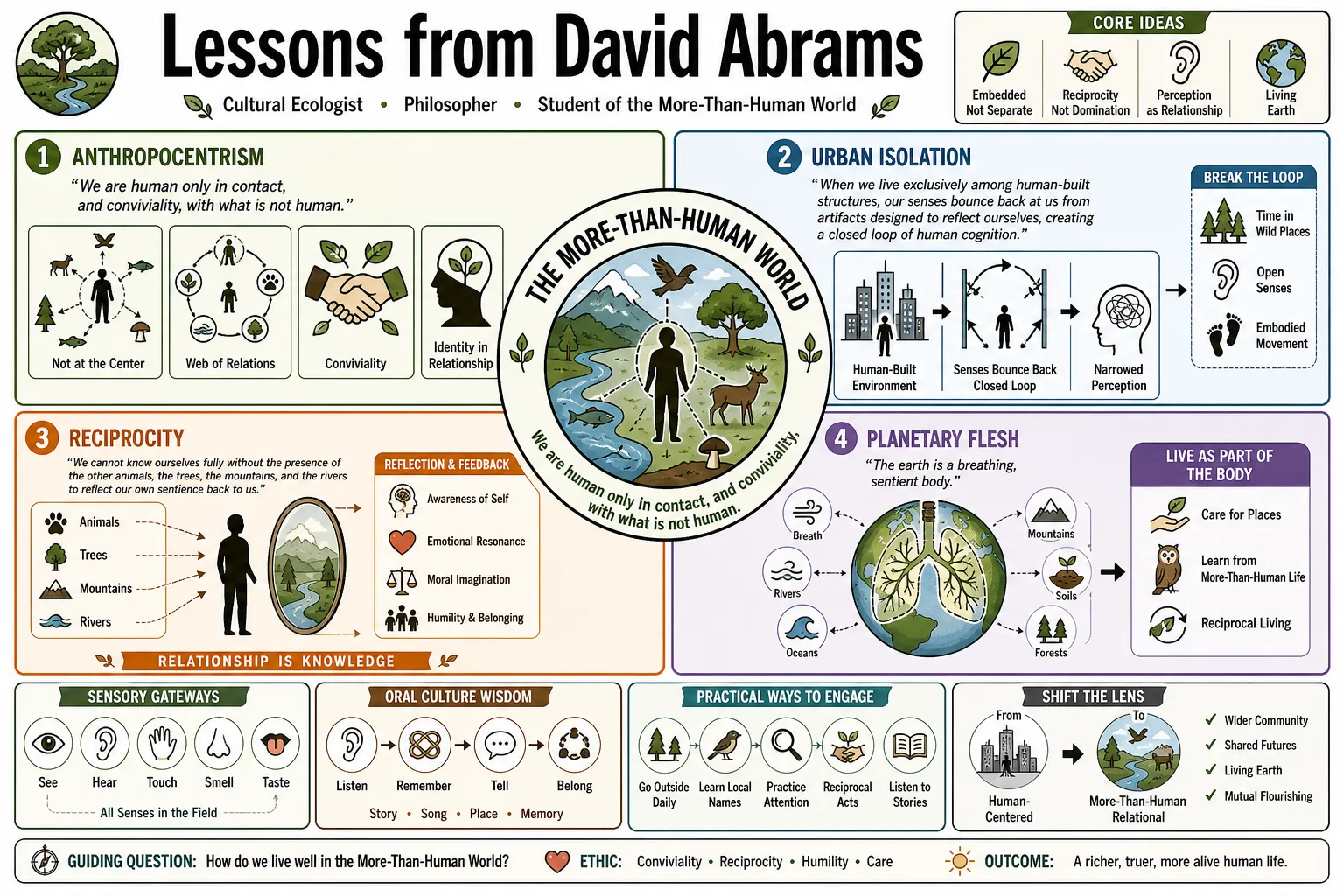
Lessons from David Abrams
Cultural ecologist and philosopher David Abrams studies the physical link between human perception and the natural environment. He coined the phrase "the more-than-human world" to describe the earthly life surrounding humanity. This collection gathers his observations on sensory experience and oral culture, outlining practical ways to engage with the living terrain.
Part 1: The More-Than-Human World
- On Anthropocentrism: "We are human only in contact, and conviviality, with what is not human." — Source: [The Spell of the Sensuous]
- On the Phrase 'More-Than-Human': "The term 'more-than-human world' was created to bypass the dichotomy between humanity and nature, recognizing that humans are completely embedded within a much wider community of life." — Source: [Emergence Magazine]
- On Urban Isolation: "When we live exclusively among human-built structures, our senses bounce back at us from artifacts designed to reflect ourselves, creating a closed loop of human cognition." — Source: [Becoming Animal]
- On Reciprocity: "We cannot know ourselves fully without the presence of the other animals, the trees, the mountains, and the rivers to reflect our own sentience back to us." — Source: [On Being]
- On Planetary Flesh: "The earth is a breathing, feeling anatomy that we are physically composed of, rather than a passive backdrop for human history." — Source: [The Spell of the Sensuous]
- On Human Exceptionalism: "To define ourselves against the rest of nature is to cut ourselves off from the very source of our own vitality." — Source: [For The Wild]
- On Earthly Community: "We are a part of the earth, and the earth is a part of us. To forget this is to lose our minds." — Source: [Becoming Animal]
- On Solitude: "True solitude is rarely experienced in wild nature, because the forest is crowded with voices, witnessing eyes, and other forms of awareness." — Source: [The Spell of the Sensuous]
- On Encountering Animals: "To look into the eyes of a wild animal is to realize that there is another center of experience in the world, one that is entirely independent of our own." — Source: [Becoming Animal]
- On the Biosphere: "We must stop thinking of the earth as a set of resources and begin experiencing it as a community of subjects." — Source: [Emergence Magazine]
Part 2: The Ecology of Perception
- On Perception as Participation: "Perception operates as an active, participatory event where the perceiver and the perceived intermingle." — Source: [The Spell of the Sensuous]
- On Synesthesia: "The senses are inherently synesthetic, continuously communicating and translating information among themselves to give us a unified experience of reality." — Source: [Becoming Animal]
- On the Sensing Body: "The body acts as a sensitive, perceiving subject that thinks through its physical engagement with the environment." — Source: [The Spell of the Sensuous]
- On Vision and Touch: "To look at a tree is also to feel the tree looking back; our vision is an invisible form of touch that reaches out to caress the textures of the world." — Source: [On Being]
- On the Horizon: "The horizon acts as an invitation that pulls our awareness outward into the wider terrain." — Source: [Becoming Animal]
- On Objectification: "When we treat objects merely as inert matter, we shut down the natural empathy of our senses, deadening our own physical experience." — Source: [For The Wild]
- On Shadows: "Shadows present themselves as active presences that give depth, mystery, and volume to our visual field." — Source: [Becoming Animal]
- On Breathing: "The air forms the most intimate medium of our existence, a shared breath that connects our internal lungs to the vast respiratory system of the forest." — Source: [The Spell of the Sensuous]
- On Sensory Atrophy: "As we spend more time looking at flat screens, our focal depth narrows and the peripheral intelligence of our eyes begins to wither." — Source: [Emergence Magazine]
- On the Ground: "Gravity is a physical relationship, the earth's way of holding us closely against its skin." — Source: [Becoming Animal]
Part 3: Language and Animate Earth
- On Language as a Bodily Act: "Spoken language functions fundamentally as an act of the flesh, born from the movement of breath, lips, and tongue against the air." — Source: [The Spell of the Sensuous]
- On the Origins of Speech: "Language began as an extension of the expressive sounds made by the environment itself—wind, water, and animal cries." — Source: [Becoming Animal]
- On Listening: "To truly hear another, whether human or raven, requires a silent opening of oneself to the bodily vibration of their voice." — Source: [On Being]
- On Meaning: "Meaning finds its weight in the melody, rhythm, and physical resonance words produce in the listener." — Source: [The Spell of the Sensuous]
- On Silence: "Silence is a thick, pregnant medium filled with the quiet rustlings and micro-sounds of the more-than-human world." — Source: [Becoming Animal]
- On Naming: "In oral cultures, to name a thing is to invoke it, recognizing a living relationship rather than assigning a permanent label." — Source: [The Spell of the Sensuous]
- On Abstraction: "When language is detached from the sensuous world, words lose their soil, drifting into a realm of pure abstraction that alienates us from the earth." — Source: [Emergence Magazine]
- On Grammar: "The structure of our grammar shapes how we perceive the world; relying heavily on nouns transforms active, living processes into static objects." — Source: [For The Wild]
- On Speaking to the World: "It is a natural human impulse to speak to the weather, the trees, and the birds, acknowledging their capacity to respond." — Source: [Becoming Animal]
- On Stories: "Stories behave as ecological entities; they root human experience into specific valleys, rivers, and mountains, mapping the local terrain." — Source: [The Spell of the Sensuous]
Part 4: Magic and Sleight-of-Hand
- On Becoming a Magician: "Learning sleight-of-hand magic as a young man taught me how easily human perception can be misdirected by exploiting the assumptions of the senses." — Source: [The Spell of the Sensuous]
- On Indigenous Shamans: "Traditional magicians and shamans operate as ecologically functioning figures, regulating the flow of nourishment between the human community and the animate earth." — Source: [Emergence Magazine]
- On Magic and the Senses: "True magic operates as the experience of the world when the senses are fully open and participatory." — Source: [Becoming Animal]
- On Healing: "The healer's role in oral cultures centers on restoring a fractured relationship between a sick individual and the surrounding ecosystem." — Source: [The Spell of the Sensuous]
- On Trance States: "Trance causes a loosening of the strictly human social boundary, allowing the practitioner's awareness to leak out into the nonhuman environment." — Source: [On Being]
- On Illusion: "Stage magic works because our perception remains naturally expectant; we complete patterns that the magician only implies." — Source: [Becoming Animal]
- On the Shaman's Audience: "The real audience for a traditional shaman's performance focuses entirely on the spirits of the plants, animals, and weather." — Source: [The Spell of the Sensuous]
- On Altered Perception: "By disrupting normal perceptual habits, the magician clears a space for the sudden, startling presence of the animate world to shine through." — Source: [For The Wild]
- On Wonder: "The ultimate goal of magic aims for the restoration of wonder, the breathless realization of the mystery of existence." — Source: [Becoming Animal]
Part 5: The Written Word vs. Orality
- On the Alphabet: "The phonetic alphabet acted as a profound form of magic, capturing the human voice and transferring the animate power of nature into flat, written characters." — Source: [The Spell of the Sensuous]
- On Reading as Synesthesia: "Reading functions as a synesthetic act where our eyes see silent marks and our ears hear spoken sounds, hijacking our sensory participation with the physical world." — Source: [Emergence Magazine]
- On Textual Isolation: "As humans began to converse primarily with their own written signs, the natural world fell silent, stripped of its expressive voices." — Source: [The Spell of the Sensuous]
- On Vowels and Breath: "Early alphabets lacking written vowels required the reader's breath to animate the text, maintaining a physical link between reading and the living air." — Source: [Becoming Animal]
- On Memory: "In an oral culture, knowledge must be woven into narratives and tied to specific places in the terrain so it can be remembered and passed down." — Source: [The Spell of the Sensuous]
- On the Book: "The book became a mirror that reflects human intellect back upon itself, replacing the ancient mirror of the surrounding ecology." — Source: [On Being]
- On Text and Earth: "Before we read pages, our ancestors read the tracks of animals, the patterns of clouds, and the changing colors of the leaves." — Source: [Becoming Animal]
- On Oral Culture: "Oral traditions remain inherently local and context-dependent, whereas written language enables abstract rules that can be applied universally." — Source: [The Spell of the Sensuous]
- On Reclaiming Animism: "We must learn to use the written word in ways that return our attention to the physical, sensory earth." — Source: [For The Wild]
Part 6: Time, Space, and the Present
- On the Illusion of Linear Time: "Linear time functions as an abstraction born of writing, creating a sense of history moving constantly away from a lost past toward an unattainable future." — Source: [The Spell of the Sensuous]
- On Cyclical Time: "For cultures deeply embedded in the natural world, time returns upon itself in the cycles of the seasons, the moon, and the tides." — Source: [Becoming Animal]
- On the Present Moment: "The present acts as a deep, enveloping space that expands as we bring our senses fully into contact with our surroundings." — Source: [Emergence Magazine]
- On Place: "Space is a heterogeneous patchwork of unique places, each with its own mood, weather, and intelligence." — Source: [The Spell of the Sensuous]
- On the Past: "The past is folded into the present terrain, visible in the scars of the trees, the shape of the rocks, and the flow of the rivers." — Source: [Becoming Animal]
- On Future Thinking: "Our obsession with planning for the future often robs us of the sensory richness available only in the immediate, physical present." — Source: [On Being]
- On Night and Day: "The transition between day and night causes a profound shift in the perceptual gravity of the world, altering how we hear and touch the environment." — Source: [Becoming Animal]
- On the Subterranean: "Our ancestors understood the underground as a realm of latent life, the dark womb from which spring growth emerges." — Source: [The Spell of the Sensuous]
- On the Sky: "The sky appears as the visible aspect of the atmosphere, an enveloping fluid that connects every breathing being across the planet." — Source: [For The Wild]
Part 7: Ecological Crisis and Climate
- On Ecological Amnesia: "The environmental crisis stems from a crisis of perception; we have forgotten how to feel the earth as a living, sensing entity." — Source: [The Spell of the Sensuous]
- On Climate Change: "A shifting climate serves as the earth's fever, a physical response to the disruption of its systemic balance by a single species." — Source: [Emergence Magazine]
- On Grief: "We must allow ourselves to feel ecological grief; mourning the loss of species and habitats helps break our numbness." — Source: [Becoming Animal]
- On Technological Fixes: "Relying on technology alone to solve ecological problems ignores the deeper relational disconnect that caused the damage in the first place." — Source: [For The Wild]
- On Local Engagement: "True environmentalism begins with a renewed, intimate commitment to the specific soils, waters, and creatures of one's local watershed." — Source: [The Spell of the Sensuous]
- On Humility: "Addressing our ecological reality requires a profound humility, a recognition that human intelligence makes up only one small part of the biosphere's vast mind." — Source: [On Being]
- On Animal Migrations: "The disruption of migratory patterns frays the earth's ancient circulatory system." — Source: [Becoming Animal]
- On Activism: "Effective activism must be grounded in physical connection to nature, otherwise it burns out in anger and abstract ideology." — Source: [Emergence Magazine]
- On Interdependence: "We are the earth trying to save itself." — Source: [Becoming Animal]
Part 8: Reawakening the Senses
- On Walking: "Walking functions as an act of conversation between the feet and the soil, a way of listening to the ground's contours and varying textures." — Source: [The Spell of the Sensuous]
- On Stargazing: "Looking at the night sky draws our vision outward into immensity, dissolving the tight boundaries of our individual egos." — Source: [Becoming Animal]
- On the Wind: "The wind moves as the breath of the world, an invisible presence that touches everything, reminding us of the unseen connections that bind all life." — Source: [For The Wild]
- On Water: "Flowing water acts as the earth's blood; watching a river moves our consciousness away from static objects and toward continuous, fluid change." — Source: [The Spell of the Sensuous]
- On Birdsong: "Birdsong acts as the local environment expressing its own melody, tuning our ears to the specific frequencies of a place." — Source: [Becoming Animal]
- On Attention: "Sustained, sensory attention to a single rock, tree, or insect serves as a radical act of resistance against the distracting speed of modern society." — Source: [Emergence Magazine]
- On Fire: "Sitting around a fire draws us back into an ancient rhythm of storytelling, focusing our eyes on the shifting flames rather than steady, artificial light." — Source: [Becoming Animal]
- On Food: "Eating is an intimate ecological act, the moment when the external world physically crosses the boundary of our lips to become our own flesh." — Source: [On Being]
- On Awakening: "To awaken our senses is to realize that we actively participate in a beautiful, living mystery, rather than looking at the world from the outside." — Source: [The Spell of the Sensuous]