Lessons from David Brooks
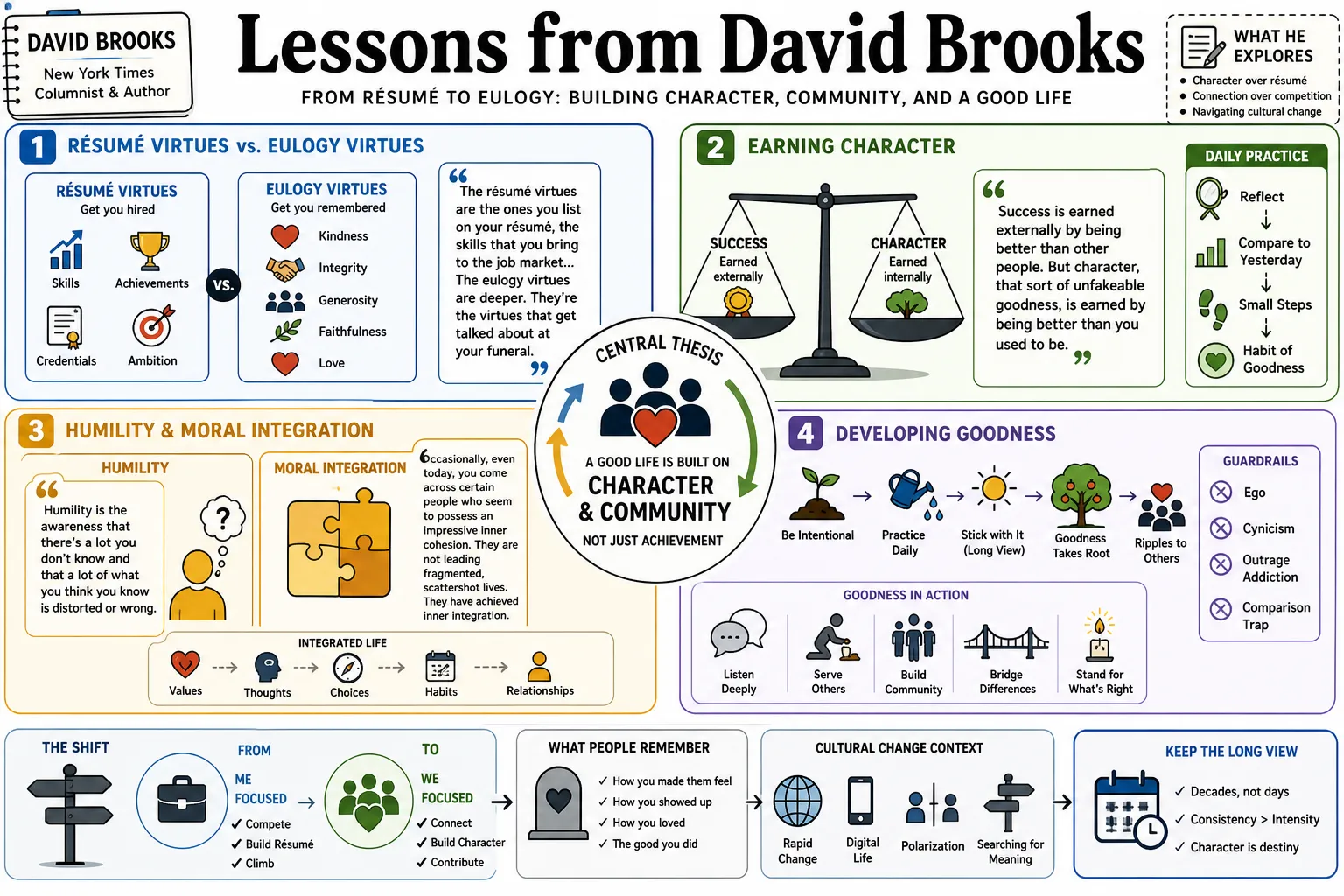
David Brooks is a New York Times columnist and the author of books on character, commitment, and human connection. His work contrasts career achievement with moral formation and asks how people can see and know one another more deeply. — How to Know a Person.
Part 1: Character and Moral Formation
- Résumé Virtues vs. Eulogy Virtues: Brooks distinguishes the skills that help us succeed at work from deeper qualities such as honesty, courage, care, and the capacity to love. — PBS NewsHour: The Road to Character.
- Earning Character: Brooks contrasts outward success with character: the latter grows through becoming better than one used to be and confronting one’s own flaws. — PBS NewsHour: The Road to Character.
- Humility: For Brooks, humility includes the ability to see one’s own limitations and weaknesses clearly, without either self-promotion or self-contempt. — PBS NewsHour: The Road to Character.
- Moral Integration: Brooks admires people whose lives show inner cohesion: they are rooted, dependable, and shaped by experience rather than scattered by every setback. — The Road to Character Excerpt.
- Developing Goodness: Brooks argues that moral growth is relational: love and commitments can draw people beyond self-focus toward care and service. — The Second Mountain Excerpt.
- Self-Confrontation: Brooks treats character growth as the difficult work of recognizing one’s own faults rather than polishing a public image. — PBS NewsHour: The Road to Character.
- Emotional Education: Brooks argues that people cannot simply choose their feelings, but can educate emotional judgment through literature, art, music, and the company they keep. — PBS NewsHour: The Social Animal.
- Growing Older: Brooks says people can improve over time by treating ordinary days as moral occasions: noticing where they fell short and trying to do better tomorrow. — PBS NewsHour: The Road to Character.
- Tenderness Through Hardship: Brooks says hardship can sometimes expose vulnerability and deepen a person’s capacity for connection; he does not present that outcome as guaranteed. — The Second Mountain Excerpt.
Part 2: Love and Marriage
- Marriage as Moral Growth: Brooks presents marriage as a demanding commitment that can educate both partners toward patience, humility, and care, rather than a guarantee of happiness. — Westmont: Four Great Commitments.
- Recommitment: Brooks describes lasting commitment as choosing again what one has already chosen—staying true through ordinary and difficult stretches. — Westmont: Four Great Commitments.
- Career and Marriage: Brooks argues that people often devote careful planning to careers while leaving marriage to chance, even though the quality of a close relationship has an enormous bearing on a life. — Chicago Booth Interview.
- The Long Conversation: Brooks calls marriage a conversation that may last thirty, forty, or fifty years—reason to choose someone one wants to keep talking with. — Westmont: Four Great Commitments.
- Seeing a Partner Clearly: Brooks argues that durable marriages involve friends who see one another clearly and improve their communication over time. — Westmont: Four Great Commitments.
- Examining Your Own Readiness: Before marrying, Brooks urges people to ask whether they are willing to change and whether they truly admire the partner—not only whether the partner seems right for them. — Westmont: Four Great Commitments.
- Small Choices in Marriage: Brooks advises spouses to address their own selfishness, look for ways to praise one another, and move toward rather than away from each other in daily exchanges. — Westmont: Four Great Commitments.
- Love and Humility: Brooks describes deep love as humbling: it can unsettle one’s sense of control and expose a more vulnerable self. — Dartmouth Commencement Address.
- Decentering the Self: Brooks says love can shift attention away from the isolated self and toward another person whose life matters deeply to us. — Dartmouth Commencement Address.
Part 3: Social Connection and Community
- Loving Attachments: Brooks says character and meaning grow through commitments to people and causes—what he calls a dense network of loving attachments. — The Second Mountain Excerpt.
- Learning to See People: Brooks argues that people often fail to make others feel seen, heard, and valued, and that learning this social skill matters for relationships and civic life. — How to Know a Person Excerpt.
- Social Media and Connection: Brooks warns that social media can create a feeling of contact without the listening and considerate acts that build trust, care, and affection. — How to Know a Person Excerpt.
- Stimulation Versus Intimacy: Brooks contrasts the stimulation and quick judgment of social media with the slower attention required for intimacy and understanding. — How to Know a Person Excerpt.
- Seeing Every Person’s Dignity: Brooks describes a pastor who approaches others as bearers of a soul of infinite worth; for Brooks, that posture changes how a person looks at and treats strangers. — The One You Feed Interview.
- The Need for Recognition: Brooks argues that being seen and understood is a deep human need and that neglecting it can leave people feeling invisible. — How to Know a Person Excerpt.
- Relationships and Well-Being: Brooks puts close personal bonds at the center of a flourishing life and cautions against treating income or status as substitutes for them. — Chicago Booth Interview.
- Civic Discourse: Brooks says pluralistic societies require people to look across differences and try to understand how others see the world. — How to Know a Person Excerpt.
- Relational Fraying: Brooks connects many public divisions to the fraying of social ties and argues that repairing them begins with small acts of attention toward others. — How to Know a Person Excerpt.
- Questions That Deepen Conversation: After trust has formed, Brooks suggests asking people about their crossroads, hopes, and commitments to help a conversation move beyond surface-level talk. — The One You Feed Interview.
Part 4: The Second Mountain
- The First Mountain: In Brooks’s metaphor, the first mountain is the phase of establishing identity, cultivating talents, building an ego, and seeking socially recognized success. — The Second Mountain Excerpt.
- Commitment on the Second Mountain: Brooks describes the second mountain as a life rooted in commitments to vocation, family, belief, and community rather than perpetual option-keeping. — The Second Mountain Excerpt.
- Happiness and Joy: Brooks associates first-mountain achievement with happiness and second-mountain commitment with a more self-transcending joy. — The Second Mountain Excerpt.
- Self-Forgetting: Brooks contrasts the first mountain’s reputation management with moments of joy that draw attention beyond the self and toward others. — The Second Mountain Excerpt.
- A Later Shift in Priorities: Brooks says a move from status-seeking to deeper commitments can follow success, failure, or hardship—and can occur at many ages. — The Second Mountain Excerpt.
- Reassessing Achievement: Brooks describes people who reach the first mountain’s summit yet find success unsatisfying and begin looking for a more relational way to live. — The Second Mountain Excerpt.
- Freedom and Rootedness: Brooks distinguishes valuable political freedom from a life of permanent social detachment; commitments can give freedom direction and purpose. — Westmont: Four Great Commitments.
- Freedom Toward Commitment: Brooks treats freedom as useful when it enables people to choose and live out meaningful commitments, not merely keep every option open. — The Second Mountain Excerpt.
- The Cost of Hyper-Individualism: Brooks argues that a culture centered too heavily on individual success and self-actualization weakens relational and communal bonds. — The Second Mountain Excerpt.
Part 5: Politics and Identity
- Politics as Balancing Interests: Brooks defends pluralist politics as a way to balance competing interests and partial truths rather than cast every disagreement as a war between good and evil. — Confessions of a Republican Exile.
- Accepting Political Limits: Because legitimate groups value different goods, Brooks says politics calls for accommodation and practical compromise rather than total victory. — Confessions of a Republican Exile.
- Partisan Identity and Belonging: Brooks warns that political team identity can become a substitute for closer forms of belonging while leaving people without the mutual care of a real community. — Echoes: Finding Community in a Broken World.
- The Illusion of Belonging: Brooks argues that merely sharing hostility toward an opposing political team can feel like belonging without creating genuine community. — Lehigh: Democracy Is Conversation.
- Politics as Social Therapy: Brooks says political combat can attract people who feel lonely or unseen because it appears to ease pain and give them a place on a team. — Echoes: Finding Community in a Broken World.
- When Compromise Feels Like Betrayal: Brooks warns that when political opponents become embodiments of evil, ordinary compromise and pluralistic negotiation become harder. — Confessions of a Republican Exile.
- False Moral Teams: Brooks says partisan politics can supply a misleading picture in which one’s own team is good and the other is evil. — Echoes: Finding Community in a Broken World.
- Insular Political Worlds: Brooks cautions that politically homogeneous institutions and neighborhoods can leave people with too little direct encounter with views unlike their own. — Confessions of a Republican Exile.
- What Politics Cannot Supply: Brooks warns against asking partisan politics to replace the friendship, mutual service, and shared purpose of a real community. — Echoes: Finding Community in a Broken World.
Part 6: Knowledge and Education
- Education and What We Love: Brooks argues that education should introduce people to things worth loving, not only train them for a job. — Interfaith America: Higher Education and Character.
- Information Is Not Moral Formation: For Brooks, knowledge alone does not make someone better; the orientation of a person’s loves and commitments also matters. — The Second Mountain Excerpt.
- Limits of Self-Knowledge: Brooks says the conscious mind tells a partial story about who we are because much emotion, intuition, and social influence operates outside awareness. — The Social Animal Introduction.
- Shallow Policy Models: Brooks criticizes policies that model people chiefly through measurable incentives while neglecting emotions, intuitions, and relationships. — The Social Animal Introduction.
- Many Layers Shape Behavior: Brooks presents behavior as shaped by a mix of inherited traits, family, culture, and learning, rather than by conscious reason alone. — The Social Animal Introduction.
- The Theory of Maximum Taste: Brooks argues that regular exposure to exceptional literature and art can expand the mind’s range, and that adults should keep seeking challenging work after college. — A Commencement Address Too Honest to Deliver in Person.
- Growing in Wisdom: Brooks describes becoming wiser as learning to see one’s shortcomings and developing a more compassionate understanding of other people. — How to Know a Person Excerpt.
- The Limits of Commencement Advice: Brooks pokes fun at commencement speeches that claim career success does not matter while offering formulaic lessons to graduates. — A Commencement Address Too Honest to Deliver in Person.
- Beyond Keeping Options Open: Brooks urges graduates to develop their own priorities and make commitments to people, work, and community rather than treat unlimited choice as an end in itself. — Dartmouth Commencement Address.
Part 7: Suffering and Resilience
- Suffering Can Change a Person: Brooks cautions that suffering does not automatically heal or ennoble people; it can make some people more fearful and others more open to care. — The Second Mountain Excerpt.
- The Art of Presence: When someone has suffered a loss, Brooks advises showing up, listening, and keeping company rather than assuming one can fix the pain. — Aspen Ideas: The Road to Depth.
- Passive Activism: Brooks calls for restrained, practical support in the face of another person’s trauma: help with what is needed without rushing to explain or solve an unsolvable loss. — Aspen Ideas: The Road to Depth.
- Let Sufferers Define Their Experience: Brooks urges helpers not to impose an explanation for someone else’s grief, but to respect that person’s own process and meaning-making. — Aspen Ideas: The Road to Depth.
- The Valley: In Brooks’s two-mountain metaphor, a crisis can knock a person into a valley where the identity built around success no longer feels sufficient. — The Second Mountain Excerpt.
- Discovering Neglected Depth: Brooks says hardship can expose vulnerabilities and longings that a success-focused life had kept out of view. — The Second Mountain Excerpt.
- Changing After a Valley: For some people, Brooks says the valley prompts a shift away from ego-driven goals and toward care, interdependence, and service. — The Second Mountain Excerpt.
- Responding to Setbacks: Brooks describes failure and other life shocks as possible occasions to question one’s old goals and choose a more meaningful path. — The Second Mountain Excerpt.
- The Capacity to Choose and Commit: Brooks argues that unconscious processes shape much of life, yet people retain some ability to redirect attention, resist impulses, choose, and commit. — The Social Animal Introduction.
Part 8: Culture and the New Elite
- The Bobo Identity: Brooks coined “Bobo” to describe an upscale culture combining bourgeois career ambition with bohemian tastes and self-expression. — Bobos in Paradise Excerpt.
- Upscale Consumption: Brooks uses lavish kitchens and high-end appliances to illustrate how affluent “Bobos” express status through purchases that seem practical or tasteful. — C-SPAN Booknotes: Bobos in Paradise.
- Turning Leisure into Graduate School: Brooks jokes that the Bobo ethos turns even hobbies into a subject for study, expertise, and self-improvement. — C-SPAN Booknotes: Bobos in Paradise.
- Feeling Unseen Across Class and Place: Brooks observes that some rural people feel overlooked by coastal elites and argues that listening across those divides matters for civic trust. — How to Know a Person Excerpt.
- The Power to Confer Prestige: Brooks argues that educated institutions and cultural gatekeepers influence which people, occupations, and ideas receive prestige. — How Ivy League Admissions Broke America.
- Serious Recreation: Brooks satirizes affluent leisure that turns a vacation or outdoor hobby into an ordeal requiring equipment, expertise, and moral seriousness. — C-SPAN Booknotes: Bobos in Paradise.
- Status Sorting: Brooks argues that a narrow educational meritocracy sorts people into prestige hierarchies and can make those outside elite pathways feel less valued. — How Ivy League Admissions Broke America.
- Distrust of Elite Institutions: Brooks says his work at elite media outlets can make some people view him as part of a system that ignores or holds them down; he recommends curiosity rather than immediate defensiveness. — The One You Feed Interview.