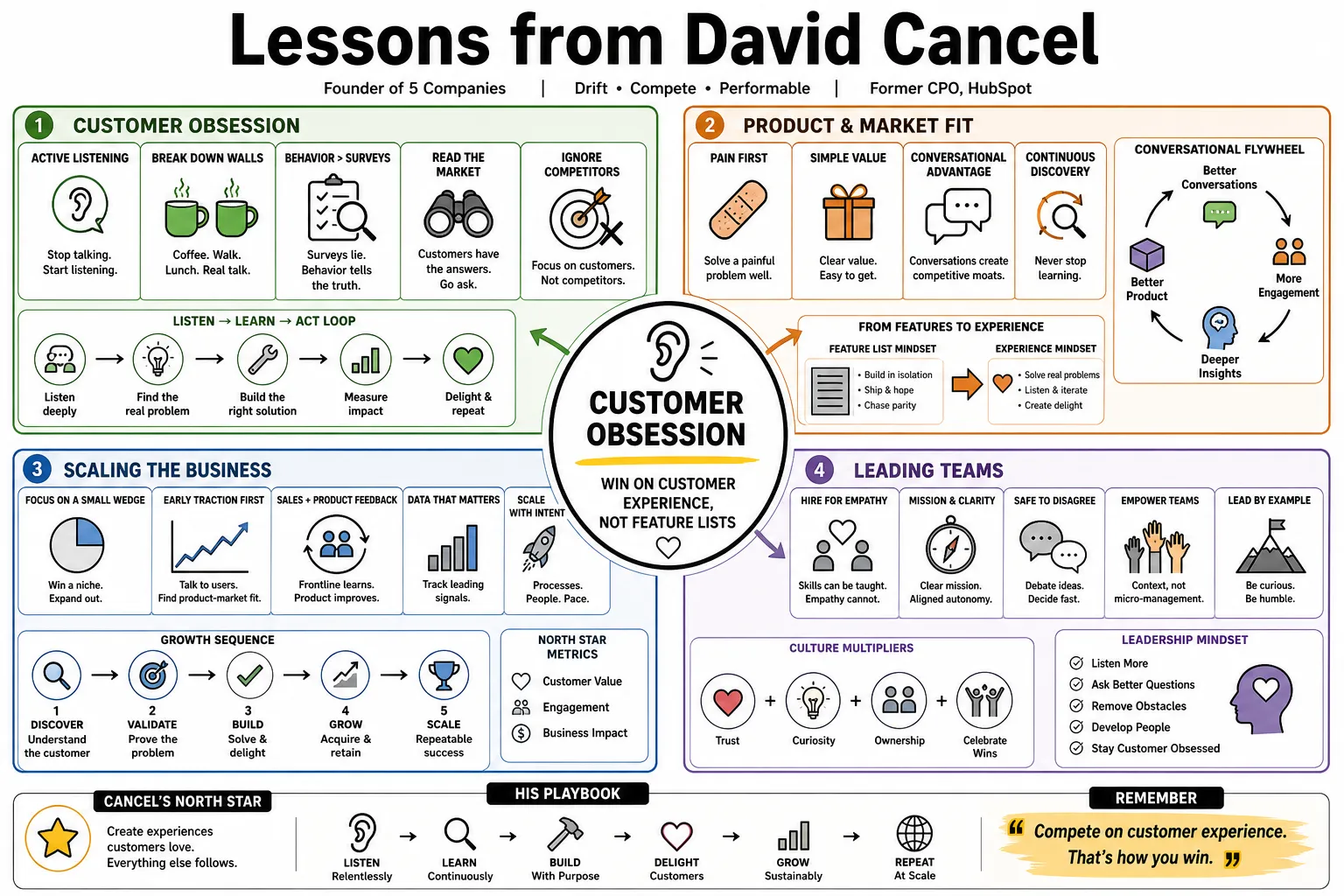
Lessons from David Cancel
David Cancel is a five-time founder who led Drift as CEO and earlier served as HubSpot’s Chief Product Officer after HubSpot acquired his company, Performable. This collection gathers his own words from talks and interviews. — David Cancel: Building a Customer Driven Product Team (Business of Software).
Part 1: Customer Obsession
- On being customer connected: David Cancel: "It’s one of those things that’s easy to say, that we’re customer connected but people hardly ever do." — David Cancel: Building a Customer Driven Product Team (Business of Software, his turns).
- On arguing about story points instead of talking to customers: David Cancel: "Instead of talking to a customer, we argue about story point for 3 hours or point allocation and charts and all these things and the extreme Agile approach." — David Cancel: Building a Customer Driven Product Team (Business of Software, his turns).
- On customers over my ideas: David Cancel: "I attribute getting better at timing to one change: Focus on the CUSTOMER and not on MY IDEAS." — AMA With David Cancel (GrowthHackers, 2015; his answers).
- On being heard and serviced: David Cancel: "Customer cares about being heard and being serviced and delivering the right solution to them." — SaaStr: 10 Ways to Get 110% Out of Your Dev Engineering Teams (David Cancel's turns).
- On who is not the customer: David Cancel: "The product manager, the engineer, whoever, the designer, the salesperson, the CEO, the COO, they’re all not the customer." — SaaStr: 10 Ways to Get 110% Out of Your Dev Engineering Teams (David Cancel's turns).
- On roadmaps customers do not care about: David Cancel: "Customers don’t care about your road map and your version numbers even though yes, I know, your sales person told you that customer wants to see your roadmap." — David Cancel: Building a Customer Driven Product Team (Business of Software, his turns).
- On owning the problem: David Cancel: "As a PM you need to focus on owning “the problem”, aka finding/validating the problem and helping the team drive adoption and usage. 2." — AMA With David Cancel (GrowthHackers, 2015; his answers).
- On building around the customer: David Cancel: "Over time I think that’s lead me to build companies centered around the CUSTOMER which is key for me." — AMA With David Cancel (GrowthHackers, 2015; his answers).
- On the feedback loop: David Cancel: "You need this feedback loop because things are constantly changing in the market." — David Cancel: Building a Customer Driven Product Team (Business of Software, his turns).
- On a firehose of feedback: David Cancel: "If you don’t have a firehose, get one and categorise it into three nice buckets that you can make the feedback actionable." — David Cancel: Building a Customer Driven Product Team (Business of Software, his turns).
Part 2: Product Development
- On the creative process: David Cancel: "Every creative process follows this model, but we get it wrong so often when it comes to building a Product, writing Software or starting a Company." — AMA With David Cancel (GrowthHackers, 2015; his answers).
- On project management disguised as product management: David Cancel: "Most of the product management work that I see done most by the product manager is project management work and we took it all away from the product managers and moved it so the tech lead had to figure that out." — David Cancel: Building a Customer Driven Product Team (Business of Software, his turns).
- On guessing what the customer wanted: David Cancel: "The important thing is we had to build these methodologies to guess what the customer wanted and we never had the chance to put a feedback loop in the process." — David Cancel: Building a Customer Driven Product Team (Business of Software, his turns).
- On asking for a roadmap: David Cancel: "Someone asking you for a roadmap, especially a larger customer, is asking you for something different." — David Cancel: Building a Customer Driven Product Team (Business of Software, his turns).
- On metrics opposed to the customer: David Cancel: "That sounds very simple, but like most of us design metrics for our teams that are totally opposed to the customer, whether making the customer successful, the prospect successful." — SaaStr: 10 Ways to Get 110% Out of Your Dev Engineering Teams (David Cancel's turns).
- On usage over time by cohort: David Cancel: "The way I implement this is to measure product teams on lots of things but most importantly usage over time by cohort." — AMA With David Cancel (GrowthHackers, 2015; his answers).
- On doing the right thing for the customer: David Cancel: "We created all these ways to really look at each product and engineering team and say that they’re doing the right thing for the customer." — SaaStr: 10 Ways to Get 110% Out of Your Dev Engineering Teams (David Cancel's turns).
- On every idea being wrong: David Cancel: "Your assumption should be that every idea, every release, every attempt is WRONG." — AMA With David Cancel (GrowthHackers, 2015; his answers).
- On building a company being exempt: David Cancel: "For some reason we think building a company/product/feature to be exempt from this fundamental law." — AMA With David Cancel (GrowthHackers, 2015; his answers).
- On one thing called product: David Cancel: "I got rid of the idea of an engineering organization and the product organization and said, like, we only have this one thing called product." — Start with the story: Drift’s David Cancel on lessons he’s learned as a 5X founder (First Round Review podcast, his turns).
Part 3: Conversational Marketing & Brand
- On punching above our weight: David Cancel: "We were always punching above our weight in terms of the way that we were able to stand out." — How to Win podcast with Peep Laja: Category creation and product-led differentiation with Drift's David Cancel (his turns).
- On investing in brand: David Cancel: "So in order to defend that we disproportionally invested, at least for the size of our company, in building brand." — How to Win podcast with Peep Laja: Category creation and product-led differentiation with Drift's David Cancel (his turns).
- On the three places you cross: David Cancel: "The truth is Drift was not everywhere, it might have been in three places, but they were the three places that you were going to cross." — How to Win podcast with Peep Laja: Category creation and product-led differentiation with Drift's David Cancel (his turns).
- On a simple world of primates: David Cancel: "We overcomplicate what we need to do and it’s a simple world, we’re all primates and it’s simple what we respond to." — David Cancel: Building a Customer Driven Product Team (Business of Software, his turns).
- On commoditized features: David Cancel: "We also knew that we had to, from a product standpoint, continue to invest and to create a platform because any single feature, or any single value proposition, would be commoditized quickly." — How to Win podcast with Peep Laja: Category creation and product-led differentiation with Drift's David Cancel (his turns).
- On forgetting the channels: David Cancel: "Forget about the tools because in terms of marketing storytelling, everyone wants to go to like the channels." — Start with the story: Drift’s David Cancel on lessons he’s learned as a 5X founder (First Round Review podcast, his turns).
- On starting with the buyer's perspective: David Cancel: "Starts with the buyer perspective, not the company perspective, not the sales rep perspective." — Start with the story: Drift’s David Cancel on lessons he’s learned as a 5X founder (First Round Review podcast, his turns).
- On a mistake in category creation: David Cancel: "I'd categorize that as a mistake because it violated the rules that I mentioned before, which were that category creation had to do with our problem, not a market problem." — How to Win podcast with Peep Laja: Category creation and product-led differentiation with Drift's David Cancel (his turns).
- On rethinking customer-facing tools: David Cancel: "So, we think all of those tools, whether it's across support, marketing, sales, that touch the customer, that interact with the customer, have to be rethought." — How to Win podcast with Peep Laja: Category creation and product-led differentiation with Drift's David Cancel (his turns).
- On what category creation costs: David Cancel: "It probably cost us about $10 million, I'd say, that order of magnitude." — How to Win podcast with Peep Laja: Category creation and product-led differentiation with Drift's David Cancel (his turns).
Part 4: Leadership and Communication
- On a focus on story: David Cancel: "And I was on this idea of story anyway, because I had basically taught myself how to become at least somewhat a marketer and starting drift." — Start with the story: Drift’s David Cancel on lessons he’s learned as a 5X founder (First Round Review podcast, his turns).
- On keeping storytelling a focus: David Cancel: "To actually keep storytelling a focus is the pruning and making sure and zooming in when we're not doing a good job there and trying to repeat those lessons and it never ends." — Start with the story: Drift’s David Cancel on lessons he’s learned as a 5X founder (First Round Review podcast, his turns).
- On autonomy and accountability: David Cancel: "Autonomy has a flipside which is accountability and with the right level of accountability then you can enjoy this autonomy." — David Cancel: Building a Customer Driven Product Team (Business of Software, his turns).
- On human resistance: David Cancel: "It’s impossible because of all the human resistance, and all the organization has created a culture around something and has incentives aligned around one set of goals, which might be the old goals." — Five-Time Founder David Cancel on Selling Performable, Building Drift, and Strategic Exits (Startup CEO Show with Mark MacLeod; his turns).
- On a personal why: David Cancel: "They created their own momentum because they were driven by their personal why that would pull the rest of the team and the company with them." — SaaStr: 10 Ways to Get 110% Out of Your Dev Engineering Teams (David Cancel's turns).
- On listening to yourself: David Cancel: "The most valuable practices for me are the ones I naturally come back to, so I’ve gotten better at listening to myself." — Seven Questions with David Cancel (Sequoia Capital newsletter, his answers).
- On personal progression: David Cancel: "We spend a lot of time trying to figure out personal progression, one on ones for everyone on the team, intern, co op, everyone." — SaaStr: 10 Ways to Get 110% Out of Your Dev Engineering Teams (David Cancel's turns).
- On having almost no meetings: David Cancel: "We had maybe two internal meetings we do monthly, but otherwise there were no meetings." — David Cancel: Building a Customer Driven Product Team (Business of Software, his turns).
- On teams that are opaque: David Cancel: "Because product and engineering can be teams that are naturally opaque to the go-to-market teams within a company." — Start with the story: Drift’s David Cancel on lessons he’s learned as a 5X founder (First Round Review podcast, his turns).
Part 5: Hiring and Team Building
- On the stage of your company: David Cancel: "Your company’s stage is super important—it adds context about what you need for where you are." — Seven Questions with David Cancel (Sequoia Capital newsletter, his answers).
- On deferring to a well-thought hypothesis: David Cancel: "Even if I completely disagree with the execution of it, I will defer to them because they've thought out something and they probably have a hypothesis that I don't understand yet, but it's very well thought out." — Start with the story: Drift’s David Cancel on lessons he’s learned as a 5X founder (First Round Review podcast, his turns).
- On skills that are not enough: David Cancel: "We’d hire people who were great on the quantitative and qualitative dimensions, and then they’d struggle." — Seven Questions with David Cancel (Sequoia Capital newsletter, his answers).
- On curious people with something to prove: David Cancel: "I look to find people that are curious, have something to prove, are always learning and are a personality we think will complement the team." — AMA With David Cancel (GrowthHackers, 2015; his answers).
- On hiring for where the company will be: David Cancel: "We try to forecast what the company’s growth will look like and where we’ll be by the time a new hire is really up and running, and then we look for people who are a good fit." — Seven Questions with David Cancel (Sequoia Capital newsletter, his answers).
- On everyone doing support: David Cancel: "So because we had more customers than employees luckily, everyone at the company including engineers, we were a 20 person company – had to do support." — David Cancel: Building a Customer Driven Product Team (Business of Software, his turns).
- On focusing on people: David Cancel: "The most important thing I think that’s helped me is that I focus on PEOPLE over everything." — AMA With David Cancel (GrowthHackers, 2015; his answers).
- On shared accountability and transparency: David Cancel: "They had this shared accountability so coupled with transparency, this brought the teams a lot of freedom." — David Cancel: Building a Customer Driven Product Team (Business of Software, his turns).
- On the product manager title: David Cancel: "I don’t like hiring people that have been serial product managers typically, because I find in my world, product manager as a title is this amorphous thing." — SaaStr: 10 Ways to Get 110% Out of Your Dev Engineering Teams (David Cancel's turns).
Part 6: Continuous Learning
- On rereading books: David Cancel: "I reread a lot of books, too, for the same reason—at a different time in my life, I’m coming in with a different context and can pull out different lessons." — Seven Questions with David Cancel (Sequoia Capital newsletter, his answers).
- On conventional wisdom: David Cancel: "I’d try to follow conventional wisdom when it often wasn’t relevant, and wouldn’t get the results I thought I should." — Seven Questions with David Cancel (Sequoia Capital newsletter, his answers).
- On accepting what doesn’t work: David Cancel: "I’ve learned to accept it and move on when something doesn’t work, and to lean into the things that feel right." — Seven Questions with David Cancel (Sequoia Capital newsletter, his answers).
- On decision-making and mental models: David Cancel: "It’s a compilation of these age-old lessons on things like decision-making and mental models—how to be more logical and avoid the traps of our biases." — Seven Questions with David Cancel (Sequoia Capital newsletter, his answers).
- On easy to access and hard to apply: David Cancel: "When I started Drift like everybody knows everything about building, scaling, doing all that stuff it’s all easy easily accessible hard to apply." — Leading A High-Growth Company, David Cancel at BoS USA 2018 (Business of Software, his turns).
- On role models and mentors: David Cancel: "I keep learning part of learning is having access to different role models different mentors and then being able to look behind the curtain and say oh that’s how they do it right." — Leading A High-Growth Company, David Cancel at BoS USA 2018 (Business of Software, his turns).
- On lessons learned the hard way: David Cancel: "As time goes on, I’ve realized that many of my most important lessons were things I thought I already knew—but I didn’t truly know them or live them until I learned the hard way." — Seven Questions with David Cancel (Sequoia Capital newsletter, his answers).
- On breakthroughs away from the desk: David Cancel: "The breakthroughs don't happen sitting behind a desk behind a laptop and just going all the time, which is a big personal change for me because I defaulted to work more, work more, work more, and try to push through things." — Start with the story: Drift’s David Cancel on lessons he’s learned as a 5X founder (First Round Review podcast, his turns).
- On applying a background in a new context: David Cancel: "Sometimes you can apply that background in a new context, but it’s difficult, and definitely something you need to be conscious of." — Seven Questions with David Cancel (Sequoia Capital newsletter, his answers).
Part 7: Founder Lessons and Mentorship
- On a company not meant to be sold: David Cancel: "I will say that Performable was my third company I had started, and I didn’t have any plans to sell it, as you said." — Five-Time Founder David Cancel on Selling Performable, Building Drift, and Strategic Exits (Startup CEO Show with Mark MacLeod; his turns).
- On investors who would not sell: David Cancel: "But we had raised three rounds, one from CRV, one from General Catalyst, and one from Sequoia, and none of them wanted to entertain an offer to sell the company." — Five-Time Founder David Cancel on Selling Performable, Building Drift, and Strategic Exits (Startup CEO Show with Mark MacLeod; his turns).
- On raising with no product: David Cancel: "I started a company after leaving HubSpot, raised a Series A that was large, $15 million, no product, no slides, no nothing." — SaaStr: Illusion and Reality in Product/Market Fit panel (David Cancel's turns).
- On saying I don’t know: David Cancel: "I was probably 10 years into my career before I started saying, “I don’t know.” Part of that was fear of being vulnerable." — Seven Questions with David Cancel (Sequoia Capital newsletter, his answers).
- On the fear of being trapped: David Cancel: "And part of that is my fear of being trapped, which is probably a common theme of a lot of entrepreneurs I know." — Five-Time Founder David Cancel on Selling Performable, Building Drift, and Strategic Exits (Startup CEO Show with Mark MacLeod; his turns).
- On not needing an epic pivot: David Cancel: "We never get to this big epic moment that says, “Oh, we need to pivot.” Every day we’re learning along the way." — SaaStr: Illusion and Reality in Product/Market Fit panel (David Cancel's turns).
- On having nothing to lose: David Cancel: "So in other words I had nothing to lose and when I started a company I had nothing to lose." — Leading A High-Growth Company, David Cancel at BoS USA 2018 (Business of Software, his turns).
- On being forced to learn lessons: David Cancel: "I think that, as much as we think that we’re self-directed, things happen that we cannot explain, and we are forced to learn lessons." — Five-Time Founder David Cancel on Selling Performable, Building Drift, and Strategic Exits (Startup CEO Show with Mark MacLeod; his turns).
- On not joining the acquirer: David Cancel: "The minute it was sold, there was no way I was going to join the acquiring company, like ever." — Five-Time Founder David Cancel on Selling Performable, Building Drift, and Strategic Exits (Startup CEO Show with Mark MacLeod; his turns).
Part 8: Scale and Growth
- On assuming your idea is wrong: David Cancel: "We should go in as product creators and say whatever our idea is it’s wrong by default and we have to ship it ASAP to the customers to try and figure out how wrong are we?" — David Cancel: Building a Customer Driven Product Team (Business of Software, his turns).
- On scaling a customer-driven approach: David Cancel: "The important thing there is we got to go from this 20-person company to this larger scale and try to scale this customer driven approach." — David Cancel: Building a Customer Driven Product Team (Business of Software, his turns).
- On learning to scale to a thousand: David Cancel: "I will add that one of the things I wanted to learn was how to scale a company from 150 people to a 1000 people." — AMA With David Cancel (GrowthHackers, 2015; his answers).
- On bringing in marketing and sales earlier: David Cancel: "I’d say one thing looking back is I think I brought in marketing and sales, I should have brought them in earlier." — SaaStr: Illusion and Reality in Product/Market Fit panel (David Cancel's turns).
- On the blind spot of product people: David Cancel: "That’s probably our blind spot as product people is just to always hire more and more engineers, because bringing them early, it wasn’t even a revenue thing." — SaaStr: Illusion and Reality in Product/Market Fit panel (David Cancel's turns).
- On a customer willing to pay: David Cancel: "For us, it could be as simple as getting $10 a month from them, from a SaaS perspective, just making sure that they were willing to pay." — SaaStr: Illusion and Reality in Product/Market Fit panel (David Cancel's turns).
- On transparent accountability: David Cancel: "And our approach was that we needed to introduce and have transparent accountability for each of these product teams to go with the autonomy we were giving the teams and they really decided everything." — David Cancel: Building a Customer Driven Product Team (Business of Software, his turns).
- On customer guardrail metrics: David Cancel: "If you built something or you ship something, or you did something from an engineering standpoint, if we could not tie that back to one of the customer guardrail metrics that you had to move as a team, remarkable how fast problems fix themselves." — Start with the story: Drift’s David Cancel on lessons he’s learned as a 5X founder (First Round Review podcast, his turns).
- On three market cycles: David Cancel: "I published some stuff around this, that I believe that there's these three cycles that markets go through, and that we're in the third cycle when it comes to SaaS software." — How to Win podcast with Peep Laja: Category creation and product-led differentiation with Drift's David Cancel (his turns).