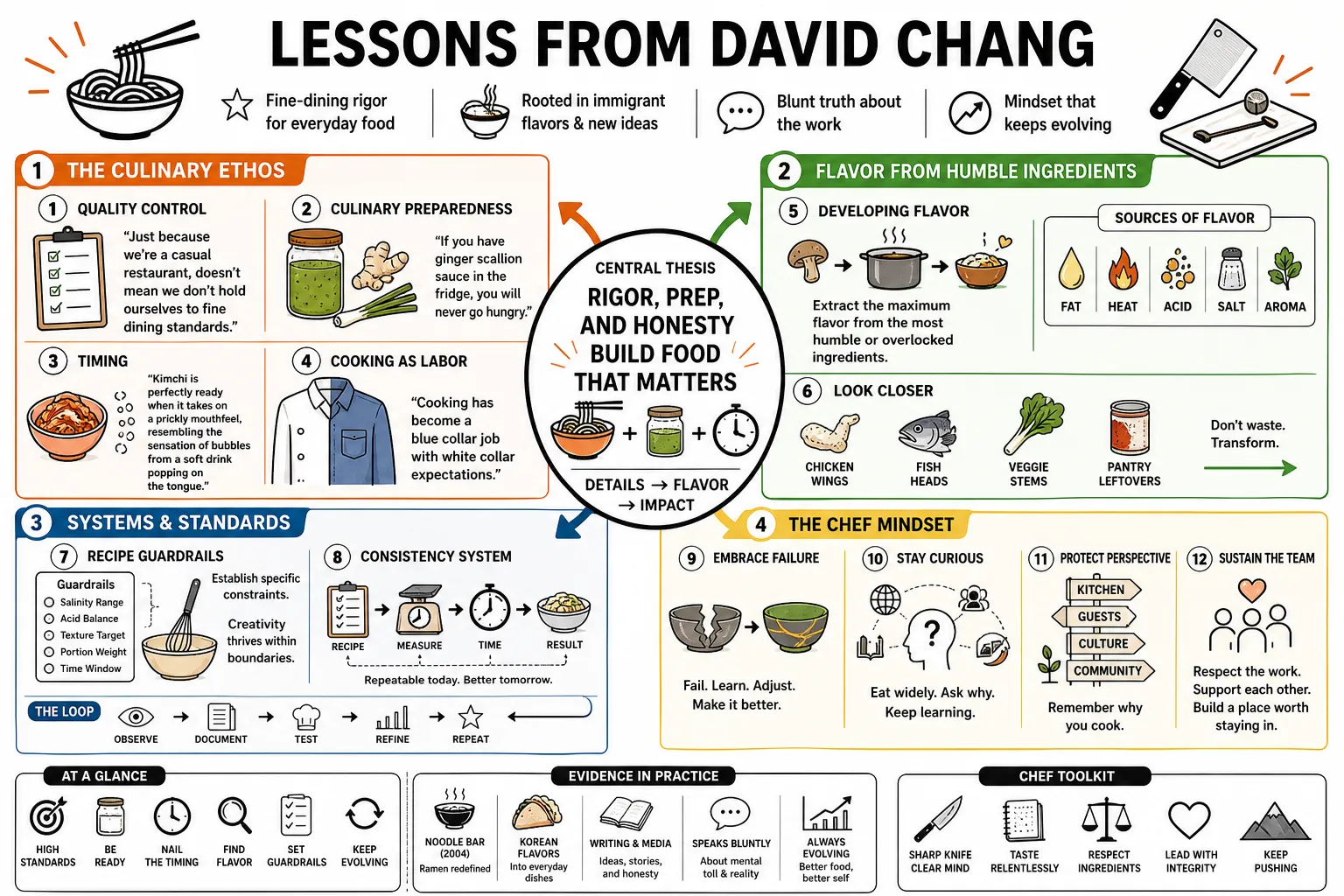
Lessons from David Chang
David Chang is the founder of Momofuku and the author of Eat a Peach. This collection gathers his own words from interviews. — From Chef to Dad: David Chang’s New Definition of Success (Guy Kawasaki).
Part 1: The Culinary Ethos
- On a populist stance on food: David Chang: "I’ve always wanted to take a populist stance on food, ever since trying to do Korean burritos at Ssäm Bar, which is the craziest thing probably I’ve ever done." — David Chang: “Almost Everything We’ve Done Has Been a Failure from the Get-go” (Eater, his turns).
- On cycles of ambition and simplicity: David Chang: "As you get older, you see chefs go through these cycles where you do something adventurous and ambitious, where you don’t know what the fuck you’re doing, and then you start simplifying." — David Chang: “Almost Everything We’ve Done Has Been a Failure from the Get-go” (Eater, his turns).
- On respect for ingredients: David Chang: "I used only American ingredients because I had too much respect for Japanese ingredients, and also, I couldn't afford it, either." — Chef David Chang On Depression, Being A Dad And The Burden Of ‘Authenticity’ (NPR Fresh Air transcript, his turns).
- On the ramen renaissance: David Chang: "I saw Japan in this renaissance of ramen, where it was as - the fervor for ramen was like pizza and barbecue and hamburgers combined." — Chef David Chang On Depression, Being A Dad And The Burden Of ‘Authenticity’ (NPR Fresh Air transcript, his turns).
- On great ingredients and a happy kitchen: David Chang: "Try to make something beautiful with great ingredients and everyone's happy to work there." — From Chef to Dad: David Chang’s New Definition of Success (Guy Kawasaki, his turns).
- On putting disparate things together: David Chang: "I learned how to put disparate things together that may not be in someone else's cup of tea." — From Chef to Dad: David Chang’s New Definition of Success (Guy Kawasaki, his turns).
- On delicious food and critics: David Chang: "I think that’s really important to do, but I’m also looking at how important it is to make super delicious food that is populist, but keeps the critics happy, without demoralizing the people around you." — David Chang: “Almost Everything We’ve Done Has Been a Failure from the Get-go” (Eater, his turns).
- On accessible food and food media: David Chang: "Maybe there’s a happy middle of making great food accessible without the bullshit of the food media that we live in right now." — David Chang: “Almost Everything We’ve Done Has Been a Failure from the Get-go” (Eater, his turns).
Part 2: The Creative Process
- On rejecting home cooking: David Chang: "When I was a younger cook, all I wanted to do was get away from home cooked meals, Korean stuff, anything that I grew up eating, because I just thought it wasn’t cool." — David Chang: “Almost Everything We’ve Done Has Been a Failure from the Get-go” (Eater, his turns).
- On proving your worth: David Chang: "Something gets lost trying to prove your worth to everyone around you in order to make food super delicious." — David Chang: “Almost Everything We’ve Done Has Been a Failure from the Get-go” (Eater, his turns).
- On following your gut: David Chang: "I’ve always followed my gut, but now it coincides with the point in my life where I’m totally comfortable being Korean and Korean-American." — David Chang: “Almost Everything We’ve Done Has Been a Failure from the Get-go” (Eater, his turns).
- On reserving judgment: David Chang: "I think another thing that food can be is about judgment and more and more when I interact with the world or experience new things I’m trying to reserve my judgment on something." — Restaurateur and chef David Chang (PBS American Masters podcast, his turns).
- On making the right kinds of mistakes: David Chang: "We’re making the right kinds of mistakes and I’m fascinated by that, mainly because I love delivery, but also I know it has to work." — David Chang: “Almost Everything We’ve Done Has Been a Failure from the Get-go” (Eater, his turns).
- On merging tech people and cooks: David Chang: "We’ve had our struggles with Ando because it’s the first merger, as far as I know, of smart tech people and cooks." — David Chang: “Almost Everything We’ve Done Has Been a Failure from the Get-go” (Eater, his turns).
Part 3: The Philosophy of Failure
- On mistakes only being mistakes if you leave them: David Chang: "I had nowhere to hide and what I learned along the way, and I don’t think I would have done this had I had a closed kitchen or had a larger budget to work with, was if I make a mistake it’s only a mistake if I leave it there." — Restaurateur and chef David Chang (PBS American Masters podcast, his turns).
- On an honest way to live: David Chang: "I thought it was an honest way to live, that I could work really hard and it wasn’t about accumulating a lot of wealth, and it’s something that I was terrible at, and I could get better at." — Restaurateur and chef David Chang (PBS American Masters podcast, his turns).
- On not being afraid of failure: David Chang: "All of the things that I was sort of afraid of, all of a sudden I wasn’t afraid of anything, I wasn’t afraid of failure." — Restaurateur and chef David Chang (PBS American Masters podcast, his turns).
- On opening without a clear goal: David Chang: "I opened Momofuku Noodle Bar without really any clear idea of what the goal was going to be." — Restaurateur and chef David Chang (PBS American Masters podcast, his turns).
Part 4: Leading and Managing
- On empathy: David Chang: "All I’m saying is, everyone should increase their empathy just a little bit before destroying someone." — David Chang: “Almost Everything We’ve Done Has Been a Failure from the Get-go” (Eater, his turns).
- On running like Mussolini: David Chang: "I’m just trying to grapple with whether I’ve fooled myself into thinking that I’ve been teaching my guys the sandbox method, when I’ve really just been running like Mussolini." — David Chang: “Almost Everything We’ve Done Has Been a Failure from the Get-go” (Eater, his turns).
- On a kitchen of lunatics: David Chang: "I think that there’s a bunch of people in this kitchen that are all lunatics and they couldn’t probably make their own bed or pay their bills on time or show up on time to anything else outside in the regular world." — Restaurateur and chef David Chang (PBS American Masters podcast, his turns).
- On sensible growth: David Chang: "We were really excited that Alex came on board because we are growing and I want to ensure that growth is done in a sensible fashion." — David Chang: “Almost Everything We’ve Done Has Been a Failure from the Get-go” (Eater, his turns).
- On not letting the team down: David Chang: "I'm so grateful for the team we have at Momofuku with Marguerite Mariscal and the whole team, that I want to make sure that they're not let down and I'm helping them out and their family, too." — Chef David Chang On Depression, Being A Dad And The Burden Of ‘Authenticity’ (NPR Fresh Air transcript, his turns).
Part 5: Identity and Authenticity
- On the only authenticity worth championing: David Chang: "I think there’s two kinds again of authenticity, the only authenticity that I am a champion of is one that is trying to preserve and trying to educate because no one else knows what is actually real or false." — Restaurateur and chef David Chang (PBS American Masters podcast, his turns).
- On what American food actually is: David Chang: "Maybe that was the truth 100, 150 years ago, but today I think it’s that’s the furthest thing from what American food actually is." — Restaurateur and chef David Chang (PBS American Masters podcast, his turns).
- On stereotyping through food: David Chang: "We’ve seen it throughout history, people stereotype whole groups of people through their food." — Restaurateur and chef David Chang (PBS American Masters podcast, his turns).
- On being comfortable in your own skin: David Chang: "Wow, I have a lot of thoughts on this because I feel like so much of my life has been about finding my identity, and I’m 41 years old now and I think I’m finally comfortable in my own skin." — Restaurateur and chef David Chang (PBS American Masters podcast, his turns).
- On finding himself in the kitchen: David Chang: "I wanted to discover myself and I honestly didn’t think I would find myself in the kitchen but it’s obviously where I was most comfortable." — Restaurateur and chef David Chang (PBS American Masters podcast, his turns).
- On being called college boy: David Chang: "Like when I started to cook, everyone calls me college boy because it was not like a cool thing to be as a cook at the time." — From Chef to Dad: David Chang’s New Definition of Success (Guy Kawasaki, his turns).
- On a father who wanted him to avoid cooking: David Chang: "My dad was so upset, so upset, because he basically worked his entire life to make sure I would never become a cook, because he knows how hard that life is." — Restaurateur and chef David Chang (PBS American Masters podcast, his turns).
- On his mother's origins: David Chang: "My mother was born a little bit closer to what is now the 38th parallel in a town called Kaesong." — Chef David Chang On Depression, Being A Dad And The Burden Of ‘Authenticity’ (NPR Fresh Air transcript, his turns).
- On studying religion: David Chang: "I wanted to study religion as to why people become religious and along the way I studied a bunch of stuff that still has impressed upon me how I think today." — Restaurateur and chef David Chang (PBS American Masters podcast, his turns).
Part 6: Mental Health and Well-being
- On talking about it now: David Chang: "I can talk about it now in a way that I never was able to talk about when experiencing it because I know it's not my fault." — Chef David Chang On Depression, Being A Dad And The Burden Of ‘Authenticity’ (NPR Fresh Air transcript, his turns).
- On being told to stop working so much: David Chang: "My mom and dad - I was like, if they wanted to screw me up in the head before, they really did a good job at this moment when they said, you have to stop working so much." — Chef David Chang On Depression, Being A Dad And The Burden Of ‘Authenticity’ (NPR Fresh Air transcript, his turns).
- On the choice of how to respond: David Chang: "You can have a choice to be like, oh, I've been presented this really crappy situation, which we're all presented all the time." — From Chef to Dad: David Chang’s New Definition of Success (Guy Kawasaki, his turns).
- On being embarrassed by how they were raised: David Chang: "I remember my dad's mother staying with us for a short period of time and how mean she was and how frugal she lived and how - I just was, like, not just embarrassed by the food, I was embarrassed by how they were raised." — Chef David Chang On Depression, Being A Dad And The Burden Of ‘Authenticity’ (NPR Fresh Air transcript, his turns).
- On getting out of his shell: David Chang: "I’m probably incredibly selfish in all of these things that are not like positive attributes and I think that by interacting and learning these things I tried to like get me out of that shell." — Restaurateur and chef David Chang (PBS American Masters podcast, his turns).
Part 7: Redefining Success
- On what accolades are worth: David Chang: "I’m at a point in my life where winning accolades and awards and making food that is constantly pushing boundaries — what is that worth?" — David Chang: “Almost Everything We’ve Done Has Been a Failure from the Get-go” (Eater, his turns).
- On no longer wanting every award: David Chang: "All I wanted to do before is win every goddamn award possible, and I just don't care." — From Chef to Dad: David Chang’s New Definition of Success (Guy Kawasaki, his turns).
- On not owning plates: David Chang: "I turned off the gas just for storage because I didn't even own plates until literally when my wife moved in with me." — Chef David Chang On Depression, Being A Dad And The Burden Of ‘Authenticity’ (NPR Fresh Air transcript, his turns).
- On learning a different way of cooking: David Chang: "I now have learned a different way of cooking that I never thought that I ever would." — Chef David Chang On Depression, Being A Dad And The Burden Of ‘Authenticity’ (NPR Fresh Air transcript, his turns).
Part 8: The Reality of the Restaurant Industry
- On knowing the plumbing: David Chang: "Literally owning a restaurant, you better know the plumbing because more often than not you are going to be cleaning up shit." — From Chef to Dad: David Chang’s New Definition of Success (Guy Kawasaki, his turns).
- On staying afloat: David Chang: "We're doing anything and everything to stay afloat and to keep as many jobs as possible." — Chef David Chang On Depression, Being A Dad And The Burden Of ‘Authenticity’ (NPR Fresh Air transcript, his turns).
- On saving neighborhood restaurants: David Chang: "My focus is like, how do you save those restaurants that are your neighborhood mom and pop, the diners?" — From Chef to Dad: David Chang’s New Definition of Success (Guy Kawasaki, his turns).
- On Yelp and food bloggers: David Chang: "I’ve had a adversarial relationship with Yelp and some food bloggers because I don’t think they understand the pain they can cause chefs." — David Chang: “Almost Everything We’ve Done Has Been a Failure from the Get-go” (Eater, his turns).
- On growing the company: David Chang: "We’ve made some changes in the company, and it’s been a tumultuous year because we have 1,000 employees on the culinary end." — David Chang: “Almost Everything We’ve Done Has Been a Failure from the Get-go” (Eater, his turns).
- On experiential dining at scale: David Chang: "You have super high end and experiential dining and weirdly that's becoming scalable and I don't know how to explain that." — From Chef to Dad: David Chang’s New Definition of Success (Guy Kawasaki, his turns).