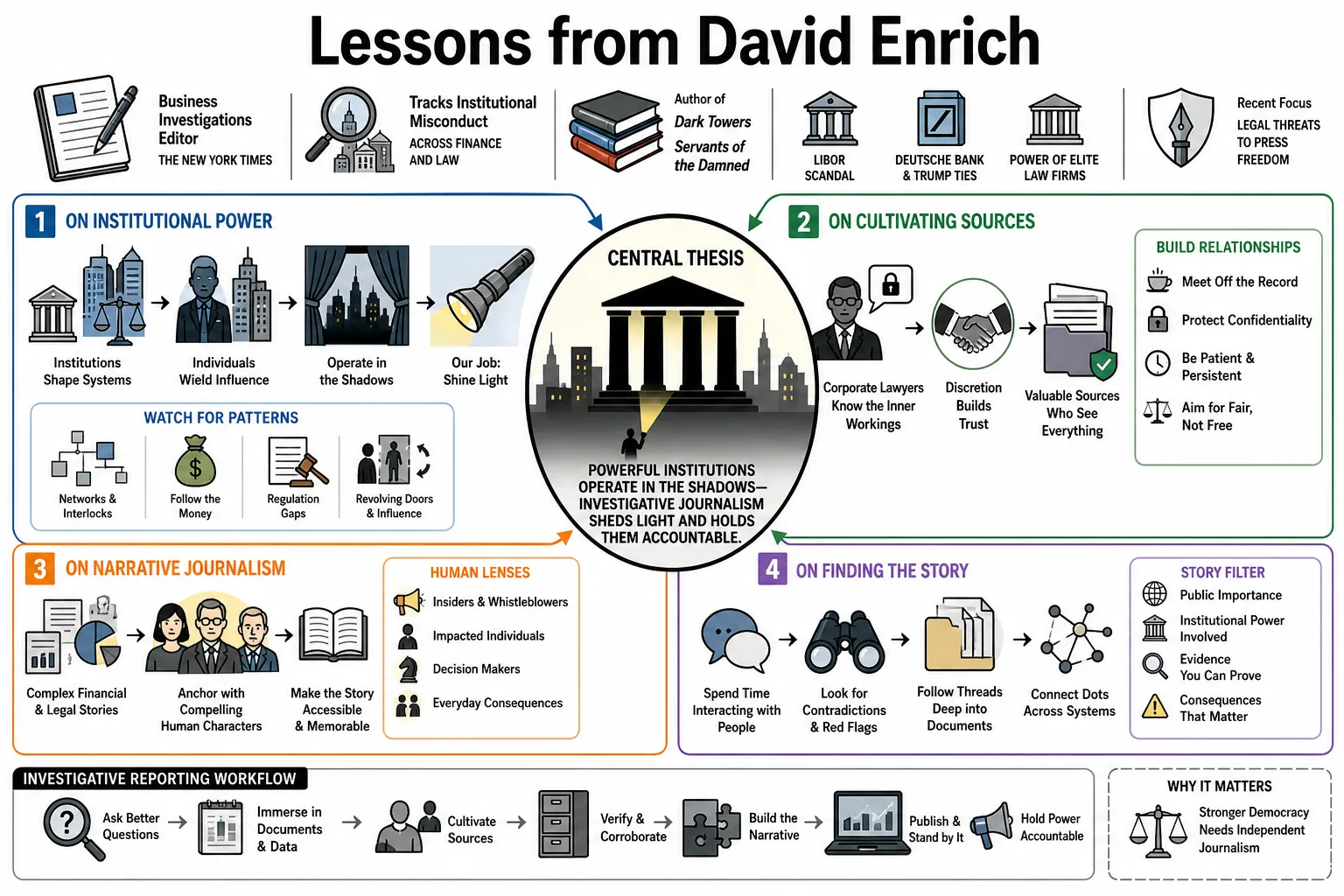
Lessons from David Enrich
David Enrich is the business investigations editor at The New York Times and the author of The Spider Network, Dark Towers and Servants of the Damned. This collection gathers his own words from interviews. — Negotiating Power: David Enrich on Corporate Law (Harvard Law School Center on the Legal Profession).
Part 1: The Foundations of Investigative Journalism
- On healthy back-and-forth with sources: David Enrich: "A lot of them provided very useful information and corrected some of the mistakes that I thought I had learned through the reporting process, which is just normal, healthy back-and-forth." — Negotiating Power: David Enrich on Corporate Law (Harvard Law School Center on the Legal Profession; his answers).
- On respecting what you don't know: David Enrich: "Like, you need to respect what you don’t know and respect what you can learn from others." — Transcript: David Enrich (Masters in Business, Ritholtz; his turns).
- On exposure as deterrence: David Enrich: "The act of writing about and exposing things educates people, and it can work as it gets people to think about how they would react if what they are about to do ends up on the front page of the newspaper." — Negotiating Power: David Enrich on Corporate Law (Harvard Law School Center on the Legal Profession; his answers).
- On lawyers who want to talk: David Enrich: "One of the great things about writing a book like this is that there are a lot of lawyers out there whom it had never occurred to that there would be journalists out there who would really want to hear the inside stuff that they’ve got." — Negotiating Power: David Enrich on Corporate Law (Harvard Law School Center on the Legal Profession; his answers).
- On disclosing empathy for a subject: David Enrich: "Ultimately, my editors and I decided that rather than trying to maintain the pretense of objectivity, the simpler and more honest thing to do would be to disclose that I had developed a real sense of empathy for Hayes and his family." — Q&A With David Enrich, Author of The Spider Network (Business Insider, 2017; his answers).
- On Deutsche Bank and scandal: David Enrich: "Look at any major financial scandal in the past 10 or 15 years, Deutsche Bank has been at or near the center." — New book explores the schemes and scandals of Deutsche Bank (PBS NewsHour; his answers).
- On pressure letters: David Enrich: "Jones Day has also hired an outside law firm to send pressuring letters to my publisher accusing me of bias and bad faith and sloppy journalism." — Negotiating Power: David Enrich on Corporate Law (Harvard Law School Center on the Legal Profession; his answers).
- On how long the reporting took: David Enrich: "Just by way of background, I spent give or take two years working on this and started engaging with Jones Day, or trying to engage with Jones Day, very early on in the process." — Negotiating Power: David Enrich on Corporate Law (Harvard Law School Center on the Legal Profession; his answers).
- On not facing legal threats alone: David Enrich: "Luckily I work for the New York Times and my publisher is HarperCollins, so I’m not an independent person facing it alone." — Negotiating Power: David Enrich on Corporate Law (Harvard Law School Center on the Legal Profession; his answers).
Part 2: Uncovering "The Spider Network" and Financial Fraud
- On what LIBOR sets: David Enrich: "It sets interest rates on all sort of debt over the world so if you have an adjustable-rate mortgage, the interest rate is based on LIBOR, if you have a credit card, a student loan, an auto loan, it is likely based on LIBOR." — Transcript: NYT's David Enrich - The Big Picture (Masters in Business, 2018; his turns).
- On watching a life disintegrate: David Enrich: "And so that was the basis for this Wall Street Journal series, the unraveling of Tom Hayes that I watched this guy who would become kind of this unlikely public face of financial crime and I watched him his life disintegrate, it was fascinating and kind of upsetting. 14 years." — Transcript: NYT's David Enrich - The Big Picture (Masters in Business, 2018; his turns).
- On how LIBOR gets set: David Enrich: "All those numbers gets smooched together, the high estimate and the low estimates get booted out and the rest are averaged and presto, you got LIBOR." — Transcript: NYT's David Enrich - The Big Picture (Masters in Business, 2018; his turns).
Part 3: The Libor Scandal's Human Toll
- On the perception that financial elites got away: David Enrich: "Incidentally, the fact that no top banking executives have even been charged with crimes (much less sent to jail) has fueled the perception that 'financial elites' got away with murder during the crisis and its aftermath, and that 'little guys' – folks like Tom Hayes – paid the price." — Q&A With David Enrich, Author of The Spider Network (Business Insider, 2017; his answers).
- On prosecutors afraid of losing: David Enrich: "Prosecutors were afraid of losing high-profile cases, and that fear led them to only focus on slam-dunk cases." — Q&A With David Enrich, Author of The Spider Network (Business Insider, 2017; his answers).
- On loosening the regulatory reins: David Enrich: "At least in the US, the government is loosening the regulatory reins on the banks and signaling in very clear fashion that law-enforcement cases will not be pursued as aggressively as they were in the past." — Q&A With David Enrich, Author of The Spider Network (Business Insider, 2017; his answers).
- On the seeds of the next scandal: David Enrich: "I have no idea what will cause the next financial crisis or scandal, but I think that when it inevitably happens, people will look back on this moment of history and say this is when the seeds were planted." — Q&A With David Enrich, Author of The Spider Network (Business Insider, 2017; his answers).
- On missed opportunity to charge executives: David Enrich: "I think regulators and prosecutors missed an enormous opportunity to build criminal cases against some bank CEOs, or at least some high-ranking bank executives." — Q&A With David Enrich, Author of The Spider Network (Business Insider, 2017; his answers).
- On being punched in the stomach: David Enrich: "When the verdict against Hayes was announced, and when he was sentenced to 14 years in prison, it felt like someone had punched me in the stomach." — Q&A With David Enrich, Author of The Spider Network (Business Insider, 2017; his answers).
Part 4: "Dark Towers" and the Culture of Deutsche Bank
- On Deutsche Bank's ambitions: David Enrich: "Deutsche Bank at that time was trying to make a name for itself on Wall Street, trying to build its brand in the United States." — New book explores the schemes and scandals of Deutsche Bank (PBS NewsHour; his answers).
- On a client that needed risk-tolerant banks: David Enrich: "Donald Trump needed banks that had higher tolerances for risk and less interest in their client's reputation." — New book explores the schemes and scandals of Deutsche Bank (PBS NewsHour; his answers).
- On a bet against housing: David Enrich: "A number of traders made a huge bet that the U.S. housing market was going to collapse." — New book explores the schemes and scandals of Deutsche Bank (PBS NewsHour; his answers).
- On what Bill Broeksmit blamed himself for: David Enrich: "One is to a family friend and the final one is to the bank CEO at the time, Anshu Jain, and it lays out in a heartbreaking detail what Bill Broeksmit blamed himself for." — Transcript: David Enrich (Masters in Business, Ritholtz; his turns).
- On what the bank knew: David Enrich: "Yes, they knew about, and in some times -- in some cases, participated in these scandals, and, in other cases, really tried to deal with the bad behavior." — New book explores the schemes and scandals of Deutsche Bank (PBS NewsHour; his answers).
Part 5: Deutsche Bank, Donald Trump, and Systemic Risk
- On a bank and a businessman who needed each other: David Enrich: "You have this bank that’s desperate for clients in the U.S. and you have this businessman who’s desperate for a bank." — Transcript: David Enrich (Masters in Business, Ritholtz; his turns).
- On one arm bailing out another: David Enrich: "As it turned out, another arm of the bank came and essentially bailed out its other arm by making another loan to Donald Trump." — New book explores the schemes and scandals of Deutsche Bank (PBS NewsHour; his answers).
- On the oversight board: David Enrich: "The Vorstand is management board and then there’s the supervisory board which is really supposed to be the oversight board." — Transcript: David Enrich (Masters in Business, Ritholtz; his turns).
Part 6: "Servants of the Damned" and the Power of Big Law
- On how recent big law is: David Enrich: "I was very surprised to learn that less than 100 years ago, the large law firm really didn’t exist at all." — Negotiating Power: David Enrich on Corporate Law (Harvard Law School Center on the Legal Profession; his answers).
- On the right to legal representation: David Enrich: "I heard over and over and over again in the course of reporting this book about how I simply did not grasp the concept that everyone, no matter what, is always entitled to legal representation." — Negotiating Power: David Enrich on Corporate Law (Harvard Law School Center on the Legal Profession; his answers).
- On checking the foundation of an argument: David Enrich: "About the 15th time I heard this from a Jones Day lawyer, I started digging, and I realized that the intellectual foundation of what they were saying was not as sturdy as they made it sound." — Negotiating Power: David Enrich on Corporate Law (Harvard Law School Center on the Legal Profession; his answers).
- On lawyer advertising: David Enrich: "The other big thing that I just had not the faintest idea about is that lawyers previously weren’t allowed to advertise." — Negotiating Power: David Enrich on Corporate Law (Harvard Law School Center on the Legal Profession; his answers).
- On solo practitioners: David Enrich: "Lawyers were basically solo practitioners who at times banded together to share back-office expenses." — Negotiating Power: David Enrich on Corporate Law (Harvard Law School Center on the Legal Profession; his answers).
- On ethical lines: David Enrich: "One of the things I get into in the book repeatedly is that there are ethical lines that you should not cross as a lawyer in representation of a client." — Negotiating Power: David Enrich on Corporate Law (Harvard Law School Center on the Legal Profession; his answers).
- On where the lines are drawn: David Enrich: "The question of where exactly to draw those lines is often a bit murky, and so I’ve heard from a lot of students and law professors who are really interested to engage in that debate about how to detect where those lines are." — Negotiating Power: David Enrich on Corporate Law (Harvard Law School Center on the Legal Profession; his answers).
- On a firm as emblem of a profession: David Enrich: "I began to realize that not only did Jones Day have this really interesting narrative arc, but it was in many ways emblematic of the arc of the legal profession." — Negotiating Power: David Enrich on Corporate Law (Harvard Law School Center on the Legal Profession; his answers).
- On a uniform leadership outlook: David Enrich: "What sets Jones Day apart is the degree to which the leadership of the firm is fairly uniform in their conservative thinking." — How lawyers from one giant DC firm influenced Trump's Supreme Court picks (NPR Fresh Air, 2022; his turns).
Part 7: Jones Day and the Corruption of Justice
- On Jones Day and late votes: David Enrich: "Jones Day very vociferously argued that doing that, as the Pennsylvania Supreme Court had allowed, that doing that was basically an open invitation to people voting after Election Day, or it possibly could open the door to improper votes being counted." — How lawyers from one giant DC firm influenced Trump's Supreme Court picks (NPR Fresh Air, 2022; his turns).
- On how students are funneled into big law: David Enrich: "Frankly, I wish I had been at this conference a year ago before I was done writing the book, because it really opened my eyes a lot to how people are funneled into Big Law firms." — Negotiating Power: David Enrich on Corporate Law (Harvard Law School Center on the Legal Profession; his answers).
- On money from Trump entities: David Enrich: "What I do know is that Jones Day continues to receive money from various Trump entities." — How lawyers from one giant DC firm influenced Trump's Supreme Court picks (NPR Fresh Air, 2022; his turns).
- On a leader who never responded: David Enrich: "I spent a lot of time trying unsuccessfully to communicate with Steve Brogan, who never once got on the phone or agreed to meet with me." — How lawyers from one giant DC firm influenced Trump's Supreme Court picks (NPR Fresh Air, 2022; his turns).
- On the firm's reaction: David Enrich: "Since the publication, the reaction has not been positive from Jones Day, and they have attacked me in the pages of the Wall Street Journal." — Negotiating Power: David Enrich on Corporate Law (Harvard Law School Center on the Legal Profession; his answers).
- On whether Jones Day will work for him again: David Enrich: "I've tried and tried to get a clear answer out of Jones Day and some of its senior lawyers about whether - if Trump decided he is officially running for president again in 2024, will Jones Day work for him?" — How lawyers from one giant DC firm influenced Trump's Supreme Court picks (NPR Fresh Air, 2022; his turns).
- On whether the firm is an outlier: David Enrich: "Jones Day has done a lot of stuff that deserves a lot of scrutiny, but I don’t think they’re really an outlier." — Negotiating Power: David Enrich on Corporate Law (Harvard Law School Center on the Legal Profession; his answers).
Part 8: "Murder the Truth" and the Future of Press Freedom
- On unfettered speech: David Enrich: "The Supreme Court wrote in Sullivan and then in some subsequent decisions that there is a great public interest that dates back to the founding of the United States in having unfettered speech and debate and argument about matters of public importance in this country." — 'Murder the Truth' describes a campaign to silence journalists and curb free speech (Fresh Air, 2024; his turns).
- On legal threats while writing: David Enrich: "I was receiving legal threats as I wrote this book from numerous people at numerous times, so yeah, I was definitely being careful." — Murder the Truth: David Enrich interview (The Handbasket; his answers).
- On smaller outlets sued into oblivion: David Enrich: "One is that smaller news outlets will simply cease to exist because they will be sued into oblivion." — 'Murder the Truth' describes a campaign to silence journalists and curb free speech (Fresh Air, 2024; his turns).
- On quiet censorship: David Enrich: "That is essentially a quiet form of censorship all over the country." — 'Murder the Truth' describes a campaign to silence journalists and curb free speech (Fresh Air, 2024; his turns).
- On the ideal democratic situation: David Enrich: "In an ideal democratic situation, journalists would not have to worry that revealing the truth would put them in legal jeopardy." — Murder the Truth: David Enrich interview (The Handbasket; his answers).
- On threatening or filing lawsuits: David Enrich: "So basically either threatening the news media and journalists with lawsuits or actually filing those lawsuits." — 'Murder the Truth' describes a campaign to silence journalists and curb free speech (Fresh Air, 2024; his turns).
- On risking financial death over a mistake: David Enrich: "There's no way to do that if every time you innocently make a mistake as a journalist, you risk kind of financially dying because you are exposed to endless litigation." — 'Murder the Truth' describes a campaign to silence journalists and curb free speech (Fresh Air, 2024; his turns).
- On the spirit of the First Amendment: David Enrich: "And second of all, it just simply is not consistent with the spirit of the First Amendment as it was created hundreds of years ago by the framers of the Constitution." — 'Murder the Truth' describes a campaign to silence journalists and curb free speech (Fresh Air, 2024; his turns).
- On legal repercussions for journalists: David Enrich: "The prospect of journalists or whistleblowers facing really serious legal repercussions seems a lot more plausible now than at any time in my lifetime." — Murder the Truth: David Enrich interview (The Handbasket; his answers).
- On holding powerful people to account: David Enrich: "And I think journalism plays an essential role at exposing wrongdoing and holding powerful people to account." — 'Murder the Truth' describes a campaign to silence journalists and curb free speech (Fresh Air, 2024; his turns).