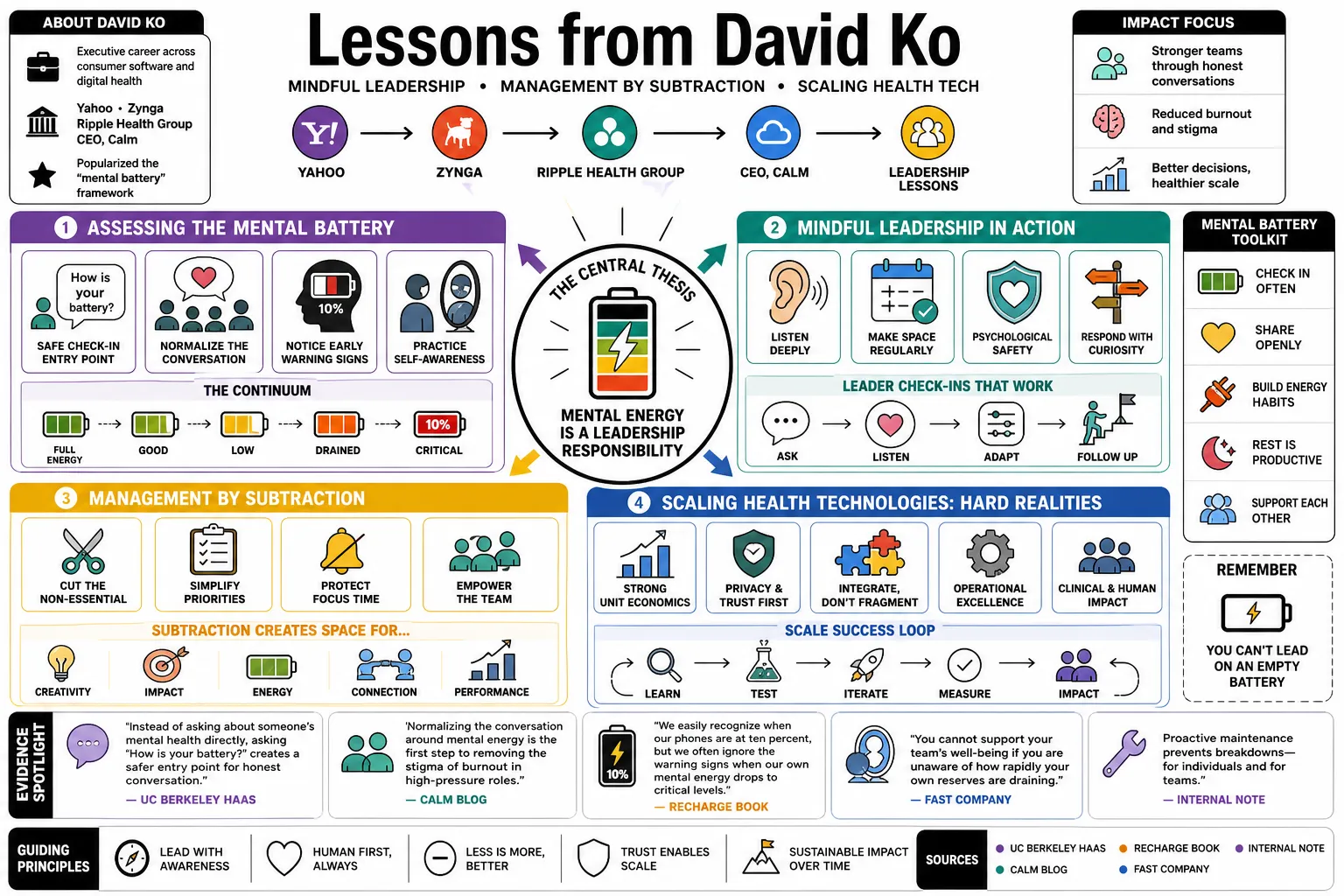
Lessons from David Ko
David Ko is the former CEO of Calm. This collection gathers his own words from interviews. — Former Calm CEO: How to retain your humanity and embrace AI (Axios).
Part 1: Assessing the Mental Battery
- On internal battery checks: David Ko: "I stay centered now by doing frequent internal battery checks — asking myself, What’s my charge level today, and what do I need to do to recharge it?" — Calm CEO David Ko on How to Recharge at Work (Katie Couric Media; his answers).
- On stepping back and asking for help: David Ko: "And it’s OK to take a step back to figure out how you reset and ask for help." — 5 Takeaways from Calm Your Mind to Thrive at Work (Calm Health; his quoted words).
- On operating at about 20%: David Ko: "Most leaders, like in this room, are operating at about 20%." — Calm CEO: Most business leaders are operating at ‘about 20%’ (Fortune; his quoted words).
- On panic attacks at fourteen: David Ko: "I started having panic attacks when I was 14, but I didn’t understand what was happening until decades later." — Calm CEO David Ko on How to Recharge at Work (Katie Couric Media; his answers).
- On having the language: David Ko: "Calm gave me the language to name what I had long experienced as stress and anxiety." — Calm CEO David Ko on How to Recharge at Work (Katie Couric Media; his answers).
- On support at all levels: David Ko: "If we really want to have conversations around mental health and the workplace, it’s got to be supported at all levels." — How leaders at Rare Beauty and Calm put human connection at the core of their companies (Fast Company; his quoted words).
- On outcomes: David Ko: "We don’t talk enough about outcomes." — 5 Takeaways from Calm Your Mind to Thrive at Work (Calm Health; his quoted words).
- On a friend asking how your battery is: David Ko: "If one friend at work can have a conversation with you about how’s your battery and can really talk to you and understand you, you’re so much happier at work." — How's your battery? Calm CEO David Ko on normalizing mental health at work (Berkeley Haas Culture Kit podcast; his turns).
- On prioritizing your own mental health: David Ko: "If you prioritize your own mental health, it will help you actually, as it’s helped me to be a better leader, because if I don’t prioritize my mental health, it’s really hard for me to lead in the best manner for the company." — How's your battery? Calm CEO David Ko on normalizing mental health at work (Berkeley Haas Culture Kit podcast; his turns).
- On normalizing it at home: David Ko: "Today, I think one of the things I would do very differently is, I have two daughters who are 17 and 14, I’ve had conversations about their mental health since a very early age because I wanted to normalize the conversation and have it in our home." — How's your battery? Calm CEO David Ko on normalizing mental health at work (Berkeley Haas Culture Kit podcast; his turns).
Part 2: The Art of Subtraction in Leadership
- On taking a break to recharge: David Ko: "When I’m in the office and there are times where I feel I can’t be present, I will prioritize and take a break to recharge for myself." — How's your battery? Calm CEO David Ko on normalizing mental health at work (Berkeley Haas Culture Kit podcast; his turns).
- On full throttle and pausing: David Ko: "Leadership is about recognizing when to go full throttle and when to pause." — Calm CEO David Ko on How to Recharge at Work (Katie Couric Media; his answers).
- On getting out of gear: David Ko: "Jack Rowe, former CEO of Aetna, once told me that he used to schedule time to “get out of gear and into neutral.” He knew if he didn’t carve out time to think, he’d crash." — Calm CEO David Ko on How to Recharge at Work (Katie Couric Media; his answers).
- On making time to recharge: David Ko: "We don’t grow if we don’t challenge ourselves — but we also can’t keep pushing without making time to recharge." — Calm CEO David Ko on How to Recharge at Work (Katie Couric Media; his answers).
Part 3: Leading with Influence, Not Authority
- On leading from authority: David Ko: "I felt, when I first started managing, whether it was one individual, hundreds, or thousands, I always felt like I needed to make sure I was heard and sometimes lead from authority." — How's your battery? Calm CEO David Ko on normalizing mental health at work (Berkeley Haas Culture Kit podcast; his turns).
Part 4: The Chief Listening Officer
- On the first 30 days: David Ko: "Take the first 30 days to just listen." — What’s the biggest mistake you’ve made starting a new job? (LinkedIn News, Milken Institute Global Conference; his quoted words).
- On tempering your intuition: David Ko: "Temper your own intuition about making change right away." — What’s the biggest mistake you’ve made starting a new job? (LinkedIn News, Milken Institute Global Conference; his quoted words).
- On talking first and listening second: David Ko: "I thought that was great because so many CEOs want to talk first and listen second." — How's your battery? Calm CEO David Ko on normalizing mental health at work (Berkeley Haas Culture Kit podcast; his turns).
- On curiosity: David Ko: "It’s the one trait that tells me someone will grow with the company." — Calm CEO David Ko on How to Recharge at Work (Katie Couric Media; his answers).
- On people hungry to learn: David Ko: "I want to work with people who are hungry to learn, unafraid to ask questions, and excited by change." — Calm CEO David Ko on How to Recharge at Work (Katie Couric Media; his answers).
- On giving everyone a voice: David Ko: "I want to hear everyone else’s opinion so that everyone feels like they’ve got a voice in the room." — How's your battery? Calm CEO David Ko on normalizing mental health at work (Berkeley Haas Culture Kit podcast; his turns).
- On the Chief Listening Officer: David Ko: "In my management meetings, I’ve taken advice from John Sculley, the former CEO of Apple, who said, his title was not CEO, but Chief Listening Officer." — How's your battery? Calm CEO David Ko on normalizing mental health at work (Berkeley Haas Culture Kit podcast; his turns).
Part 5: Vulnerability as Strength
- On powering through: David Ko: "Early on, I tried to “power through” challenges the way I had growing up." — Calm CEO David Ko on How to Recharge at Work (Katie Couric Media; his answers).
- On modeling vulnerability: David Ko: "I didn’t always model vulnerability because I thought leadership meant showing certainty." — Calm CEO David Ko on How to Recharge at Work (Katie Couric Media; his answers).
- On sharing challenges: David Ko: "But I’ve come to see that sharing challenges and bringing more people into the fold isn’t weakness — it builds trust." — Calm CEO David Ko on How to Recharge at Work (Katie Couric Media; his answers).
- On sharing your own experiences: David Ko: "I will tell you as a leader, it is so important that we start by sharing some of our own experiences because we then open the door for others to do the same." — 5 Takeaways from Calm Your Mind to Thrive at Work (Calm Health; his quoted words).
- On opening up dialogue: David Ko: "What I started to do was to open up dialogue around [my mental health], show my own vulnerability and talk about what I have been through." — How leaders at Rare Beauty and Calm put human connection at the core of their companies (Fast Company; his quoted words).
- On admiring empathy: David Ko: "I’ve always admired Satya Nadella for how he transformed Microsoft’s culture through empathy." — Calm CEO David Ko on How to Recharge at Work (Katie Couric Media; his answers).
- On kindness and performance: David Ko: "He showed me that kindness and performance aren’t mutually exclusive." — Calm CEO David Ko on How to Recharge at Work (Katie Couric Media; his answers).
Part 6: Scaling Thoughtfully
- On trusted brands: David Ko: "What really stands out are trusted brands, and that trust has to be earned." — 5 Takeaways from Calm Your Mind to Thrive at Work (Calm Health; his quoted words).
- On too many apps: David Ko: "There are just so many apps out there today that we can choose from." — 5 Takeaways from Calm Your Mind to Thrive at Work (Calm Health; his quoted words).
- On being tested on mission and culture: David Ko: "You’ll get tested to see if your mission statement, your culture of everything is going to hold it." — How's your battery? Calm CEO David Ko on normalizing mental health at work (Berkeley Haas Culture Kit podcast; his turns).
- On using data to improve: David Ko: "We want to use the data to continue to evolve, to make the product better, so that ultimately we can make you healthier and be with you in your mental health journey every step of the way." — How leaders at Rare Beauty and Calm put human connection at the core of their companies (Fast Company; his quoted words).
- On phones and rest: David Ko: "The problem is, none of it is truly relaxing." — Calm CEO David Ko on How to Recharge at Work (Katie Couric Media; his answers).
- On a mindful relationship with devices: David Ko: "Our goal is to help people build a mindful relationship with their devices, one that leaves them feeling better, not worse." — Calm CEO David Ko on How to Recharge at Work (Katie Couric Media; his answers).
- On you-stress and shared purpose: David Ko: "You-stress is actually when you have shared purpose, you understand why, what you’re doing." — How's your battery? Calm CEO David Ko on normalizing mental health at work (Berkeley Haas Culture Kit podcast; his turns).
Part 7: Career Paths and Taking Risks
- On staying linear in a career: David Ko: "I tell you that because people, like, sometimes stay very linear in their careers." — How's your battery? Calm CEO David Ko on normalizing mental health at work (Berkeley Haas Culture Kit podcast; his turns).
- On finding purpose in healthcare: David Ko: "I feel like I’ve found that purpose in healthcare, especially around mental health." — How's your battery? Calm CEO David Ko on normalizing mental health at work (Berkeley Haas Culture Kit podcast; his turns).
- On being the youngest in the room: David Ko: "Sometimes, when you’re the youngest person in the room, you feel like you’ve got to almost overperform because you’re the youngest person in the room." — How's your battery? Calm CEO David Ko on normalizing mental health at work (Berkeley Haas Culture Kit podcast; his turns).
- On going to talk to a nurse: David Ko: "Meaning, I was given great advice by a lot of CEOs that said, if you’re going to talk to anyone in healthcare, if you’re going to start, go talk to a nurse." — How's your battery? Calm CEO David Ko on normalizing mental health at work (Berkeley Haas Culture Kit podcast; his turns).
Part 8: The Power of Human Connection
- On a phone as a lifeline: David Ko: "For those without access to traditional mental health care, a phone can be a lifeline that delivers tools to improve well-being." — Calm CEO David Ko on How to Recharge at Work (Katie Couric Media; his answers).
- On a safe space for rest: David Ko: "Calm offers a safe space where people can use their phones for genuine rest and recovery." — Calm CEO David Ko on How to Recharge at Work (Katie Couric Media; his answers).
- On leaving because of AI: David Ko: "If we didn't have AI, I would not leave." — Former Calm CEO: How to retain your humanity and embrace AI (Axios; his quoted words).
- On not repeating the mistake: David Ko: "Let's not make that same mistake twice with something that's moving twice as fast." — Former Calm CEO: How to retain your humanity and embrace AI (Axios; his quoted words).