David Packard co-founded Hewlett-Packard in a one-car garage in 1939, building it into an engineering giant and defining the early culture of Silicon Valley. He is best known for creating "The HP Way," a management framework focused on employee autonomy, decentralized decision-making, and corporate responsibility. This collection compiles his specific advice on building organizations, managing people, and contributing to society.
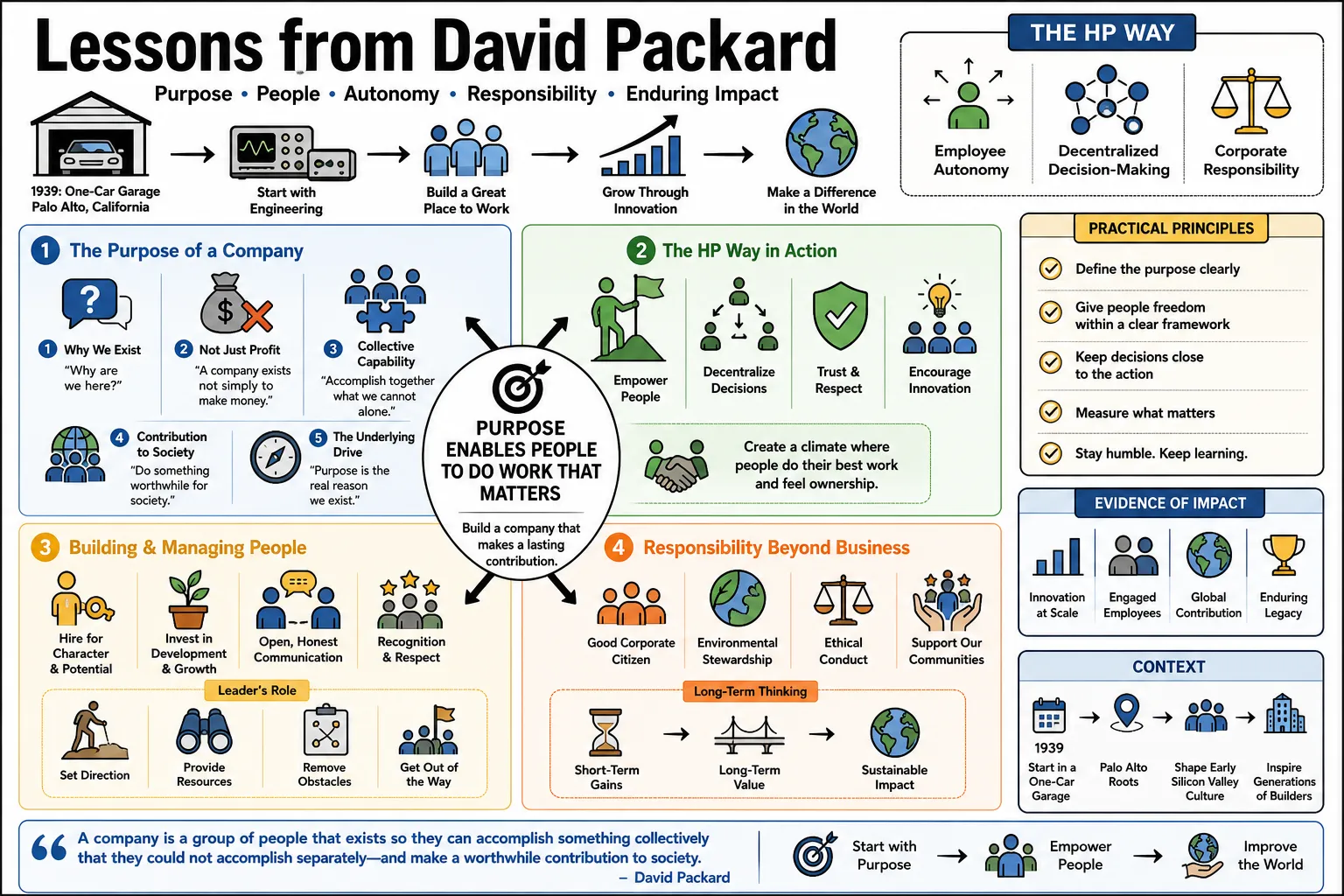
Part 1: The Purpose of a Company
- On organizational existence: "I want to discuss why a company exists in the first place. In other words, why are we here?" — Source: [1960 Speech to Managers]
- On profit versus purpose: "I think many people assume, wrongly, that a company exists simply to make money." — Source: [1960 Speech to Managers]
- On collective capability: "A group of people get together and exist as an institution that we call a company so they are able to accomplish something collectively that they could not accomplish separately." — Source: [The HP Way]
- On societal contribution: "They are able to do something worthwhile, meaning they make a contribution to society, a phrase which sounds trite but is fundamental." — Source: [The HP Way]
- On the underlying drive: "While this is an important result of a company's existence, we have to go deeper and find the real reasons for our being. The underlying drive comes largely from a desire to do something." — Source: [1960 Speech to Managers]
- On betrayal of purpose: "A company that focuses solely on profits ultimately betrays both itself and society." — Source: [Forbes Interview Archive]
- On building an institution: "Set out to build a company and make a contribution, avoiding the temptation to build an empire and a fortune." — Source: [HP Corporate Archives]
- On long-term perspective: "The margin we have is the source of our capital for growth, but it is never the sole objective of our operations." — Source: [1960 Speech to Managers]
- On maintaining character: "Profitability determines whether we can continue to grow, keep an efficient organization, and maintain our company's character as we scale." — Source: [The HP Way]
- On human dignity in business: "A company has a responsibility beyond making a profit for stockholders. It has a responsibility to recognize the dignity of its employees as human beings." — Source: [The HP Way]
Part 2: Management by Objectives and Trust
- On decentralization: "If you provide people with the right goals, resources, and conditions, you can turn them loose and trust them to achieve those goals in a common direction." — Source: [HP Corporate Archives]
- On trusting employees: "It has always been important to Bill and me to create an environment in which people have a chance to be their best." — Source: [The HP Way]
- On objective setting: "Management by objective relies on giving individuals a clear understanding of the company's goals and the autonomy to figure out the details of execution." — Source: [The HP Way]
- On top-down control: "Strict top-down control stifles the creativity and expertise that frontline workers bring to their daily tasks." — Source: [Stanford Engineering Legacy]
- On the manager's role: "The job of a manager is to support his or her staff, and that begins by being among them." — Source: [HP Corporate Archives]
- On management by walking around: "True insight into organizational health requires leaving the office, observing operations, and engaging with employees directly without relying solely on formal reports." — Source: [The HP Way]
- On humane management: "The best business decisions are the most humane decisions. All other talents being even, the greatest managers are also the most human managers." — Source: [Forbes Interview Archive]
- On employee motivation: "When people are treated with trust and respect, they naturally become more motivated, innovative, and deeply loyal to the organization." — Source: [HP Corporate Archives]
- On open communication: "An environment where any employee can raise an issue without fear of retaliation is essential for identifying problems before they threaten the business." — Source: [The HP Way]
Part 3: Innovation and Engineering
- On technical originality: "Make a technical contribution. Innovate, don't emulate." — Source: [HP Corporate Archives]
- On practical utility: "To be useful an invention must fill a real need and serve as an economical, efficient solution to that need." — Source: [The HP Way]
- On taking risks: "The greatest success goes to the person who is not afraid to fail in front of even the largest audience." — Source: [Forbes Interview Archive]
- On the six-to-one rule: "Engineering projects should target an expected lifetime profit that is at least six times the initial development cost." — Source: [1960 Speech to Managers]
- On the true value of research: "The most fundamentally innovative products often exceed standard return metrics by the widest margins because they define entirely new markets." — Source: [Stanford Engineering Legacy]
- On rewarding defiance: "Sometimes you must reward extraordinary contempt and defiance beyond the normal call of engineering duty when an employee pursues a technically brilliant idea despite management skepticism." — Source: [The HP Way]
- On product uniqueness: "A company's success is rooted in designing and manufacturing products that are genuinely unique and provide superior value that customers cannot source elsewhere." — Source: [1960 Speech to Managers]
- On process innovation: "Companies must avoid being a one-trick pony. Sustained success requires looking beyond product innovation toward process improvements and new business models." — Source: [HP Corporate Archives]
- On engineering freedom: "Bureaucracy is the enemy of innovation. You must minimize rigid structures to let engineers experiment freely." — Source: [Stanford Engineering Legacy]
Part 4: Dealing with People and Leadership
- On prioritization in relationships: "Think first of the other person." — Source: [11 Simple Rules]
- On building confidence: "Build up the other person's sense of importance." — Source: [11 Simple Rules]
- On individual differences: "Respect the other person's personality rights." — Source: [11 Simple Rules]
- On recognizing good work: "Give sincere appreciations." — Source: [11 Simple Rules]
- On the danger of criticism: "Eliminate the negative, as constant criticism rarely changes behavior and almost always causes deep resentment." — Source: [11 Simple Rules]
- On accepting people: "Avoid openly trying to reform people." — Source: [11 Simple Rules]
- On empathy: "Try to understand the other person." — Source: [11 Simple Rules]
- On snap judgments: "Check first impressions, because early evaluations of a person's character or capability are often incomplete or wrong." — Source: [11 Simple Rules]
- On resolving dislike: "Follow Abraham Lincoln’s advice. I do not like that man, therefore, I shall get to know him better." — Source: [11 Simple Rules]
Part 5: Customers and Markets
- On the scope of marketing: "Marketing is too important to be left to the marketing department." — Source: [The HP Way]
- On selling solutions: "We are never selling hardware. We are selling solutions to customer problems." — Source: [HP Corporate Archives]
- On defining profit: "Profit is simply a measure of the contribution we have made to our customers." — Source: [1960 Speech to Managers]
- On cross-functional customer focus: "Every single employee in the company must understand how their work impacts the end customer's experience." — Source: [The HP Way]
- On identifying real needs: "Instead of pushing what you want to build, spend time observing customers to see the problems they do not even know they have." — Source: [Stanford Engineering Legacy]
- On maintaining quality: "Growth should never come at the expense of product reliability, because a broken promise to a customer is harder to repair than a broken machine." — Source: [The HP Way]
- On honest dealings: "Uncompromising integrity and open dealings are the only sustainable ways to earn the lasting trust of customers." — Source: [HP Corporate Archives]
- On value over price: "If you deliver a genuinely superior and unique solution, customers will recognize the value and be willing to pay for it." — Source: [The HP Way]
- On staying close to the market: "Managers cannot understand market shifts from inside a boardroom. They must go out and interact directly with the people using their products." — Source: [HP Corporate Archives]
- On customer service: "The relationship with a customer begins, rather than ends, when the sale is made." — Source: [The HP Way]
Part 6: Business Growth and Financial Discipline
- On overexpansion: "More businesses die from indigestion than starvation. I have observed the truth of that advice many times since then." — Source: [The HP Way]
- On self-funded growth: "Sustainable growth should be self-funded rather than fueled by taking on excessive amounts of debt." — Source: [1960 Speech to Managers]
- On managing scale: "Taking on more opportunities than a company can effectively manage is a faster route to failure than lacking opportunities altogether." — Source: [The HP Way]
- On steady pacing: "We must be willing to walk away from rapid, short-term expansion if it threatens our long-term stability and financial independence." — Source: [HP Corporate Archives]
- On investing in the future: "Prioritize reinvesting profits into people, research, and development to ensure value creation decades into the future." — Source: [1960 Speech to Managers]
- On market share versus profitability: "Seeking market share just for the sake of size is a mistake. Volume without healthy margins ultimately weakens the enterprise." — Source: [The HP Way]
- On structural efficiency: "As an organization scales, you must fight ruthlessly to prevent administrative overhead from outpacing the productive output of the business." — Source: [Stanford Engineering Legacy]
- On economic downturns: "A conservatively financed balance sheet is what allows a company to keep its workforce intact and continue innovating during inevitable economic recessions." — Source: [The HP Way]
- On capital allocation: "The profit margin we generate is simply the internal cost of our future growth." — Source: [1960 Speech to Managers]
Part 7: Corporate Social Responsibility and Philanthropy
- On community obligation: "A company has a responsibility to the well-being of the community at large, separate from its obligations to immediate stakeholders." — Source: [The HP Way]
- On shared responsibility: "The betterment of society is a job that cannot be left to a few. It is a responsibility to be shared by all." — Source: [David and Lucile Packard Foundation]
- On the role of philanthropy: "Private philanthropy must serve as a powerful and necessary complement to government, civil society, and the private sector." — Source: [David and Lucile Packard Foundation]
- On civic action: "Business leaders have a moral obligation to engage in public service and civic action to improve the environments in which they operate." — Source: [HP Corporate Archives]
- On inclusive progress: "A healthy society requires that everyone has the opportunity to flourish, which means investing heavily in education and community support." — Source: [David and Lucile Packard Foundation]
- On the limits of government: "Corporations and foundations must step in to solve local problems because centralized government cannot efficiently address every community need." — Source: [Stanford Engineering Legacy]
- On environmental stewardship: "Long-term prosperity is impossible if we deplete the natural resources and environmental health of the communities we live in." — Source: [David and Lucile Packard Foundation]
- On investing in youth: "The most effective philanthropic investments a society can make are those focused on the well-being and education of children and families." — Source: [David and Lucile Packard Foundation]
- On ethical operations: "The health of a business is inextricably linked to the health and trust of the society in which it operates. You cannot have one without the other." — Source: [HP Corporate Archives]
Part 8: Personal Character and Rules for Life
- On small gestures: "Take care of little details. A tone of voice, a smile, or remembering names often matters more than grand statements." — Source: [11 Simple Rules]
- On genuine interest: "Develop genuine interest in people as the foundational bedrock for any successful relationship." — Source: [11 Simple Rules]
- On maintaining integrity: "Uncompromising personal integrity is the one asset that, once lost, can almost never be bought back." — Source: [The HP Way]
- On humility: "The most effective leaders do not need to be the loudest voice in the room. They let the results of their teams speak for them." — Source: [Stanford Engineering Legacy]
- On hard work: "There is absolutely no substitute for showing up early, staying late, and sweating the details alongside your team." — Source: [HP Corporate Archives]
- On continuous learning: "Never assume you have all the answers. The moment you stop asking questions is the moment your competence begins to decline." — Source: [Forbes Interview Archive]
- On facing failure: "When you make a mistake, admit it openly, learn the lesson quickly, and move forward without shifting the blame to others." — Source: [The HP Way]
- On fairness: "Treat the person sweeping the floor with the exact same level of respect and attention as the person sitting in the executive suite." — Source: [HP Corporate Archives]
- On simplicity: "Complex management theories are often useless in practice. Rely instead on simple, honest communication and common sense." — Source: [The HP Way]
- On leaving a legacy: "At the end of your life, you will not be measured by the wealth you accumulated, but by the institutions you built and the people you helped succeed." — Source: [David and Lucile Packard Foundation]