David Vélez is the founder and CEO of Nubank. This collection gathers his own words from interviews. — Seven Questions with David Vélez (Sequoia).
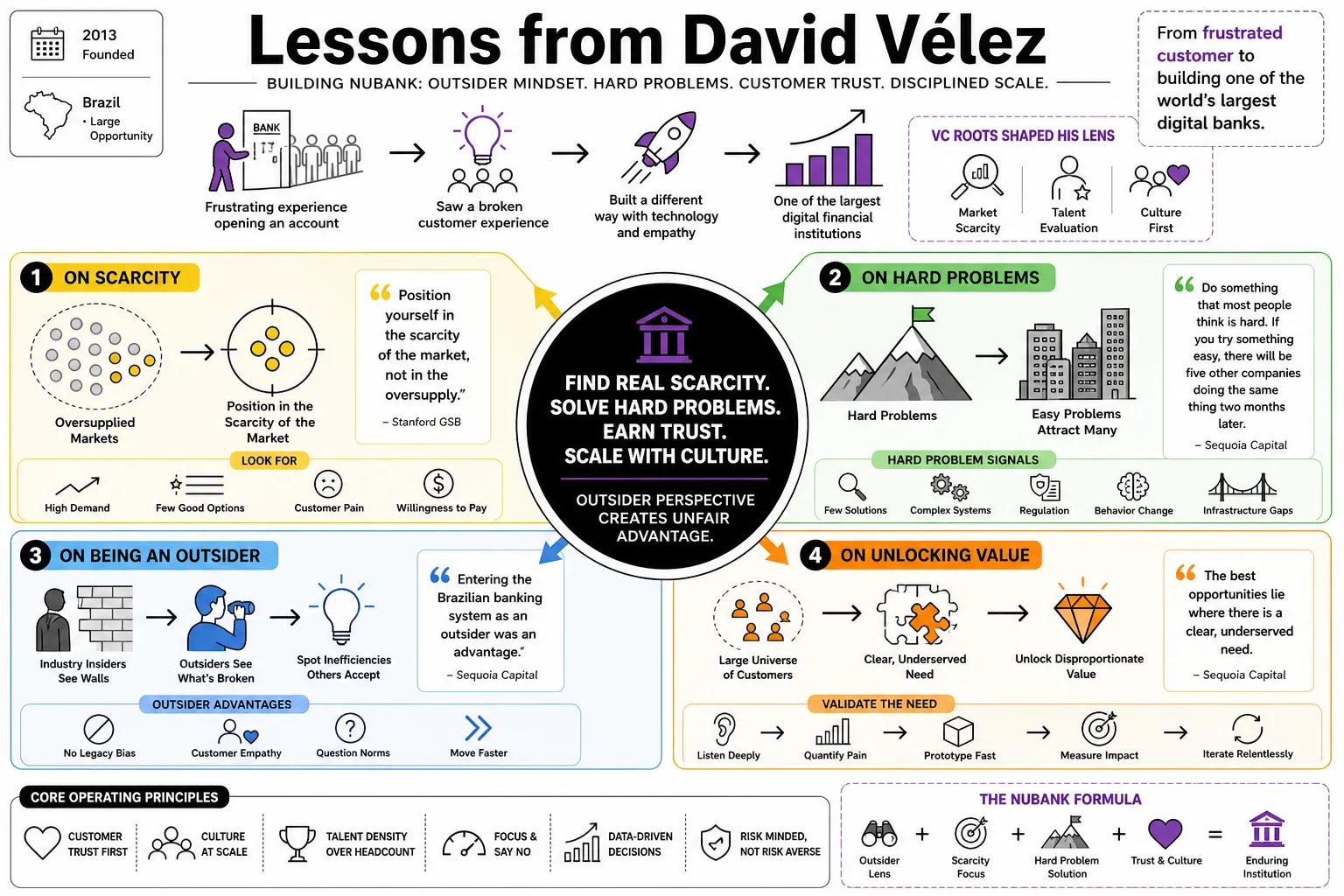
Part 1: The Opportunity and The Outsider Advantage
- On financial services as an opportunity: David Vélez: "Financial services, I would say, is probably the most underappreciated opportunity in technology around the world." — Nubank: The Missionaries of Modern Banking (podcast transcript; David Vélez's turns).
- On doing something hard: David Vélez: "Do something that most people think is hard." — Sequoia: Seven Questions with David Vélez (his answers).
- On being an outsider: David Vélez: "Being an outsider, I think it was helpful in that, perhaps at times, it gives you a little bit of naïvety." — Nubank: The Missionaries of Modern Banking (podcast transcript; David Vélez's turns).
- On impact over ease: David Vélez: "It might as well be something impactful, that made a difference, versus something easy that everybody could copy." — Deep Purpose podcast (David Vélez's turns).
- On a bad day at the bank: David Vélez: "They asked me to put all my stuff in a locker outside the branch, to then come back in, then waiting 45 minutes, it took until somebody who had no interest really, in helping me, and he clearly let me know with his attitude." — Deep Purpose podcast (David Vélez's turns).
- On using the money now: David Vélez: "Why would you not use all that money now to solve those issues?" — Stanford GSB View From The Top: David Vélez (his turns).
- On not knowing how hard it might be: David Vélez: "You don’t really know how hard it might be and you don’t know fully what you’re getting yourself into." — Nubank: The Missionaries of Modern Banking (podcast transcript; David Vélez's turns).
- On experts who said impossible: David Vélez: "A lot of the local experts, the former COO of a Brazilian bank, the expert in banking, all of them were basically saying, “No, impossible,” and they had their own arguments." — Deep Purpose podcast (David Vélez's turns).
- On a pair of cows: David Vélez: "I decided that the best investment and the best startup I could do was buying a pair of cows, because the cows multiply themselves." — Deep Purpose podcast (David Vélez's turns).
- On a conference before business school: David Vélez: "I remember right before business school going to a conference in New York, a venture capital conference, Latin America venture capital conferences and seeing one day eight private equity funds in Latin America pitching their fund." — Stanford GSB View From The Top: David Vélez (his turns).
Part 2: Challenging the Incumbents
- On a commoditized oligopoly: David Vélez: "Fully commoditised industry, big oligopoly, where you have five banks that own 85% of the investments, credit card, insurance." — Nubank: The Missionaries of Modern Banking (podcast transcript; David Vélez's turns).
- On companies that take customers hostage: David Vélez: "We were very mad, we were upset about these big companies, not only banks, big companies that ultimately take their customers as hostage, and use a lot of complexity, a lot of fees, to keep [inaudible 00:22:38] more hostages." — Deep Purpose podcast (David Vélez's turns).
- On bringing more competition: David Vélez: "So if I manage to figure out how to bring more competition to that industry, make it 5, 10 percent better by competing with these five giants, then the impact of that was going to spread around to an entire region." — Stanford GSB View From The Top: David Vélez (his turns).
- On David versus Goliath: David Vélez: "When a Latin America or Brazilian investor hears the story of David versus Goliath, they run as fast as possible." — Nubank: The Missionaries of Modern Banking (podcast transcript; David Vélez's turns).
- On copycat startups: David Vélez: "At some point, there were 3,000 clones of Groupon in Brazil, and this happened over a six-month period." — Deep Purpose podcast (David Vélez's turns).
- On what the cloud made possible: David Vélez: "The cloud and AWS enabled me to open a bank, have a bank infrastructure from scratch with a couple of hundred thousand dollars." — Nubank: The Missionaries of Modern Banking (podcast transcript; David Vélez's turns).
- On the cost three years earlier: David Vélez: "If I had tried to do this three years before, I would have needed $14 million to buy mainframes from IBM." — Nubank: The Missionaries of Modern Banking (podcast transcript; David Vélez's turns).
- On expensive branches: David Vélez: "And the basic insight was these branches, and this infrastructure, and this huge hierarchy of the big banks is just too expensive." — Deep Purpose podcast (David Vélez's turns).
- On serving customers efficiently: David Vélez: "Just to give you one data point, today we have 54 million customers, that we serve with about 6,000 employees, where competitors in Brazil had also around 50 million customers, and they had over 100,000 employees." — Deep Purpose podcast (David Vélez's turns).
- On fear in the environment: David Vélez: "There was a lot of fear in the environment, about competing with these big banks, and that’s why nobody had even tried it to do." — Deep Purpose podcast (David Vélez's turns).
Part 3: Customer Obsession as a Strategy
- On who customers choose: David Vélez: "We love that view because ultimately, if you think about an environment of alternatives it’s very simple, customers will choose whoever treats them the best and gives them t he lowest price." — Nubank: The Missionaries of Modern Banking (podcast transcript; David Vélez's turns).
- On a number one cultural value: David Vélez: "And we set that as our number one cultural value which is we want to customers to love us fanatically." — Nubank: The Missionaries of Modern Banking (podcast transcript; David Vélez's turns).
- On naming the enemy: David Vélez: "We discussed a lot, and we decided ultimately, the enemy was going to be complexity in financial services and beyond, and that’s what really brings people passion for what they do." — Deep Purpose podcast (David Vélez's turns).
- On the wrong product at the wrong price: David Vélez: "If we provide the wrong product at the wrong price for the customer, that customer will be in massive debt, but we also lose a very great customer that we could have in our base." — Stanford GSB View From The Top: David Vélez (his turns).
- On actions speaking louder than words: David Vélez: "It’s actions speak louder than words, and for us, this was a value that we, in the early days, when we had about three people, we set up in fact a culture deck." — Deep Purpose podcast (David Vélez's turns).
- On saying it versus doing it: David Vélez: "It’s hard when you’re faced with those actual dilemmas, of making more money or prioritizing the customer." — Deep Purpose podcast (David Vélez's turns).
- On permission to act: David Vélez: "And it was the easiest conversation because there was a cultural value that gave everybody in the organization the permission to act that way." — Deep Purpose podcast (David Vélez's turns).
- On creating scarcity: David Vélez: "So that started to created this sense of scarcity in the market where people would go to social media to ask for an invite." — Nubank: The Missionaries of Modern Banking (podcast transcript; David Vélez's turns).
- On a toy for the dog: David Vélez: "Somebody called saying my dog ate the credit card, I need a new credit card, and our customer service team would send the credit card and they would send a toy for the dog and a handwritten letter saying, hope you enjoy it, have fun." — Nubank: The Missionaries of Modern Banking (podcast transcript; David Vélez's turns).
Part 4: Building the Right Culture Early
- On culture built in the first six months: David Vélez: "The other thing I heard a lot about at Sequoia that I was able to learn when I was sitting in front of this entrepreneur was hearing a lot saying the culture of a company was built in the first six months by the first 10 to 15 people." — Stanford GSB View From The Top: David Vélez (his turns).
- On culture and hiring: David Vélez: "There’s nothing more important because culture allows you to hire people." — Stanford GSB View From The Top: David Vélez (his turns).
- On culture aligned with business objectives: David Vélez: "And that exemplifies very well what we think, which is ultimately this culture is aligned with business objectives." — Stanford GSB View From The Top: David Vélez (his turns).
- On corrupted hierarchy: David Vélez: "So I think that’s when your organization hierarchy ends up being a bit corrupted because it’s just more ego and power and titles that are driving a lot of layers rather than doing the right thing for the organization." — Stanford GSB View From The Top: David Vélez (his turns).
- On actions speaking louder: David Vélez: "So, ultimately, that is a very powerful example internally and shows the integrity of the culture, which is actions speak louder than words." — Stanford GSB View From The Top: David Vélez (his turns).
- On the monthly culture deck: David Vélez: "Every month, I present this culture deck with the values to every single person, from the customer service, the receptionist to the engineer." — Stanford GSB View From The Top: David Vélez (his turns).
- On treating employees like owners: David Vélez: "Part of our culture was treating everybody like an owner and a partner, and that means being very transparent with our employees." — Nubank (Crucible Moments podcast; David Vélez's turns).
- On hierarchies for the wrong purposes: David Vélez: "What’s not good are hierarchies that are created sometimes for other purposes rather than doing the right thing for the organization or doing the right thing for the product." — Stanford GSB View From The Top: David Vélez (his turns).
- On self-selection: David Vélez: "It created the perfect self-selection, in that it biased the people that were courageous enough to go after these giants, and go fight this fight." — Deep Purpose podcast (David Vélez's turns).
Part 5: Hiring, Teams, and Leadership
- On not trusting great hires: David Vélez: "I realized I’d been hiring all these great people and then basically not trusting them from day one." — Sequoia: Seven Questions with David Vélez (his answers).
- On finding people with skills I lack: David Vélez: "I got to find people to bring on board that had the level of experience and skillset that I don’t have." — Deep Purpose podcast (David Vélez's turns).
- On who walks in the door: David Vélez: "And there was another type of people that would go in, yes, this seems a little bit odd but they would go in." — Nubank: The Missionaries of Modern Banking (podcast transcript; David Vélez's turns).
- On the job of building a team: David Vélez: "But his conclusion was therefore your number one job is finding a team that is going to fill all the different gaps that you have in your experience." — Nubank: The Missionaries of Modern Banking (podcast transcript; David Vélez's turns).
- On being part of something bigger: David Vélez: "I think people need to feel that they’re part of something bigger than themselves, and work with great people, smart people, that are all feel part of a mission that goes beyond just getting a paycheck." — Deep Purpose podcast (David Vélez's turns).
- On the courageous gene: David Vélez: "So that DNA, let’s call it the courageous gene, was part of those first 10, 15 employees, part of the culture." — Deep Purpose podcast (David Vélez's turns).
- On hiring the next hundred: David Vélez: "And once you have those first, ten, 15 people then you bring the next 100 that are consistent with those first 15 people and they help you interview them." — Nubank: The Missionaries of Modern Banking (podcast transcript; David Vélez's turns).
- On rethinking a policy: David Vélez: "One of my co-founders eventually came to me and encouraged me to rethink the policy." — Sequoia: Seven Questions with David Vélez (his answers).
- On insiders and outsiders: David Vélez: "Being an outsider is great, you’ve found the opportunity, but you’re going to need to be an insider also to be able to execute." — Nubank: The Missionaries of Modern Banking (podcast transcript; David Vélez's turns).
- On looking for insiders: David Vélez: "And so what we’ve increasingly done and as we scale the organization, we’ve been actively more looking for those insiders that can help us reinvent." — Stanford GSB View From The Top: David Vélez (his turns).
Part 6: Strategy, Risk, and Decision Making
- On doing something hard: David Vélez: "And what was interesting also is that doing something hard, challenging, ended up being actually easier at the end." — Nubank: The Missionaries of Modern Banking (podcast transcript; David Vélez's turns).
- On less competition for hard things: David Vélez: "Competition will be lower, because everyone else thought it was too hard." — Sequoia: Seven Questions with David Vélez (his answers).
- On thinking time: David Vélez: "I wasn’t spending enough time thinking about the next week, or month, or quarter." — Sequoia: Seven Questions with David Vélez (his answers).
- On changing a policy: David Vélez: "Even though I’d focused so much energy on punctuality, the moment we changed that policy, I really let it go." — Sequoia: Seven Questions with David Vélez (his answers).
- On raising from the best investors: David Vélez: "It’s easier to raise capital from the best investors, because the best investors want to be backing something that is hard." — Nubank: The Missionaries of Modern Banking (podcast transcript; David Vélez's turns).
- On making the hard decisions: David Vélez: "I wanted to be the one that was making the hard decisions, not necessarily telling them what to do, but actually doing it myself." — Stanford GSB View From The Top: David Vélez (his turns).
- On backing low-probability stories: David Vélez: "That’s what they want to be doing with their time, with their capital, backing those stories that might be low probability of success but, if they work out, they will reinvent an entire industry." — Nubank: The Missionaries of Modern Banking (podcast transcript; David Vélez's turns).
- On a list of key goals: David Vélez: "I keep a list of our key goals and the things that need to happen to get us there, and I go through it a couple of times every week.Every Friday when I go home, I know whether we moved the needle.Most of the time, we have, and I can’t wait to come back on Monday and see what we’re going to do next." — Sequoia: Seven Questions with David Vélez (his answers).
- On Mastercard timelines: David Vélez: "So, this meant that we had to go to Mastercard and every time they told us, “Well, it’s going to get 30 days to get back on you.” We said, “No, no, no, no, no." — Nubank (Crucible Moments podcast; David Vélez's turns).
Part 7: Personal Growth and Management
- On protecting time: David Vélez: "Now I try to protect one hour in the morning and one in the afternoon where I turn off Slack, and I don’t check email." — Sequoia: Seven Questions with David Vélez (his answers).
- On delivery over schedule: David Vélez: "We have metrics and processes to tell us whether someone is delivering, and that’s what we focus on, not some arbitrary schedule I came up with." — Sequoia: Seven Questions with David Vélez (his answers).
- On crystallizing purpose: David Vélez: "I would say my purpose has… I’ve been able to crystallize it over the past 10 years, and I’ve come to realize that to me, what matters is first, it’s impact." — Deep Purpose podcast (David Vélez's turns).
- On the single hardest thing: David Vélez: "And given that’s what I was about to do, then I wanted to focus on the single -hardest thing I could possibly imagine, the single thing that could have the most impact." — Nubank: The Missionaries of Modern Banking (podcast transcript; David Vélez's turns).
- On giving it all while alive: David Vélez: "And we went through a bit of a logic, a lot of thinking process, and we concluded that the right thing for us to do was give it all while we’re still alive." — Deep Purpose podcast (David Vélez's turns).
- On credit underwriting: David Vélez: "The other parts that I think was ultimately hard was, in financial services at least, credit underwriting is fundamentally hard." — Deep Purpose podcast (David Vélez's turns).
- On fire: David Vélez: "You can do great things with fire, but you can also get burned really badly, and that’s why most fintechs globally, or even most new banks, started with payments first, and then they went to credit." — Deep Purpose podcast (David Vélez's turns).
- On building a consumer-obsessed culture: David Vélez: "It’s hard, number one, to build a culture that is consumer obsessed, because ultimately, that’s what drives product development, and that’s what drives a user acquisition that is effectively zero." — Deep Purpose podcast (David Vélez's turns).
- On time as the scarce resource: David Vélez: "So time was the most scarce resources and we were all in 24/7 trying to figure out obstacles as things came up." — Nubank: The Missionaries of Modern Banking (podcast transcript; David Vélez's turns).
Part 8: Long-Term Vision and Impact
- On wanting to build and have impact: David Vélez: "We did Nubank, as I said, because we wanted to build, we wanted to problem solve, we wanted to create an impact." — Stanford GSB View From The Top: David Vélez (his turns).
- On people who need help: David Vélez: "There is a lot of people that don’t have to eat, that have been waiting for six months to get a surgery in a hospital, that don’t know how to put their kids through school." — Deep Purpose podcast (David Vélez's turns).
- On allocating society’s capital: David Vélez: "Let’s allocate this capital that society owns, on society’s behalf on a better way than simply leaving it somewhere yielding some interest rates for the next 40 years." — Deep Purpose podcast (David Vélez's turns).
- On philanthropy: David Vélez: "And so philanthropy and social impact, giving back, plays a role." — Stanford GSB View From The Top: David Vélez (his turns).
- On Latin Americans building their own companies: David Vélez: "If you solve it, then you have all Latin Americans building their own programming and design and product, creating the next companies they’re going to be reinventing in this region." — Stanford GSB View From The Top: David Vélez (his turns).