Debbie Millman is a designer, author, educator and host of Design Matters. In her own interviews and talks, she describes branding as manufactured meaning and reflects on how courage, rejection and deliberate choices shaped her creative career. — Debbie Millman Bio.
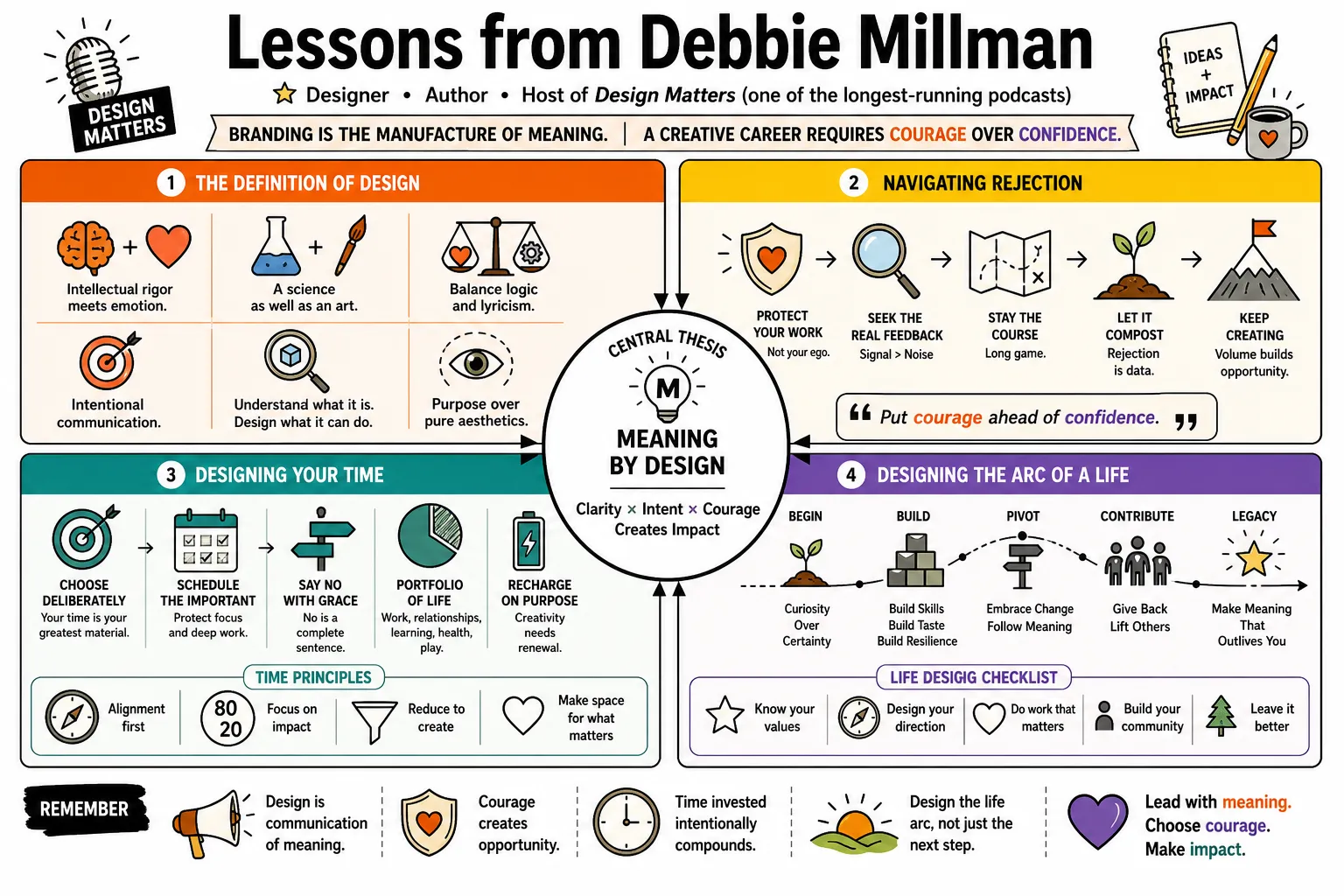
Part 1: The Definition of Design
- Balance Analysis and Feeling: Millman treats branding and design as more than visual styling: they draw on behavioral understanding, strategy and creativity to give meaning to what people see. — NPR Design Interview.
- Communicate Meaning Intentionally: Millman describes design as the intentional communication of meaning built through branding. — Brandingmag Presentation.
- Show What a Brand Can Do: In Millman’s distinction, branding establishes what something is, while design helps people sense what it can do. — Brandingmag Presentation.
- Look Beyond Appearance: Millman argues that designed symbols and communications shape how people interpret products, ideas and affiliations, not merely how they look. — NPR Design Interview.
- Research Before Presenting: Millman says she studies a potential client extensively and rehearses questions before presenting design work, so her proposal shows an understanding of that client. — Newfangled Interview.
- Read the Culture Around a Design: Millman describes visual symbols as a language that can signal shared beliefs and affiliations across communities. — NPR Design Interview.
- Allow a Career to Evolve: Millman describes her early design years as experiments, with chance encounters and failed attempts eventually informing later work. — The Great Discontent Interview.
Part 2: The Architecture of Branding
- Manufacture Meaning Deliberately: Millman defines branding as creating a construct around a thing that people come to recognize through agreed attributes. — Brandingmag Presentation.
- Use Branding Beyond Commerce: Millman argues that visual symbols can help social movements communicate beliefs and collective demands, not only sell products. — NPR Design Interview.
- Do Not Ask Brands for Self-Worth: Millman warns that branded possessions cannot provide a lasting sense of self, love or achievement. — Porchlight Q&A.
- Give a Brand a Reason to Exist: Millman says a strong brand begins with an inside-out intention and a reason to exist, before the visual details are designed. — Brandingmag Presentation.
Part 3: Courage Over Confidence
- Do Not Wait for Confidence: Millman cautions against waiting to feel confident before starting something new; confidence develops through doing, not beforehand. — IDEO U Interview.
- Build Confidence Through Repetition: Millman describes confidence as the result of successfully repeating an activity, using learning to drive as her example. — IDEO U Interview.
- Act Despite Possible Failure: Millman says courage is taking a first step without knowing whether it will succeed, even when rejection or failure is possible. — IDEO U Interview.
- Practice Courage Daily: Millman says she tries to live in courage rather than fear, while acknowledging that this is an effort every day. — Stay Brave Interview.
Part 4: Redefining Failure and Rejection
- Risk Is Part of Remarkable Work: Millman says remarkable work requires taking risks, because doing something uncertain exposes one to possible failure. — The Great Discontent Interview.
- Keep Trying After Setbacks: Millman says she once felt ashamed of failures, but now shares them to offer context and hope; she frames failure as stopping the attempt. — The Great Discontent Interview.
- Allow Rejection to Be Felt: On Radio Headspace, Millman says that when she is rejected for something important to her, she lets herself cry privately before processing the feeling. — Radio Headspace Transcript.
- Recognize Self-Doubt as a Cost: Looking back on her early career, Millman describes her lack of belief in pursuing original creative dreams as a major personal failure, while also saying she understands and does not regret her choices. — Fast Company Interview.
- Share the Less Impressive Parts: Millman argues that showing only successes gives an incomplete picture of creative work; honestly sharing failure and rejection can help others connect. — Emma Interview.
- Let Rejection Redirect the Work: Millman says a harsh 2003 blog post about her work became a catalyst for many of the projects she pursued afterward. — The Great Discontent Interview.
- Question the Safe Path: Millman says her early career was organized around avoiding failure and that self-imposed doubts kept her from taking risks she later wanted to take. — The Great Discontent Interview.
Part 5: The Arc of a Creative Career
- Expect Worthwhile Work to Take Time: Millman calls “everything worthwhile takes a long time” a personal mantra, shaped by how slowly many of her own projects developed. — Tim Ferriss Show Transcript.
- Begin Pursuing the Work You Love: In her “Fail Safe” essay and commencement advice, Millman urges readers to pursue work they love, imagine more ambitiously and begin now rather than waiting decades. — Fail Safe — Authorized Excerpt.
- Treat Busy as a Choice: Millman calls “Busy is a decision” her own design quote; in a later interview she explains it as a prompt to examine priorities rather than use busyness as an automatic excuse. — The Logo Creative Interview.
- Recognize Work Can Feel Like Play: Discussing her own balance between work and play, Millman says her podcasting and teaching felt joyful after she gained those opportunities in her forties; she does not present that experience as a rule against balance in one’s twenties or thirties. — Tim Ferriss Show Transcript.
- Design the Arc of Your Life: Millman uses a ten-year life-design exercise to help people imagine a future in concrete detail and reconsider what choices might lead there. — TED Interview Transcript.
- Expect a Messy Creative Process: Millman says her own creative process has no cookie-cutter formula: she begins with a vision, experiments, and keeps working even when ideas come slowly. — Tim Ferriss Show Transcript.
Part 6: Navigating Fear and Uncertainty
- Notice What Fear Reveals: Millman says the fear of not living up to her potential motivates her, even as she tries to choose courage over fear. — Stay Brave Interview.
- Make Room for Not Knowing: Millman’s “Six Degrees of Navigation” closes by saying she is comfortable not knowing how an experiment in life will turn out. — Six Degrees of Navigation.
- Do Not Presume a Life’s Outcome: Millman writes that a seemingly typical life may become something else, and that its historical meaning is not clear until the story has unfolded. — Six Degrees of Navigation.
- Revise Self-Imposed Codes: Millman argues that the internal “codes” by which people limit themselves are constructed rather than fixed, and she describes her own attempt to rewrite one. — Fixing the Code.
- Let Meaning Emerge Beyond Certainty: In “Fixing the Code,” Millman wonders whether the larger shape of a life is less about simply knowing or choosing than about expressing experience through art and poetry. — Fixing the Code.
- Hope Can Mean Trying Again: Millman challenges the familiar saying about repeating an action and expecting a different result, suggesting that such persistence can sometimes express hope and build empathy. — Six Degrees of Navigation.
Part 7: Creativity and the Human Experience
- Create With an Open Heart: Millman argues that vulnerability helps creative work connect with other people; she recommends sharing honestly, without implying that disclosing trauma is required or therapeutic. — Emma Interview.
- Listen for Mutuality: Millman says meaningful interviews require listening, following the guest’s answers and noticing visual cues that help a genuine connection form. — Time Sensitive Interview.
- Ask How Creative People Think: Millman describes Design Matters as a search for people’s identity through origin stories, beliefs and creative work, rather than only their polished output. — TED Interview Transcript.
- Use Stories to Understand Experience: On her own course page, Millman describes visual storytelling as a way to connect human experiences and make sense of events through image and language. — Debbie Millman — Visual Storytelling.
- Stay Curious About People: Millman says genuine curiosity about how people became who they are keeps her interested in interviewing and deep research after decades of work. — TED Interview Transcript.
Part 8: Designing a Meaningful Life
- Design the Way You Interact: Millman argues that design is not only visual: a conversation or interaction can also be shaped deliberately through preparation, curiosity and attention to the other person. — TED Interview Transcript.
- Know Your Non-Negotiable: Reflecting on an early career compromise, Millman asks what one thing matters enough to shape the trade-offs a person is willing to make; for her, living in Manhattan had been that priority. — Tim Ferriss Show Transcript.
- Build Character, Reputation and Work: Millman advises people against treating themselves as manufactured personal brands; she recommends building character, reputation and a body of work instead. — TED Interview Transcript.